[review and recipe] Fannie in the Kitchen by Deborah Hopkinson and Nancy Carpenter

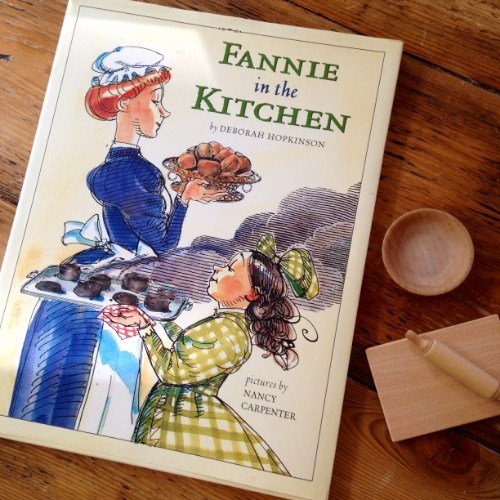
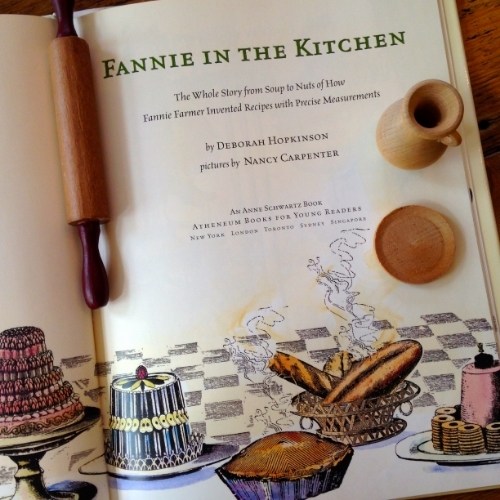
Several years ago, Anamaria at Books Together tipped me off to this charming picture book about Fannie Farmer by Deborah Hopkinson and Nancy Carpenter. Happy to say I’m finally getting around to featuring it here at Alphabet Soup and I even rewarded myself by making Fannie’s Famous Griddle Cakes using the recipe provided in the book. 🙂

These days, most of us don’t think twice about reaching for our measuring cups, spoons, or kitchen scales when we’re ready to cook or bake. Especially with baking, when precise measurements can mean the difference between a cake that rises nicely or sinks like a stone, it’s always about starting out with a good, reliable recipe.

Boston native Fannie Farmer is often credited with inventing the modern recipe. She was one of the first to write down exact instructions for measuring and cooking. But what inspired her to do that, and to eventually publish a cookbook that’s been popular for over 100 years?

Continue reading

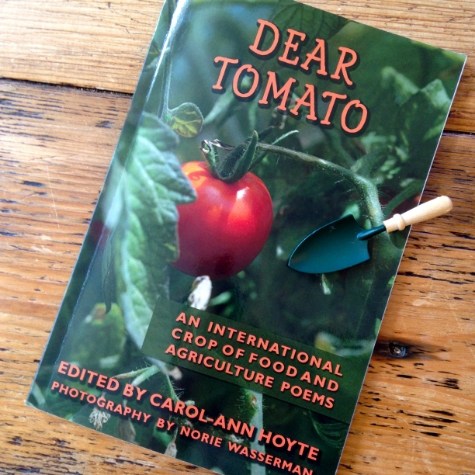
friday feast: a taste of Carol-Ann Hoyte’s new anthology, Dear Tomato (+ 2 recipes)

Just in time for growing season, here’s a brand new anthology that serves up a delectable cornucopia of poems celebrating the food we eat and where it comes from.

Edited by Canadian poet Carol-Ann Hoyte, Dear Tomato: An International Crop of Food and Agriculture Poems (CreateSpace, 2015), contains over fifty verses by thirty-four poets from seven countries, with fetching black-and-white photographs by Norie Wasserman. Along with praise for the hardworking farmer, the global menu offers much food for thought with topics such as composting, urban gardening, food activism, vegetarianism, honeybee collapse disorder, free-range vs. caged hens, food banks and fair trade.

Kids 8-12 will enjoy the tasty assortment of poetic forms, styles, points-of-view and flavors of emotion, from light-hearted to reverent to joyous to pensive. They will delight in J. Patrick Lewis’s dancing mushrooms, Ken Slesarik’s nude root veggies, and Cindy Breedlove’s and Conrad Burdekin’s diatribes against peas. They will likely find April Halprin Wayland’s personal narratives about picking figs or buying a frog at a farmers market fascinating, and thanks to Matt Forrest Esenwine, Buffy Silverman and Frances Hern, think about familiar foods like pumpkins, corn, squash, beans, and peaches in new ways.

I was happy to see nine Poetry Friday friends in the line-up and be introduced to many new poets, three of whom I’m featuring today. Philippa Rae rhapsodizes about her favorite vegetable, Helen Kemp Zax extols the wonders of the farmers market, and Matt Goodfellow’s lyrical farmer’s song exalts the agrarian lifestyle upon which we all depend. I think their poems will give you a nice taste of the delightfully different voices and styles included in this toothsome collection.

I thank Philippa, Helen and Matt for allowing me to post their poems, for providing a little backstory about writing them, and for sharing recipes and food notes. Grab your forks and enjoy the feast!

Continue reading

[review and recipe] Kids Cook French by Claudine Pépin, Jacques Pépin and Shorey Wesen

Bonjour! Êtes vous affamé? (Hello! Are you hungry?)

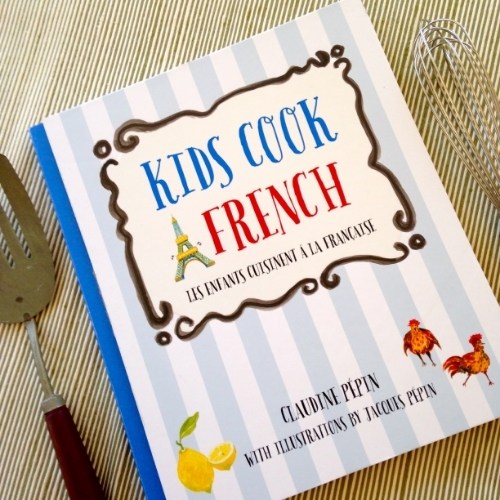
I don’t know about you, but after reading the yummy recipes in Kids Cook French (Quarry Books, 2015), I’m starving! At this very moment, I would love to feast on Claudine Pépin’s Spring Menu: Eggs Jeannette with a Salad, Chicken Breast with Garlic and Parsley, Sautéed Swiss Chard, Parsnip-Potato Purée, and Almond Cake. Mmmmmm!

You may know Claudine from any one or all three of the James Beard Award-winning PBS cooking series she appeared in with her father, legendary French chef Jacques Pépin. It is natural that Claudine (an accomplished home cook and wine educator who married a chef), should publish a cookbook for kids, since she grew up with fine cuisine and now cooks most nights for her 11-year-old daughter Shorey.

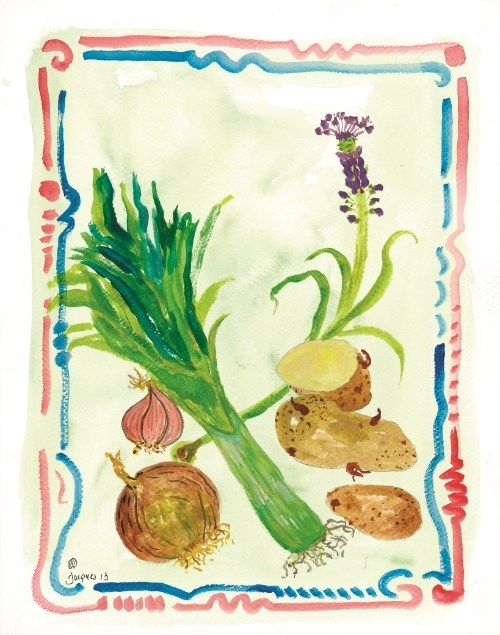
Art © 2015 Jacques Pépin

True to Claudine’s guiding philosophy — that there’s no such thing as “kids food,” only “good food” — Kids Cook French doesn’t look or read like a children’s cookbook. You won’t find rebus-like directions in large print with little measuring spoons, or yet another “recipe” for peanut butter and jelly sandwiches. This is not to say that the recipes are overly complicated, only that adult supervision is required for what are clearly family projects.

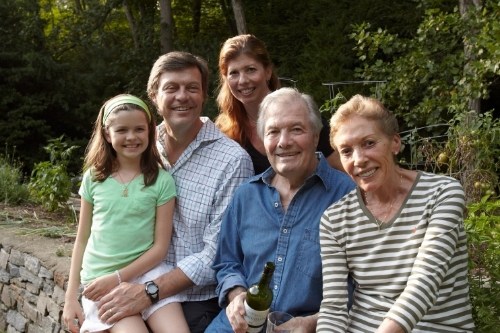
Claudine (center) with Shorey, Rollie, Jacques and Gloria (by Tom Hopkins).

Continue reading

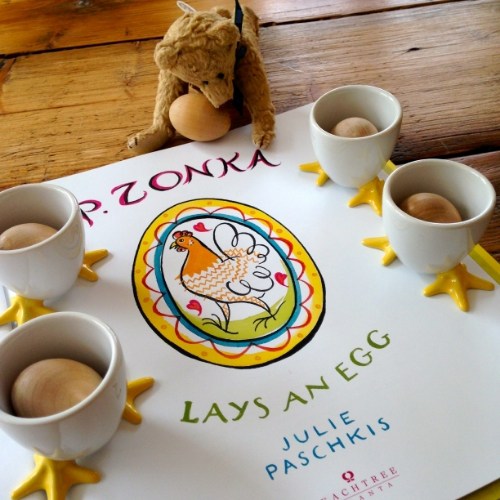
a chat, a cluck, a kulich and a giveaway: Julie Paschkis on P. Zonka Lays an Egg

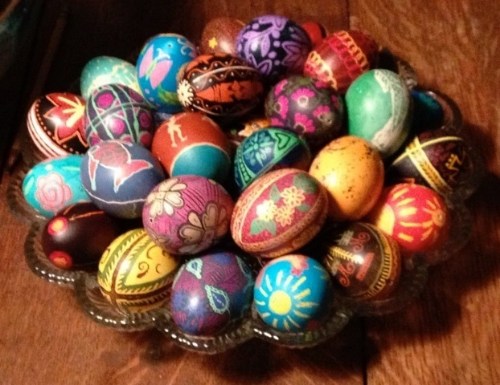
Every year, Seattle-based author/illustrator Julie Paschkis attends a big neighborhood party hosted by her sister Jan and husband Greg, where family and friends gather to decorate eggs and eat lots of delicious food.

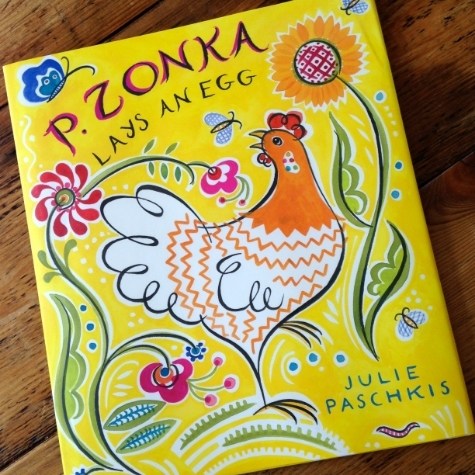
Their eggs, Ukrainian pysanky, are decorated with patterns of beeswax and layers of dye, and are part of a longstanding folk art tradition that honors the Sun and welcomes Spring. Julie’s new picture book  P. Zonka Lays An Egg (Peachtree, 2015), which officially hits shelves this week (!), was inspired by these marvelous egg-decorating parties, and is, in a word, GORGEOUS.

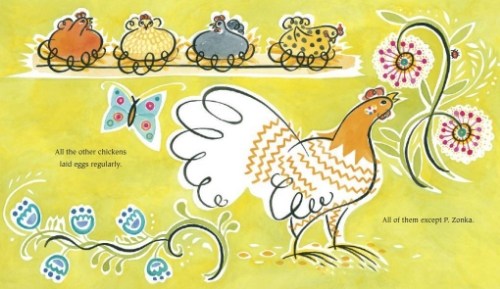
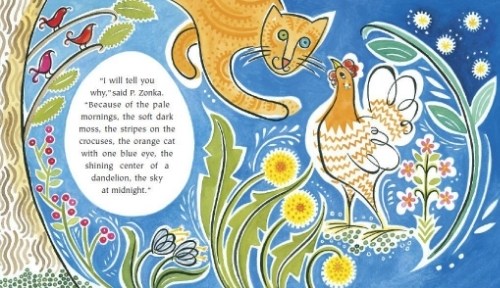
P. Zonka herself is no ordinary hen. Unlike her clucky friends Maud, Dora and Nadine, she’s a not a regular egg layer, preferring to spend her days gazing at the wonders of the natural world. Much to the bewilderment of the other hens, who think she’s either daft or just plain lazy, P. Zonka is enthralled by soft dark moss, the deep blue of the sky, pale mornings, and the shining centers of dandelions.

After much pestering, urging and coaxing by the other hens, P. Zonka finally decides to give egg laying a try — and the result is well beyond any could have imagined — in a word, SPECTACULAR!

Continue reading

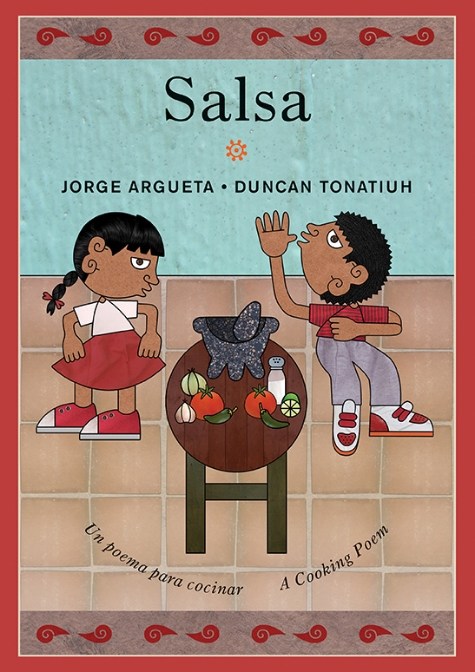
friday feast: spicing things up with Salsa: Un poema para cocinar/A Cooking Poem by Jorge Argueta and Duncan Tonatiuh

Put on your aprons and dancing shoes, it’s time to SALSA!

So pleased to see another yummy book in Jorge Argueta’s popular bilingual Cooking Poem Series. Previously, Jorge treated us to Sopa de frijoles/Bean Soup (2009), Arroz con leche/Rice Pudding (2010), Guacamole (2012), and Tamalitos (2013). Mmmmm!

Now, with Salsa (Groundwood Books, 2015), illustrated by Pura Belpré winner Duncan Tonatiuh, Argueta infuses his lyrical, lip-smacking recipe with savory musical instruments, lively rhythms, a wealth of sensory details, and just the right amount of spice to make readers crave more.

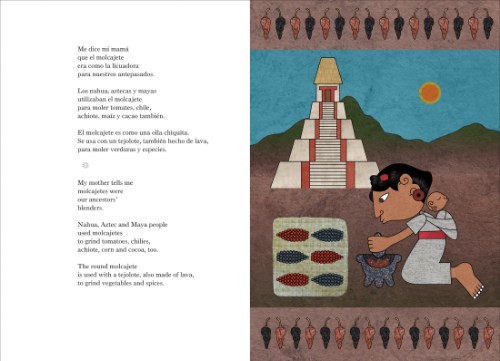
A young boy first describes the molcajete, a type of stone bowl dating back to the time of the ancient Aztec, Mayan, and Nahua peoples used to grind tomatoes, corn, chilies, vegetables and spices. He mentions how every weekend his family uses their molcajete to make salsa while they sing and dance.

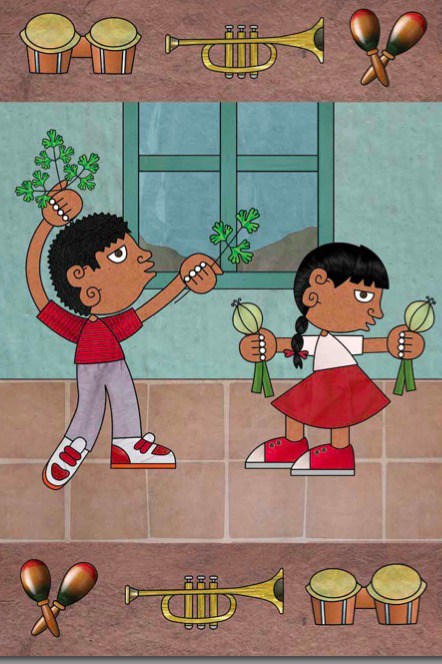
Before proceeding, he and his sister “play” the ingredients from their very own “salsa orchestra”:


I am ready with four tomatoes.
They are bongos and kettledrums.
My onion is a maraca.
Cloves of garlic are trumpets,
and the cilantro is the orchestra conductor
with his shaggy, green hair.

*

Ya tengo listos cuatro tomates.
Son bongos y timbales.
La cebolla es una maraca.
Los ajos son trompetas,
y el cilantro un director de orquesta
con su pelo verde todo despeinado.

Continue reading