“the patience of ordinary things” by pat schneider

“Mountain Blues” by Karen Hollingsworth (2013)


THE PATIENCE OF ORDINARY THINGS
by Pat Schneider

It is a kind of love, is it not?
How the cup holds the tea,
How the chair stands sturdy and foursquare,
How the floor receives the bottoms of shoes
Or toes. How soles of feet know
Where they’re supposed to be.
I’ve been thinking about the patience
Of ordinary things, how clothes
Wait respectfully in closets
And soap dries quietly in the dish,
And towels drink the wet
From the skin of the back.
And the lovely repetition of stairs.
And what is more generous than a window?

~ from Another River: New and Selected Poems (Amherst Writers & Artists Press, 2005)

“Connected” by Karen Hollingsworth (2010)

*

And is it not a kind of love how a poem can hold the words you most need to hear? Vessel of heart, unadorned yet profound, luminous in its simplicity, Schneider’s poem speaks to the sacred in the everyday and is a beautiful paean to patience and gratitude.

If you’re a writer, you know all about waiting. And waiting. And waiting. Every step in the process has a distinct purpose and unfolds in its own time. Every story or poem waits its turn for someone to give it form, shape, and resonance. Just as I appreciate the cup that holds my tea, I marvel at how ideas know how to find just the right people, and how the hundreds of books on my shelves silently wait for me to reach for them. I am most grateful for the patience of stories waiting to be told, and smile at the thought of how happy characters must be when we finally open their books and let them speak.
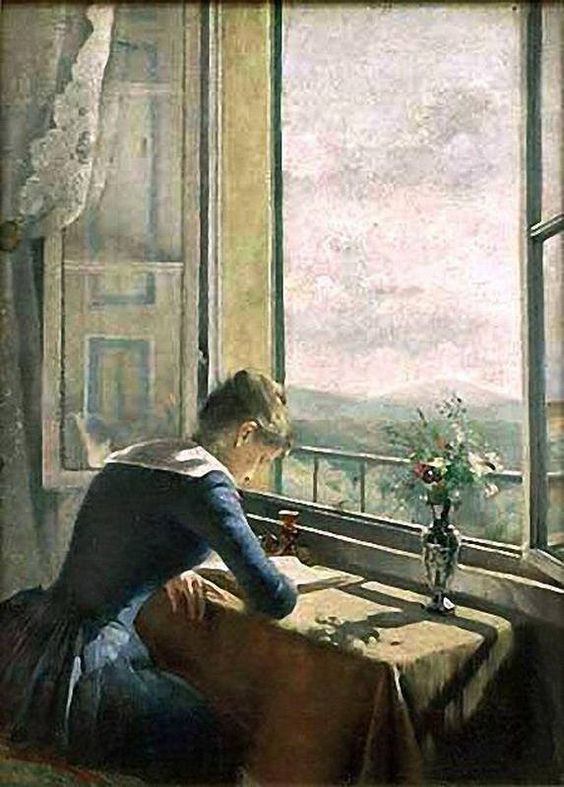
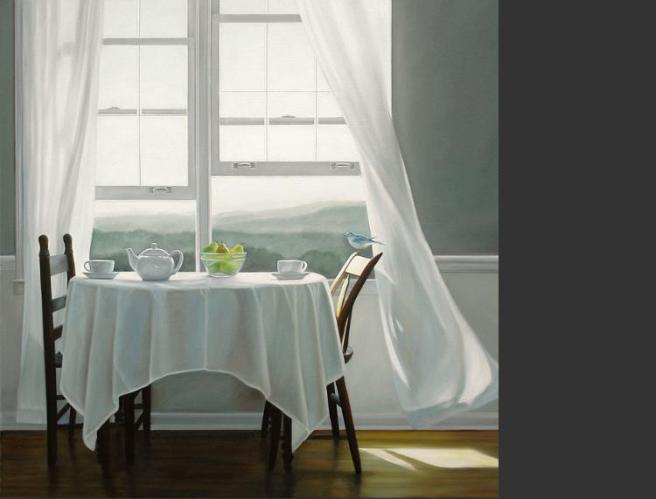
“Reading Woman by the Open Window” by Asta Norregaard (1889)

This poem gives me an inner sense of calm, making me feel centered and grounded. The outside world is chaotic and full of upheaval and uncertainty. It is good to know there are things we can count on, and that no matter what happens, there is art, the power of the imagination, unique voices and vision. One person’s poem can be another’s prayer.

*

A renowned teacher of writing, Pat Schneider is the author of ten works of poetry and nonfiction, including Writing Alone and With Others. Founder of Amherst Writers & Artists, she travels frequently to teach and has been leading workshops in creative writing at the Pacific School of Religion for almost thirty years. Garrison Keillor has read her poems sixteen times on “Writers Almanac.” Her most recent book is How the Light Gets In: Writing as a Spiritual Practice (2013). Find out more about Pat’s books and writing workshops at her Official Website.

*

🐶 PET CRAZY GIVEAWAY WINNER! 🐰

Thank you for commenting about your favorite pets last week. Enjoyed reading the rhymes and picturing a white stray cat named Silmarillion lapping milk, a hound who croons at the moon, and a dog who likes to lick his owner’s feet. There was also a Lizzy and a Lizzie, one a salamander, the other a fish . . . or a dragon? 🙂

Mr Cornelius picked the winner with the careful long distance supervision of Monsieur Random Integer Generator, who’s in Provence having his mustache trimmed.

So, with a little trumpet fanfare and a jiggedy jig (drumrolls are passé this season),

we are pleased to announce that the winner of a brand new copy of Pet Crazy is:

🎉 Jan Godown Annino at BookSeedStudio!! 🎈

Congratulations, Jan!!

Please send your snail mail address to: readermail (at) jamakimrattigan (dot) com to receive your book. 🙂

Thanks again to everyone for entering the giveaway!

*
 

The lovely and immensely talented Laura Purdie Salas is hosting the Roundup at Writing the World for Kids. Glide over and check out the full menu of poetic goodness being shared in the blogosphere this week. I can’t believe September is all but over already! Enjoy your weekend. 🙂


Copyright © 2017 Jama Rattigan of Jama’s Alphabet Soup. All rights reserved.
Save

Save

Save

Save

Save

Save

Save

SaveSave

Save

Save

Save

Barking About Pet Crazy by Sylvia Vardell and Janet Wong (+ a giveaway!)

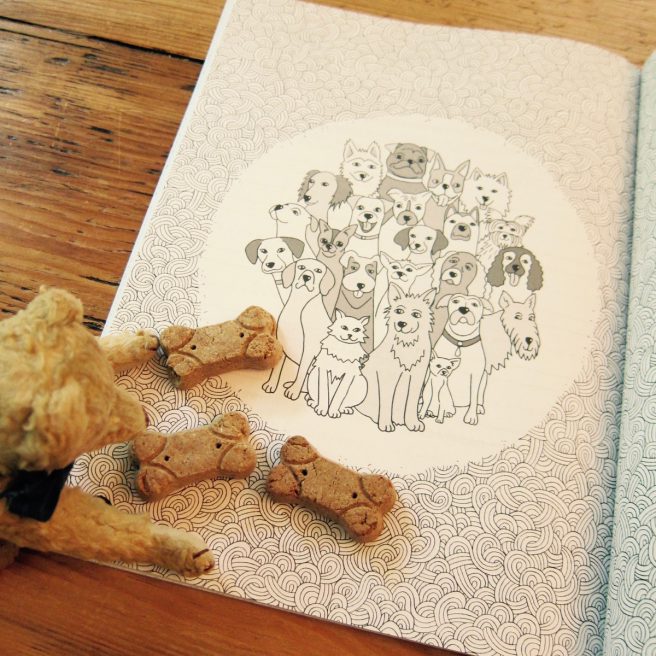
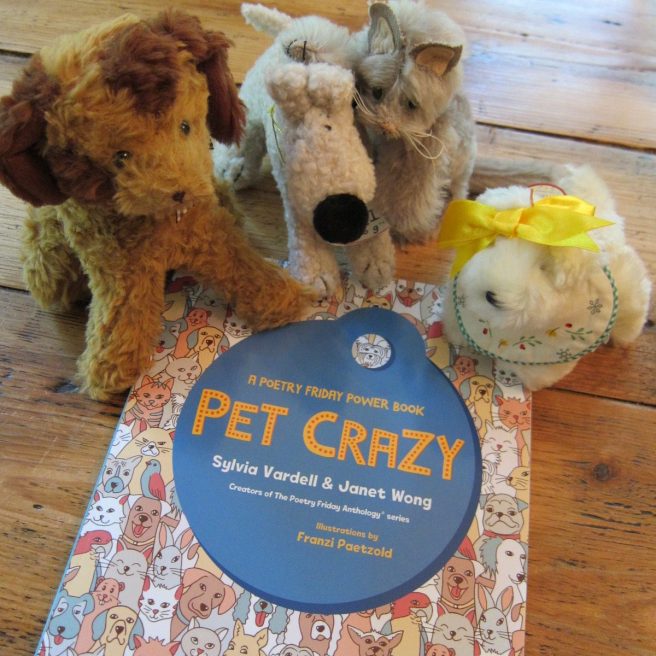
Jump, roll over, sit, and stay . . . it’s time to sniff out Pet Crazy, the third title in the popular Poetry Friday Power Book series created by poetry goddesses Sylvia Vardell and Janet Wong. Yip!

Just for this post, you may bark, meow, cluck, or tweet your approval at any time. Perfectly acceptable. After all, it’s hard to curb your enthusiasm for this fun and frisky interactive story-in-verse and writing journal rolled into one, just purrrrfect for kids in grades K-3 (or bears of any age).

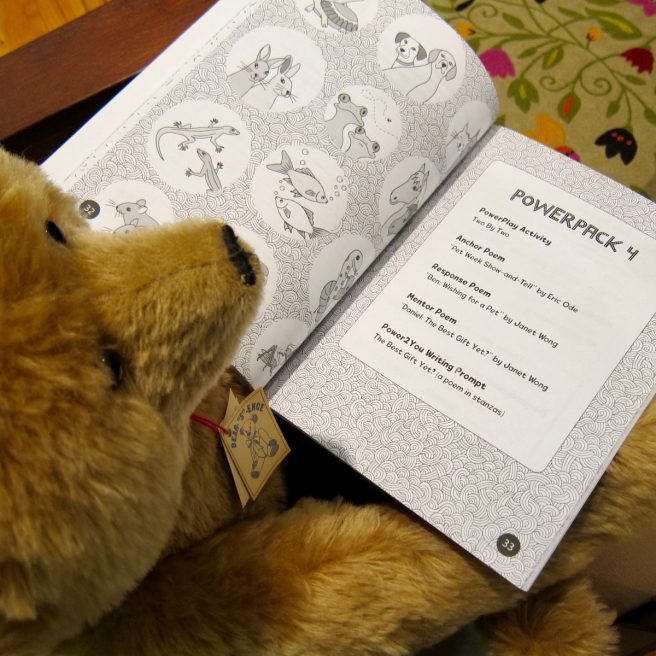
Pet Crazy includes 36 poems in all, with three poems featured in each of 12 PowerPacks.

PowerPacks include:

  1. Powerplay Activity
  2. Anchor Poem
  3. Response Poem
  4. Mentor Poem
  5. Power2You Writing Prompt

The anchor poems in Pet Crazy were written by Kristy Dempsey, Janice Harrington, Carole Boston Weatherford, Eric Ode, Helen Frost, Tamera Will Wissinger, Elizabeth Steinglass, Laura Shovan, Padma Venkatraman, Eileen Spinelli, April Halprin Wayland and Don Tate. Five poems culled from the Poetry Friday Anthology series take their place alongside seven newly penned verses.

Janet Wong has written original response and mentor poems, cleverly weaving all into a charming story about young Ben, who yearns for a dog of his own, friend and cat lover Kristy, and Daniel, Ben’s best friend, who gives Ben an unusual pet for his birthday.

Continue reading

munching on frank o’hara’s “lines for the fortune cookies”

“It may be that poetry makes life’s nebulous events tangible to me and restores their detail; or conversely, that poetry brings forth the intangible quality of incidents which are all too concrete and circumstantial. Or each on specific occasions, or both all the time.” ~ Frank O’Hara

via Pop Sugar

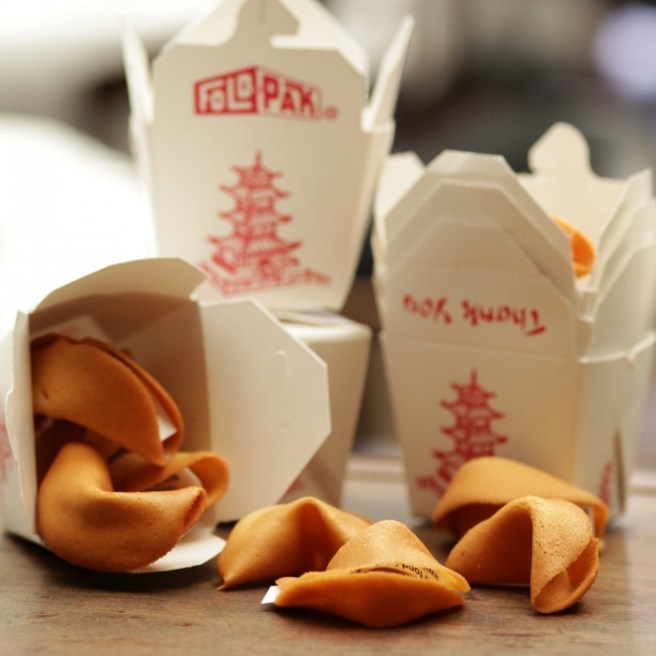
It’s always fun, after a delicious Chinese meal of won ton soup, spring rolls, lemon chicken, sweet and sour pork, Peking duck, steamed sea bass, and beef chow fun, to take that last sip of jasmine tea and crack open your fortune cookie.

Oh, the anticipation as you hope for something positive: “You will meet a tall British actor whose last name rhymes with ‘girth,'” “You will write the next picture book bestseller,” or, “You will travel to a foreign land and have many exciting adventures.” 🙂

For those few seconds before I remove that little slip of paper, anything is possible. I hold my breath as I read, “I cannot help you. I am just a cookie,” or, “You will be hungry again in 30 minutes.” On a really good day, I’ll get “You have rice in your teeth.”

Nothing that helps the digestion more than a cheeky cookie.

I’ve always wondered about the people who write these fortunes. Seems like it would be a blast. You have the power to determine destiny . . . or, at the very least, make someone feel good. If you’re a poet, you can take fortune cookie fortunes to the next level. If you’re Frank O’Hara, you can create food for thought that is thoroughly charming and delightful.

*

Continue reading

three poems from My Daddy Rules the World by Hope Anita Smith

Happy Poetry Friday and Happy Father’s Day Weekend!

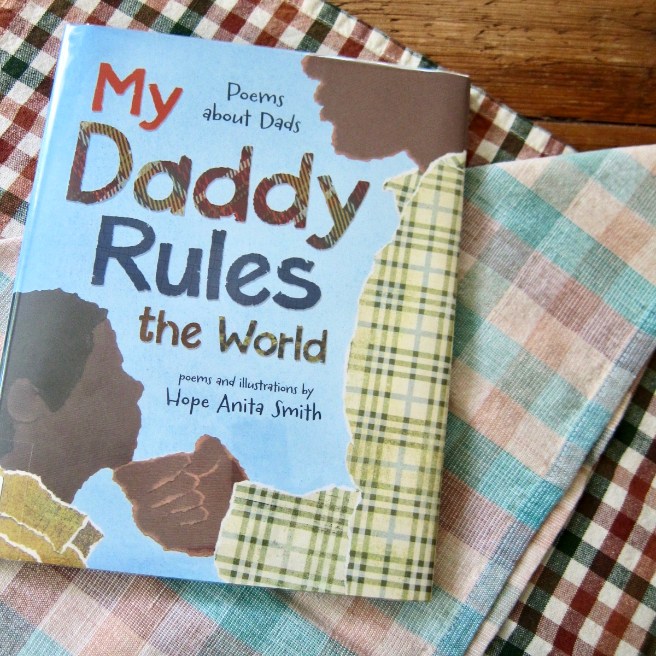
I can’t think of a better way to celebrate all the cool dads in the world than with Hope Anita Smith’s brand new poetry picture book, My Daddy Rules the World: Poems About Dads (Henry Holt, 2017).

Through fifteen heartwarming poems told in a child’s voice, Smith captures the singular bond between father and child as evidenced in everyday activities such as eating, dancing, playing music, and reading. Smith focuses on those small, intimate moments and interactions that mean so much to children, and every one of these gems brims with pride, adoration and pure love.


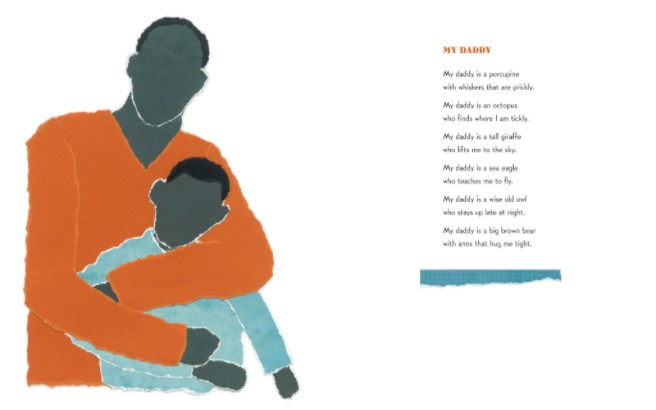
MY DADDY

My daddy is a porcupine
with whiskers that are prickly.

My daddy is an octopus
who finds where I am tickly

My daddy is a tall giraffe
who lifts me to the sky.

My daddy is a sea eagle
who teaches me to fly.

My daddy is a wise old owl
who stays up late at night.

My daddy is a big brown bear
with arms that hug me tight.

The poems are paired with Smith’s beautiful torn paper collages that feature fathers, sons and daughters in a variety of skin tones without facial features. I love how Hope is able to convey so much warmth and emotion through body language: an affectionate tilt of the head, a concerned hand lifting a chin, the reassurance of Dad holding the bike seat, being encircled in Dad’s arms as he reads aloud or teaches guitar.

Continue reading

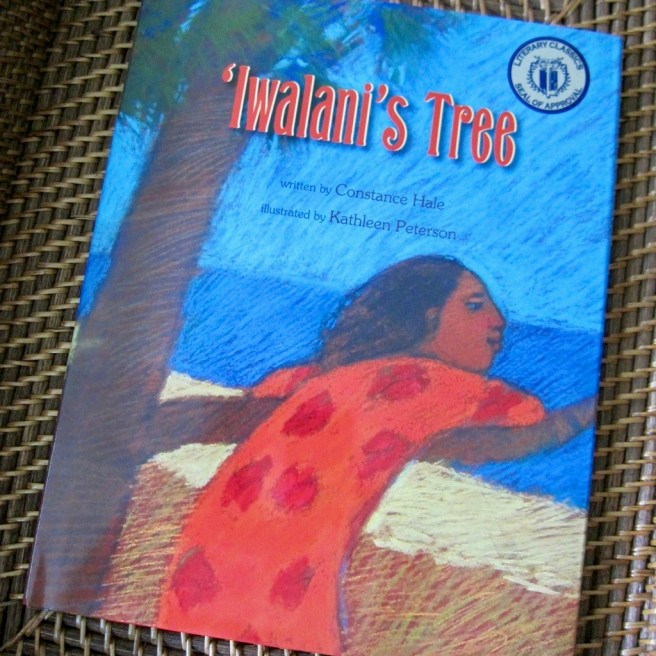
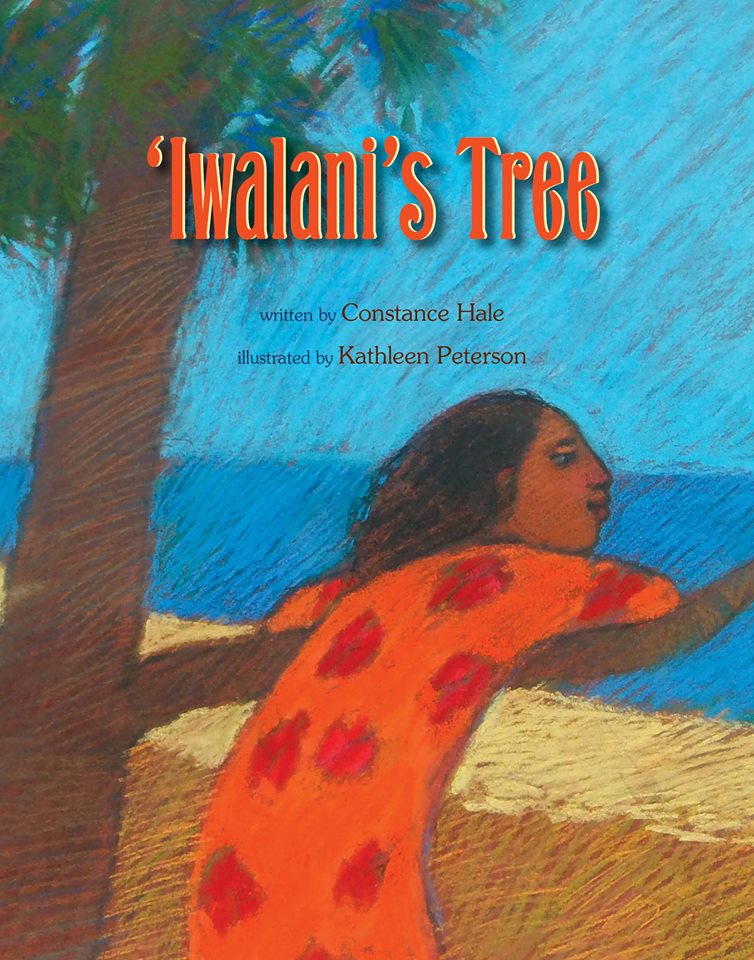
[review] ‘Iwalani’s Tree by Constance Hale and Kathleen Peterson

Were you a daydreamer when you were growing up? Was there a special place you frequented to be alone with your thoughts?

Told as a gentle free verse poem, ‘Iwalani’s Tree is an enchanting story about a girl from O’ahu’s North Shore who has a special bond with an ironwood tree that’s her secret friend, muse, elder, and solace.

I like to lean on a low branch of a tree
that stands way way down the beach,
toward Ka’ena,
just on the spot
where the land becomes sand.

Some people call it a paina,
some call it an ironwood.
It has fuzzy brown bark,
a trunk strong and good,
and long willowy needles
that whisper in the wind.

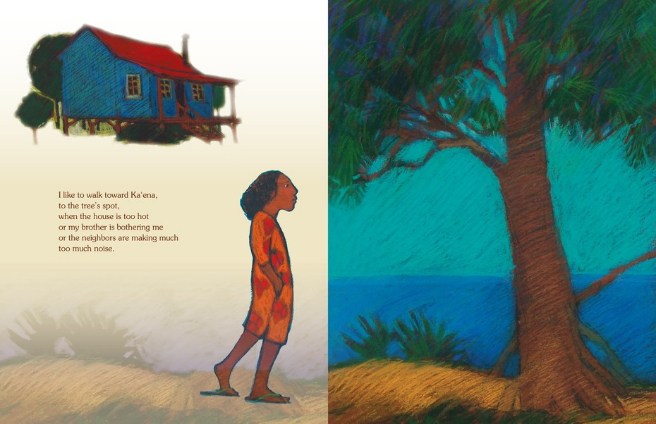
She goes on to explain that the tree is a kind of refuge, a place to go “when the house is too hot/or my brother is bothering me/or the neighbors are making much too much noise.” She leans against its trunk and plays beneath its branches, carrying on conversations with the tree, who never demands or judges, only listens.

In the tree’s presence, ‘Iwalani’s dreams take flight. What better place than in the cool shade, with only the “Sounds of the sea and the sand and the waves and the wind,” the tree whispering as the wind tickles its needles?

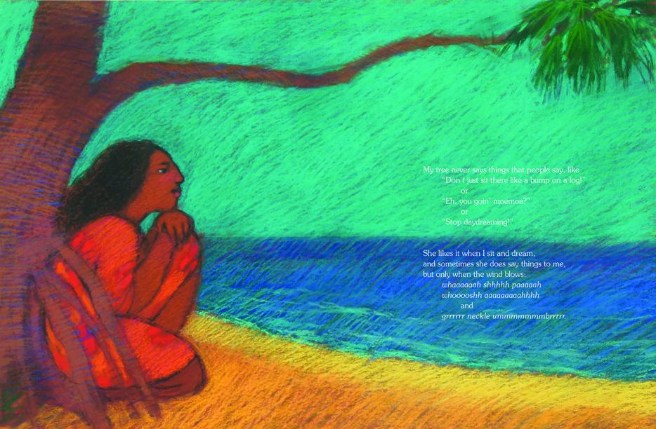
Sometimes, when there’s a brisk wind (he makani Mālua), the tree “yowls scary sounds.” Then, ‘Iwalani also hears the mongoose, owl, hawk, and wild boar. She asks the tree what it does all day and night, and the tree, who “speaks” only when the wind blows, tells ‘Iwalani she dreams — after all, she has “legs to rrrrun down the beach/and arms to rrrreach for the sea.” ‘Iwalani thinks that’s silly, but soon changes her mind.

One night there’s a big storm and ‘Iwalani wonders whether her tree will be able to withstand the harsh conditions.

Huge white waves smash onto the sand.
A howling wind tears the leaves off trees.
Lightning cracks the sky open like a coconut.

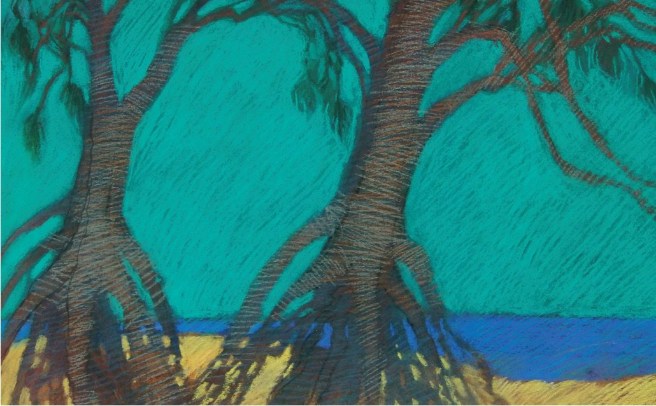
The next morning ‘Iwalani frantically races down the beach, relieved to find her tree still standing, but something has changed. So much sand has been pulled away, that the tree’s big roots are exposed. They resemble “giant knees and feet.” Having lost so much of its needles, the tree’s branches now resemble “giant elbows and fingers” stretching toward the sea.

So the tree was right all along; it really can have legs to run down the beach and arms to reach for the sea! ‘Iwalani continues to observe how the tree changes with each succeeding storm, only too pleased to while away the hours in its company, dreaming and dreaming.

Communing with nature affords ‘Iwalani many peaceful hours of introspection and a fresh appreciation of the world around her.

Hale’s soothing lyrical verse (which seamlessly incorporates a few Hawaiian words), and Peterson’s lush and evocative jewel-toned illustrations, celebrate Hawai’i’s natural beauty and the ongoing reverence locals have for ocean and shore. I like how the artist’s pastel strokes give the pictures a marvelous texture. This story is also an ode to the child’s imagination, the power of dreams, and the freedom to be oneself.

The lulling, meditative tone makes this a nice bedtime book. In a noisy, competitive world where children are sometimes over-scheduled and raised to believe bigger, faster, and flashier are better, this quiet, contemplative story offers an opportunity for parent and child to slow down and reflect.


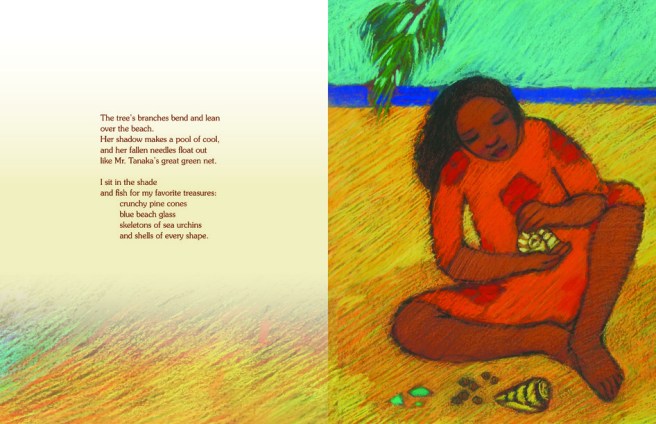
The tree’s branches bend and lean
over the beach.
Her shadow makes a pool of cool,
and her fallen needles float out
like Mr. Tanaka’s great green net.

A good introduction to free verse with its sensory detail and poetic devices such as personification, imagery, rhyme, rhythm, onomatopoeia, assonance and alliteration, ‘Iwalani’s Tree also has great curriculm connections with science and geography. The author offers teaching guides for each of these disciplines at her website.

I especially enjoyed reading this story, since it transported me to my warm and friendly home state. I could just about feel those gentle trade winds caressing my cheek and hear the tree whispering in the wind:

whaaaaaah shhhhh paaaaah
whooooshh aaaaaaaaahhhh


Quite hypnotic; it was easy falling under this story’s magic spell. I definitely felt calmer and more centered after reading it, and recommend it to those desiring a tranquil Hawaiian story with universal themes. Back matter includes information about the ironwood, legends about the ironwood and Ka’ena Point, and a pronunciation guide for the Hawaiian words used in the text. Don’t miss this rare gem!

*

‘IWALANI’S TREE
written by Constance Hale
illustrated by Kathleen Peterson
published by BeachHouse Publishing, September 2016
Picture Book for age 4-8, 32 pp.
*Literary Classics Seal of Approval
**Study Guides for Poetry, Science and Geography available here.

*

Our fearless PF leader Mary Lee Hahn is hosting the Roundup at A Year of Reading. Drift over and check out the full menu of poetic goodness being served up in the blogosphere this week. Happy Weekend!


*Interior spreads posted by permission of the publisher, text copyright © 2016 Constance Hale, illustrations © 2016 Kathleen Peterson, published by BeachHouse. All rights reserved.

**Please Note: Some of the colors in the illustrations shown here differ from the book.

Copyright © 2017 Jama Rattigan of Jama’s Alphabet Soup. All rights reserved.
Save

Save

Save

Save

Save

Save

Save

Save

Save

Save

Save

Save

Save

Save

Save