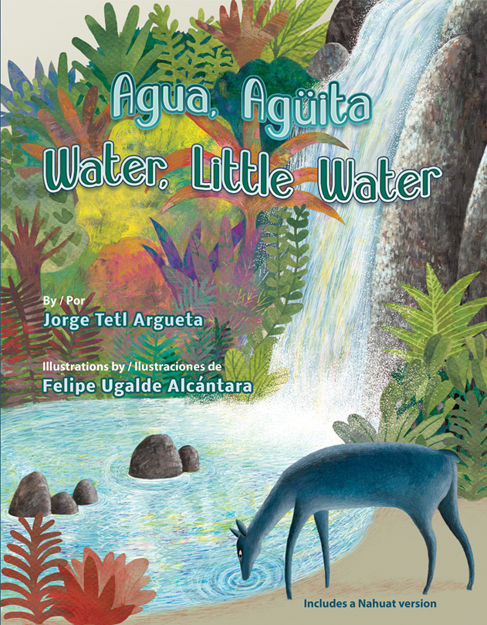
[review + giveaway] Agua, Agüita (Water, Little Water) by Jorge Tetl Argueta and Felipe Ugalde Alcántara

“A drop of water, if it could write out its own history, could explain the universe to us.” ~ Lucy Larcom
Listen. Raindrops patter on the roof. A tossed pebble plops into a pond. Water burbles over smooth stones in a stream. Big waves crash onto the shore — foamy ebb bubbles and sloshes, smaller waves lap.

Water — life giver, wonder, miracle.
In his beautiful new trilingual picture book, Agua, Agüita/Water, Little Water (Piñata Books, 2017), award-winning author and poet Jorge Argueta describes the life cycle of water from the perspective of a single drop.

My name
is Water
but everyone
calls me ‘Little Water.’

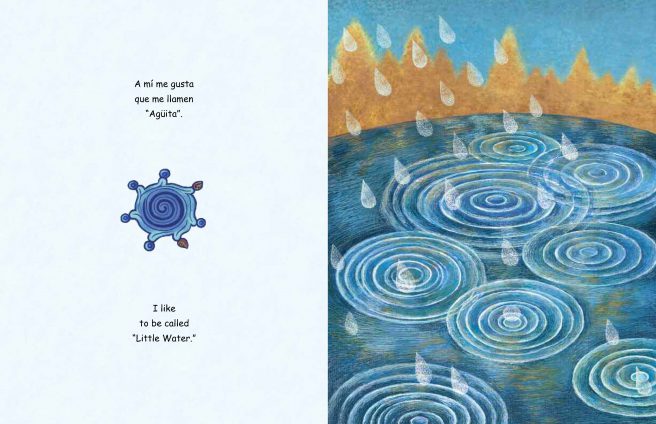
I like
to be called
‘Little Water.’

*

Mi nombre
es Agua
pera todas
me conocen por “Agüita”.

A mí me gusta
que me llamen
“Agüita”.

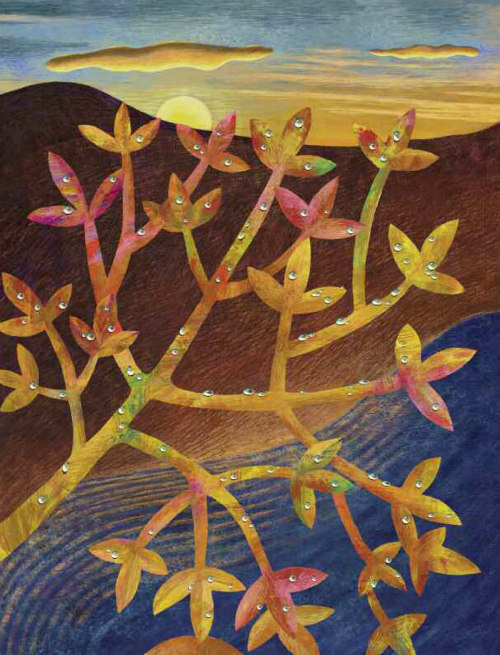
Little Water explains how it is born “deep in our Mother Earth,” gradually climbing along rocks and roots through light and darkness until it reaches the surface, becoming visible as droplets resting on spider webs, flower petals and the tips of leaves. Little Water is a “sigh of morning dew” singing “a sweet, tender and strong song.”
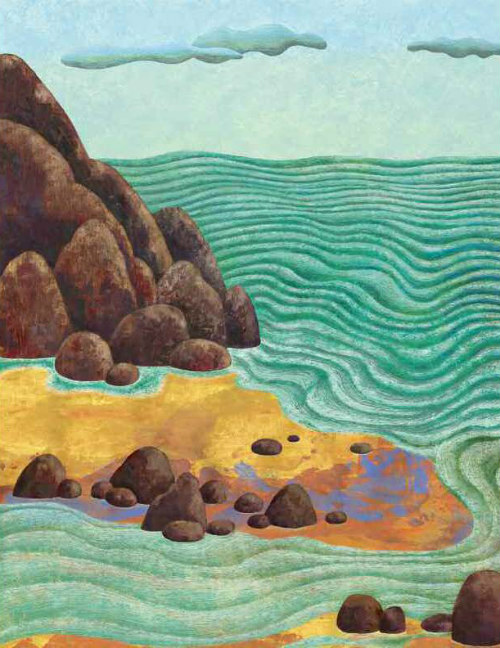
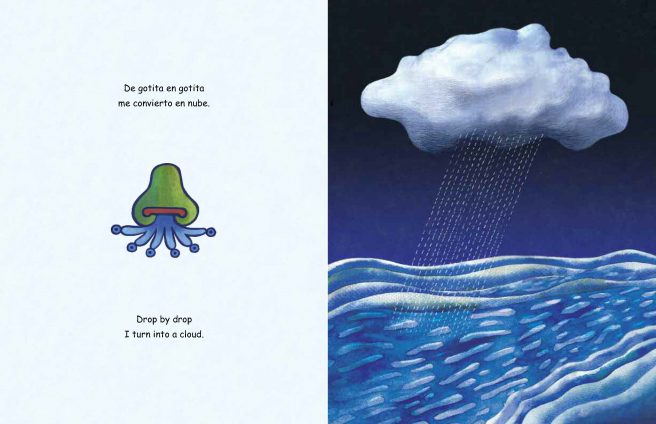
Drop by tiny drop, Little Water becomes a river, a lake, an ocean. Then it climbs to the sky, turning into a cloud until it returns “singing to our Mother Earth.”
I love Argueta’s spare lyrical free verse, his metaphor of song and music, and most of all, his use of personification to give voice to nature, a voice that’s endearing, intimate, and sometimes whimsical.

I am one color
in the morning and
another in the afternoon.

Soy de un color
por la mañana y
de otro color en la tarde.

Children will delight in following Little Water’s wondrous journey and seeing the interconnectedness of all living things. They will like hearing Little Water speak directly to them, one small friend to another sharing the secret of its existence, and with personal connection comes awareness, appreciation and caring for Mother Earth.

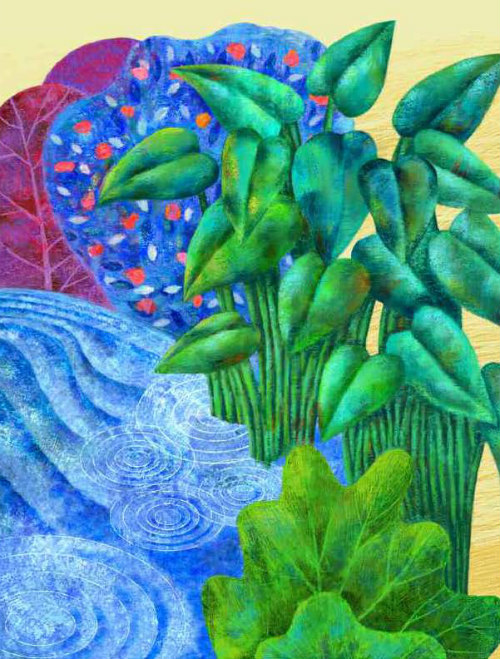
Alcántara’s luminous, jewel-toned illustrations reinforce the sense of continuity, fluidity and constant motion with their concentric circles and ripples. As raindrops make ever widening circles on the water, we are reminded that even small things can have an impact, as they transform themselves into larger elements with powerful repercussions.

We see many “little waters” bubbling up deep from the ocean floor, entangled amongst roots, flowing through verdant landscapes, tinted by the sunset, cascading down rocky cliffs, caressing the shoreline. Finally, there is the “water bird” described in Argueta’s final stanza, a graceful, blue winged creature symbolizing life itself.
As in many of his books, Argueta expresses his affection and deep reverence for Mother Earth. Water is perhaps her greatest gift, essential to the web of life, as soft as it is forceful, mysterious and pervasive:

I am all colors
and have no color.
I am all flavors
and have no flavor.
I am all shapes
and am shapeless.
I am Water,
I am Little Water.

*

Soy de todos los colores
y no tengo color.
Soy de todos los sabores
y no tengor sabor.
Soy de todas las formas
y no tengo forma.
Soy Agua,
soy Agüita.

In addition to Spanish and English, Argueta’s poetic ode is presented in the back of the book in Nahuat, the language of his Pipil-Nahua ancestors in El Salvador — a great way to introduce readers to a fascinating ancient culture. Here’s a taste of it:

Nutukay At
Maya ha muchi
Nech ishmatit guey atchin

Naja Nugustú
Manéchilguiya
Atchin

In addition to sparking interesting discussions about the importance of water and identifying its different manifestations, Agua, Agüita will likely inspire young readers to write their own poems about the wonders of the natural world, perhaps personifying their favorite parts of it.
Beautiful and awe-inspiring with its own brand of charm, don’t miss this lovely, informative book, which holds special appeal for those who enjoy blending poetry with science.

*
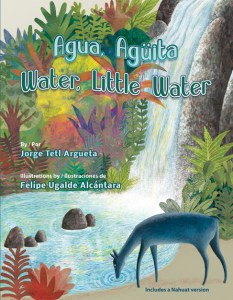
AGUA, AGÜITA/WATER, LITTLE WATER
written by Jorge Tetl Argueta
illustrated by Felipe Ugalde Alcántara
translated by Gabriela Baeza Ventura
published by Piñata Books/Arte Público Press, October 2017
Picture Book for ages 4-7, 32 pp.
*Junior Library Guild Selection
**On shelves October 31, 2017

*

📘 SPECIAL BOOK GIVEAWAY! 📕

The publisher has generously donated a copy of the book for one lucky Alphabet Soup reader. For a chance to win, simply leave a comment at this post no later than midnight (EST) Wednesday, November 8, 2017. You may also enter by sending an email with WATER in the subject line to: readermail (at) jamakimrattigan (dot) com. Giveaway open to U.S. residents only, please. Good Luck!

*
The lovely, warm and welcoming Linda Baie is hosting the Roundup at TeacherDance. Waltz on over to check out the full menu of poetic goodness being shared in the blogosphere this week. Have you eaten all your Halloween candy yet? 🙂


*Interior spreads posted by permission of the publisher, text copyright © 2017 Jorge Tetl Argueta, illustrations © 2017 Felipe Ugalde Alcántara, published by Piñata Books/Arte Público Press. All rights reserved.

**Copyright © 2017 Jama Rattigan of Jama’s Alphabet Soup. All rights reserved.
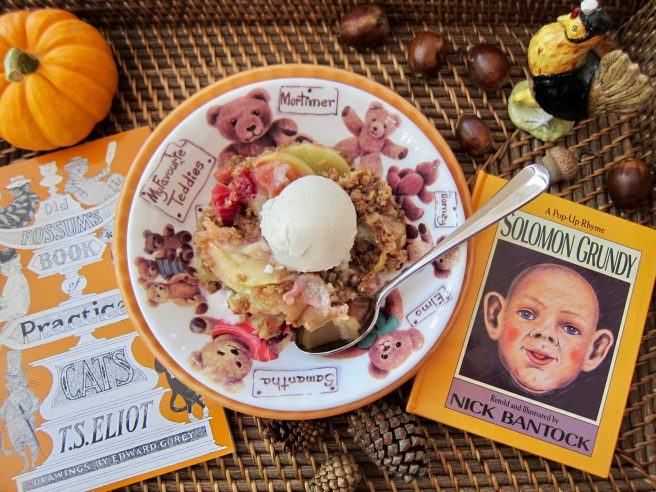
a trio of fall favorites: cats, corpse, crisp

‘Tis the season of apples, pumpkins, black cats and twisted tales, so we’re getting our Fall on this week with a three course meal of old favorites.

I suppose one could say this post is equal parts miao, morbid, and mmmmm. 🙂

*

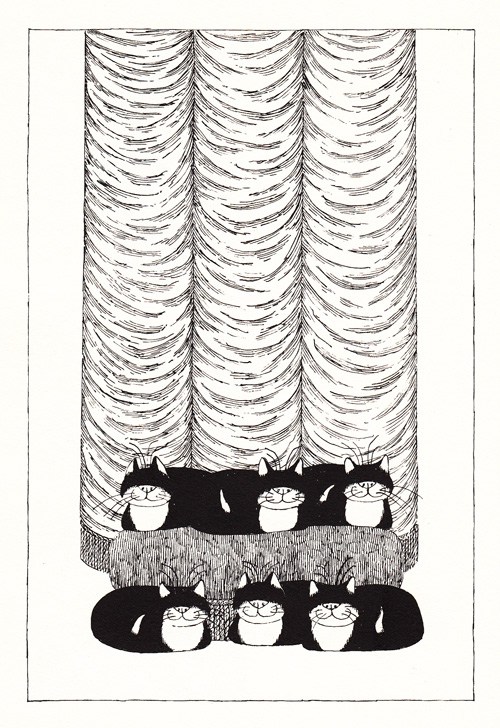
PRIMO: THE SONG OF THE JELLICLES

I love cracking open my Edward Gorey version of T.S. Eliot’s Old Possum’s Book of Practical Cats. Not only does it remind me of when we saw Andrew Lloyd Weber’s “Cats” in London many moons ago (I’ve been licking my paws and prancing about ever since), but of the pleasant after dinner walks Len and I used to take around our old neighborhood.

You see, two streets down and around the corner we were usually greeted by a Jellicle Cat. A fine fellow he was, all tuxedo-ed up for the ball under the bright moonlight. He was both sleek and adorable, having washed behind his ears and between his toes (he knew we were coming). A Fred Astaire of cats, we think of him still.

I love this reading by T.S. Eliot himself:

*

Continue reading

[spooky review + giveaway] The Pomegranate Witch by Denise Doyen and Eliza Wheeler

Hello my pretties! Ready for a spookalicious story?

*cackles and strokes chin wart*

No matter where we grew up, most of us can remember a mean or eccentric neighbor, a creepy old house that was supposedly haunted, or a place we were afraid (or not allowed) to frequent for one reason or another.

It was the kind of thing where we were both curious and terrified at the same time. We hungered for more even as we trembled in our boots. It’s wonderful how local lore and enduring legends figured in our childhoods, how we bore witness to the dynamic process of their evolution.

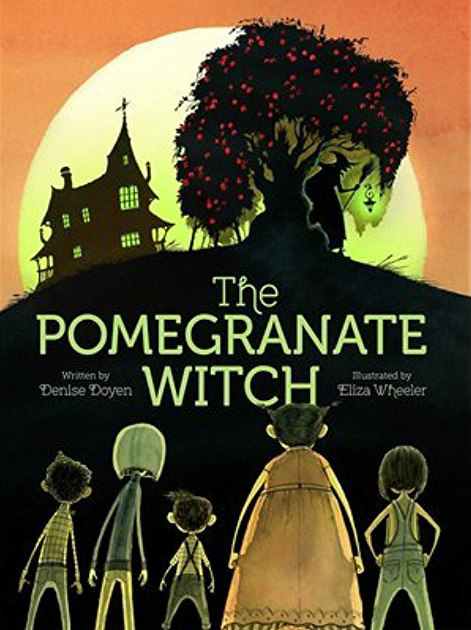
In The Pomegranate Witch (Chronicle Books, 2017), Denise Doyen and Eliza Wheeler serve up a deliciously eerie and suspenseful tale of five neighborhood kids who battle a green twiggy-fingered Witch for fruit from her haunted, zealously-guarded pomegranate tree.

Beyond the edge of town,
where streetlights stopped and sidewalks ended,
A small boy spied a farmhouse in a field long untended —

And before its sagging porch, amid a weedy foxtail sea,
Found the scary, legendary, haunted pomegranate tree.

The gnarled tree loomed high and wide; its branches scraped the ground.
Beneath there was a fort, of sorts, with leafed walls all around.
Its unpruned limbs were jungle-like, dirt ripplesnaked with roots,
But glorious were the big, red, round, ripe pomegranate fruits.

Continue reading

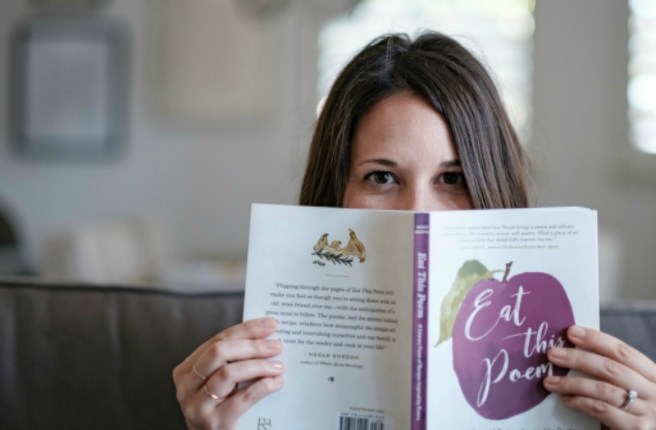
[review + recipe] eat this poem by nicole gulotta

“Both the cook and the poet are makers. One holds a knife, the other a pen. One grinds fresh pepper over a mound of tender lettuce, while the other adds a period to the end of a sentence or a dash to the end of a line. With available ingredients — vegetables and herbs, rhymes and words — layers of flavor and meaning are infused in the pan and composed on the page.” ~ Nicole Gulotta (Eat This Poem, 2017)

Some of you may remember when Nicole Gulotta wrote a guest post for Alphabet Soup several years ago featuring an Apple Crumb Muffin recipe inspired by Amy Ludwig VanDerwater’s poem “Apple Pockets.”

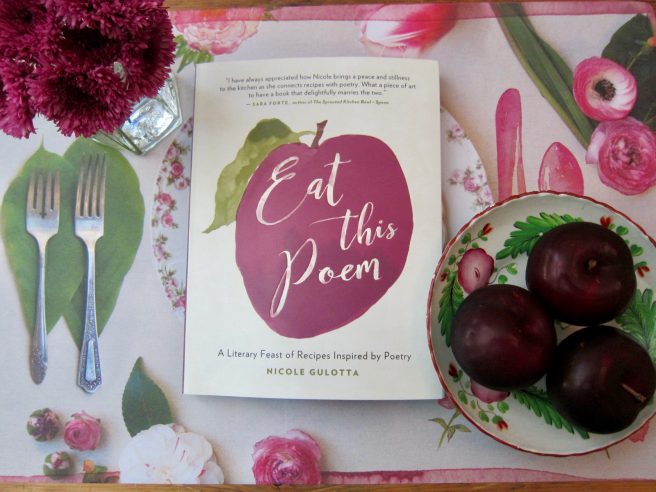
As a longtime fan of Nicole’s literary food blog, Eat This Poem, I was happy to see her first book come out earlier this year. This summer I finally had a nice chunk of time to give it a careful reading, savoring each word, each poem, each recipe.

Eat This Poem: A Literary Feast of Recipes Inspired by Poetry (Roost Books, 2017) features 75+ new recipes paired with poems by 25 of America’s most beloved poets (Billy Collins, Naomi Shihab Nye, Mark Strand, Mary Oliver, Wendell Berry). Just as she does at her blog, Nicole includes thoughtful commentary on each poem, followed by personal stories about the recipes.

All are presented thematically in five sections: On What Lingers, On Moments in Time, On Growth, On Gathering, and On Splendor. Recipe categories include Breakfasts, Salads, Soups, Snacks and Small Bites, Meat and Seafood, Vegetables/Vegetarian, Desserts and Drinks.

Enjoy Diane Lockward’s “Blueberry,” then read about Nicole’s Christmas morning family tradition of opening stockings by the fireplace while eating muffins (she then tempts us with a recipe for Blueberry Bran Muffins).

Contemplate Joy Harjo’s “Perhaps the World Ends Here” (one of the first food poems I ever shared at Alphabet Soup back in 2007), and then read about how Nicole’s great-grandmother used to slather a chicken in fresh oregano before roasting it for family dinners. Nicole’s recipe for Oregano Roast Chicken had me drooling (imagine the aroma of olive oil and savory spices wafting through your kitchen on a Sunday afternoon).

Do you know Sharon Olds’s bittersweet poem “First Thanksgiving” — about a mother anticipating her daughter’s return home after her first few months away at college? Nicole offers a recipe for Wild Rice with Chestnuts and Leeks, inspired by a semester abroad in London. In December, she took walks around the city the last week she was there to take it all in before returning home. She chanced upon a stall selling hot roasted chestnuts and tasted them for the first time, a wonderful moment that became an indelible memory.

Continue reading

to picnic or not to picnic?

“If ants are such busy workers, how come they find time to go to all the picnics?” ~ Marie Dressler

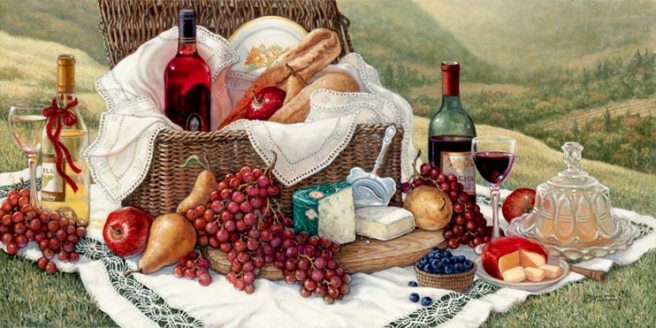
“Tuscan Picnic” by Janet Kruskamp”

What a nice day for a picnic! Let’s pack our hampers full of delectable goodies to eat and drink, drive out to the beautiful, unspoiled countryside, and have a grand time.

Or maybe not.

*

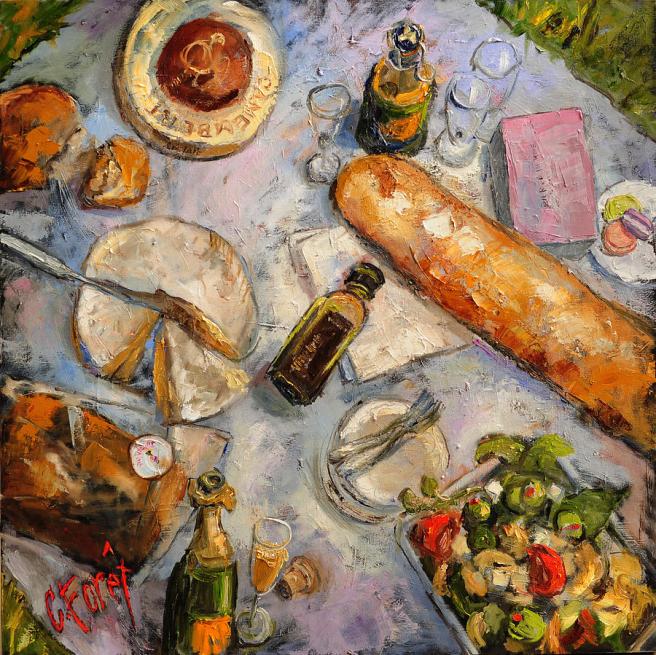
“Picnic at the Eiffel Tower” by Carole Foret


SO MANY THINGS CAN RUIN A PICNIC
by Faith Shearin

So many things can ruin a picnic—
mosquitoes, for instance, arriving
in a gray hum or black flies or a wind
strong enough to blow napkins
over the lawn like white butterflies,
steaks stolen by dogs, unruly fire,
thunderstorms that come on suddenly,
clouds converging over a field,
where you have just unpacked
your basket. It’s amazing, really,
that people have picnics at all
considering how many plates
have fallen in the dirt and how many
hot dogs have erupted in black blisters,
how many children have climbed hills
alive with poison ivy and how much ice
has melted before the drinks
were ever poured. It’s amazing
how many people still want to eat
on a blanket anyway, are still willing
to take their chances, to endure
whatever may fall or bite. Either they
don’t consider the odds of success
or they don’t care. Some of them
must not mind the stains on their pants,
the heavy watermelon that isn’t sweet
once it’s carved. Some must understand
the way lightning is likely to strike
an open field. Even so—they wrap up
a few pieces of fried chicken, fold
a tablecloth until it is as small as hope.
They carry an umbrella or a jacket
that they accidentally drop on the ground
where it fills with bees. They leave
the houses they built to keep them safe
and eat uncovered, ignoring the thunder,
their egg salad growing dangerously hot.

~ from Telling the Bees (Stephen F. Austin University Press, 2015)

*

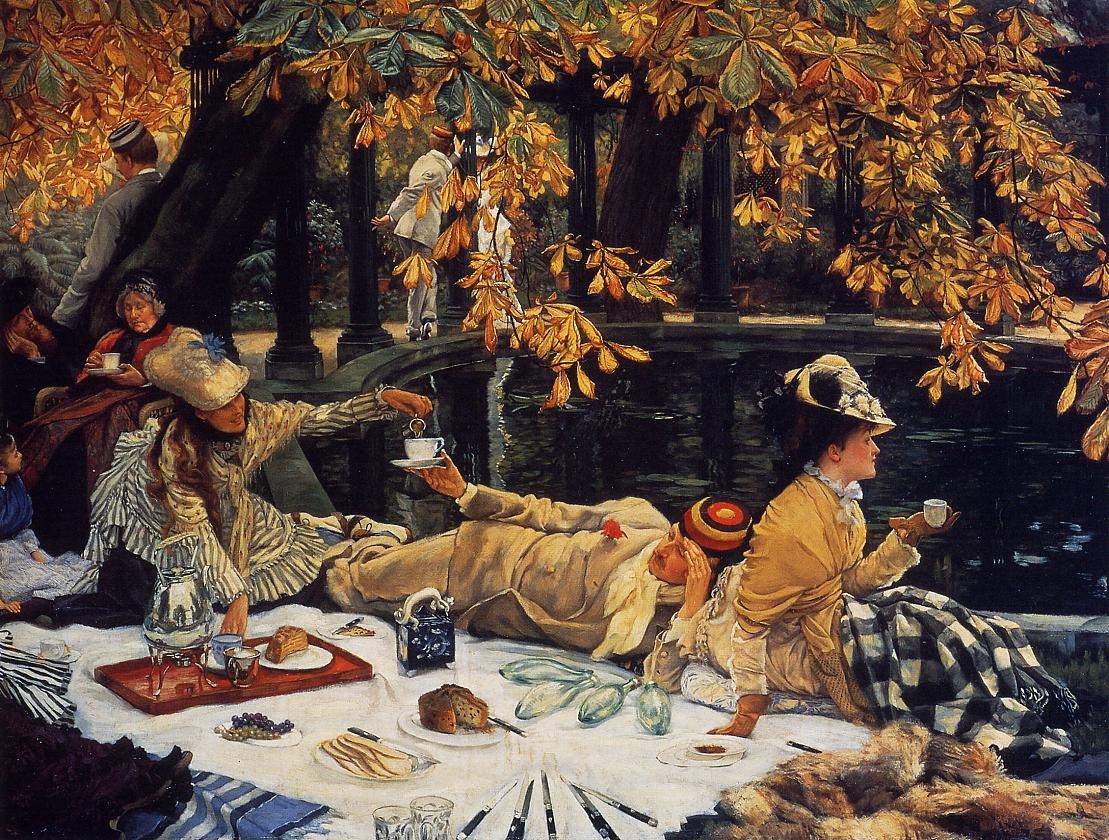
“Holyday/The Picnic” by James Tissot (ca. 1876)

Continue reading