a pitch for “Happiness” by Stuart A. Paterson

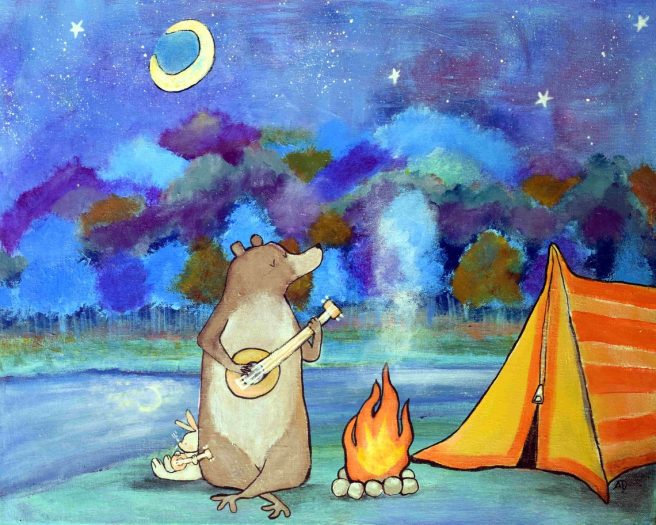
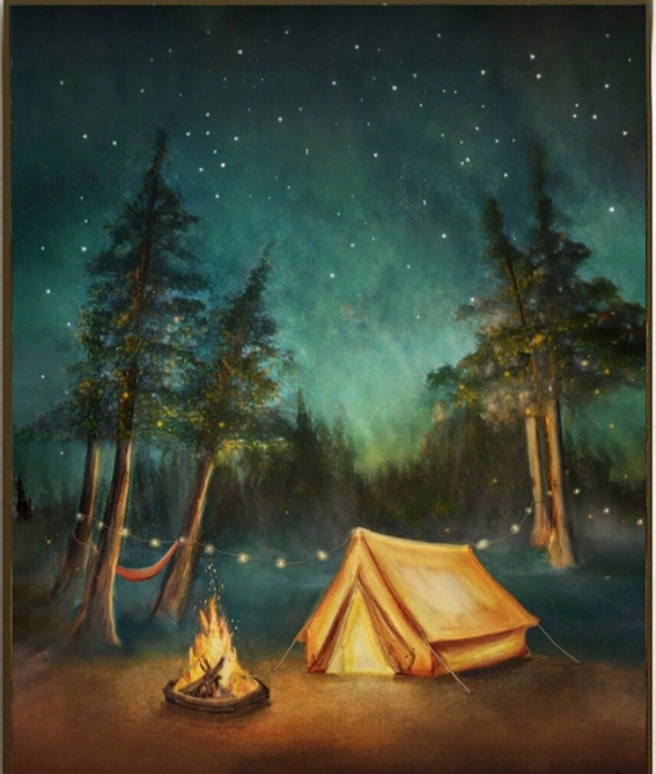
“Moonlight Camping” by Deidre Lynn (Brush and Bramble Art).
HAPPINESS
by Stuart A. Paterson

I’ve made my own Museum of
Happiness, which isn’t built of brick
or stone or wood, its walls the thickness
of the day, a flapping tongue of canvass
held in place by rope & peg to stop
it flying off & joyously away
up into everywhere in time & space.

I’ll carry it around with me to pitch
beside the sea, in a field or by
that river, a billowing rickety marquee,
a travelling show of personal delights
performing one night only & forever.

What sights! What wonders! See those things unseen
except in meanwhiles, vivid dreams,
smile, laugh & gasp & live a lifetime
somewhere in between the daily grind
of minutes into hours, be amazed
by happiness’s alchemy
transmogrifying days of certainty
to joyous, raucous aeons of impossibility.

Step right up, pay nothing, be called in
to watch the carnival of you begin,
the show to beat all shows where nothing’s
out of bounds & every good thing goes
around & comes around again, not down
or out & you’re the hottest act in town,
the permanently top display, the troupe
of you booked solid every single smiling day.

~ written for Personal Best (October 2017).
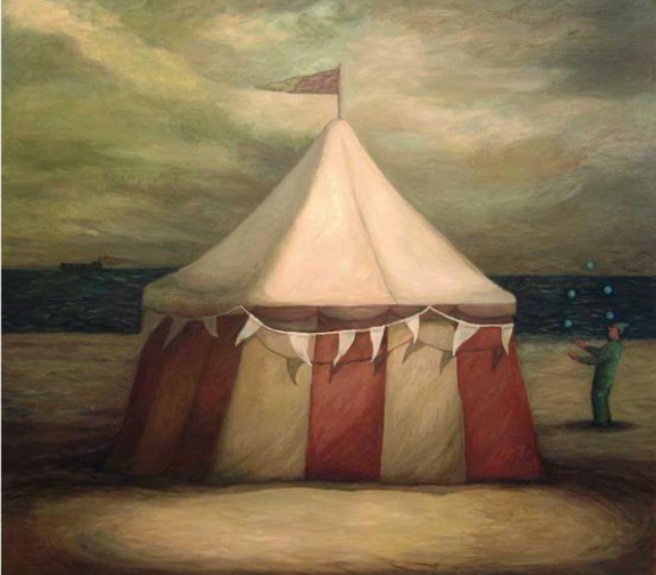
“Juggler” by Dayle Bolton.

*

“Camping Under a Striped Tent” by Andrea Doss

This poem had me smiling from beginning to end. Sheer delight!

I reveled in Paterson’s choice words, his artful turn of phrase, and his brilliant use of extended metaphor.

Tents are portable; they can be set up just about anywhere. Never a burden, they allow us to travel lightly through life (don’t you love “its walls the thickness of the day”?). We carry our personal museums of happiness with us wherever we go. 
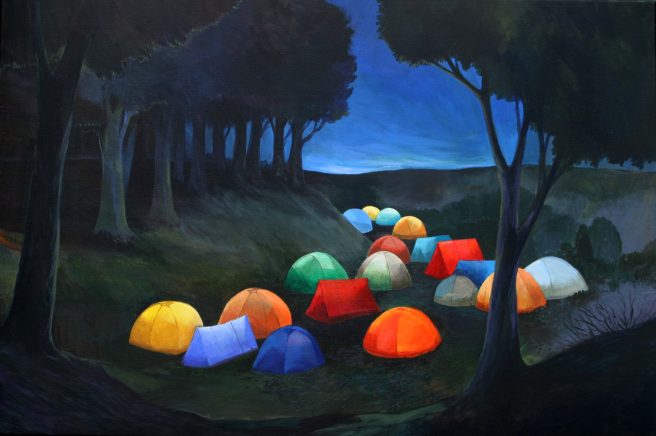
“Camping in the Woods” by Joanna Karpowicz.

The notion that happiness lies within, that it’s something we can all cultivate, is certainly not new, and while I appreciate the reminder, sometimes this message can be cloaked in cliché. Not so with Paterson’s poem. An invitation to “step right up” to watch “the carnival of you begin” takes care of that. Every performance is as unique as the individual; there is no sameness or predictability, not when you’re dealing with “raucous aeons of impossibility.”
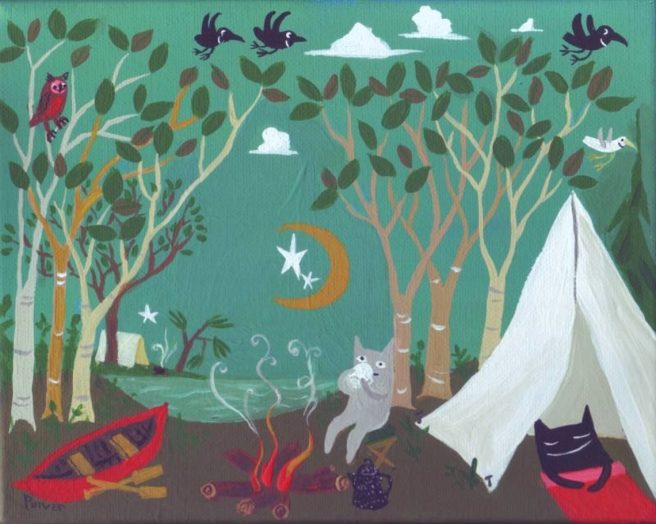
“Camping Cat” by Sara Pulver.

Stuart A. Paterson wrote “Happiness” for Personal Best (a Health and Fitness podcast), when he was BBC Scotland Poet in Residence (2017-18). He has a proven track record of initiating and encouraging engagement in creative writing in many sectors of the community – primary and secondary schools, libraries, progressing writers, mental health and wellbeing, the elderly and in the area of Scots language. He has received many awards for his poetry, including Scots Poet of the Year 2020.

I’d love to stay and juggle a few more words, but I must run (this happens when you’re the hottest act in town).

Showtime!
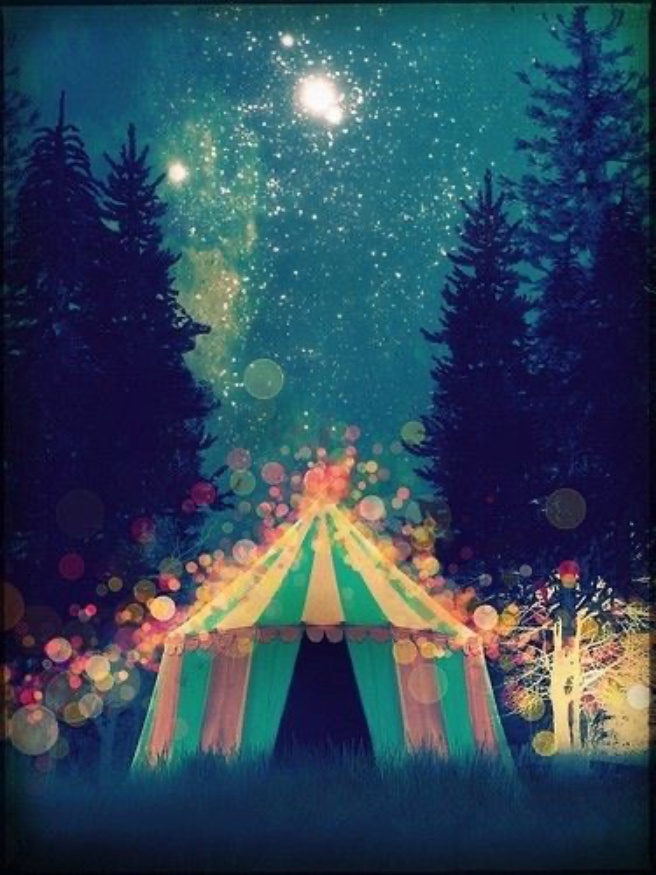
What does your Museum of Happiness look like?

*
The lovely and talented Heidi Mordhorst is hosting the Roundup at My Juicy Little Universe. Tap dance on over to check out the full menu of poetic goodness being served up around the blogosphere this week. Have a great weekend!


*Copyright © 2023 Jama Rattigan of Jama’s Alphabet Soup. All rights reserved.
to blurb or not to blurb?

Have you ever been asked to write a blurb for a new poetry book or read one that turned you off? Here’s some light-hearted advice from Scottish poet Helena Nelson.

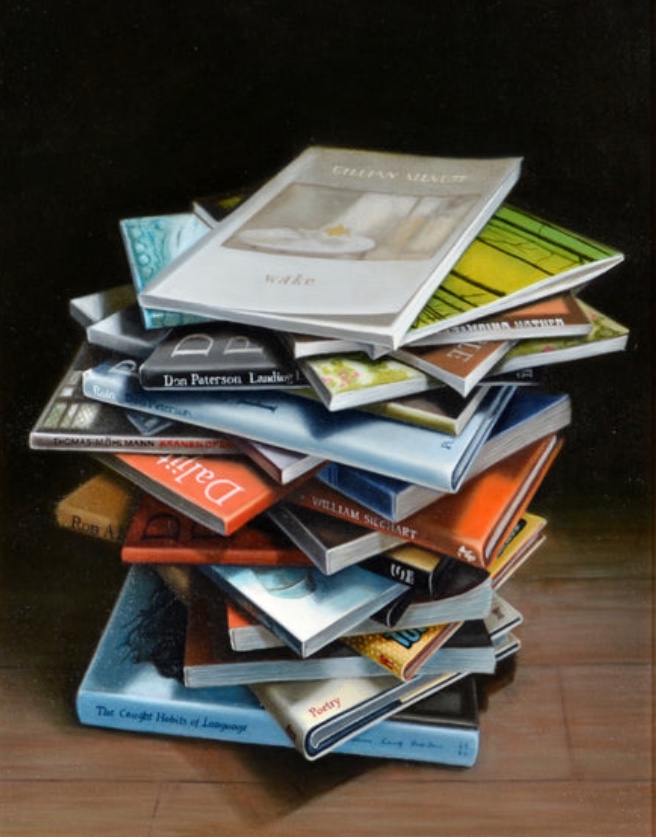
“Pile of Poetry” by Nichola Martin.
WHAT NOT TO WRITE ON THE BACK  JACKET OF YOUR DEBUT COLLECTION
by Helena Nelson

This book is not bad.
A number of these poems feature the poet’s dog: George.
The author’s mother recommends this book.
Boris Johnson recommends this book.
Most of the poems are quite short.
Poetry is not for everybody.
These poems are accessible if reasonable adjustments are made.
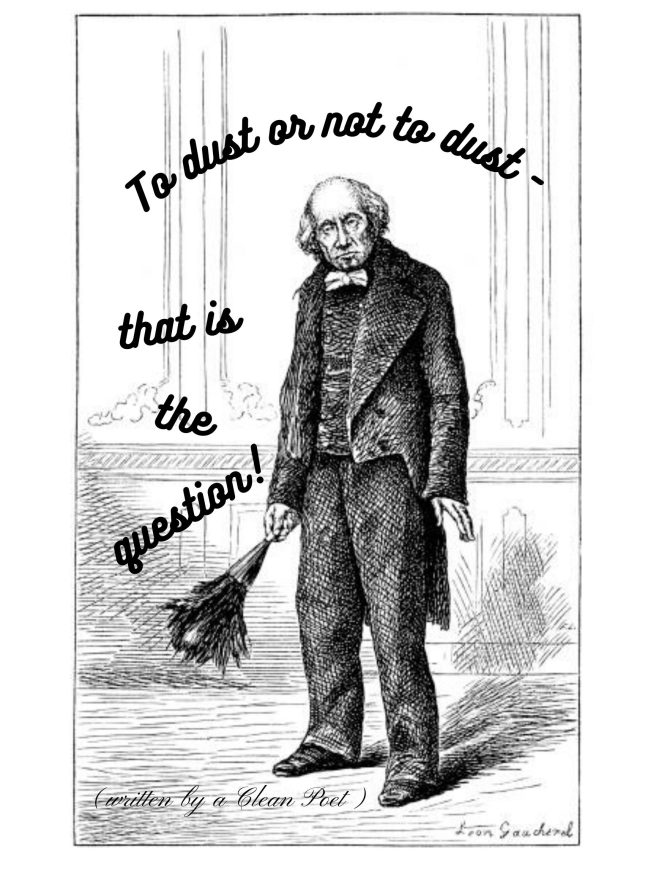
Many of these poems were written while dusting.
The poet applied three times for funding to assist in the completion
of this book.
Please buy this book.
The poems in this book have universal resonance some of the time.
Includes five villanelles and three sestinas.
There is a glossary of difficult words for readers new to poetry.
The poet skillfully employs seven types of metonymy.
The main theme is death.

~ from Down with Poetry! (Glenrothes: HappenStance, 2016)

*

Blurbing new poetry books is a tricky business. Your task is to help sell the book, but how do you do justice to it without sounding too cliché or over the top?

I always read the blurbs on the back covers of new single poet collections and sometimes find them pretentious, intimidating, even unbelievable. I sometimes run away screaming. And I’m someone who actually likes poetry.

At the Scottish Poetry Library, Nelson said this about her poem:

In Issue 25 of The Dark Horse (2011), there was an article called ‘The Blurbonic Plague’ by the late, lamented Dennis O’Driscoll. It was about the awfulness of much of the text on back jackets of new poetry books. This struck a chord close to my heart, and also gave me the courage to form a deliberate policy for HappenStance Press, which ever since has been officially ‘anti-blurb’. When I issue books and pamphlets, the text on the back cover never includes words like ‘new and exciting’, and I don’t commission blurbs or, worse still, get poets to write their own. But then what do you write? The truth? Frequently that won’t do either. It’s easier to say what not to write, and have some fun with that. So I made a list, some of which turned into this poem.

I thoroughly enjoyed her list and her wry humor (some of the suggestions could also apply to things one should not include in a manuscript submission cover letter).

Truly, what could be more enticing (esp. to a potential non-poet reader) than a platter full of shop talk? We all eat metonymy, synecdoche, asyndeton and caesura for breakfast, right? 🙂

And they say poetry is a hard sell . . .

Actually, I think Nelson is definitely onto something with her “anti-blurb” stance. If a blurb can make you laugh, wouldn’t you be more apt to buy the book? Hold the mega hype, please.

Here is Nelson reciting the poem:

How do you feel about book blurbs? How seriously do you take them?

*

Helena Nelson (Nell Nelson) is the originator and editor of HappenStance Press as well as a poet in her own right. Her first Rialto collection Starlight on Water was a Jerwood/Aldeburgh First Collection winner. Her second was Plot and Counterplot from Shoestring Press. She also writes and publishes light verse – Down With Poetry! (HappenStance, 2016) and Branded (Red Squirrel Press, 2019). In 2016, she published a HappenStance best seller: How (Not) to Get Your Poetry Published, a book that collects the insights and useful ideas she has gathered over the last twelve years in poetry publishing.

She reviews widely, writes a publisher’s blog regularly, and also curates the pamphlet review site Sphinx Review.

*

The lovely and talented Tanita S. Davis is hosting the Roundup at {fiction, instead of lies}. Waltz on over to check out the full menu of poetic goodness being shared around the blogosphere this week. Happy March!


*Copyright © 2023 Jama Rattigan of Jama’s Alphabet Soup. All rights reserved.
[poem + recipe] solitary scones

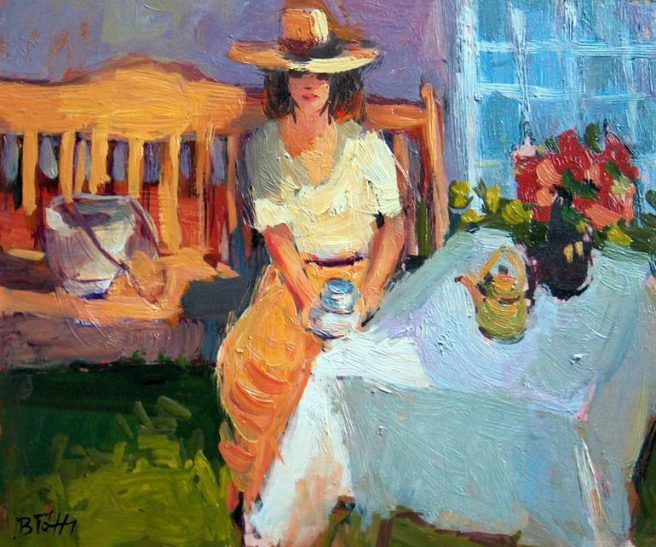
“Drinking Tea in the Garden” by Edit B. Toth.
SHELTERING TIMES
by Judith Heron

Our need is surely now for gentle news.
Lives, stilled by necessity, call out for calm,
a kind of deep attention monks have known.
My kneeling stool has become a friend.

The garden and my small abode are alight
with both loss and pleasure. Old songs spring
easily to an open heart. The call, to replenish
gratitude, knocks each day on my door.

Odd that I have perfected now, the recipe
for scones. Buttermilk with ginger, apricots,
free range eggs that turn them golden.
Tops brushed with milk, a dust of sugar.

Old friend, it is you I wish I could
bring them to -- in a basket covered
with a cotton cloth -- and walk again,
arm in arm, round that mountain lake.

~ as published at Your Daily Poem (March 2021)
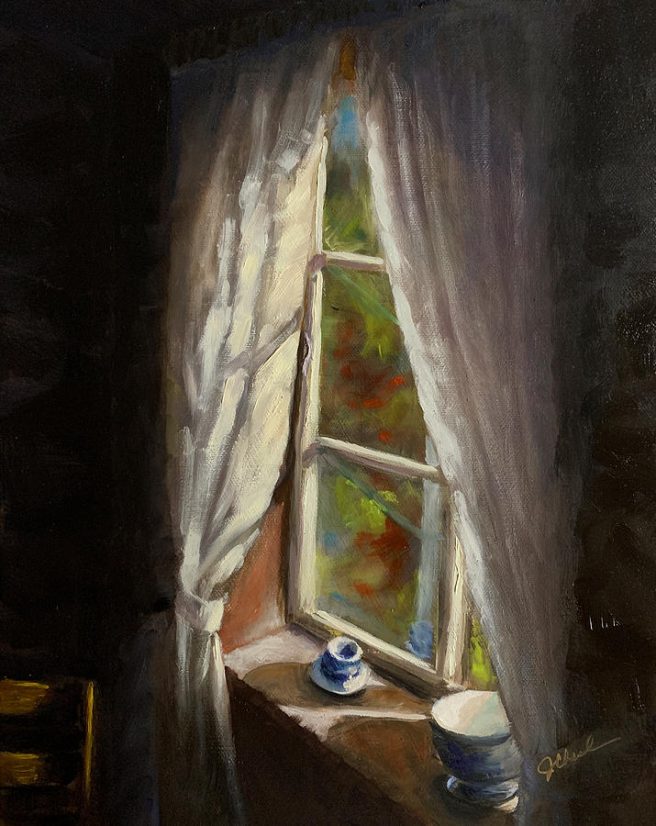
“View from Rebecca Spit (XXII)” by David A. Haughton (2020).

*

“Solitude” by Jan Chesler.

No matter how truly sad, frightening or stressful it all was, having our lives “stilled by necessity” in the early days of the pandemic gave us a unique opportunity to self reflect and focus on what truly matters: human connection.

When we were suddenly thrust into unpredictable lives of isolation, we learned to take nothing for granted. Have we ever been as vulnerable or felt as powerless in the face of an invisible enemy?

Continue reading

love is in the air

Just for you: A perfect evocation of love in anticipation of Valentine’s Day. ♥️

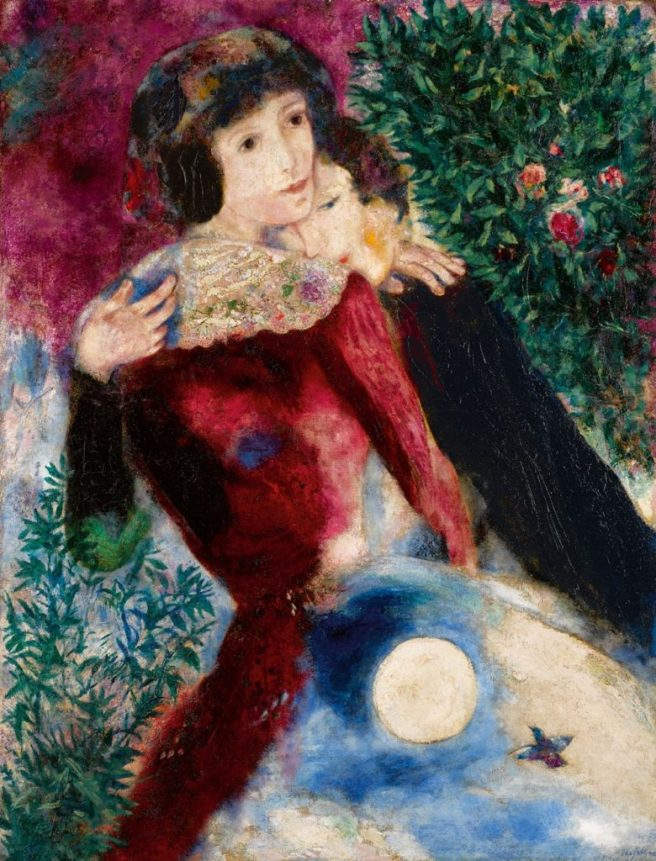
“Les Amoureux” by Marc Chagall (1928).
TOUCH THE AIR SOFTLY
by William Jay Smith

Now touch the air softly, step gently, one, two …
I’ll love you ’til roses are robin’s egg blue;
I’ll love you ’til gravel is eaten for bread,
And lemons are orange, and lavender’s red.

Now touch the air softly, swing gently the broom.
I’ll love you ’til windows are all of a room;
And the table is laid, And the table is bare,
And the ceiling reposes on bottomless air.

I’ll love you ’til heaven rips the stars from his coat,
And the moon rows away in a glass-bottomed boat;
And Orion steps down like a river below,
And earth is ablaze, and oceans aglow.

So touch the air softly, and swing the broom high.
We will dust the grey mountains, and sweep the blue sky:
And I’ll love you as long as the furrow the plough,
As however is ever, and ever is now.

~ from The Girl in Glass: Love Poems (Books & Co., 2002)

*

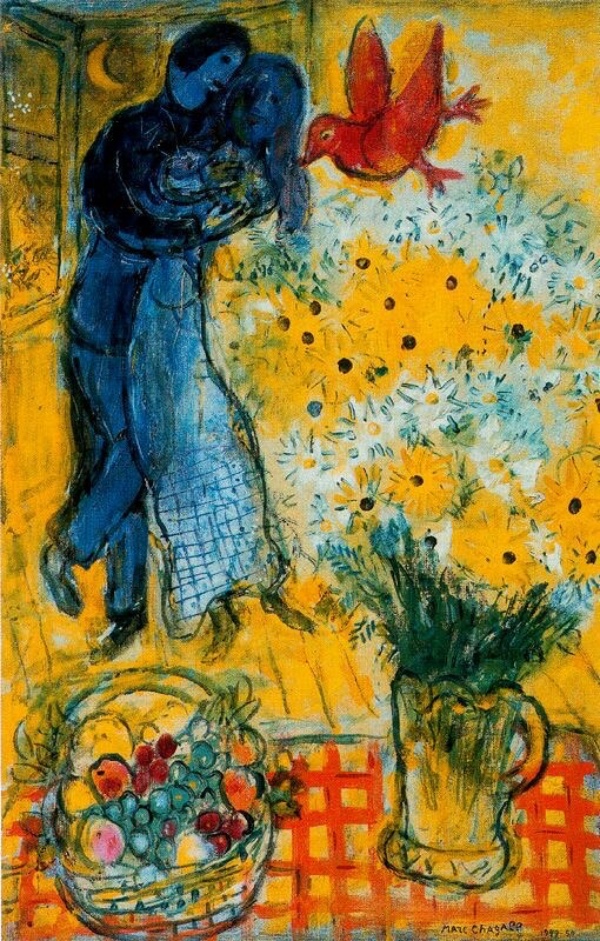
“Lovers with Daisies,” by Marc Chagall (1949-59).

I was totally enchanted by every word of this lyrical gem, which is alternately titled “A Pavane for the Nursery.” Something about, ‘step gently, one, two’ struck me as an ingenuous invitation to delight.

This poem has been set to music by several composers, is a popular choral piece, and is often sung or recited at weddings.

A former U.S. Poet Laureate, William Jay Smith once said, “Great poetry must have its own distinctive music; it must resound with the music of the human psyche,” and this poem certainly bears that out.

Smith favored traditional poetic styles to free verse, hence his use of a rhymed metrical-stanzaic structure here. His pronouncements are charming as well as disarming despite the formal style. Who can resist “the moon rows away in a glass-bottomed boat,” or “we will dust the grey mountains and sweep the blue sky”?

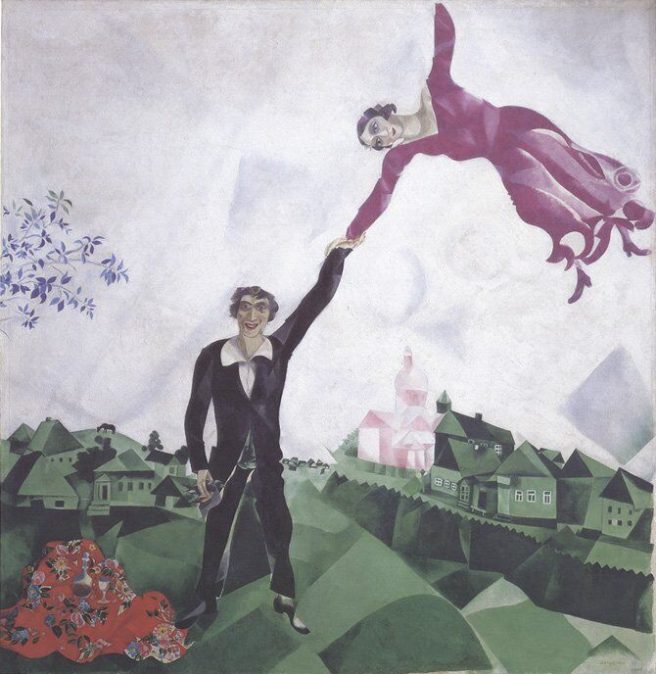
“La Promenade,” by Marc Chagall (1918).

Brooms are symbols of good luck, as they can be used to “sweep away” evil spirits or bad fortune. According to an old Welsh custom, newlyweds should enter their new home by stepping over a broom so luck will follow them. Similarly, if a bride and groom jump over a broom during their marriage ceremony, good luck and fortune will flourish in their union.

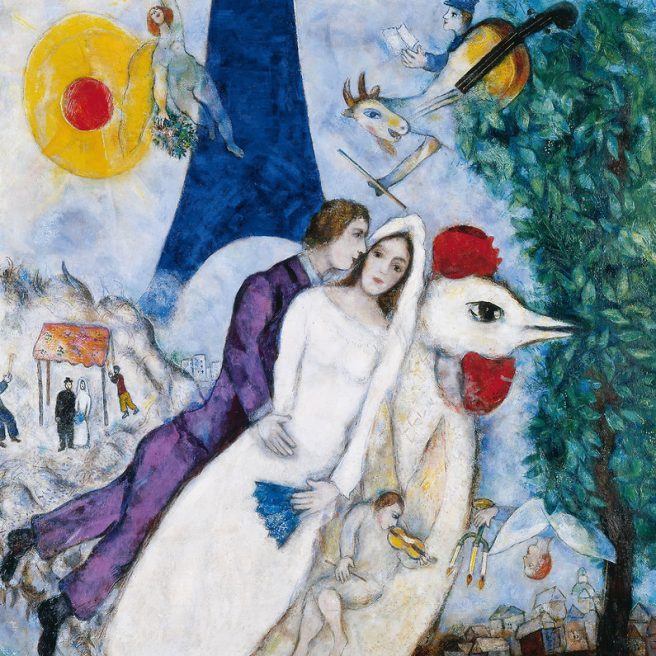
Upon reading this poem, I thought immediately of Marc Chagall. After all, he’s considered “the ultimate painter of love.” He masterfully captured the euphoria of love with his levitating lovers, who blissfully float on air, defying gravity, soaring beyond earthly realms as one. 

“Bride and Groom of the Eiffel Tower,” by Marc Chagall (1938-39).

His wife Bella was not only the love of his life, but the muse who inspired his best work. He said, “Is it not true that painting and color are inspired by love? In art, as in life, all is possible when conceived in love.”

I thought Chagall’s flying lovers a good match for Smith’s poem, for it is the life-sustaining purity of air that blesses those united in love, enfolding them in their own universe.

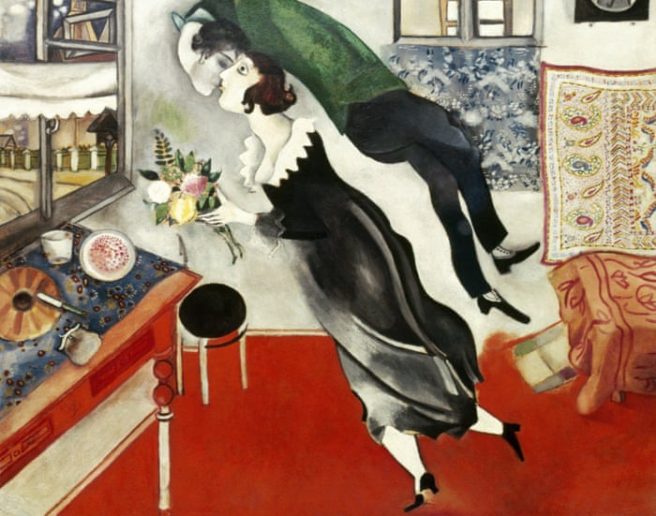
“Birthday” by Marc Chagall (1924).

After listening to several renditions of this poem put to music, I decided my favorite is by Minnesota folk musician Peter Mayer. His crisp, warm, fluid acoustic treatment is perfection.

♥️ HAPPY VALENTINE’S DAY! ♥️

*

The lovely and talented Carol Varsalona is hosting the Roundup at Beyond LiteracyLink. Waltz on over to check out the full menu of poetic goodness being served up around the blogosphere this week. Enjoy your weekend and watch out for cupid’s arrows next week. 🙂


Copyright © 2023 Jama Rattigan of Jama’s Alphabet Soup. All rights reserved.

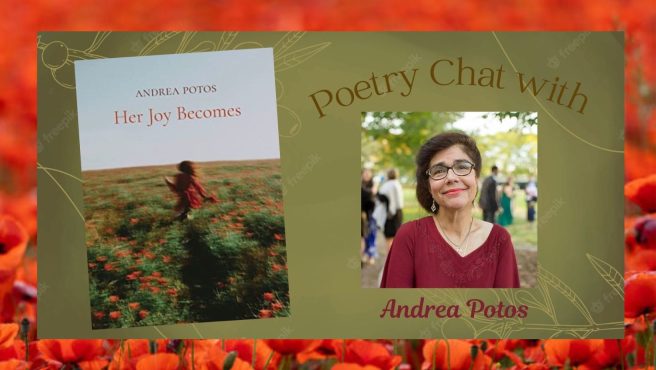
Chatting with Andrea Potos about Her Joy Becomes

“The hurt you embrace becomes joy.” ~ Rumi

I’m happy to welcome Wisconsin poet Andrea Potos back today to answer a few questions about her latest book, Her Joy Becomes (Fernwood Press, 2022).

Just as Keats once wrote, “A thing of beauty is a joy for ever,” Andrea writes, “nothing of beauty is ever wasted.” 

Embracing beauty and choosing joy, even in the face of loss and despair, are prevailing themes. Safe to say, each fully realized lyrical gem in this collection is a thing of beauty. Andrea’s prologue:

Gathering

As you begin, look just slant,
the same way one should not look directly
into the sun's gaze.
Graze with your consciousness,
keeping your hands nimble, your reach a fluency
of light as words begin to sift
and fall and settle where they
know they belong.

A thread of female kinship and connection is woven throughout the book, whether familial (grandmother, mother, daughter), or literary (Dickinson, Alcott, Brontës, Dorothy Wordsworth). Loved ones deeply missed as well as writers who came before inhabit introspective “rooms of thought,” informing Andrea’s poetic sensibility, igniting her imagination. 

As a sentient witness of life’s ordinary miracles, she finds magic in an iridescent soap bubble and revels in freshly washed laundry flapping on the line (“releasing their music of fabric to the air”). She experiences unexpected epiphanies as peonies bloom and a lone cardinal sings of her late mother’s loving divinity.

Intimate and accessible, these poems quietly resonate. Are you turning into your mother? Remember the thrill of new patent leather Mary Janes or the heyday of Laura Ashley dresses? Like prayer, attentiveness, and humility, taking joy is a practice worth cultivating. Moreover, poetry heals, gently guiding us on the path towards wholeness.

Here’s the lovely opening poem:

Andrea’s daughter Lexi
ABUNDANCE TO SHARE WITH THE BIRDS

Another early morning
in front of the bathroom mirror --
my daughter making faces
at herself while I pull
back her long brown hair,
gathering the breadth and shine
in my hands, brushing
and smoothing before weaving
the braid she will wear
to school for the day.
Afterward, stray strands
nestle in the brush, and because
nothing of beauty is ever wasted,
I pull them out,
stand on the porch and let them fly.

*

Continue reading