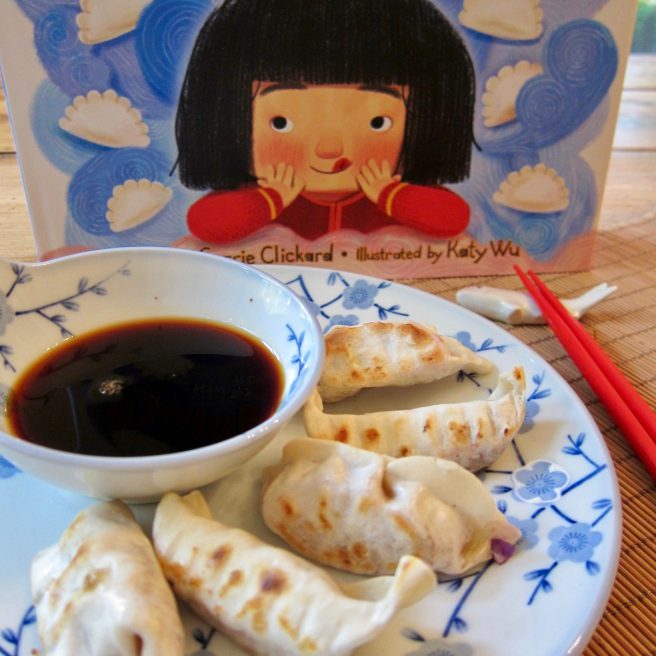
[tasty review + giveaway] Dumpling Dreams: How Joyce Chen Brought the Dumpling from Beijing to Cambridge by Carrie Clickard and Katy Wu

Help yourself to a Joyce Chen 5-Minute Potsticker


Ni hao! Hello!

Do you ever dream about dumplings? I certainly do.

In fact, just hearing the word “dumpling” makes me happy. It’s the ultimate comfort food and my favorite term of endearment (feel free to call me ‘Dumpling’ any time). 🙂

Whenever you have a meat and vegetable filling wrapped with dough it’s a good thing. Plump, tender, savory, lip-smackingly delicious. Mmmmmm!
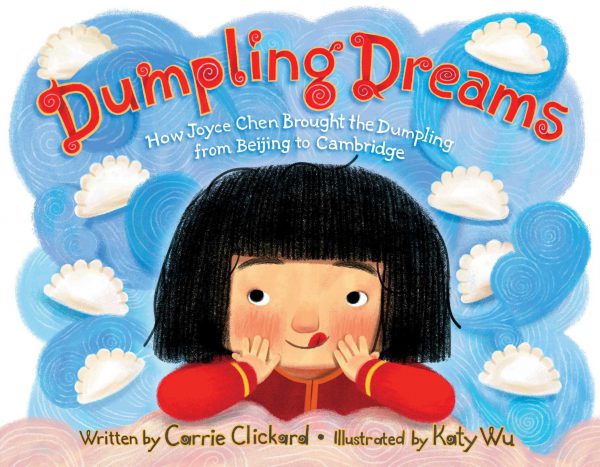
Since I’m a big fan of Chinese dumplings in particular, I was especially happy to see Dumpling Dreams: How Joyce Chen Brought the Dumpling from Beijing to Cambridge by Carrie Clickard and Katy Wu (Simon & Schuster, 2017).

Written in rhyming couplets, this delectable new picture book is an absolute delight, a charming introduction to the Chinese-American chef, author, restaurateur, entrepreneur, and TV personality who popularized Northern Chinese and Shanghainese cuisine in America.
Continue reading

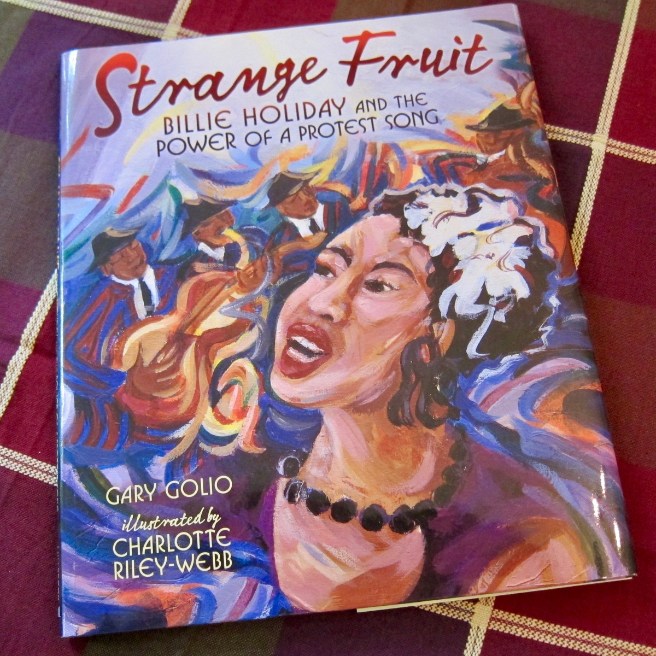
[review] Strange Fruit: Billie Holiday and the Power of a Protest Song by Gary Golio and Charlotte Riley-Webb

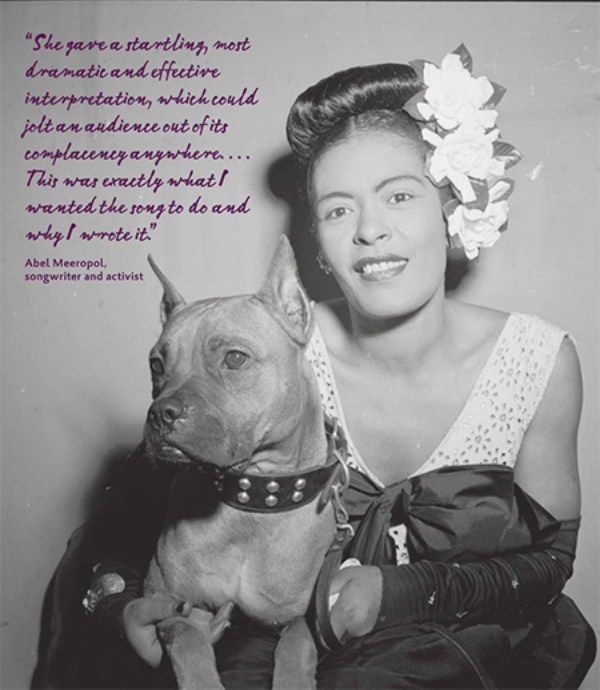
The first time I heard Billie Holiday’s rendition of “Strange Fruit” I was confused. What was she . . . could she be . . . NO! . . . and then the awful realization that she was singing about lynching — one of the most horrific, unconscionable atrocities in American history.

Strangely enough, before I read Strange Fruit: Billie Holiday and the Power of a Protest Song by Gary Golio and Charlotte Riley-Webb, I hadn’t really thought of “Strange Fruit” as a protest song, at least not the kind of protest song popular at Labor Union rallies à la Woody Guthrie, or sung in unison at 60’s civil rights marches or counterculture anti-war sit-ins. Protest songs roused and inspired people to stand up to social injustice; they unified, mobilized and galvanized.

Mister and Lady Day

Of course “Strange Fruit” did all of these things, but I think it should be in a category of its own. It shocked and outraged people, leaving many anguished and ashamed. It was, and still is, hard to listen to, and it was hard on the singer, as it brought to bear her own struggles with racism, violence, drug and alcohol addiction — all the ugliness she had experienced as an African American woman. Billie’s performances of “Strange Fruit” could be thought of as visceral theater. Singing it became an act of courage, as she was sometimes “verbally or physically harassed” afterwards.

Continue reading

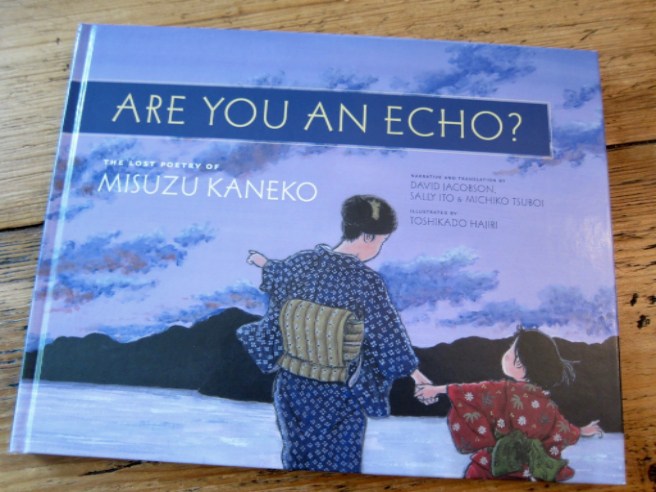
[review] Are You an Echo?: The Lost Poetry of Misuzu Kaneko by David Jacobson, Sally Ito, Michiko Tsuboi, and Toshikado Hajiri

Though every elementary school student in Japan is familiar with Misuzu Kaneko’s poetry, relatively few in the English-speaking world are familiar with her work.

Marked by a refreshing ingenuousness, curiosity, and extraordinary empathy for the world around her, Misuzu’s poems resonate with people of all ages, demonstrating that quiet, gentle words have their own special power.

DEWDROP

Let’s not tell anyone.

In the corner of the garden this morning,
a flower shed a tear.

If word of this spreads
to the ears of the bee,

it’ll feel it’s done wrong
and go back to return the nectar.

Thanks to this breathtakingly beautiful picture book, a new audience of North American children can now read a selection of Misuzu’s poetry in English, learn about her short tragic life and the fascinating backstory of how her work was lost for half a century before being rediscovered in 1982.

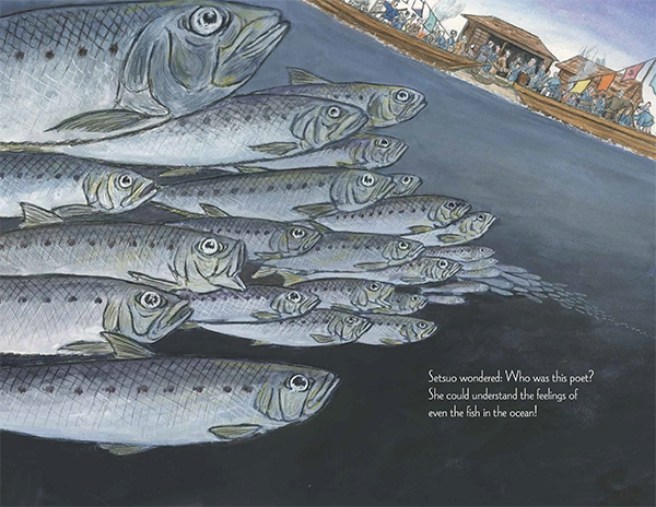
 In Are You an Echo?: The Lost Poetry of Misuzu Kaneko (Chin Music Press, 2016), author David Jacobson frames the story of Misuzu’s life with an account of how young student poet Setsuo Yazaki read one of her poems and was so impressed by it that he spent the next 16 years searching for more.

Art © 2016 Toshikado Hajiri

BIG CATCH

At sunrise, glorious sunrise
it’s a big catch!
A big catch of sardines!

On the beach, it’s like a festival
but in the sea, they will hold funerals
for the tens of thousands dead.

Continue reading

friday feast: a taste of Issa’s haiku and a favorite childhood treat


Ohayoo gozaimasu! Good Morning!

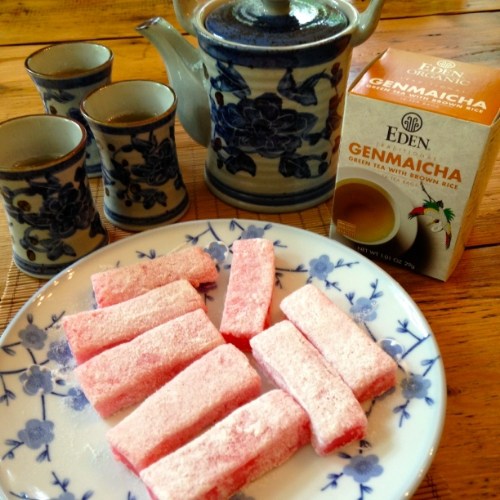
Please help yourself to a nice warm cup of Genmaicha (green tea with brown rice) and a piece of chi chi dango mochi. I remember many a time when my mother made a pot of Genmaicha after a good meal — a soothing way to cleanse the palate and set the stage for some lively ‘talk story.’

A couple of weeks ago, I searched Lee and Low’s website for books I hadn’t yet read and found the perfect picture book to share for Asian-Pacific American Heritage Month. Cool Melons — Turn to Frogs!: The Life and Poems of Issa by Matthew Gollub and Kazuko G. Stone was first published in 1998, so many of you are probably already familiar with it. How did I miss it? I’m so glad I finally read it, as now it’s one of my favorite haiku picture books ever.

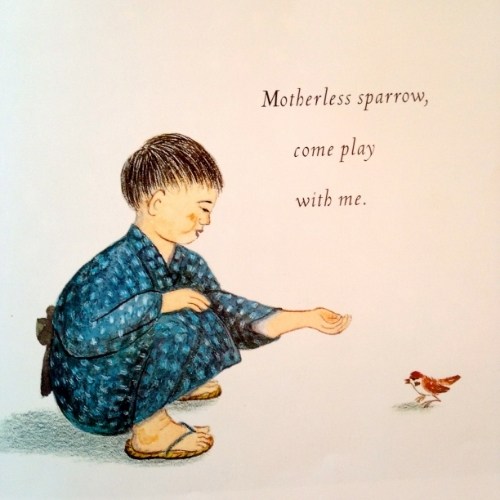
Issa wrote this haiku when he was just six years old.

I love how every aspect of this book embodies the essence of haiku — its complex simplicity, beauty, elegance, and ability to open the eyes, refresh the mind, and inspire contemplation.

Continue reading

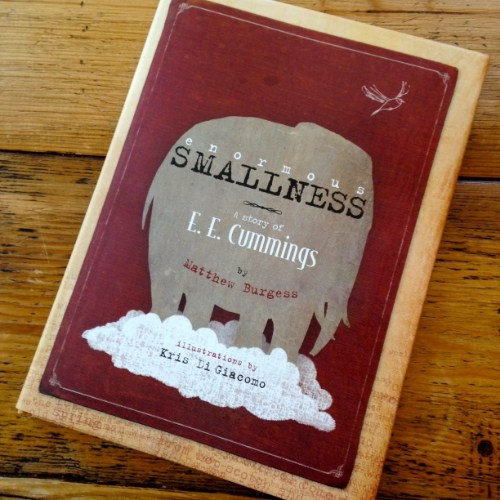
friday feast: Enormous Smallness: A Story of E. E. Cummings by Matthew Burgess and Kris Di Giacomo (+ chocolate mud puddles)

“No modern poet, to my knowledge, has such a clear, child-like perception as E.E. Cummings — a way of coming smack against things with unaffected delight and wonder . . . This candor results in breathtakingly clear vision.” (S.I. Hayakawa)

When I first heard a few months ago that a new picture book biography of E. E. Cummings was being published by Enchanted Lion Books, my heart literally skipped a beat. Cummings is, after all, my all-time favorite poet. Then when I learned the book was being illustrated by Kris Di Giacomo, who did Take Away the A (one of my favorite alphabet books), it was all I could do to contain my excitement until the book finally hit shelves earlier this month.

It takes courage to grow up and become who you really are.

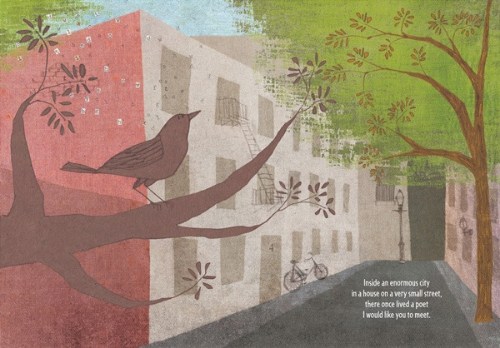
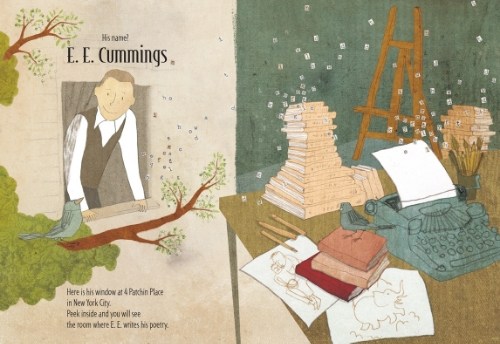
In Enormous Smallness: A Story of E. E. Cummings, debut picture book author, scholar, educator and poet Matthew Burgess recounts Cummings’s life from his magical childhood in Cambridge, through his days at Harvard, to when he finally settled in Greenwich Village, where he lived for nearly four decades.

Kids will enjoy seeing how Cummings loved playing with words from a very early age, received lots of encouragement along the way, and found the courage to remain true to himself, ultimately becoming one of the most innovative and inventive poets of the 20th century, a true champion of individuality whose lyrical experiments with grammar, syntax, and punctuation continue to baffle and delight.

Continue reading