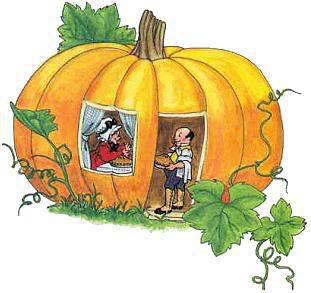
Peter Peter Pumpkin eater,
Had a wife but couldn’t keep her.
He put her in a pumpkin shell,
And there he kept her very well.
That saucy Mother Goose is full of surprises. We started out fine on Monday, talking about Pat-a-cake and how comforting and life affirming it was to hear those words when we were little. Yesterday, I discovered pease porridge was made from peas. I admit that rattled my pod some. Now, I learn that Peter Peter Pumpkin Eater has some X-rated connotations.
As they say in some polite circles, “Butter my butt and call me a biscuit!”
Unlike the vast majority of nursery rhymes which originated in Europe, Peter and his pumpkin sprouted right here on American soil. This makes perfect sense when you consider that pumpkins were not indigenous to England. The British had never seen or eaten pumpkins until recently. That lets them off the hook.
On the surface, this nursery rhyme seems simple enough: Peter, a pumpkin connoisseur, doesn’t get along with his wife. He locks her up at home so she’ll behave. End of story. Then, along come some literary historians who love to analyze, interpret and speculate. They say that Peter’s wife has strayed, so he makes her wear a chastity belt (pumpkin shell). Supposedly the word “pumpkin” was a euphemism for a woman’s genitalia in Colonial America. Hence the chastity belt being a shell for the pumpkin.
Another interpretation cites the practice of nobility exiling unwanted wives to remote locations, such as nunneries or castles. Case in point: Henry VIII sending Catherine of Aragon to Kimbolten Castle, so Anne Boleyn can become Queen Bee.
But the darkest take of all is that Peter has murdered his wife, and married someone else. This is a loveless relationship, but after educating and improving himself, all is well. Read about it in the second verse to Peter’s tale:
Peter Peter pumpkin eater,
Had another and didn’t love her;
Peter learned to read and spell,
And then he loved her very well.
Hmmm. What can we deduce from all this? It sounds like Peter blames his poor wife for everything. But, if he hadn’t spent so much time eating pumpkins, and paid more attention to his wife, she wouldn’t have acted up. Exiling her didn’t solve anything. On the rebound, he caroused with a woman he didn’t love. His only saving grace was that he educated himself and finally came to his senses. My conclusion? No pumpkin pie for the guys this Thanksgiving.
Another disturbing event: it seems that Peter isn’t the only one eating pumpkins. For Halloween, we put two almost perfectly shaped pumpkins on our front doorstep. We don’t usually carve our pumpkins, since we want them to last until after Thanksgiving.
About a week ago, I saw this:
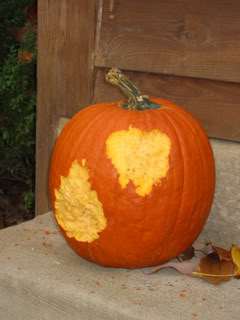
Bad, bad squirrels. I’m guessing they’re all named Peter.
Their wives must have been very naughty, because look:
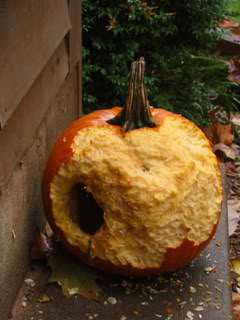
You have to admire the perfectly rounded entrance, though. The squirrels are gorging themselves. Sign of a cold winter? Len even saw two chipmunks munching away inside the pumpkin, or what’s left of it.
Dear friends, after seeing the remains of my pumpkins and reading about Peter, I am fairly traumatized. I must go lie down. While I’m resting, consider this recipe delish from the Birchwood Inn in Temple, New Hampshire. I’m sure you’ve had pumpkin bread before, but not like this.
PUMPKIN APPLESAUCE TEA BREAD
(makes one 9×5″ loaf)
2 cups sugar
1/3 cup molasses
1 cup cooked and mashed pumpkin
1 cup applesauce
2/3 cup oil
3 eggs
1/3 cup milk
3-2/3 cups flour
1-1/2 tsp baking powder
2 tsp baking soda
2 tsp cinnamon
1 tsp nutmeg
1 tsp vanilla
1 cup chopped nuts
1 cup raisins or dates (I prefer dates)
1. Beat sugar, molasses, pumpkin, applesauce, oil, milk, and eggs on medium speed.
2. Sift in flour, baking powder, baking soda, cinnamon, and nutmeg.
3. Add remaining ingredients; mix well. Pour into greased 9×5″ loaf pan. Bake at 350 degrees for 1 hour.
4. Cool 10 minutes in pans. Wrap in foil and store overnight.
5. Never trust a man alone with a pumpkin.
Tomorrow: Off with their heads!
 Jama's Alphabet Soup