friday feast: a soothing lullaby and a side of chocolate!

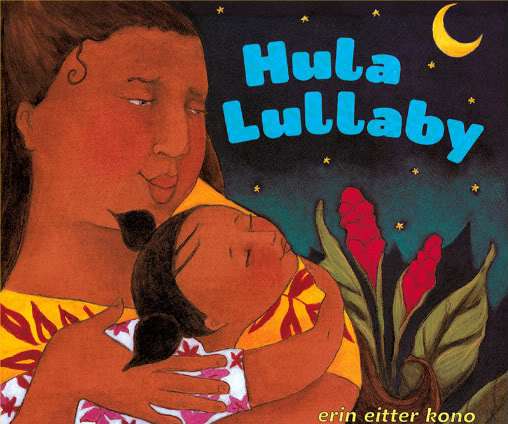
“In Hawai’i the warm breeze often carries the sound of the ocean waves, the rustling leaves, and the rhythmic chants of the hula. It is not difficult to imagine rocking one’s child, or keiki (keh kee), to sleep to the accompaniment of this gentle cadence.” ~ Foreword, Hula Lullaby, by Erin Eitter Kono.

I first heard about Hula Lullaby when Sam Riddleburger interviewed Erin Eitter Kono for Robert’s Snow: Blogging for a Cure 2007, organized by Jules and Eisha at 7-Imp.

High quality picture books about Hawai’i always get my immediate attention because they are so few and far between. This one just happens to be beautifully produced and culturally authentic, making it even rarer and cause for unabashed adulation.

Hula Lullaby is pitch perfect — from the title page, awash in deep, Prussian blue and graced by red anthuriums, to the Foreword spread, set against the red-orange sky of a Hawaiian sunset, to the simple, soothing, repetitive rhyme of the lullaby itself, as it enfolds the reader in its warm, tropical spell:

Continue reading

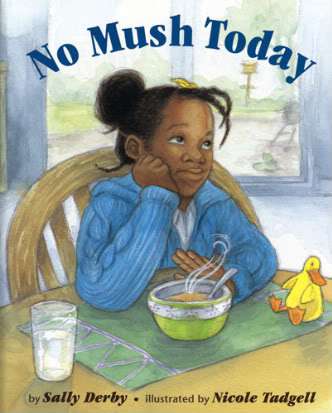
a big bowl of goodness: No Mush Today by Sally Derby and Nicole Tadgell


For breakfast this fine Monday morning, we’ve got mush!

Just released this month by Lee and Low, No Mush Today, by Sally Derby, will provide a satisfying meal for picture book fans needing some familial reassurance.

Nonie is fed up with her bowl of cornmeal mush and her baby brother’s crying. Why not go live with Grandma?

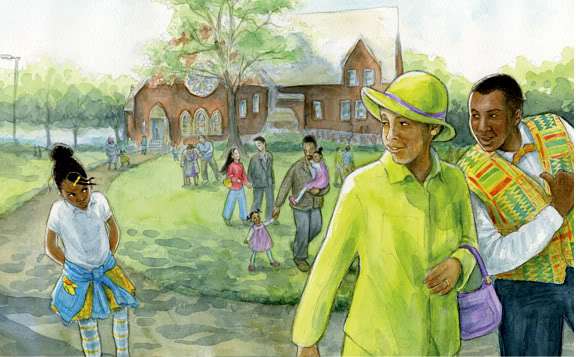
After all, Grandma “attends” when Nonie speaks, and calls her “Sweet Pea.” They head out to grown-up church, where neighbors greet them along the way. Once there, Nonie’s daddy winks at her, trying to make her smile.

But Nonie’s having none of that, and later grumps that no one told her there was going to be a church picnic. Grandma calls her along, saying, “We’ll all go together.”

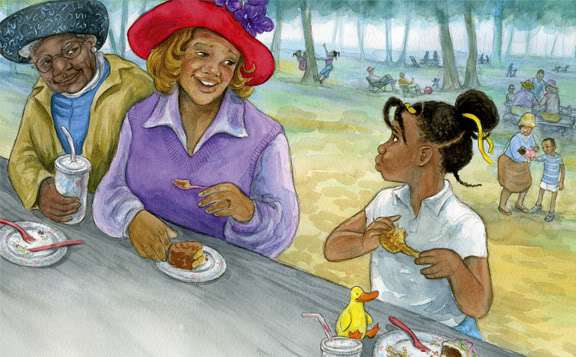
After a delicious lunch of fried chicken, three kinds of cake, and lemonade, Daddy finally convinces Nonie to go on a boat ride. He shows her some wonderful things, including a family of ducks. “Ducklings stick with their families,” he reminds her.

After a lovely afternoon, they head back home, where Momma’s waiting at the gate, and Nonie’s brother is smiling and reaching out for her. By then, Nonie realizes she has missed her family, and maybe being with them isn’t so bad after all. She’ll come back under one condition — no more mush!

Written in spare text that conveys believable, child-centric emotion with a splash of Southern dialect, No Mush Today is beautifully illustrated in soft watercolors by Nicole Tadgell. Tadgell expands the narrative by creating a context of loving communion, a small town backdrop of good folk and simple pleasures. The warmth of family radiates in spreads showing neighbors and church friends greeting each other with big smiles and hugs. And then there’s Nonie’s toy duck, which young eyes will follow with great interest.

When it isn’t clutched tightly in her hand, it’s sitting on the table or peeking out of her pocket, a constant companion for a child missing the attention of her parents. At the end of the story, Nonie hands the duck over to her little brother, a sweet gesture that shows her heart has opened up a little to sharing her parents with a sibling. Just as her daddy said at the park, “Lots to learn from ducks.”

The yellow endpapers, Nonie’s yellow hair ribbons, and of course, the yellow toy duck, visually complement the bowl of cornmeal mush. Take your time with this book in order to fully appreciate its riches. The children you share it with will likely say, “More mush today!”

No Mush Today has received glowing reviews from Kirkus, School Library Journal, Rutgers, and Booklist, which you can read at the Lee and Low website.

Check out these cool photos showing how the artwork was done at Sally Derby’s website.

And drop by Nicole Tadgell’s blog. It’s the friendly thing to do!

*Interior spreads posted by permission, copyright © 2008 Nicole Tadgell, published by Lee and Low Books, Inc. All rights reserved.

hot stuff: linda sue park!

Call out the fire department!

We’re serving up some hot stuff for the last course in our Asian Pacific Heritage Month potluck, courtesy of 2002 Newbery Award winner, Linda Sue Park!

Her newest book, Keeping Score (Clarion, 2008), is a warm, captivating, insightful, and sometimes heart-wrenching historical novel set in the 50’s, featuring 9-year-old Maggie Fortini, baseball lover to the core.
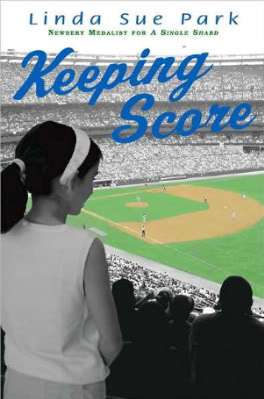
No, you don’t have to like or even know much about baseball to love this book. A few paragraphs in, and you’ll find yourself rooting for Maggie-o, as her dad calls her (after his favorite Yankees’ player, Joe DiMaggio). Like everyone else in the neighborhood (except her father and newfound friend, Jim, a firefighter like her dad), Maggie is a huge Brooklyn Dodgers fan. Her loyalty and perseverance are unwavering, as is her fierce determination to make things right. She is heartbroken when her team loses again and again, despite everything she’s done to “help” them, like praying really hard and keeping score for every game.

Jim’s the one who taught Maggie to keep score, and their special bond adds another dramatic layer to the story, since Jim is drafted, sent to Korea, and then stops writing to Maggie after awhile. This prompts her to learn more about the war, but it doesn’t allay her disappointment or uncertainty — a lot to cope with, especially for a girl who takes everything to heart, and ultimately feels responsible for things beyond her control. What happened to Jim in Korea? Can she help make him better? Will the Dodgers ever win the World Series? Much as she wants that, she’d be willing to let the Giants win if it would help Jim.

Keeping Score is superbly crafted, another example of Linda Sue’s masterful storytelling. I don’t think I’ve ever read a finer portrayal of what it really means to be a true-blue, dyed-in-the-wool fan. Maggie-o is as pure as they come. And I learned some new things about baseball, the Korean War, and hope. 

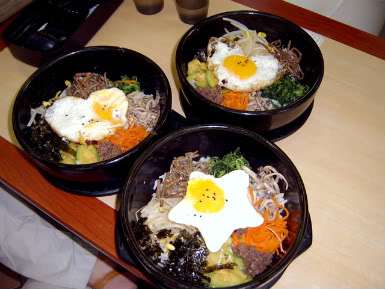
Today, Linda Sue is sharing her recipe for Korean bee-bim bop (rice topped with vegetables and meat). It is included in her picture book, Bee-Bim Bop (Clarion, 2005), which is a delightful read aloud written in verse, about a child helping her mother make the dish.

Linda Sue: “There are as many versions of bee-bim bop as there are families who cook it. This recipe is one that we make at home . . . Mung bean sprouts, sesame seeds, kochee-chang, and kimchee are available at many large supermarkets as well as Asian grocery stores.”

BEE-BIM BOP
(serves 4)


2 cups white rice

Marinade

2 cloves garlic, peeled
2 green onions (scallions)
5 T soy sauce
2 T sugar
2 T vegetable oil
1 tsp sesame seeds, roasted (optional)
1 T sesame oil (optional)
1/8 tsp black pepper

Meat

1 lb. tender, lean beef (such as sirloin tip)

Vegetables

2 carrots
2 pkgs. frozen spinach, defrosted, or 1 lb. fresh spinach, washed
1 lb mung bean sprouts

Other ingredients

4 eggs
salt and pepper
vegetable oil for frying

1. Cook rice with 4 cups water, either in a rice cooker or pot. If using a pot, let the water boil, then lower the heat, cover and let simmer for 20-30 minutes until the rice is tender and all of the water has been absorbed.

2. Mince the garlic and chop the green onions. Mix all the marinade ingredients in a big bowl.

3. Slice the beef across the grain into very, very thin slices. Put the beef into the bowl with the marinade. Stir well with a big spoon. Wash your hands. Then stick your hands into the bowl, grab handfuls of beef, and squish all of it around for 2-3 minutes (to make it tender). Set beef aside.

4. Beat the eggs with a fork until the whites and yolks are completely mixed together.

5. Coat a nonstick frying pan with 1 tsp. of vegetable oil and heat on medium for about a minute. Pour about 1/4 of the egg, and rotate the pan quickly so the egg spreads out in a thin layer on the bottom. After a minute, flip the egg using a wide spatula, and cook another minute. Cook the rest of the egg this way until you have about 4 thin pancakes.

6. When the pancakes are cool enough to handle, stack them on top of each other and roll the stack tightly. Cut the roll into 1/4-inch slices. Toss the slices in a medium size bowl, then set aside.

7. Julienne the carrots and fry them in about 1 T of vegetable oil in a large frying pan or wok over a high flame until tender. Set aside.

8. If you are using frozen spinach, thaw, then squeeze some of the water out of it. If you are using fresh spinach, cook in a pot of boiling water for about 2 minutes, drain, let cool for a few minutes, then squeeze some water out. Stir fry thawed or precooked spinach in 1 T of vegetable oil for 2-3 minutes until tender. Empty the spinach into a bowl, season with salt and pepper, then set aside.

9. Pour 1 cup water into a large saucepan, add 1/4 tsp salt, bring to a boil. Add bean sprouts, cover and cook for 2-3 minutes. Drain the sprouts and empty them into a bowl.

10. Cook the beef with marinade in a large frying pan over high heat, about 2-3 minutes.

To serve:

Put the rice, bowl of egg strips and vegetables, and the pan of meat where everyone can reach them. Each person puts a pile of rice in the middle of a soup bowl or plate and some meat and vegetables on top. Top with egg ribbons. If you like spicy food, add some ko-chee-chang (hot pepper paste). Now mix everything together. Serve with kimchee* on the side if you wish.

(Adapted from the printed recipe found in the book, which contains directions for a child to help an adult.)
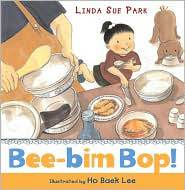
For more about Linda Sue and her books, visit her website and blog.

On Keeping Score:

New interview and review at papertigers.org.

Original essay by Linda Sue at Powells Books.

Book excerpt at Amazon.com.

**for some yummy kimchee, click here!
something sweet from cynthia chin-lee

I see you’re back again, with that hungry look on your face.

After wontons, Chinese chicken salad, bay scallops with lemon sauce, and masoor dalCynthia Chin-Lee has brought something sweet for our Asian Pacific American Heritage Month potluck!

 One of the “Best 100 American Children’s Books of the Century” (Ruminator Review)

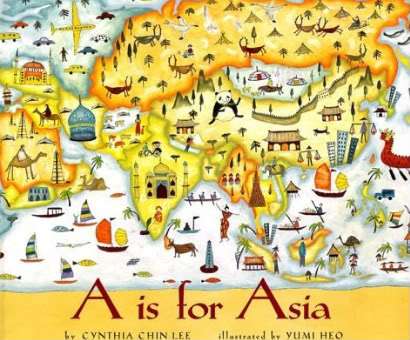
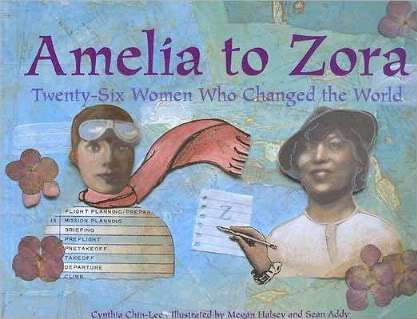
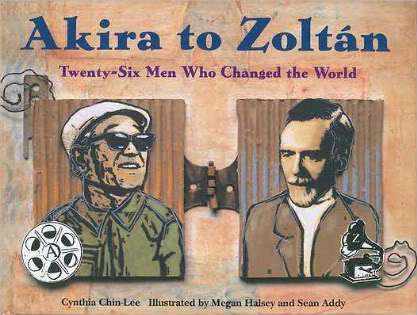
You may have noticed that I love soup — and cookies — and the alphabet. Cynthia Chin-Lee may just be the author of my dreams. Four out of her fivepicture books feature the alphabet. These are not baby portions, but ones that offer more substantial servings for sophisticated readers 9 and up, such as A is for Asia (Orchard,1997), A is for the Americas (Orchard, 1999), Amelia to Zora: Twenty-Six Women Who Changed the World (Charlesbridge, 2005), and Akira to Zoltan: Twenty-Six Men Who Changed the World (Charlesbridge, 2006).

In Amelia to Zora and Akira to Zoltan, we meet 26 courageous visionaries in each book, some well known and others not so well known, from many different professions, such as scientists, political leaders, writers, architects, doctors and performing artists, who have made a difference in the 20th century. I like the diversity of cultures and ethnicities represented, and the fact that the profiles are alphabetized according to the first names of the honorees, giving them a familiarity that will appeal to children.

Each page features an enticing profile that will whet the appetite for further study, an inspiring quote, and a brilliant mixed media collage (whimsical, literally cutting edge, and very very cool), created from elements appropriate to each subject by Megan Halsey and Sean Addy. Especially appealing are the childhood anecdotes included in each juicy capsule. Akira to Zoltan focuses on peacemakers such as Gandhi, Langston Hughes, Octavio Paz, and Nelson Mandela. Some of the strong, imaginative, and innovative women include Kristi Yamaguchi, Yoshika Uchida, Grace Hopper, and Dolores Huerta.

This is one alphabet that is sure to inspire and delight. And thanks to Cynthia, we have something delish to munch on while enjoying her books. In 1993, Polychrome Publishing brought out Cynthia’s first picture book, Almond Cookies and Dragon Well Tea, illustrated by You Shan Tang. In this story, Erica visits Nancy, her Chinese American friend, for the first time. Erica is a little shy and apprehensive about what Nancy’s home will be like, but as soon as Nancy’s grandmother serves homemade almond cookies and special tea, Erica warms right up! 

Maybe you’d like to serve these cookies to your guests, if there are any left after you’ve tasted them! Mmmmm almond extract!

GRANDMA WONG’S ALMOND COOKIES
(makes about 48 cookies)

2-3/4 cups flour
1 cup white sugar
1/2 tsp baking soda
1/2 tsp salt
1 tsp almond extract
1 cup shortening (lard, margarine, butter, or Crisco)
1 egg
whole almonds, sliced
red and yellow food coloring

1. Preheat oven to 325 degrees F.

2. Sift flour, sugar, baking soda and salt together. Add shortening, egg, almond extract and food coloring into mixture. Color should be orange-yellow. Mix into a smooth dough.

3. Roll dough into 1-inch balls. Set about 2 inches apart on greased cookie sheet. Flatten ball with palm of hand and place an almond slice in center of each cookie.

4. Bake for 15-18 minutes.

Visit Cynthia’s website, or read a fab interview at papertigers.org!

two scoops rice: hiromi suzuki and sammy lee

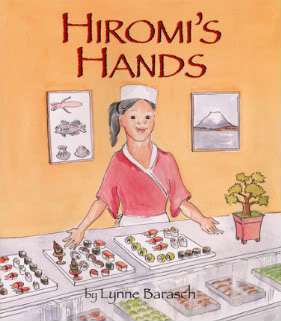
For this last Nonfiction Monday of Asian Pacific Heritage Month, here are two exceptional picture book biographies. First up is Hiromi’s Hands by Lynne Barasch (Lee and Low, 2007).


This is my favorite PB biography from last year. Sure, I might be a tad partial to a book about food. But the story of how Hiromi Suzuki became one of the first female sushi chefs in New York City touches on so many inspiring themes — the value of hard work and determination, respect for tradition, family love, and the importance of progressive thinking in realizing goals.

Told from Hiromi’s point of view, we see how her father, Akira, trained to be a sushi chef in Japan, working long hours for three years before he was even allowed to slice the fish. He is hired by a restaurant in NYC, and shortly thereafter opens his own restaurant, Akasaka. This is rewarding but demanding work, and Hiromi misses her father. When she is eight, she begs him to take her to the fish market where he purchases for the restaurant.

Recognizing her desire to become a sushi chef, Akira allows Hiromi to help in his restaurant when she is 13, even though the profession has always been dominated by males. Like her father, Hiromi works long and hard for 3 years before she is given her own yanagi (sushi knife), to truly begin her apprenticeship. The first person point of view will engage and endear readers, young and old alike.

Lynne Barasch’s ink and pastel watercolours are light, airy, and just detailed enough for depicting the bustling fish markets in Japan and NYC, trays of colorful sushi, and the warmth of father and daughter. There is an excellent glossary and pronunciation guide listing all kinds of sushi, as well as an author’s note about Hiromi, who was a childhood friend of the author’s daughter. Did I already mention the mouthwatering pictures of sushi?

Continue reading