“There is no sincerer love than the love of food.” ~ George Bernard Shaw
“Breakfast with Humpty Dumpty” by Michael Cheval.
COME EAT WITH ME AND BE MY LOVE by Cathy Bryant
Come eat with me and be my love and we will buy some plus size pants and gorge on sweet syruped kisses down supermarket food aisles dance until thrown off the premises, my fine eclair, my lemon puff.
Come eat with me and lose your scales and gain lasagne, served with wine, and ripe persimmons, plums and pears my fragrant fruit, oh lover mine, and we will laugh at diet cares and low-fat bread that swiftly stales.
Come eat with me and roll on cake and find crumbs in each other's hair and nibble on as far as we can until, replete, we lie quite bare on our smooth bed of marzipan, my love who dares to shake and bake.
Come eat with me and feel our flesh as soft as custard, warm as toast as comforting as treacle tart as healthy as a hot nut roast, my love, who nestles in my heart - no sell-by date. Forever fresh.
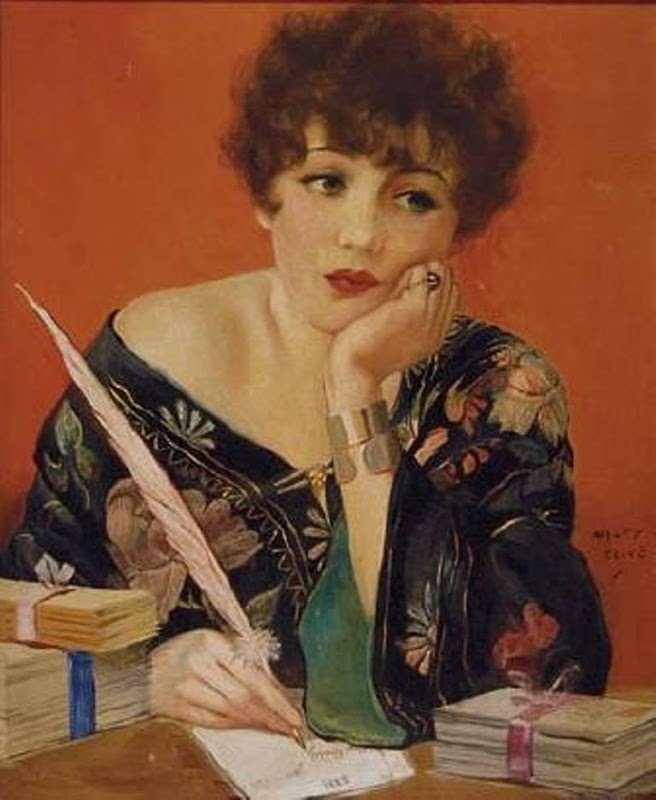
“Woman Writing Letter at Desk” by Henry Clive (ca. 1940s).
EXCHANGE OF LETTERS by Wendy Cope
'Man who is a serious novel would like to hear from a woman who is a poem' (classified advertisement, New York Review of Books).
Dear Serious Novel,
I am a terse assured lyric with impeccable rhythmic flow, some apt and original metaphors, and a music that is all my own. Some people say I am beautiful.
My vital statistics are eighteen lines, divided into three-line stanzas, with an average of four words per line.
My first husband was a cheap romance; the second was Wisden’s Cricketers’ Almanac. Most of the men I meet nowadays are autobiographies, but a substantial minority are books about photography or trains.
I have always hoped for a relationship with an upmarket work of fiction. Please write and tell me more about yourself.
Yours intensely, Song of the First Snowdrop
Dear Song of the First Snowdrop,
Many thanks for your letter. You sound like just the kind of poem I am hoping to find. I’ve always preferred short, lyrical women to the kind who go on for page after page.
I am an important 150,000 word comment on the dreams and dilemmas of twentieth-century Man. It took six years to attain my present weight and stature but all the twenty-seven publishers I have so far approached have failed to understand me. I have my share of sex and violence and a very good joke in chapter nine, but to no avail. I am sustained by the belief that I am ahead of my time.
Let’s meet as soon as possible. I am longing for you to read me from cover to cover and get to know my every word.
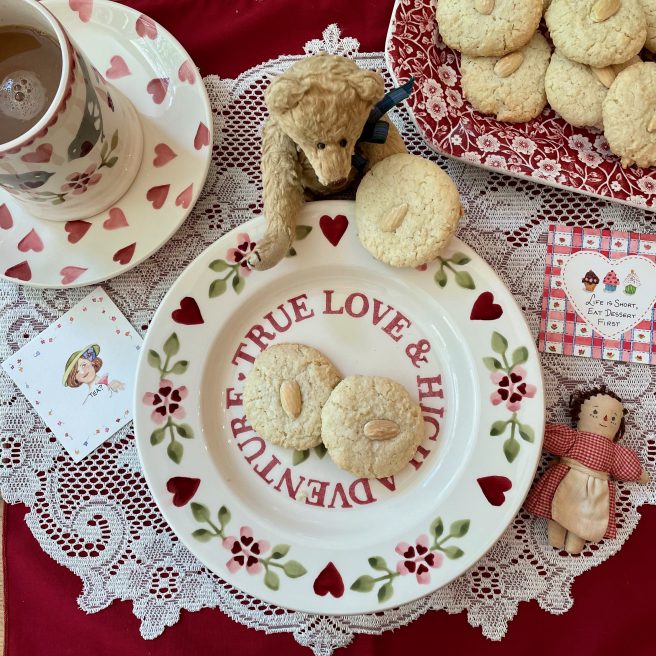
American Fireside Poet James Russell Lowell elevates a humble cookie to romantic delectability in his amusing recipe poem. I wish Eleanor would make some of her macaroons for my birthday. 🙂
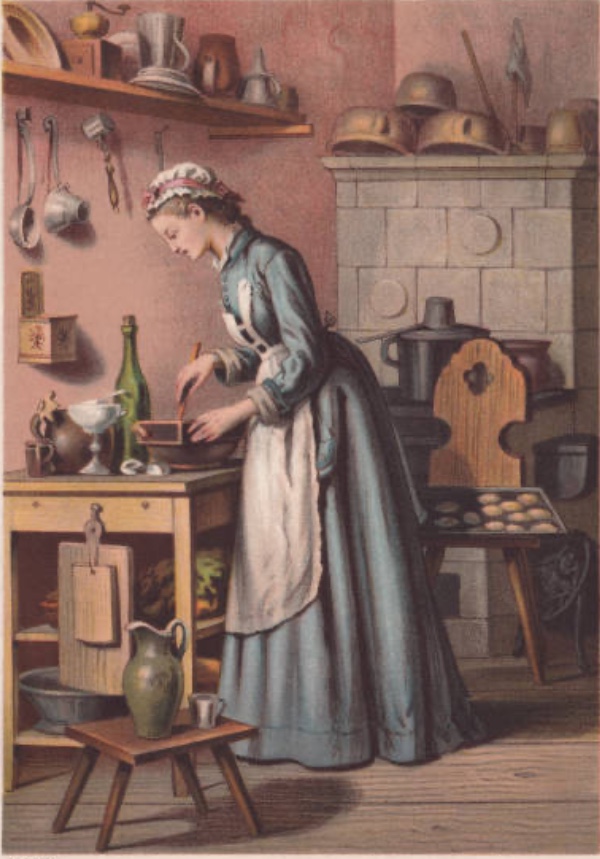
Chromolithograph after a drawing by Hugo Bürkner (1878).
ELEANOR MAKES MACAROONS
by James Russell Lowell

Light of triumph in her eyes,
Eleanor her apron ties;
As she pushes back her sleeves,
High resolve her bosom heaves.
Hasten, cook! impel the fire
To the pace of her desire;
As you hope to save your soul,
Bring a virgin casserole,
Brightest bring of silver spoons,—
Eleanor makes macaroons!

Almond-blossoms, now adance
In the smile of Southern France,
Leave your sport with sun and breeze,
Think of duty, not of ease;
Fashion, ’neath their jerkins brown,
Kernels white as thistle-down,
Tiny cheeses made with cream
From the Galaxy’s mid-stream,
Blanched in light of honeymoons,—
Eleanor makes macaroons!

Now for sugar,—nay, our plan
Tolerates no work of man.
Hurry, then, ye golden bees;
Fetch your clearest honey, please,
Garnered on a Yorkshire moor,
While the last larks sing and soar,
From the heather-blossoms sweet
Where sea-breeze and sunshine meet,
And the Augusts mask as Junes,—
Eleanor makes macaroons!

Next the pestle and mortar find,
Pure rock-crystal,—these to grind
Into paste more smooth than silk,
Whiter than the milkweed’s milk:
Spread it on a rose-leaf, thus,
Cate to please Theocritus;
Then the fire with spices swell,
While, for her completer spell,
Mystic canticles she croons,—
Eleanor makes macaroons!

Perfect! and all this to waste
On a graybeard’s palsied taste!
Poets so their verses write,
Heap them full of life and light,
And then fling them to the rude
Mumbling of the multitude.
Not so dire her fate as theirs,
Since her friend this gift declares
Choicest of his birthday boons,—
Eleanor’s dear macaroons!

(February 22, 1884)

~ from Heartsease and Rue (Houghton Mifflin, 1888)
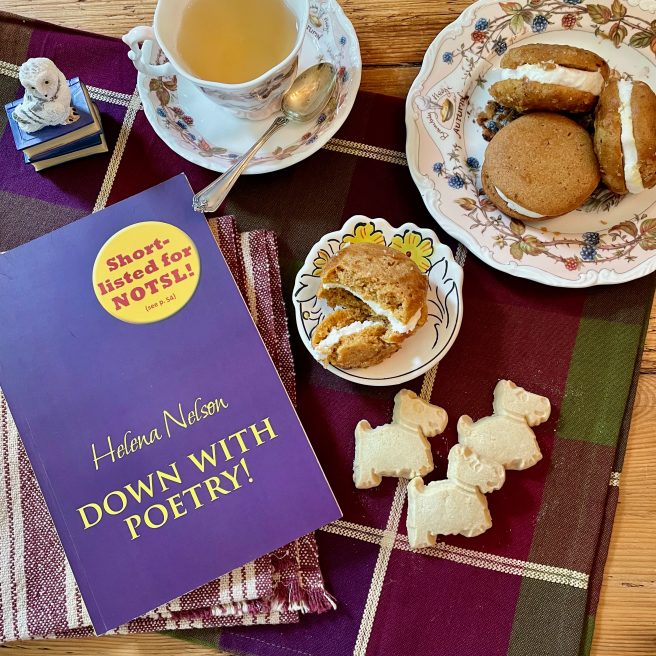
Please help yourself to tea, pumpkin whoopee pies and a shortbread scottie.
Welcome to Poetry Friday at Alphabet Soup!
Some of you may remember when I shared, “What Not to Write on the Back Jacket of Your Debut Collection,” from Scottish poet Helena Nelson’s delightful book, Down with Poetry! (HappenStance, 2016). Well, here are two more ‘unsuitable,’ rabble-rousing, anti-poetry rib ticklers designed to keep any literary snobs in check. Yes, poetry is SERIOUS BUSINESS. But that also makes it the perfect subject for serious satire, and Nelson is so good at it.
Have you ever been asked to write a blurb for a new poetry book or read one that turned you off? Here’s some light-hearted advice from Scottish poet Helena Nelson.
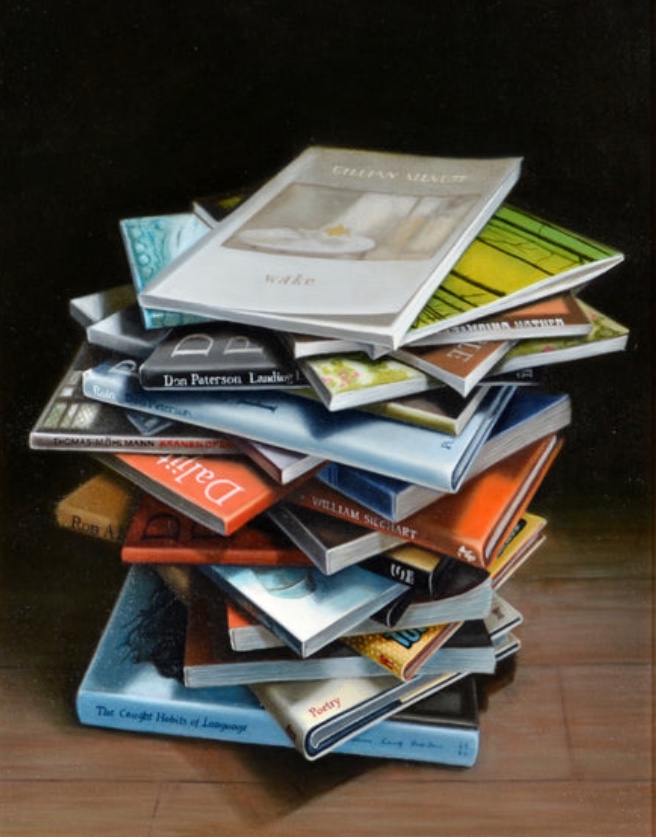
“Pile of Poetry” by Nichola Martin.
WHAT NOT TO WRITE ON THE BACK  JACKET OF YOUR DEBUT COLLECTION
by Helena Nelson

This book is not bad.
A number of these poems feature the poet’s dog: George.
The author’s mother recommends this book.
Boris Johnson recommends this book.
Most of the poems are quite short.
Poetry is not for everybody.
These poems are accessible if reasonable adjustments are made.
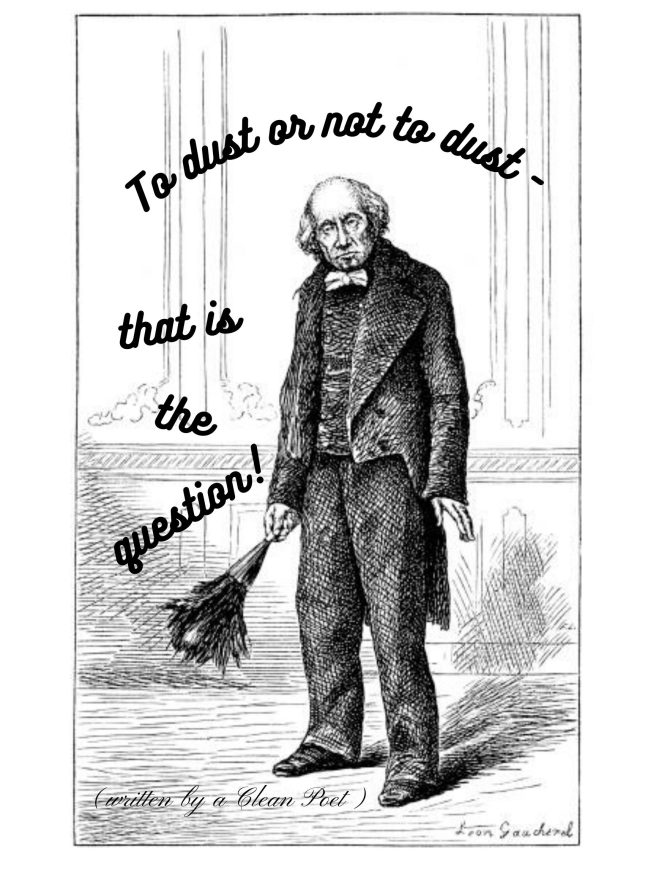
Many of these poems were written while dusting.
The poet applied three times for funding to assist in the completion
of this book.
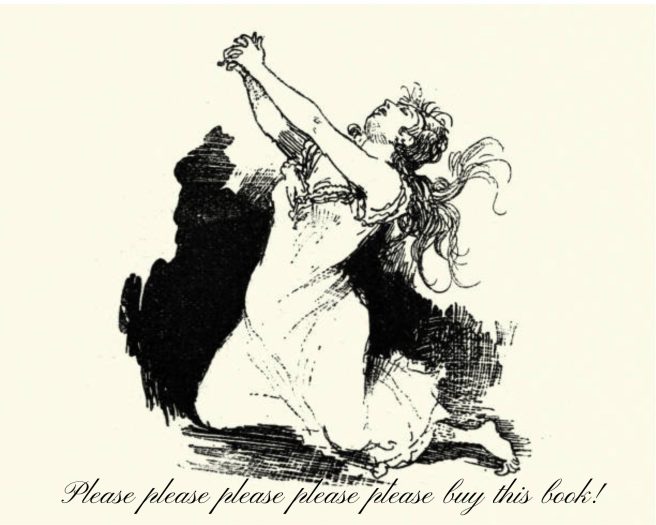
Please buy this book.
The poems in this book have universal resonance some of the time.
Includes five villanelles and three sestinas.
There is a glossary of difficult words for readers new to poetry.
The poet skillfully employs seven types of metonymy.
The main theme is death.

~ from Down with Poetry! (Glenrothes: HappenStance, 2016)
*
Blurbing new poetry books is a tricky business. Your task is to help sell the book, but how do you do justice to it without sounding too cliché or over the top?
I always read the blurbs on the back covers of new single poet collections and sometimes find them pretentious, intimidating, even unbelievable. I sometimes run away screaming. And I’m someone who actually likes poetry.
In Issue 25 of The Dark Horse (2011), there was an article called ‘The Blurbonic Plague’ by the late, lamented Dennis O’Driscoll. It was about the awfulness of much of the text on back jackets of new poetry books. This struck a chord close to my heart, and also gave me the courage to form a deliberate policy for HappenStance Press, which ever since has been officially ‘anti-blurb’. When I issue books and pamphlets, the text on the back cover never includes words like ‘new and exciting’, and I don’t commission blurbs or, worse still, get poets to write their own. But then what do you write? The truth? Frequently that won’t do either. It’s easier to say what not to write, and have some fun with that. So I made a list, some of which turned into this poem.
I thoroughly enjoyed her list and her wry humor (some of the suggestions could also apply to things one should not include in a manuscript submission cover letter).
Truly, what could be more enticing (esp. to a potential non-poet reader) than a platter full of shop talk? We all eat metonymy, synecdoche, asyndeton and caesura for breakfast, right? 🙂
And they say poetry is a hard sell . . .
Actually, I think Nelson is definitely onto something with her “anti-blurb” stance. If a blurb can make you laugh, wouldn’t you be more apt to buy the book? Hold the mega hype, please.
Here is Nelson reciting the poem:
How do you feel about book blurbs? How seriously do you take them?
*
Helena Nelson (Nell Nelson) is the originator and editor of HappenStance Press as well as a poet in her own right. Her first Rialto collection Starlight on Water was a Jerwood/Aldeburgh First Collection winner. Her second was Plot and Counterplot from Shoestring Press. She also writes and publishes light verse – Down With Poetry! (HappenStance, 2016) and Branded (Red Squirrel Press, 2019).In 2016, she published a HappenStance best seller: How (Not) to Get Your Poetry Published, a book that collects the insights and useful ideas she has gathered over the last twelve years in poetry publishing.
She reviews widely, writes a publisher’s blog regularly, and also curates the pamphlet review site Sphinx Review.
*
The lovely and talented Tanita S. Davis is hosting the Roundup at {fiction, instead of lies}. Waltz on over to check out the full menu of poetic goodness being shared around the blogosphere this week. Happy March!






 Jama's Alphabet Soup