#7 in the Poetry Potluck Series, celebrating National Poetry Month 2012.
Hey, Poetry Friends – You’ve got mail!
I’m pretty sure there’s nothing children’s writer Martha Calderaro would rather do for Poetry Month than visit your neighborhood to drop a freshly penned poem in each and every mailbox. Imagine finding a love sonnet, a bawdy limerick, an inspirational verse, a clever bit of wordplay or calming lyric nestled among the bills and bank statements!
Since this isn’t physically possible, lovely Martha is doing the next best thing: she’s written a poem especially for the Potluck, a humorous flight of fancy that doubles as a tribute to a vanishing breed of messengers.
Daisy, Martha’s Muse: “Pat me. You know you want to.”
She’s also brought along her adorable six-month-old Newfoundland pup, Daisy, who was there when inspiration struck for today’s poem. It sounds like in Martha’s neighborhood, dogs wax poetic rather than chase after the mailman. We’re doubly glad Martha’s here today, cause her special delivery also includes a yummy recipe straight from the Muffin Man. ☺
#6 in the Poetry Potluck Series, celebrating National Poetry Month 2012.
via New Jersey Jewish News
Today I’m very pleased to welcome New Jersey poet Gail Fishman Gerwin to the Potluck, the first of four guest poets who write primarily for adults rather than children. Whether you celebrate Passover or Easter, it’s likely you’ll be spending time this weekend observing holy rituals and sharing special meals with family and friends.
Gail is sharing a poem from her poetic memoir, Sugar and Sand (Full Court Press, 2009), a 2010 Paterson Poetry Prize finalist. “With or Without Rice, a Kitchen Ballet” is one of three poems comprising a segment about Gail’s mother, “Mastering the Art of Cele’s Cooking.”
Most of you know there’s nothing I love more than a recipe/cooking poem, and this slice-of-life beauty provides ample nourishment for body and soul, a delicious blend of family history and cultural heritage. We thank Gail for so generously sharing precious photos of her parents, sister, daughters and grandchildren, four generations in her family who’ve enjoyed stuffed cabbage at Passover. Gail has already made two batches for tonight’s Seder, which will include gefilte fish, matzoh ball soup, brisket, spinach gnocchi, matzoh kugle, sponge cake, and veggies, among other special foods. Yum!
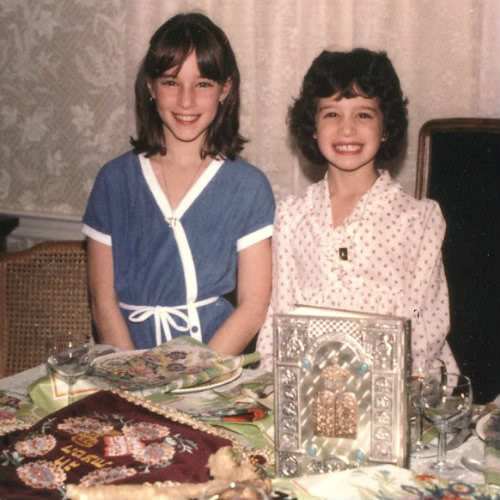
Gail’s daughters, Karen (10) and Kate (7), at the Seder table.
Now, let’s listen to the voices from Cele’s kitchen.
“Remember well, and bear in mind, a constant friend is hard to find.” ~ Laura Ingalls Wilder
I like to think of Laura as a good friend. I first “met” her as a shy child who devoured her books, and she’s remained a constant presence in my life as a reader, writer and human being.
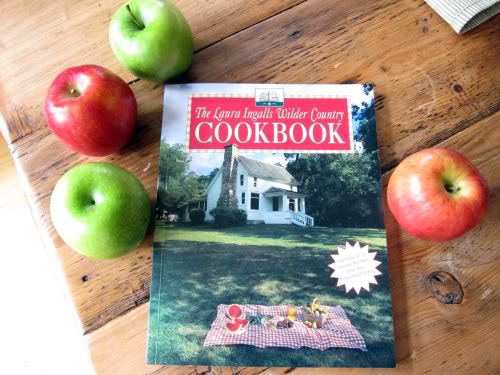
I’ve enjoyed deepening my connection to Laura by learning more about the foods mentioned in the Little House books (via Barbara M. Walker’s Little House Cookbook), and making some of the recipes contained in The Laura Ingalls Wilder Country Cookbook (Trophy Press, 1997). Some of you may know that this cookbook contains over 70 recipes compiled by Laura during the 30’s and 40’s when she lived with Almanzo at Rocky Ridge Farm in Mansfield, Missouri.
Last year, I made her Chicken and Dumplings and Apple-Upside Down Cake, and two years before that, her famous Gingerbread. To celebrate Laura’s birthday this year, I decided to try her Apple Slump, another of the six apple recipes included in the Country Cookbook.
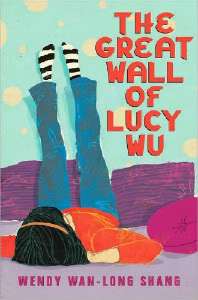
Last year, when I first read The Great Wall of Lucy Wu, the wonderful middle grade novel by Wendy Wan-Long Shang that recently won the 2012 APALA Asian/Pacific American Children’s Literature Award, I noticed something interesting in the Acknowledgements:
No acknowledgement would be complete without recognizing my sources of support: my mom, who told me I could do anything; my dad, who made me believe writing was in my blood; my husband, who wrote ‘writer’ on our tax forms and has never (never!) once wavered in his support; our three beautiful, funny children; my amazing extended family; Fairfax County Public Library; A&J Restaurant, which makes absolutely inspirational bowls of soup. Get the Shanghai-style wonton soup.
Is there anything more exciting than a writer who cites soup as a source of inspiration? If you’ve read the book, you know it opens with a restaurant scene and contains many food references, including a reverential beef noodle soup as well as homemade dumplings. Yum!
#7 in an eclectic collection of notable noshes to whet your appetite and brighten your day.
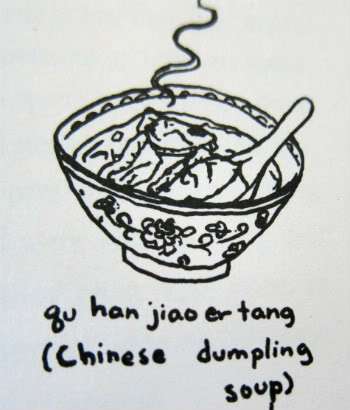
Line drawings from the book.
So, as I was reading and drooling throughDumpling Days, I came to the part when Pacy’s cousin Clifford explains how you can tell wontons from dumplings — dumplings are shaped like ears.
He tells the story of a very famous Chinese doctor who supposedly invented dumpling soup. Ah! I had never heard this story before and found it not only fascinating, but quite uncanny, as a character in my picture book, Dumpling Soup, thinks dumplings look like elephant ears. Little did I realize the very first “ears” had great medicinal benefits. Totally cool!
STORY OF DUMPLING SOUP
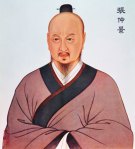
Once there was a famous doctor, Zhang Zhongjing, who lived by the river in a cold part of China. He treated and cured many things, but in the winter, the things he treated most were people’s ears! That sounds strange, I know, but where he lived in China, the winters were particularly cold. The icy wind whipped and burned any exposed skin.
It was so cold that when a villager joked that his breath froze into pieces of ice in the air, all believed him because even if the cold did not freeze one’s breath, it really did freeze people’s ears. The doctor was kept busy during the winters treating frostbitten ears. He knew that people with frostbite needed warmth to heal, so he began to make a remedy that would warm peoples’ insides as well as their outsides. He cooked meat with warming herbs and finely chopped it. Then he wrapped it in thinly rolled dough and boiled the pieces in soup with more herbs. When the mixture was finished, he called it “soup that takes away the cold,” or “qu han jiao er tang.” He then served it to his frostbitten patients, who not only healed quickly, but enjoyed the soup so much that they continued to eat it.
People made the soup at home, usually eating it in the winter. They say the dumpling is the shape it is because it is made to resemble an ear, in honor of Doctor Zhongjing’s treatment of people’s frostbitten ears. The name of the soup, qu han jiao er tang, was shortened to jiao er tang, and the dumplings were eventually called jiaozi.
~ from “Story of Dumpling Soup,” Dumpling Days by Grace Lin (Little, Brown, 2012), page 119.
Zhang Zhongjing (150-219 AD) was an eminent physician in the Han Dynasty and is extremely well known in modern Chinese medicine.
Take two ears and call me in the morning.
He wrote China’s first book (actually 16 volumes worth), combining medical theory with his own experiences as a practitioner, analyzing causes, symptoms and methods of treatment. He recorded some 300 classic prescriptions, many of which are still used today. For his first dumplings he boiled mutton with warming herbs like chili (cayenne), which improved circulation and promoted healing. His “Warming Ear Soup” is traditionally eaten on the nights of Winter Solstice and Lunar New Year’s Eve.



 Last year, when I first read The Great Wall of Lucy Wu, the wonderful middle grade novel by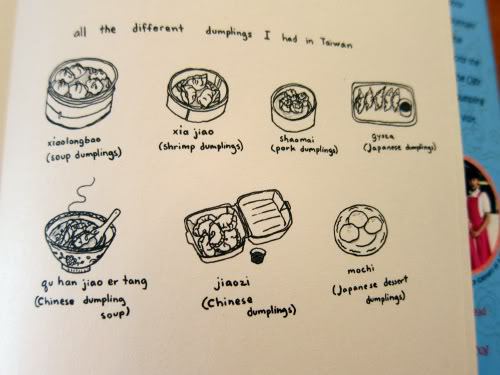

 Jama's Alphabet Soup