friday feast: one potato two potato three potato five

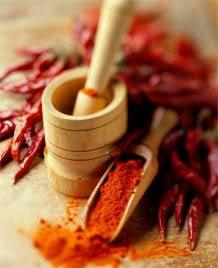
Paprika via Food Additives World

They say one man’s potato is another man’s soup.

And I say there is nothing more endearing than a college student learning how to make his first soup from his mother and his aunt. Via laptop, of course.

I was tickled pink to find Daniel Nyikos’s poem happily simmering over at Ted Kooser’s American Life in Poetry. Love the juxtaposition of old world and new, the easy family banter, and proof once again that love is the best seasoning for any soup.
 

POTATO SOUP
by Daniel Nyikos

I set up my computer and webcam in the kitchen
so I can ask my mother’s and aunt’s advice
as I cook soup for the first time alone.
My mother is in Utah. My aunt is in Hungary.
I show the onions to my mother with the webcam.
“Cut them smaller,” she advises.
“You only need a taste.”
I chop potatoes as the onions fry in my pan.
When I say I have no paprika to add to the broth,
they argue whether it can be called potato soup.
My mother says it will be white potato soup,
my aunt says potato soup must be red.
When I add sliced peppers, I ask many times
if I should put the water in now,
but they both say to wait until I add the potatoes.
I add Polish sausage because I can’t find Hungarian,
and I cook it so long the potatoes fall apart.
“You’ve made stew,” my mother says
when I hold up the whole pot to the camera.
They laugh and say I must get married soon.
I turn off the computer and eat alone.
Copyright © 2010 Daniel Nyikos. All rights reserved.
——————————————————————————

Daniel’s poem prompted a recipe search for Hungarian Potato Soup. There were many variations, of course, some were clear and some were creamy. Some were simple concoctions of potatoes, water, milk, onions, salt and paprika — while others called for sour cream, celery, tomatoes, even garlic.

I also learned a bit more about Hungarian paprika and its varying degrees of hotness. Didn’t want to set my mouth on fire, so with apologies to Daniel’s aunt, I adapted a simple crock pot recipe and used both hot and sweet paprika. Like Daniel, I couldn’t find any Hungarian sausage, so substituted Polish Kielbasa. And like Daniel’s, my soup eventually turned into a “stew.” But it made a nice winter’s meal, along with crusty bread and fresh creamery butter. Next time, I’ll experiment with smoky paprika. I feel like part of the family now ☺.

*
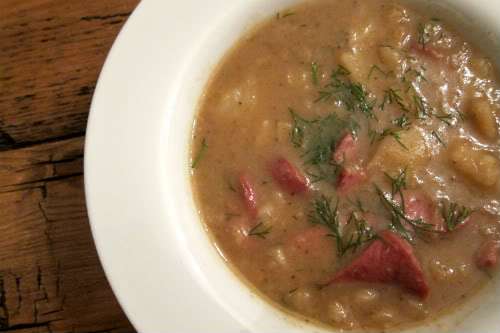
 

HUNGARIAN POTATO AND SAUSAGE SOUP

5-6 russet potatoes, peeled and cut into 2″ cubes
4 cups low-sodium chicken broth
1 tablespoon sweet paprika
1 teaspoon hot paprika
1 teaspoon celery seeds
1/2 teaspoon salt
1 tablespoon olive oil
1 white onion, finely chopped
2 tablespoons finely chopped dill
1/8 teaspoon ground nutmeg
1 cup fat-free or low-fat milk
1 ring turkey kielbasa 

Place potatoes, broth, paprikas, celery seeds and salt in 4-quart or large slow cooker. Stir to combine.

Heat oil in medium skillet over medium-high heat. Add onion and sauté until translucent, about 5 minutes. Transfer to cooker.

Cover. Cook on low 4 to 6 hours, or until potatoes are tender. Stir to break up potatoes into broth for a slightly chunky consistency.

Add dill, nutmeg, and freshly ground black pepper to taste. Stir in milk. Add sliced sausage and cover. Cook 20 to 30 more minutes, or until heated through.

————————————————————————-

Poet and fiction writer Daniel Nyikos was born in Germany to a Hungarian mother and an American father of Hungarian descent. He earned his B.A. and M.A. at Utah State University and is currently working towards his doctorate in Creative Writing at the University of Nebraska. I wonder if he has finally perfected his Potato Soup?

What was the first soup you ever made? Who taught you the recipe?

♥ Talented poet, proud grandmother and excellent cook Elaine Magliaro is hosting today’s Poetry Friday Roundup at Wild Rose Reader. Get thee hence and check out the full menu of poetic goodness being served up in the blogosphere this week.

♥ Learn more about Hungarian Paprika here.

—————————————————————————–

Copyright © 2012 Jama Rattigan of Jama’s Alphabet Soup. All rights reserved.
friday feast: of poetry and paprikash

“Poetry should . . . strike the reader as a wording of his own highest thoughts, and appear almost a remembrance.” ~ John Keats

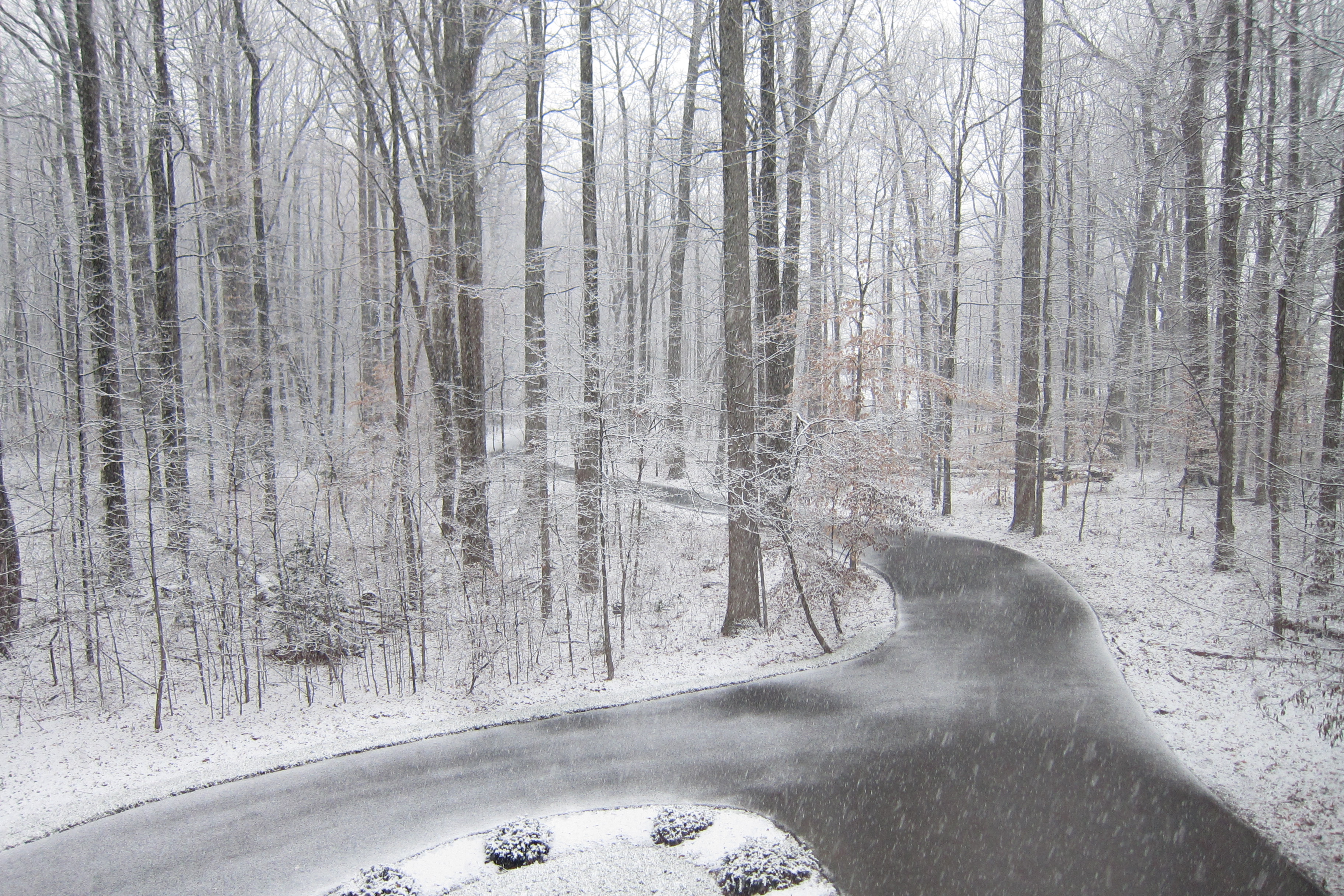
We had our first snowfall of the year this week. When feather-light flakes frost bare branches, it’s time for winter daydreams.

My mindscape of choice is London, so it’s the perfect time to share this poem by New Jersey poet Nancy Scott. I love this wonderful example of cooking as meditation. As we gather and combine ingredients, we season with pleasant memories, nourishing body and soul.

Nancy: My husband was a professor and he took sabbaticals on a regular basis. We often lived in London because it was London. Because there was no language barrier, it was easier for the kids to attend the local schools. This poem is set in 1973, when the two younger boys were 5 and 7. No supermarkets nearby and with a very small refrigerator, we went shopping for food almost every day. I know we had a car, but I wanted the kids to burn off energy by walking and helping to carry the bags rather than tearing apart the flat.

“Hampstead, North London” by Sam Burton (oil on canvas)

HAMPSTEAD AGAIN
by Nancy Scott

for Billy and Jimmy

On a snowy day, when the neighborhood
has gone quiet, except for the plows,
I’m peeling onions, stripping layers of fat
from a pot roast, sizzling oil in the pan.

And it’s Hampstead again. Grey leaden
skies, damp warning its way through
our clothes. Along the streets where Keats
took a turn, past the chemist, the ironmonger,
I’m choosing grapes, lettuce, fresh beets,
and tomatoes at the greengrocer’s.
You two are juggling oranges and apples.
At the butcher’s you kick up sawdust,
giggle at pigs’ feet, fake gag at the tongue
and the tripe until a stern Brit scolds you both.
Short hop to the bakery where a plump-faced
clerk greets us: Right wet one we’re havin’.
I pay for warm yeasty loaves; you wolf down
jam tarts as if you haven’t eaten in days.
Then the ten-block walk home loaded
with parcels. I sidestep puddles; you splash
about like irreverent ducks.

While the roast simmers, I curl up
with a book, any one will do, and listen for
echoes of lively dinners,
when we gathered at the table, forks ready.

~ from One Stands Guard, One Sleeps (Plain View Press, 2009). Copyright © Nancy Scott. All rights reserved.


Hampstead grocer by Alex Eisenberg

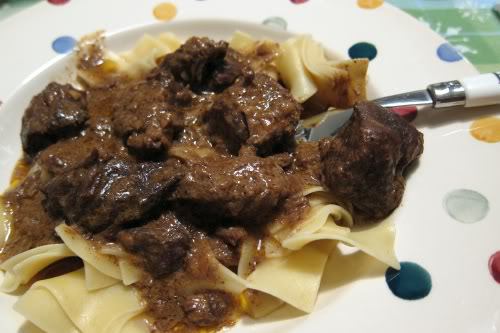
Naturally I was curious about Nancy’s roast and asked for a recipe. Apparently she was actually making Beef Paprikash, too complicated a recipe for her poem, so she included a pot roast instead.

Nancy: This is a recipe I’ve used for this dish, but I’ve never been able to replicate the version that I ate as a child. The Czech woman who cooked for us never wrote anything down, and her English was halting. I can remember my mother following Elaine around the kitchen with a pad and pencil trying to capture some of this, a pinch of that, whatever I have on hand, until it tastes right. Mother finally gave up, and we just enjoyed Elaine’s potato pancakes, goulash, sweet and sour cabbage, homemade strudel, kolacky, and other specialties for many years.

Hearty, comforting, and satisfying.

BEEF PAPRIKASH
(serves 6)

1/2 cup unsalted butter
3 lbs. beef chuck, cut into 2-inch cubes
salt and pepper to taste
5 tablespoons sweet Hungarian paprika
2 large onions, chopped
3 cloves garlic, minced
2 tablespoons tomato paste
2 cups beef stock
1 cup sour cream, at room temperature

Melt 1/4 cup butter in a heavy frying pan. Sprinkle beef with salt and pepper and 1 tablespoon paprika, brown the meat for about 15 minutes and set aside.

In a heavy pot, warm 1/4 cup butter, add onions and sauté until translucent, add garlic and remaining paprika and heat for a few more minutes. Add tomato paste, stock and beef. Bring to a boil, then simmer until beef is tender, about 2 hours.

Remove from heat and stir in sour cream. Serve with butter noodles or boiled potatoes.

*

The perfect afternoon: Nancy’s paprikash simmering on the stove, snow falling outside.

It brought to mind studying Keats in college, visiting Keats House as a newlywed, my student who saw Paul McCartney on Hampstead Heath, the famous lines from “When Harry Met Sally”: “there’s too much pepper in my pa-pri-kash.” Oh, the ever widening ripples of memory!

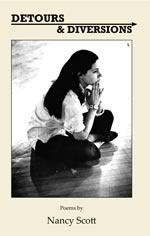
Award-winning poet Nancy Scott, a three time nominee for the Pushcart Prize, has published four poetry collections, the most recent of which is Detours & Diversions (Main Street Rag Publishing Co., 2011). She is the current Managing Editor of U.S. 1 Worksheets, the journal of the U.S. 1 Poets’ Cooperative in New Jersey. Her poems have also appeared in such journals as Slant, Poet Lore, Lullwater Review, and Slipstream. She once spotted Sean Connery browsing the stalls in Portobello Road. (I hope she writes a poem about that someday!) Visit her website for more info about her poetry and work as a collage artist.

Thanks so much, Nancy. Your poem and paprikash were absolutely delish!

♥ Tara at A Teaching Life is hosting today’s Poetry Friday Roundup. Stop by for the full menu of poetical dishes being served up in the blogosphere this week.

♥ Samuel Burton’s original oil painting, “Hampstead, North London,” is available for purchase here. Be sure to check out his other lovely cityscapes and landscapes!

—————————————————————–

Copyright © 2012 Jama Rattigan of Jama’s Alphabet Soup. All rights reserved.

friday feast: putting the kettle on

“Come, let us have some tea and continue to talk about happy things.” ~ Chaim Potok

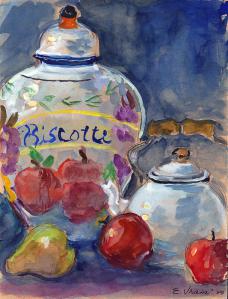
Over a fine cup of Darjeeling the other day, I thought about how often I heard the phrase, “I’ll put the kettle on,” when I lived in England. A surprise visit, a day’s disappointment,

“Still Life with Apples and Tea Kettle by Ethel Vrana

trouble brewing, an invitation to chat — tea always made everything better. One had to wait patiently for the water to boil, and if you were lucky, part of your reward was that friendly whistle with a sudden burst of steam.

I miss this bit of antiquity, since these days many prefer to use their microwaves or electric kettles for almost instant hot water. Gone are those few extra minutes of anticipation, of slowing down, that cosmic link to hearths of yore. And those old kettles, especially the copper ones, had so much personality!

Continue reading

friday feast: peeling it back with j. patrick lewis (the top banana)

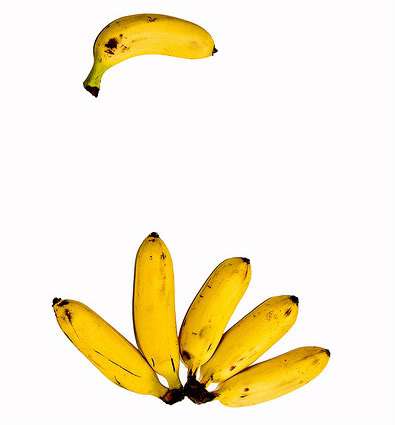
Top Banana by shutterbugdeb

I must confess to feeling quite yellow today.

Not yellow as in dingy or cowardly.

Yellow as in sunshiny bright and slap happy. It’s all because I’ve just read a poem that feels like it was written just for me. ☺

Oh, at last! Somebody understands! Somebody KNOWS. And it’s our  Children’s Poet Laureate, no less. Phew! I thought I was the only one. Yes, we have some bananas today.


BANANA STRINGS
by J. Patrick Lewis

Why not divide the world in two:
Those who don’t from those who do
Detest banana strings? Do you?

I wish bananas just came plain
Without that long mushy membrane,
That nauseating food chain chain.

Take a banana, then start to peel.
Now tell the truth, how does it feel?
And don’t ask me, What’s the big deal?

If I so much as see a string,
I tweezer off the ugly thing
As gummy as a bathtub ring.

Would you eat hot dogs wearing hair?
No! Say good night to this nightmare.
Always eat your bananas bare.

Copyright © 2011 J. Patrick Lewis. All rights reserved.

While we’re in a bare bananas frame of mind, do you by chance also belong to the, “I’m the only one in my house who eats bananas, and hate when the entire bunch ripens at the same time” club? Oh, the pressure to eat them all!

This just in: There’s hope! Supposedly, if you peel a banana top to bottom with the stem side down (like monkeys do), the strings (phloem bundles) are less likely to adhere to the fruit.

I tried this with my breakfast banana the other day, and it didn’t work. Those strings were still clinging and messy and positively mocking me! What am I doing wrong? They just won’t leave me alone. But you might have better luck. My only consolation is that I have Pat’s poem, which I’ll henceforth read several times before battling any future strings.

Phloem bundles? Who knew they had such an important function — carrying nutrients to the entire fruit? Mother Nature doesn’t make any mistakes. But she sure likes to string us along (sorry, couldn’t resist). ☺

Thanks a bunch, Pat!

To alleviate your string stress, wrap your lips around this (no strings attached):

(click for Black Bottom Banana Cream Pie recipe)

♥ Today’s Poetry Friday Roundup host is Katie at Secrets and Sharing Soda. Feast on the full menu of poems and enjoy your weekend!

♥ Visit J. Patrick Lewis’s official website!

♥ For more monkey business, i.e., a “disturbing new fashion trend,” read this.

♥ To bask in more yellowness, click here.

♥ Yes, there is even a I Hate Banana Strings Facebook Page.

One more thing: Do you peel as you go, or take the entire peel off before eating? I like my bananas totally naked. ☺

————————————————————————–

Copyright © 2011 Jama Rattigan of Jama’s Alphabet Soup. All rights reserved.
friday feast: ogden nash mash

Happy Birthday to Ogden Nash!

America’s favorite humorist would have been 109 years old today. His poems and witticisms are part of America’s DNA; at one time or another, we’ve all heard Nashisms like, “Candy is dandy, but liquor is quicker,” “Parsley is gharsley,” and, “Progress might have been all right once, but it has gone on too long.”
A shot of his light verse is the sure cure for doldrums of any sort. He’s one of those poets whose style is so recognizable that even when you encounter lines he’s written that you’ve never seen before, you sort of nod, knowingly, and think, “this has got to be Ogden Nash.” Who else so deftly misspells words (or makes up his own), packs in the puns, teases the reader with irregular meter and lines of uneven length? He took great pleasure in the element of surprise, pulling out all the stops for comic effect.

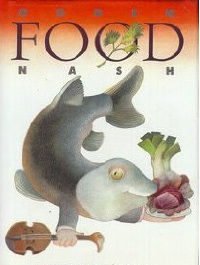
Not too long ago, I purchased a collection of his food poems aptly embellished with Etienne Delessert’s droll illustrations. Whenever I’m in the mood for a laugh snack, I treat myself to a serving of Squab, Tarragon, Smelt, or Kippers (things I wouldn’t necessarily eat in real life, but find strangely palatable cooked up in Nash’s literary kitchen). Thought it would be fun to celebrate his birthday by featuring what is perhaps his most well known food poem. Just for today, you may also have all the virtual candy and/or liquor you please. Continue reading