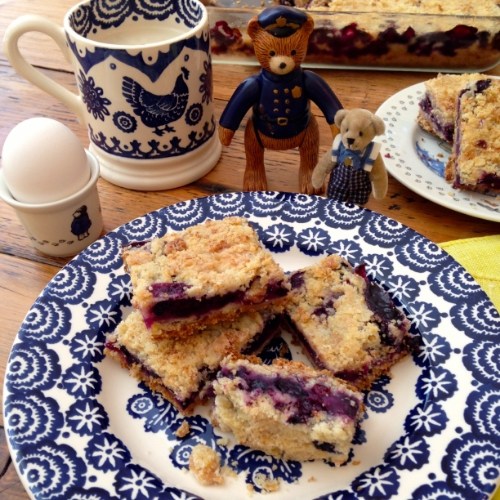
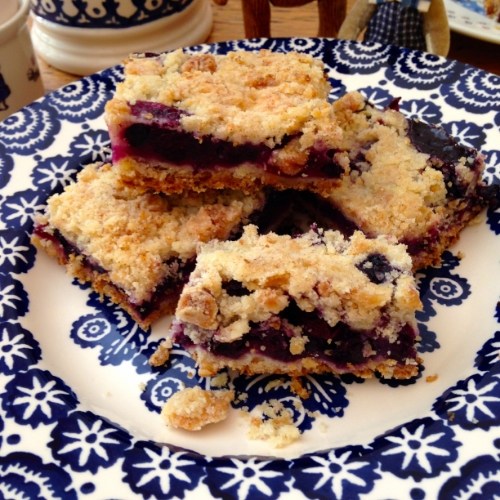
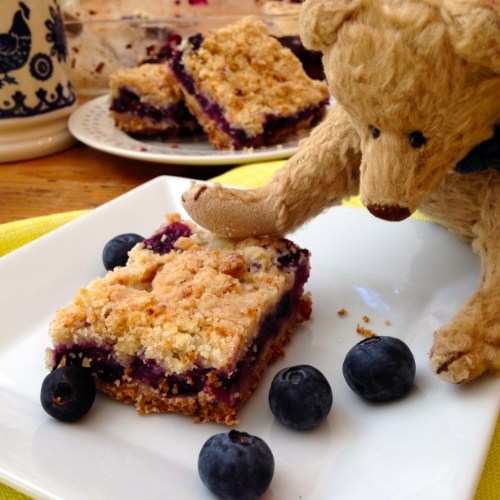
Please help yourself to a mug of coffee, tea or milk and a blueberry crumb bar — just the thing for hopping from blog to blog and reading some good poems. 🙂
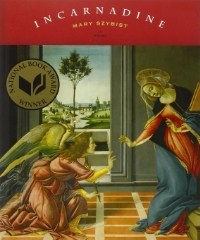
To set you on your way, thought I’d share a poem from Mary Szybist’sIncarnadine (Graywolf Press, 2013), which won the 2013 National Book Award for Poetry. I like the intersection between the temporal and the spiritual, the dissolution of will and ego while singing praise for the divine glory of the world. And, too, in this day and age of blatant self aggrandizement, it is humbling to contemplate Mother Nature’s largesse as well as her indifference to our inconsequential and fleeting existences, our infinitesimal obsessions.
*
“Blueberries’ Great Escape” via Dogwood Studio Alaska
HERE, THERE ARE BLUEBERRIES by Mary Szybist
When I see the bright clouds, a sky empty of moon and stars,
I wonder what I am, that anyone should note me.
Here there are blueberries, what should I fear?
Here there is bread in thick slices, of whom should I be afraid?
Under the swelling clouds, we spread our blankets.
Here in this meadow, we open our baskets
to unpack blueberries, whole bowls of them,
berries not by the work of our hands, berries not by the work of our fingers.
what taste the bright world has, whole fields
without wires, the blackened moss, the clouds
swelling at the edges of the meadow. And for this,
I did nothing, not even wonder.
You must live for something, they say. People don’t live just to keep on living.
But here is the quince tree, a sky bright and empty.
Here there are blueberries, there is no need to note me.
This poem appears near the end of the book, a sort of benediction. The entire collection is luminous and deeply thought provoking, with inventive explorations of the divine in everyday life. The National Book Award judges citation reads in part: “This is a religious book for nonbelievers, or a book of necessary doubts for the faithful.” Definitely worth a look — Szybist is a poet’s poet.
*
Speaking of which, Heartfelt Congratulations to Juan Felipe Herrera, our new U.S. Poet Laureate, and Jacqueline Woodson, our new Young People’s Poet Laureate! Way cool! 🙂
*
Now, please leave your links with Mr. Linky below. Don’t forget to include the title of the poem you’re sharing or book you’re reviewing in parentheses after your name. The links page will stay up indefinitely and can be accessed at any time for your reading convenience.
*
* * *
Thanks for joining us today. If you’d like the Blueberry Crumb Bars recipe, click over to Smitten Kitchen. Cool thoroughly before slicing and enjoy with a side of vanilla ice cream or whipped cream. 🙂
Have a wonderful weekend!
(Here there are blueberries, here there are poems.)
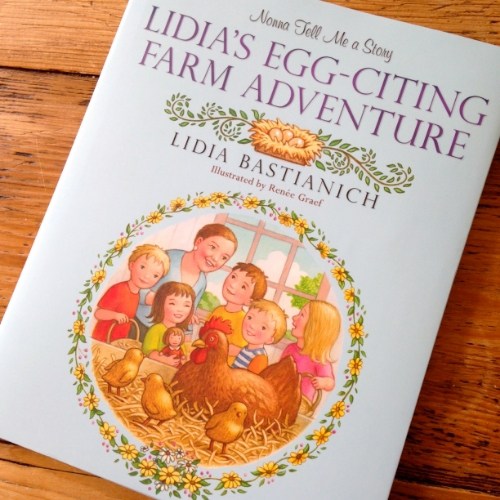
Over the years, I’ve enjoyed tuning in to her various PBS cooking shows and browsing through her numerous cookbooks. Besides being a celebrity chef and bestselling author, Lidia Bastianich is a successful restaurateur (4 eateries in NYC, one in Pittsburgh, one in Kansas City), and part of the team who opened Eataly, the largest artisanal Italian food and wine market/mall in NYC. She has an exclusive line of high-end cookware and serveware (Lidia’s Kitchen) for QVC. With her daughter Tanya, she launched Nonna Foods, a platform for distributing LIDIA’S pastas and sauces, and with her son Joseph, she produces fine winesat two vineyards in Italy. In short, this woman has a LOT on her plate!
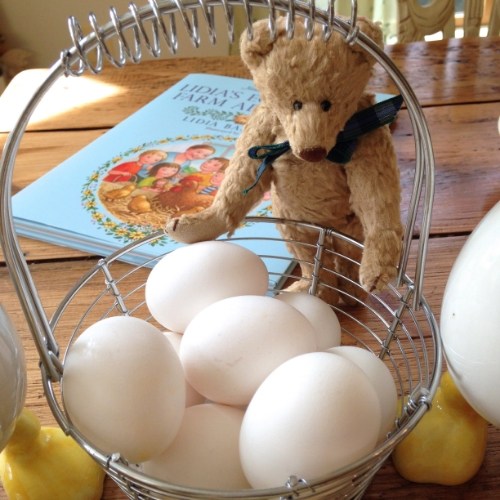
But who knew she also wrote children’s books? I only recently discovered her delightful Nonna Tell Me a Story series, a delightful blend of semi-autobiographical stories and kid-friendly family recipes.
In Jeff Gundy’s chewy list poem, we are invited to look at ourselves and ponder questions about life and faith. Despite our fortunes and failings, and the many labels we might use to separate ourselves from others, we are beloved by a benevolent being who delights in us all just as we find joy and grace through him.
via Makoto Kagoshima
THE COOKIE POEM by Jeff Gundy
“Here are my sad cookies.”
The sad cookies. The once and future cookies.
The broken sweet cookies. The cookies
of heartbreaking beauty. The stony cookies
of Palestine. The gummy and delicious
olive and honey cookie. The pasty
damp cookie trapped in the child’s hand.
Sad cookies, weird cookies, slippery
and dangerous cookies. Brilliant helpless
soiled and torn cookies, feverish and sweaty
cookies. Sullen cookies, sassy cookies, the cookies of tantrum and the cookie of joy
and the sweet dark cookie of peace.
The faithful cookie of Rotterdam. The wild-eyed
cookie of Muenster. The salty Atlantic cookie.
Cookies in black coats, in coveralls,
in business suits, cookies in bonnets
and coverings and heels, cookies scratching
their heads and their bellies, cookies utterly
and shamelessly naked before the beloved.
Cookies of the Amish division, cookies
of the Wahlerhof, cookies of Zurich and
Strassburg and Volhynia and Chortitza,
Nairobi Djakarta Winnipeg Goshen.
Cookies who hand their children off
to strangers, who admonish their sons
to remember the Lord’s Prayer, cookies
who say all right, baptize my children
and then sneak back to the hidden church anyway.
Cookies who cave in utterly. Cookies
who die with their boots on. Cookies
with fists, and with contusions.
The black hearted cookie. The cookie with issues.
Hard cookies, hot cookies, compassionate
conservative cookies, cookies we loathe
and love, cookies lost, fallen, stolen,
crushed, abandoned, shunned. Weary
and heroic cookies, scathingly noted cookies,
flawed cookies who did their best.
Single cookies, queer cookies, cookies of color,
homeless cookie families sleeping in the car,
obsolete cookies broken down on the information
highway. Sad cookies, silent cookies,
loud cookies, loved cookies, your cookies,
my cookies our cookies, all cookies
God’s cookies, strange sweet hapless cookies
marked each one by the Imago Dei,
oh the Father the Son the Mother the Daughter
and the Holy Ghost all love cookies,
love all cookies, God’s mouth is full
of cookies, God chews and swallows and flings
hands wide in joy, the crumbs fly
everywhere, oh God loves us all.
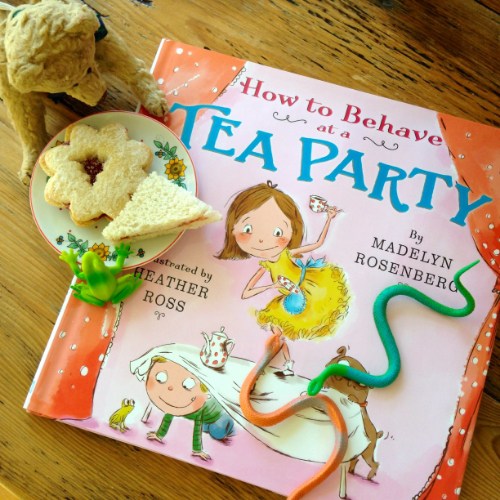
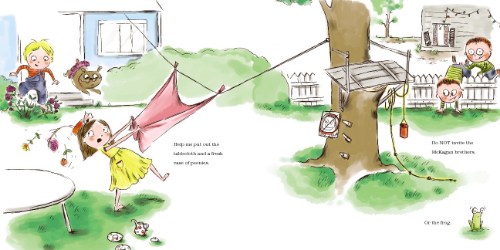
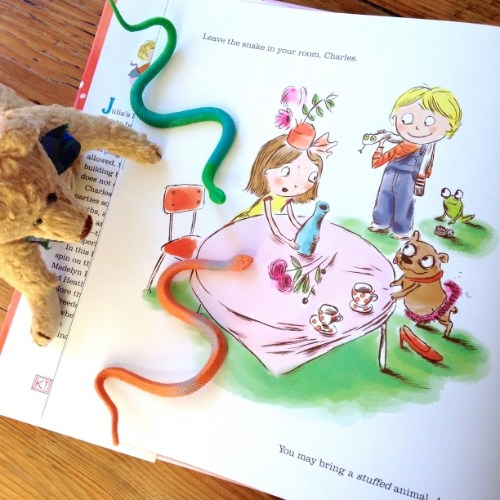
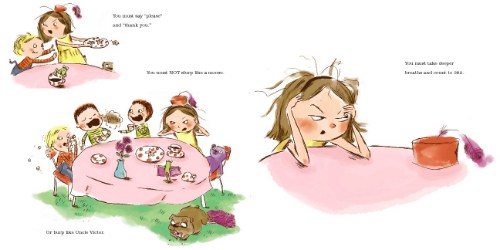
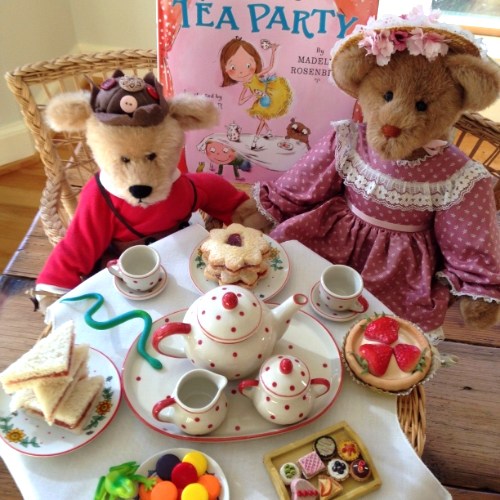
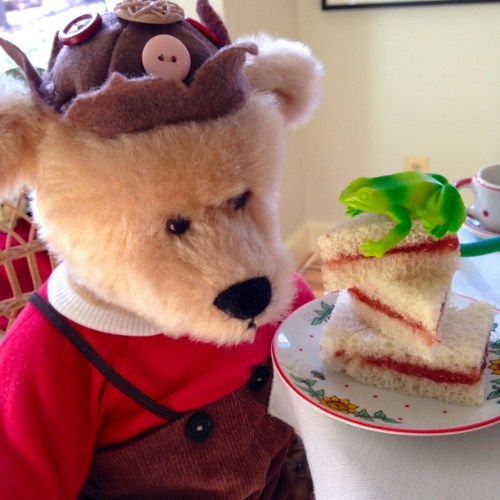
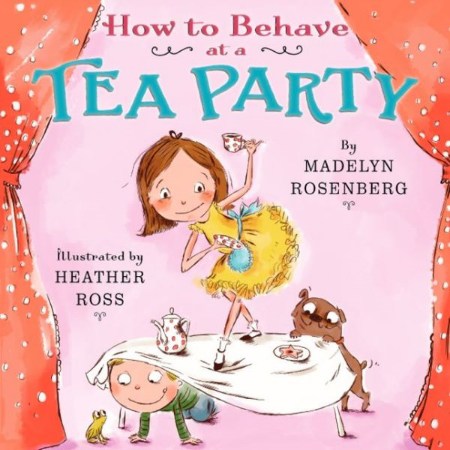
In this delightful story, Julia briefs her younger brother Charles on the finer points of tea party etiquette. Apparently this includes washing strategic parts of his body (left elbow, right knee, ears, nose), donning fancy clothes and hat, bringing a stuffed animal and present (no snakes), holding the teacup just so, and definitely not inviting the McKagan brothers or the frog.
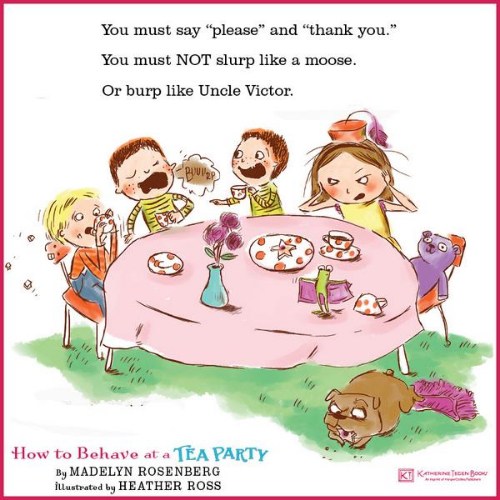
Also crucial? Not eating the peonies or the tablecloth. And no slurping or burping. “Please” and “thank you” are the mark of civilized guests, who ideally would nibble ever-so-daintily on little sponge cakes with jam and cookie cutter sandwiches.
Well.
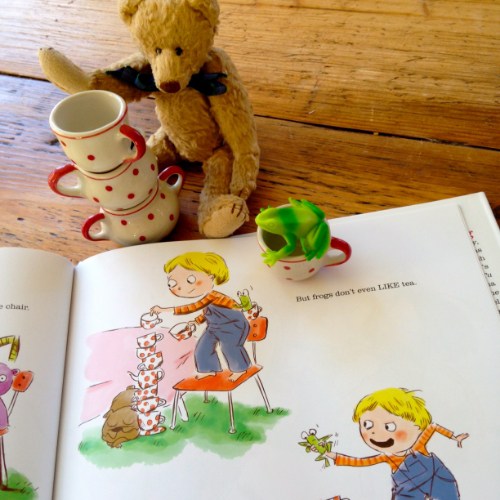
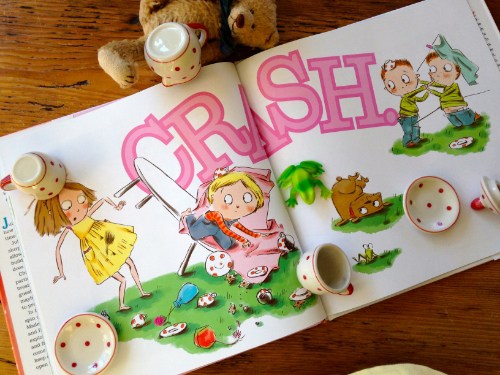
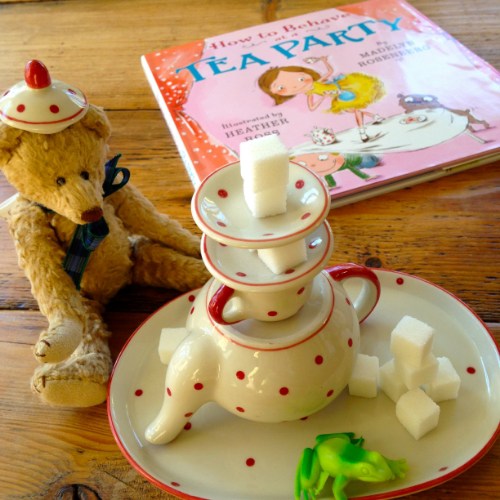
Charles and the McKagan brothers have their own ideas. Julia’s perfectly laid plans deterioriate rapidly as the boys make rocket ships out of sugar cubes and towers out of teacups. They are champion burpers and slurpers. Not surprisingly, things come to a CRASHING halt and Julia has a meltdown.
But is this the proper way for a hostess to behave? One certainly can’t have a tea party without any guests. Maybe sugar cube rocket ships could be fun after all, along with castles, moats and dragons. While you’re at it, let’s juggle saucers, put spoons on our noses, and use the tablecloth as a cape! Now you’re talkin’.
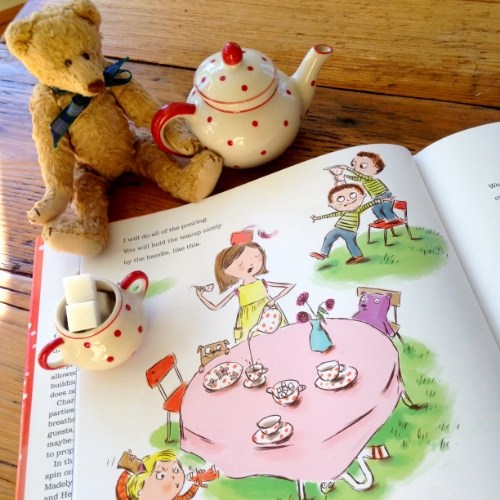
Heather Ross’s emotive, action-packed illustrations effectively dramatize Rosenberg’s spare text, heightening the humor at every turn. When Julia reminds Charles to clean his ears, we see Charles brushing the dog’s ears with Julia’s toothbrush. The McKagan brothers are appropriately rambunctious as they tie the stuffed bear to its chair and balance teacups on their heads. And who can resist a dog in a pink tutu or that feisty frog, as he laughs, points, and hot-tubs in a cup (drying himself off with a napkin, of course)?
Julia’s spot-on facial expressions aptly chart her gradual unraveling — from cool, confident and authoritative, to doubtful, peeved, harried, frustrated, exasperated, just plain FED-UP. Ross also deftly captures Julia’s change of heart as she decides to re-invite her guests, and it’s amusing to see Charles and the McKagan brothers treading a little more carefully the second time around as they all settle into a fun afternoon (high tea in a treehouse, anyone?).
How to Behave at a Tea Party serves up the classic older sister-mischievous younger brother scenario with a skillful nod at the importance of remaining flexible, keeping an open mind, and learning how to go with the flow. Since life is often unpredictable, the art of compromise is key. Some will see themselves in Julia, with her need for control, while others will identify with Charles, who has his own definition of fun. Either way, kids will love the face-off between Prim-and-Proper vs. Let’s-Wing-It. One lump or two? 🙂
* * *
☆ TEA PARTY TREATS! ☆
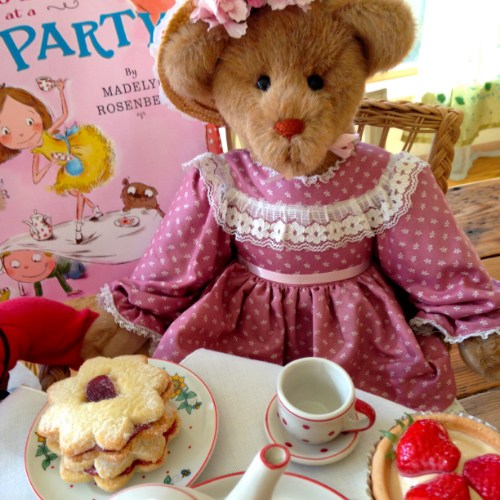
By now you’re probably anxious to host your own winter tea. What to serve? Madelyn and Heather both like to nibble on homemade cookies with their tea. Madelyn says, “For tea parties, I like anything with jam.” Me too! 🙂
Be sure to whip up batches of these goodies and read How to Behave at a Tea Party aloud to all your guests. Fancy hats and superhero capes, optional. Just have fun!
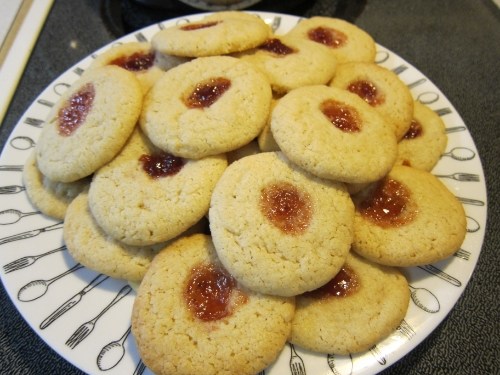
JAM THUMBPRINTS from Madelyn Rosenberg
1 cup butter, softened
1/2 cup light brown sugar
1/2 cup white sugar
One egg (yolk only)
2 cups flour
1 teaspoon vanilla
jam of your choice
Preheat oven to 350 degrees.
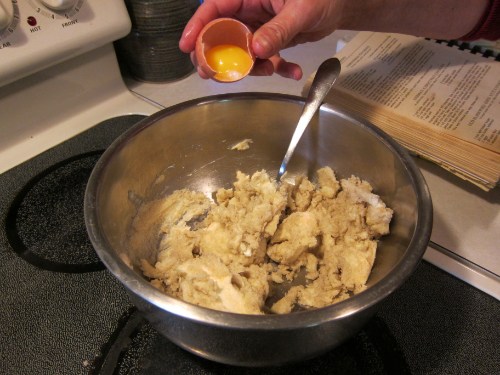
Cream the butter and both sugars (by hand). Mix in the egg yolk and gradually add the flour. Finally, add the vanilla and mix well.
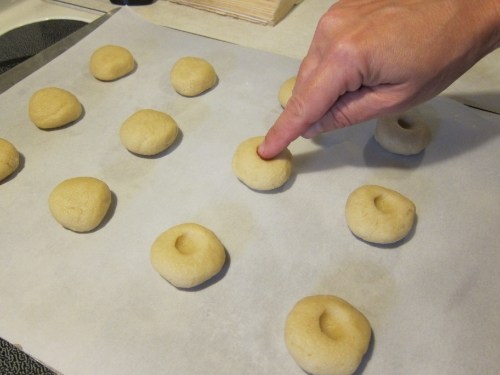
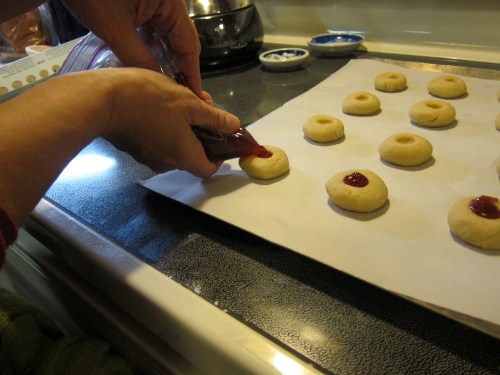
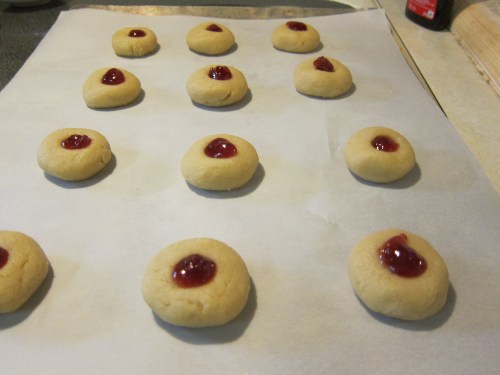
Take the dough by teaspoon and roll into balls. You’ll flatten those a bit as you place them on an ungreased cookie sheet, about two inches apart. Put your thumbprint in the middle. Fill with jam (I usually put the jam in a sandwich bag and cut off the end to make it easier to deal with.)
Bake for around 10 minutes or until edges are golden. Careful not to overbake.
Yields 4 dozen cookies.
~ Adapted from the Words Worth Eating Cookbook‘s recipe for German Christmas Cookies.
*
(PERFECT?) PEANUT BUTTER CHOCOLATE CHIP COOKIES from Heather Ross
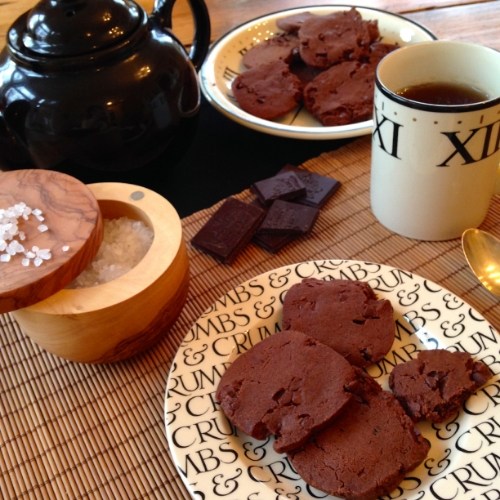
I have been working on this recipe for quite some time, and I am happy to report that I have succeeded in making batch after batch that actually stay soft for up to a week without using icky corn syrup. The list of ingredients might sound like something that only our yoga teacher would consider to be the makings of a cookie, but trust me. These are chewy heaven.
1/2 cup (4 oz) butter, cut into 1/2-inch slices
1/2 cup plus one tablespoon peanut butter (my favorite brand is Arrowhead Mills Organic Creamy Valencia Peanut Butter)
1/2 cup organic brown sugar (I like Hain Organic)
1/2 cup turbinado sugar or raw cane sugar (also perfect in your morning coffee!)
1 egg
1-1/4 cup whole wheat pastry flour
1/2 teaspoon baking soda
1/2 teaspoon baking powder
1/4 teaspoon salt
1 cup dark chocolate chips
Preheat oven to 375 degrees.
Using a stand mixer with a paddle attachment and set to speed 3, cream butter, peanut butter and sugars until well blended. Some of the sugar will still be granulated.
Add egg and mix well.
In a large bowl, blend the flour, baking powder, soda, and salt together (I use a whisk). Add these ingredients to the butter mixture and blend on speed 2.
Add chocolate chips, mix on speed 1 until well distributed.
Drop cookie dough by teaspoonfuls onto a lightly greased baking sheet. Press each cookie lightly with a fork to flatten.
Bake for exactly 13 minutes, then remove (cookies will still look very soft and squishy) and place baking sheet on the top of your stove and leave your oven on, for about twenty minutes.
Transfer cookies to a plate or cooling rack and allow to cool.
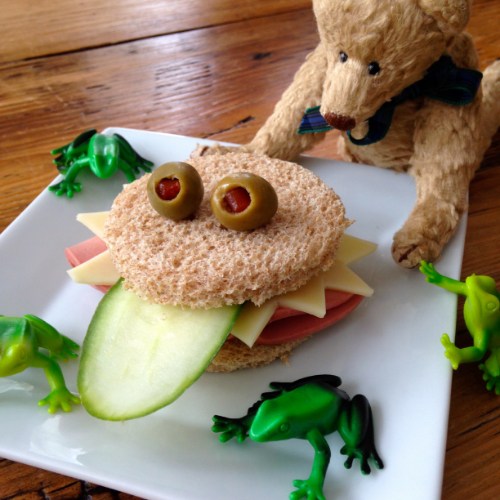
2. Cut each slice of bread into rounds using a 2-1/2″ biscuit or cookie cutter.
3. Slice the bologna into pie-shaped fourths.
4. Cut the corners off the cheese slice, then trim to make a jagged edge all the way around.
5. Slice the cucumber vertically (about 1/8″ thickness), making sure to include the rounded end.
6. If using, spread mayo on one of the bread slices.
7. Carefully roll the baloney pieces and lay on the bread. Place cheese slice and cucumber “tongue” over them.
8. Place other piece of bread on top, and position the olive eyes.
9. Ribbet before eating. Burp afterwards.
* * *
HOW TO BEHAVE AT A TEA PARTY written by Madelyn Rosenberg illustrated by Heather Ross published by Katherine Tegen Books/HarperCollins, 2014 Picture Book for ages 4-8, 32 pp.
We have a brand new copy of How to Behave at a Tea Party to give away to one lucky Alphabet Soup reader. For a chance to win, simply leave a comment at this post telling us what your favorite teatime treat is no later than midnight (EST) Sunday, January 25, 2014. Giveaway open to U.S. residents only, please. Good Luck!
* * *
This post is being linked to Beth Fish Read’s Weekend Cooking, where all are invited to share their food-related posts. No fancy hats or raised pinkies required to join the culinary fun. 🙂
Stories about runaway food — whether pancakes, bannocks, rice cakes, latkes, tortillas or gingerbread men — have long delighted children of all ages. Though Queen Elizabeth I is credited with the first man-shaped gingerbread cookie, portraying the Gingerbread Boy as a story hero is a uniquely American invention. The cheeky, spicy guy first appeared in print in an 1875 issue of St. Nicholas Magazine, and he’s been running and taunting readers ever since.
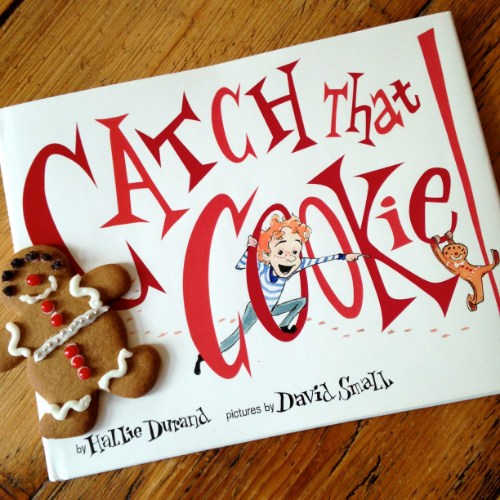
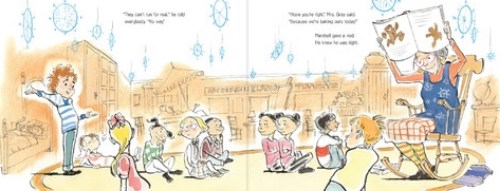
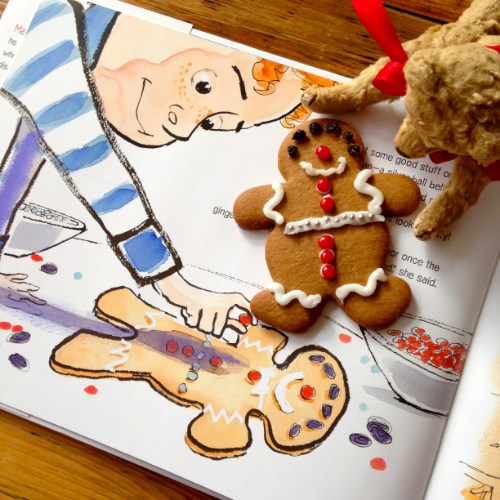
In the charmingly clever interactive mystery Catch that Cookie (2014), which was inspired by author Hallie Durand’s son, young Marshall doesn’t believe gingerbread men can walk or run. Sure, he’s heard all the stories his teacher Mrs. Gray has shared with the class, but Marshall doesn’t buy any of it. Cookies are for eating, period.
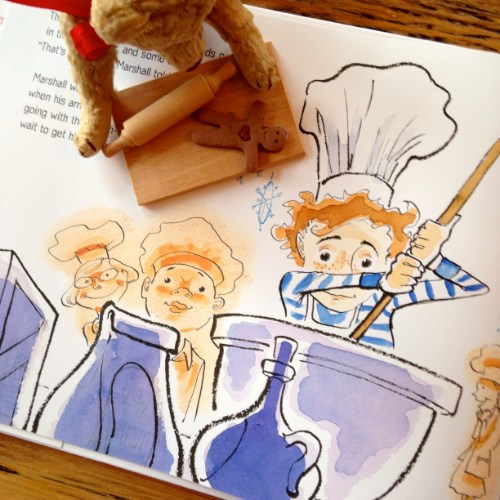
When it’s time for them to make their own gingerbread boys, Marshall enjoys mixing the dough (Mrs. Gray tells him he “rocked” it), and decorating his little man with “good stuff”: six raisins for eyes and a special silver-ball belt. But later when Mrs. Gray unlocks the oven to retrieve the baked cookies, they’re gone!
 To set you on your way, thought I’d share a poem from Mary Szybist’s Incarnadine (Graywolf Press, 2013), which won the 2013 National Book Award for Poetry. I like the intersection between the temporal and the spiritual, the dissolution of will and ego while singing praise for the divine glory of the world. And, too, in this day and age of blatant self aggrandizement, it is humbling to contemplate Mother Nature’s largesse as well as her indifference to our inconsequential and fleeting existences, our infinitesimal obsessions.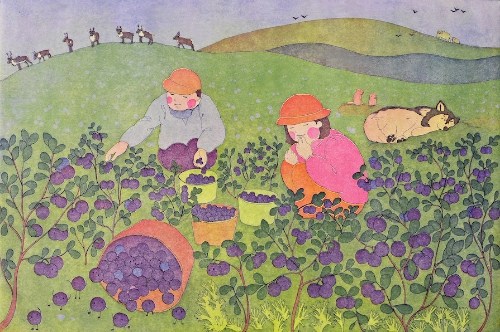


 Jama's Alphabet Soup