[Author and Illustrator Chat + Giveaway] Eat Your U.S. History Homework by Ann McCallum and Leeza Hernandez

Huzzah, Fine Friends, Huzzah!

Put on your deerskin skirts and mantles, your finest waistcoats and breeches, your linen aprons, your three-cornered cocked hats and buckle shoes.

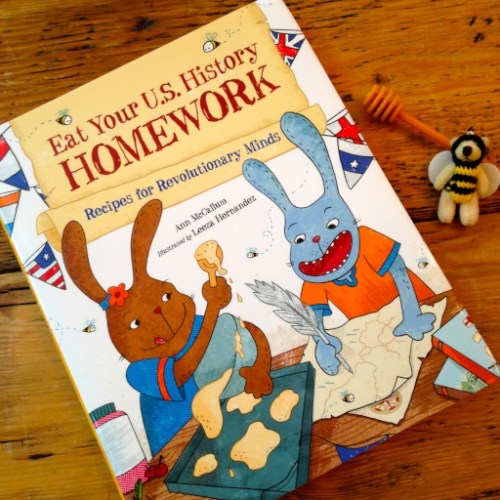
‘Tis a banner day for those of us who like to eat our homework. 🙂 Yes, the third book in the popular Eat Your Homework series by Ann McCallum and Leeza Hernandez officially hits shelves today!!

You may remember how these clever, ravenous ladies tessellated our taste buds (Eat Your Math Homework: Recipes for Hungry Minds (2011)) and cooked up culinary magic in the kitchen lab (Eat Your Science Homework: Recipes for Inquiring Minds (2014)). With their lip smacking recipes, easy-to-digest info and fetching illustrations, these books quelled math phobia and demonstrated scientific principles at work in our everyday lives.

And now, with Eat Your U.S. History Homework: Recipes for Revolutionary Minds (Charlesbridge, 2015), Ann and Leeza serve up six chewy slices of America’s early history by highlighting events and food from 1620 – 1789. That would be from the time the Pilgrims landed in America till George Washington became our first President. 🙂

Wrap your lips around some Thanksgiving Succotash while reading about the arrival of the Pilgrims and how the Wampanoag people taught them to hunt and grow food in the New World. Sweeten your understanding of the thirteen original colonies while getting down with some Colonial Cherry-Berry Grunt. Nosh on Lost Bread while considering what was behind the French and Indian War.

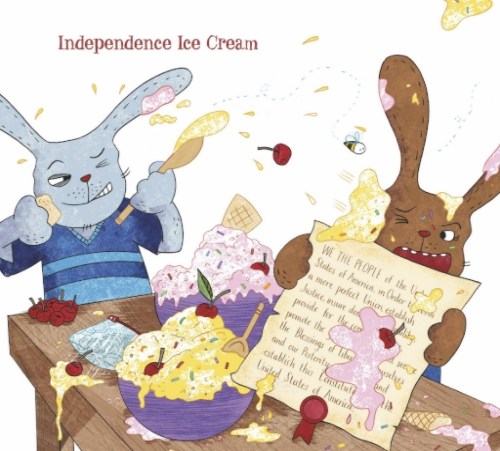
No lesson on slavery and Southern plantation culture would be complete without a tall stack of Hoe Cakes, and when there are rumblings of discontent about unfair British taxation and 45 tons of tea get dumped into Boston Harbor, you’ll want to fortify yourself by joining the patriots for coffee and Honey-Jumble Cookies in the taverns where they’re making big plans. Finally, when it’s time for full-out war and signing the Declaration of Independence, nothing better to get you riled up than an Independence Ice Cream food fight!

Continue reading

[Review, Author Chat + Giveaway] Pat Zietlow Miller on Sharing the Bread: An Old-Fashioned Thanksgiving Story

What’s your favorite part of Thanksgiving dinner?

Is it that steamy mound of creamy mashed potatoes, begging for a generous splash of savory gravy? Grandma’s candied sweet potatoes or Aunt Beverley’s green bean casserole? Maybe for you it’s all about the turkey itself with its golden brown crispy skin — moist when you slice into it, even better with cornbread stuffing and fresh cranberry sauce. Can’t forget the pies — homemade pumpkin or apple? Yes, please!

Safe to say, this traditional holiday meal wouldn’t be quite as delicious without all the sharing — the sharing of cooking, baking, and serving tasks, and of course, having family and friends sitting around the table to devour every last bite.

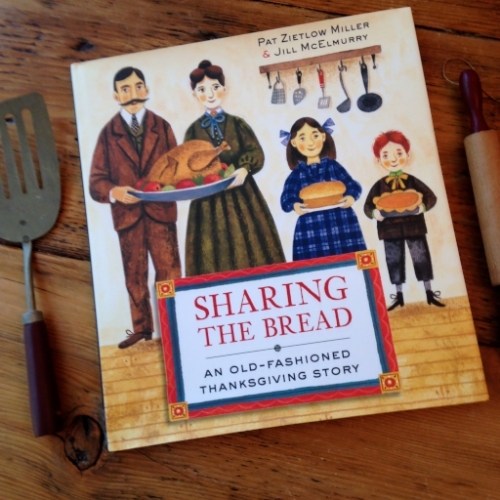
Pat Zietlow Miller’s delectable new picture book, Sharing the Bread: An Old-Fashioned Thanksgiving Story (Schwartz & Wade, 2015), invites us to step back into the 19th century to feast with a lively family of 10:

Mama, fetch the cooking pot.
Fetch our turkey-cooking pot.
Big and old and black and squat.
Mama, fetch the pot.

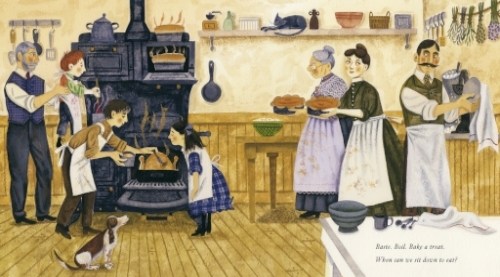
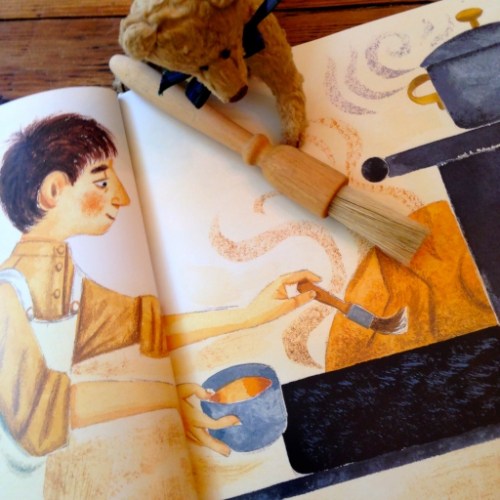
An enthusiastic young boy coaches each member of his family on a specific task: Mama prepares the turkey, Daddy tends the fire, Sister kneads the dough, Brother bastes the turkey, Grandpa boils the cranberries, Grandma bakes pumpkin pie, Auntie mashes potatoes, Uncle pours cider, and even Baby’s got a job — to “be a sleeping mouse.” With his brother and sister, the boy also makes paper pilgrim hat placemats, and when all is finally done, he calls everyone to the table. Yum!

Continue reading

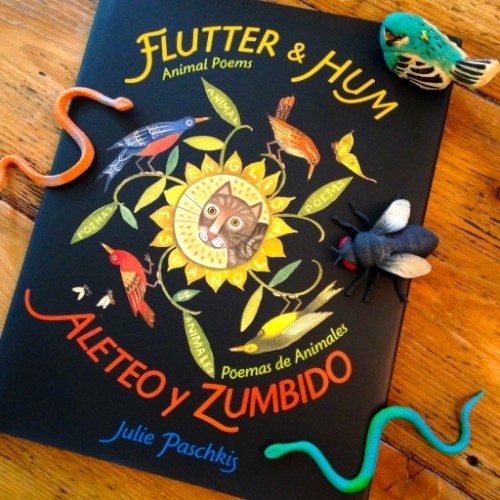
friday feast: Chatting with Julie Paschkis about Flutter & Hum/Aleteo y Zumbido (+ a giveaway!)

Several years ago, in order to illustrate Monica Brown’s Pablo Neruda: Poet of the People (Henry Holt, 2011), Julie Paschkis immersed herself in Neruda’s poetry and took Spanish language classes.

She fell in love with Spanish, its sounds and structure. Already a lover of words, she found these new words both interesting and fascinating, so much so, that she incorporated them in her paintings to stunning effect. She had created her own brand of visual poetry inspired by Neruda’s words.

Her love affair with the language didn’t end with that book. As one thing can sometimes beautifully lead to another, Julie discovered that her unfamiliarity with Spanish freed her to write poetry. The fourteen free verse animal poems in Flutter & Hum/Aleteo y Zumbido (Henry Holt, 2015) were first written in Spanish, then translated by Julie into English. And as she did with the Neruda book, she added words inspired by the poems to her illustrations.

In this exquisite tapestry of three languages — Spanish, English, and Art — we are treated to Julie’s charming insights and observations of creatures inhabiting land, sea and air, inviting us to appreciate them in new and surprising ways. Did you ever wonder what a turtle might be hiding in her shell?
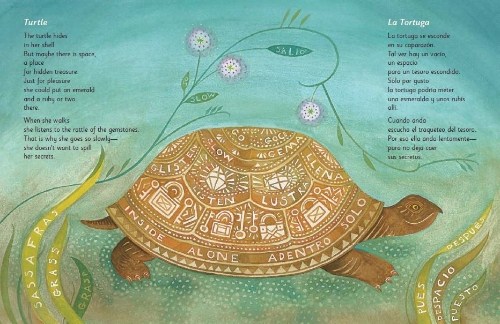
TURTLE

The turtle hides
in her shell.
But maybe there is space,
a place
for hidden treasure.
Just for pleasure
she could put an emerald
and a ruby or two
there.

When she walks
she listens to the rattle of the gemstones.
That is why she goes so slowly —
she doesn’t want to spill
her secrets.

*

LA TORTUGA

La tortuga se esconde
en su caparazón.
Tal vez hay un vacío,
un espacio
para un tesoro escondido.
Sólo por gusto
la tortuga podría meter
una esmeralda y unos rubís
allí.

Cuando anda
escucha el traqueteo del tesoro.
Por eso ella anda lentamente —
para no deja caer
sus secretos.

And the snake? He writes “a slippery poem/with his body . . . He only knows one letter: ssssssssss.” There’s also a whale that dances “In a dazzle of bubbles.” Sheer delight!

The poems vary in mood from playful (a dog’s wagging tail “fans wild happiness/into the wild world”) to peaceful and evocative (“Out of the darkness/an owl hoots./An echo./The night train/is leaving”) to ethereal (“I am a fish in the sea of dreams”).
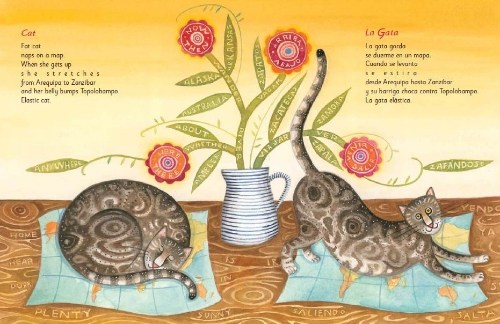
I really love the CAT:

Fat cat
naps on a map.
When she gets up
s  h  e     s  t  r  e  t  c  h  e  s
from Arequipa to Zanzibar
and her belly bumps  Topolobampo.
Elastic cat.

*

LA GATA

La gata gorda
se duerme en un mapa.
Cuando se levanta
s e    e s t i r a
desde Arequipa hasta Zanzibar
y su barriga choca contra  Topolobampo.
La gata elástica.

Isn’t ‘Topolobampo’ the best word ever? Even if we didn’t know it’s a city in Mexico, we get a good sense of how the cat’s moving in that winsome alliterative line, so much fun to read aloud. Flutter and Hum truly celebrates words, languages, and instinctual creative expression. It certainly contributes to our appreciation of how and where poems might emerge, and it’s fun to imagine Julie playing with both Spanish and English and exploring some of the magical places in between.
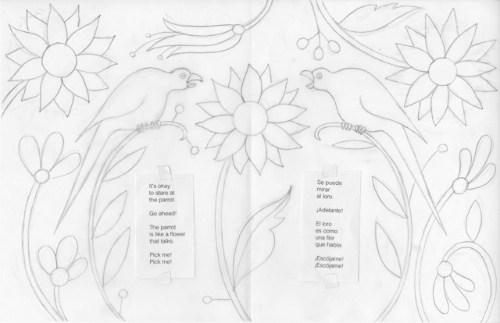
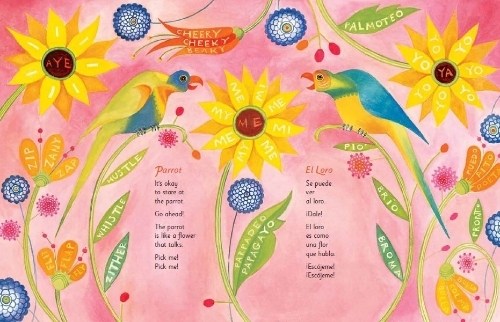
As someone who loves hand lettering, I fairly swooned over Julie’s gorgeous paintings. As words slither on long blades of grass, swirl in the ripples of pond water, ride atop the backs of crows (“crass/brash,” “craven/crooked,” “brujo/brusco”), float in clouds, adorn both halves of a juicy strawberry (“fresh, blush, ripe, giddy, gozo, julio, frivolo”), and stream in dark ocean waves (“nightfall, fill, flow, flung, luna, lustra, bunco, oscuro”), we hear these juicy words spark and sing, bask in their collective serenade, feel the heart quicken. Her careful choice of words, as well as how they are paired or juxtaposed, creates a new energy, another poetic revelation.

Readers will also enjoy the little touches of humor: the parrot is “cheery, cheeky, beaky,” the whale, “buoyant”/”oh boy,” and that irresistible cat,  “now/then,” “here/there.” Surprise gifts in the fine details, a veritable feast of words. Perfecto!

I know you’ll enjoy hearing more from Julie herself, and we thank her for visiting today, and for creating this treasure of a book. Perhaps the turtle should stash a copy in her shell? 🙂

Continue reading

friday feast: Jumping Off Library Shelves by Lee Bennett Hopkins and Jane Manning (+ a giveaway!)

WELCOME BOOK LOVERS!

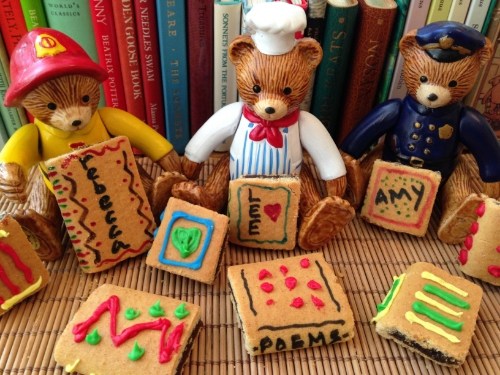
The Alphabet Soup Mini Library is now open.

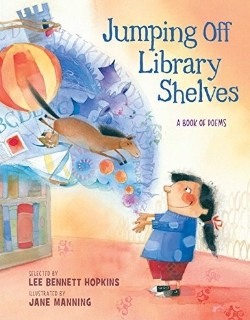
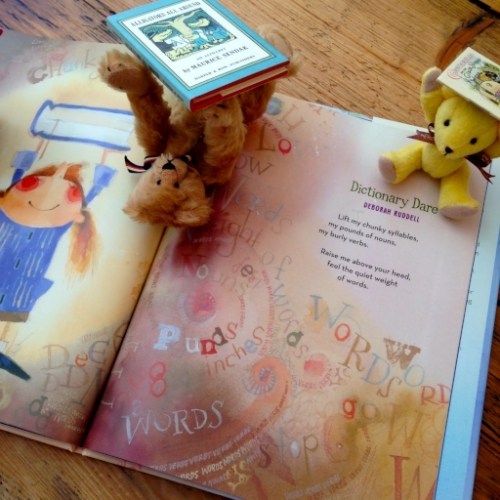
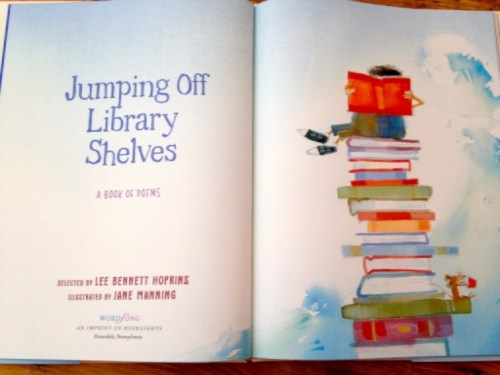
Please help yourself to a yummy fig bar book compliments of the Teddy Town Bears. They made them especially for you to celebrate the recent release of Jumping Off Library Shelves (Wordsong, 2015), a very cool collection of 15 poems selected by master anthologist, author, poet, editor, educator and eternal hotTEA Lee Bennett Hopkins.
Two words make me instantly happy: LOVE and LIBRARY. They’re kind of synonymous in my mind, and truly, could any of us thrive without either one?

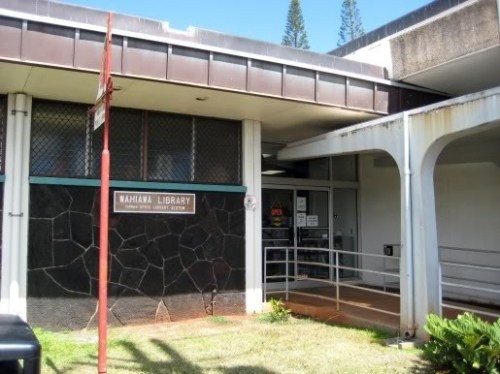
Wahiawa Library front entrance.

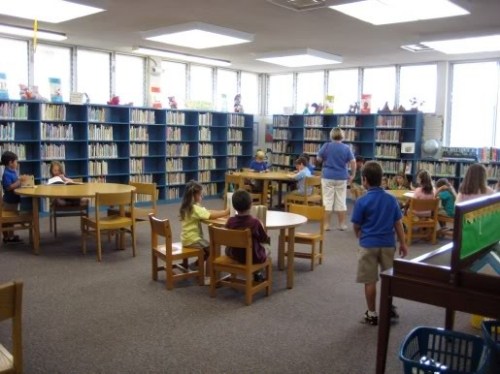
The public library in my small country hometown of Wahiawa, Hawai’i, was my safe haven while growing up — a true home away from home where I discovered the likes of Laura Ingalls Wilder, Lois Lenski, Louisa May Alcott, Frances Hodgson Burnett, Beverly Cleary, Eleanor Estes, and Sydney Taylor. It was a quiet place to think, read, dream, wonder, learn and imagine – a place where I could travel new roads, discover new worlds within the pages of a favorite book, the place where it first occurred to me that anything can happen, anything is possible.

Wahiawa Library children’s section.

The poems in Jumping Off Library Shelves joyously celebrate the singular experiences that make any library a magical place, from the breathless anticipation of first entering “the sweet kingdom of story,” to getting one’s first library card, to cozily snuggling up with a good story, to basking in the power and privilege of choosing books and being transported and transformed. Who would not thrill at the prospect of so much knowledge, so many good stories right there for the taking?

Continue reading

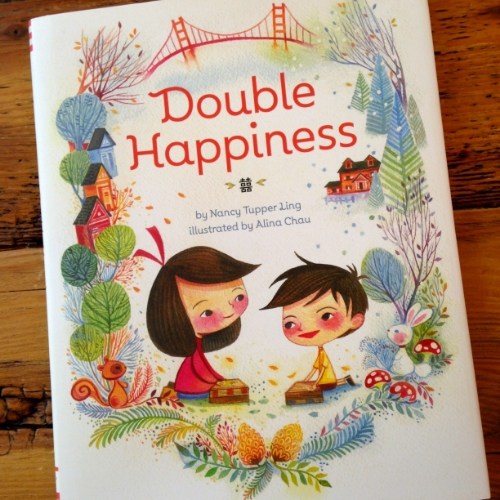
Chatting with Nancy Tupper Ling about Double Happiness (+ a giveaway!)

Today I’m doubly pleased to welcome poet and author Nancy Tupper Ling, who’s here to tell us all about her new book Double Happiness (Chronicle Books, 2015), a heartwarming story about a family moving from San Francisco to the East Coast.

Beautifully told through a series of lyrical poems in the alternating voices of Gracie and her little brother Jake, Double Happiness deftly captures the mixed emotions of leaving loved ones behind, traveling across country, and seeing one’s new home and surroundings for the first time.

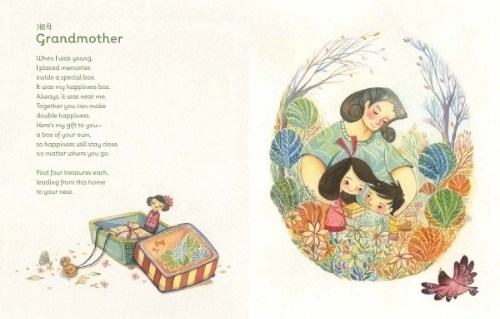
It is especially hard saying goodbye to Nai Nai (Grandmother), Auntie Su and Uncle Woo. To help ease the transition, Nai Nai gives each of the children a special box, suggesting they fill it with four treasures “leading from this home to your new.” She explains that when she was young she had her own “happiness box,” which enabled her to keep special memories close.

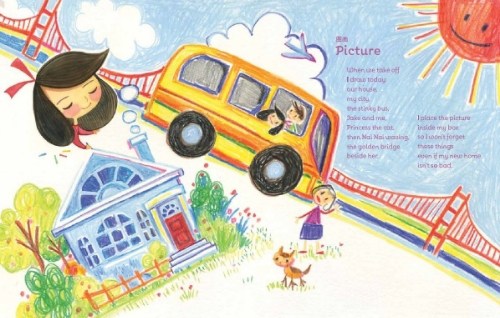
Jake is as much excited, adventurous, and playful as Gracie is apprehensive, reflective, and sad. The treasures they add to their boxes (panda, marble, lucky penny, leaf, snake) mark specific moments in their journey with attendant feelings and impressions.

Both Gracie’s and Jake’s voices ring true, and the poems seamlessly keep the engaging storyline moving forward. Alina Chau incorporates cultural elements (Chinese calligraphy, Jake’s mystical dragon, first dinner) in her charming soft watercolor illustrations, illuminating this gentle gem of a story that will surely resonate with young readers.

In Chinese tradition, “double happiness” is usually associated with weddings, but Nancy’s story artfully extends the concept: two homes, two coasts, two cultures, two boxes, the old and the new, two children, a dragon and a phoenix, two halves of a perfect whole coming full circle in the blessed harmony of family.

I know you’ll enjoy learning more about how and why Nancy wrote this book. And yes, she’s sharing a favorite recipe! Enjoy!

*   *   *

Continue reading