“Oppression won’t win.
The light comes from within.”
~ Linda McCartney
February is Love and Chocolate Month, and today it’s all about love.
Paul has always been the one.
Ever since 7th grade.
I’ll never stop idolizing him.
This week I’ve been drowning myself in Beatles music, using my big headphones, so I can listen to everything as loud as I want. The old songs still resonate and amaze even after 40 years, and I was once again blown away by some of my favorites: “She’s Leaving Home,” “I’ll Follow the Sun,” “Yesterday,” and what I consider to be Paul’s perfect lyrical masterpiece, “Blackbird.”
You’d think that after forty years, you’d know a song inside and out. I can’t even begin to estimate how many times I’ve heard “Blackbird,” — hundreds, maybe, thousands, of times? I’ve always taken it at face value — the bird symbolizing an inner need for personal expression, breaking free, overcoming adversity — not unlike some of the longings Hopkins expressed in his poem, “The Windhover.” I suppose Paul’s acoustic guitar and deceptively simple lyrics form the perfect whole — with something so sublime, why search for deeper meaning?
Blackbird singing in the dead of night
Take these broken wings and learn to fly
All your life
You were only waiting for this moment to arise.
And then I did a little research, and discovered that Paul had something else in mind. In Many Years from Now, Barry Miles quotes him as saying,
I developed the melody on guitar based on the Bach piece and took it somewhere else, took it to another level, then I just fitted the words to it. I had in mind a black woman, rather than a bird. Those were the days of the civil rights movement, which all of us cared about, so this was really a song from me to a black woman, experiencing these problems in the States: ‘Let me encourage you to keep trying, to keep your faith, there is hope.’
Now, of course, I love the song even more, with its added layer of meaning. And I truly understand what Paul means when he says, “This is symbolic of one of my themes: take a sad song and make it better, let this song help you. ‘Empowerment’ is a good word for it.”
Long before he wrote any songs, Paul wrote poetry. He tried to get his work published in a school magazine, but it was rejected. He has said that he’s been trying to get back at them ever since. Years after the Beatles broke up, Paul befriended Allen Ginsberg, who called “Eleanor Rigby,” one hell of a poem. Paul later returned to writing poetry in the 1990’s, after his friend, Ivan Vaugn, died of cancer. (Ivan had introduced Paul to John Lennon.)
There is an ongoing debate about whether song lyrics qualify as poetry. Jeffrey Stock attended Paul’s New York poetry reading when his new compilation, Blackbird Singing: Poems and Lyrics (1965-1999), was published in 2001. In his article for liveDaily.com, he relates that Paul makes no distinction between lyrics and poetry, citing Homer’s epics, traveling troubadors, and the Beat poets.
Stock contends that there is poetry in the best lyrics, and music in the best poetry. “A poem has its own independent propulsion, but a lyric is part of a whole, pulled ineluctably along a musical current. A good lyric must also make room for singing, which is why many superb lyrics presented without their music come off as light verse at best.”
Though Paul’s lyrics and poems both spring from the same creative well, they are composed in different ways. Paul says his lyrics and melodies are written simultaneously; there is a lot of working and reworking to make things fit perfectly. With poems, however, “the language tends to come and stay put.”
Paul wrote some very sweet love songs for Linda (“Maybe I’m Amazed,” and “I Will”), as well as some touching poems, which stand on their own quite well. Here are two of my favorites from Paul’s book:
BLESSED
I would come back from a run
With lines of poetry to tell,
And having listened, she would say,
“What a mind.”
(Read the rest here.)
HER SPIRIT
Her spirit moves wind chimes
When air is still
And fills the room
with fragrance of lily.
(Read the rest here.)
Poet Adrian Mitchell, who edited the book, says in his introduction:
Paul is not in the line of academic or modernist poets. He is a popular poet in the tradition of popular poetry. Homer was and is a popular poet and loved by millions of people who never saw a university . . . Paul takes risks, again and again, in all of his work. He’s not afraid to take on the art of poetry — which is the art of dancing naked . . . he’s a jeweler and a juggler when it comes to words. Both his poems and lyrics are full of surprises.
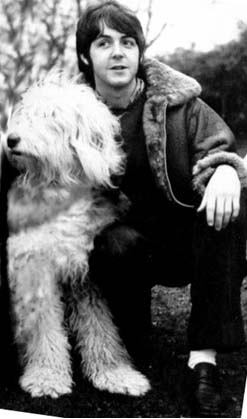
When I was teaching high school English in Wimbledon, England, one of my students told me she had seen Paul walking his sheepdog, Martha, in Hampstead Heath. After I stopped screaming, I begged her for more details. Janice and some friends had been kicking around a soccer ball, and Paul remarked that the game seemed a little rough for girls. He was cordial, interested, and gave Janice the nicest of smiles.
Thirty plus years later, I’m still insanely jealous.
Paul has that effect on me.
As I said, he’s always been the one.
For a live performance of “Blackbird,” click here.
To listen to a live performance of “Yesterday,” click here.
To visit the Paul McCartney YouTube channel, click here.
And, for a charming look at Paul in the kitchen, yes, the KITCHEN! — click here. He’s really really really adorable in this :)!
He can mash my potatoes any time . . .
Today’s Poetry Friday Roundup is at Big A little a.
 Jama's Alphabet Soup