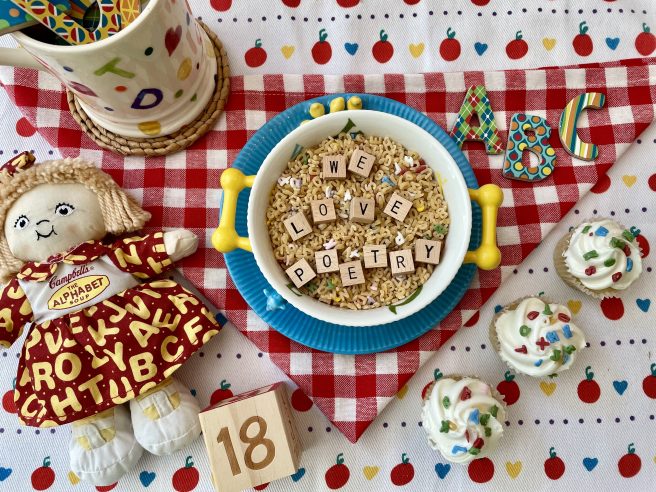
#65 in an ongoing series of posts celebrating the alphabet.
Welcome to the Poetry Friday Roundup at Alphabet Soup!
So glad you’re here. Hope you’re having a good September. 🙂
Today we’re celebrating Alphabet Soup’s 18th blogiversary with one of my favorite (and oh-so-appropos) poetic forms, the abecedarian. Recently stumbled upon this gem by new-to-me poet Tom Disch (1940-2008).
A prolific award-winning author of speculative fiction as well as a noted poet, Disch was also a librettist, essayist, theater critic, and author of historical novels, computer-interactive fiction and children’s books (perhaps you’re familiar with his novella, The Brave Little Toaster (1980)). Of all these genres, he wished to excel most in poetry (Dana Gioia considered him a genius).
Love his conversational tone, sharp wit and matter-of-fact storytelling, which gives the poem a fresh, spontaneous feel. I haven’t read an abecedarian quite like this one before (so fun!); I like how his mind works.
There’s nothing more nourishing or restorative than a bowl of homemade soup, especially when your mother makes it. 🙂
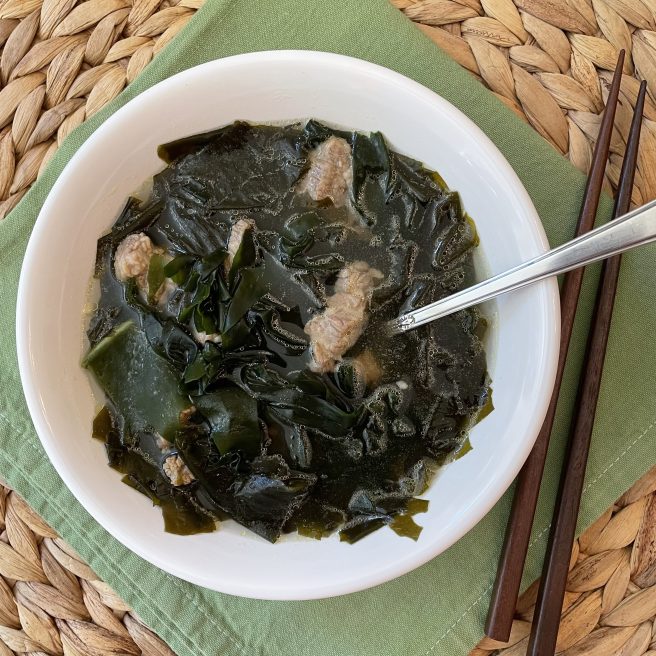
If we had a cool rainy day, if someone was feeling under the weather, or whenever she just felt like it, my mom made Korean miyeok-guk (seaweed soup). Though she cooked many delicious dishes, this soup was easily the most comforting and I always loved devouring my fair share.
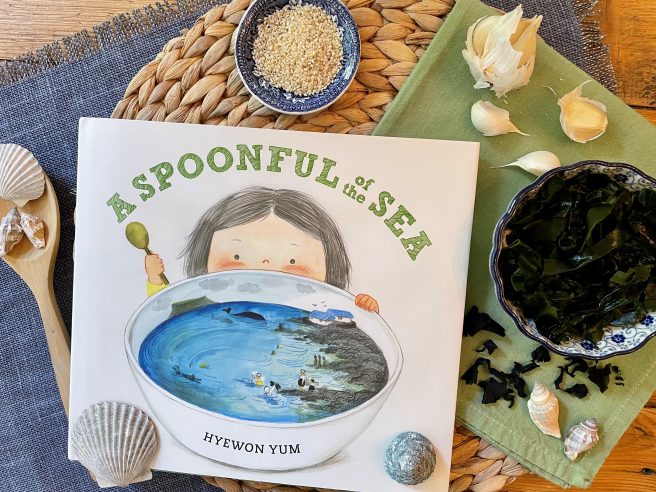
But for all those years of eating miyeok-guk while growing up, I only recently learned about its cultural significance thanks to Hyewon Yum’s touching new picture book, A Spoonful of the Sea (Norton Young Readers, 2025).
I didn’t know that in Korea, miyeok-guk is a traditional birthday soup honoring and celebrating mothers, and that this custom dates back more than a thousand years! Referencing Jeju Island’s revered haenyeo (female free divers), Yum has lovingly created an inspiring tale of family history and heritage told through a matriarchal lens.
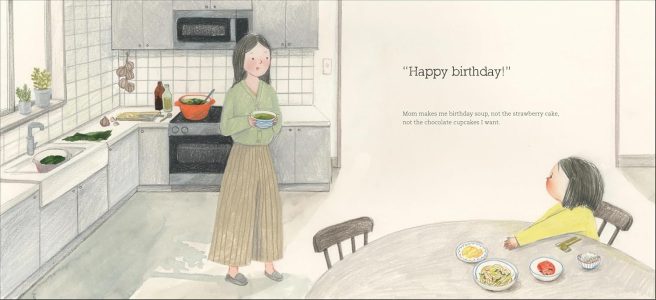
As the story opens, a girl is given a bowl of her mother’s seaweed soup on her birthday. Disappointed it’s not the strawberry cake or chocolate cupcakes she actually wanted, she pouts over the briny-smelling soup that “looks like sea water.” But while she’s stirring it, her mom explains why the soup is so special.
“You will be pleased to know I stand obediently for the national anthem, though of course I would defend your right to remain seated should you so decide.” ~ Ira Glasser
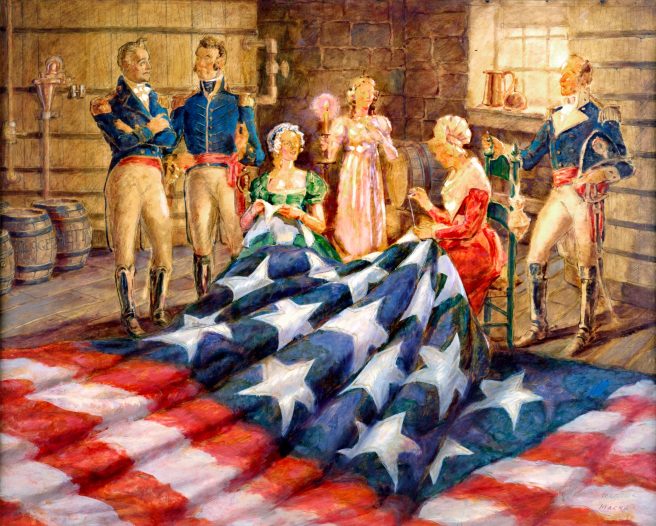
“Placing the Stars on the Flag That Inspired Francis Scott Key to Write Our National Anthem, Claggett’s Brewery, Baltimore, 1812-1814,” by Robert McGill Mackall (1962). This depicts Mary Pickersgill and her nieces in 1813, sewing the flag that would become known as the Star-Spangled Banner.
A NEW NATIONAL ANTHEM by Ada Limón
The truth is, I’ve never cared for the National Anthem. If you think about it, it’s not a good song. Too high for most of us with “the rockets red glare” and then there are the bombs. (Always, always, there is war and bombs.) Once, I sang it at homecoming and threw even the tenacious high school band off key. But the song didn’t mean anything, just a call to the field, something to get through before the pummeling of youth. And what of the stanzas we never sing, the third that mentions “no refuge could save the hireling and the slave”? Perhaps, the truth is, every song of this country has an unsung third stanza, something brutal snaking underneath us as we blindly sing the high notes with a beer sloshing in the stands hoping our team wins. Don’t get me wrong, I do like the flag, how it undulates in the wind like water, elemental, and best when it’s humbled, brought to its knees, clung to by someone who has lost everything, when it’s not a weapon, when it flickers, when it folds up so perfectly you can keep it until it’s needed, until you can love it again, until the song in your mouth feels like sustenance, a song where the notes are sung by even the ageless woods, the short-grass plains, the Red River Gorge, the fistful of land left unpoisoned, that song that’s our birthright, that’s sung in silence when it’s too hard to go on, that sounds like someone’s rough fingers weaving into another’s, that sounds like a match being lit in an endless cave, the song that says my bones are your bones, and your bones are my bones, and isn’t that enough?
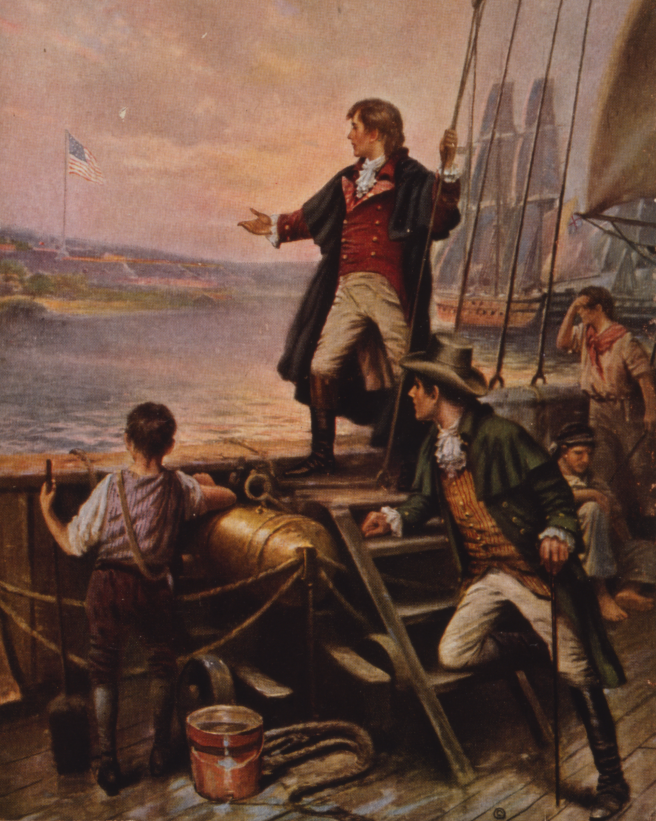
“By Dawn’s Early Light” by Edward Percy Moran (1913) – Francis Scott Key observing the flag the morning after the Battle of Baltimore, Fort McHenry, Baltimore, Maryland.
*
Distress or dissent?
Limón’s poem is especially relevant right now, not only because we are a country in crisis, but because 211 years ago, on September 14, 1814, American lawyer Francis Scott Key wrote his poem, “Defence of Fort M’Henry,” which became the lyrics for our national anthem.
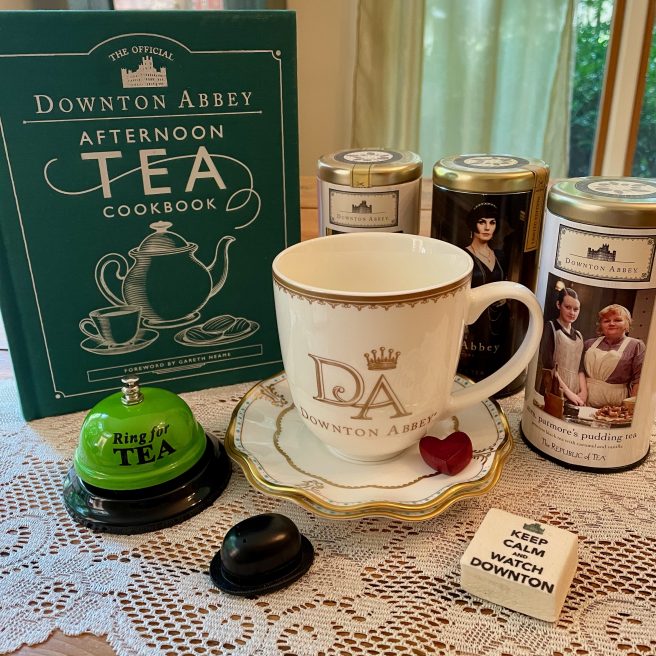
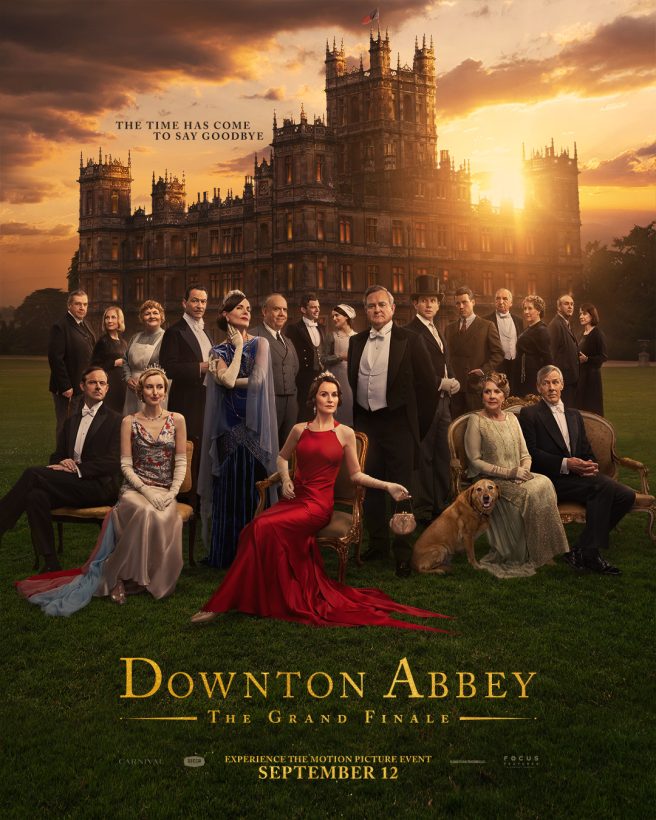
After six television seasons and two big screen sequels, “Downton Abbey: The Grand Finale” will hit theaters on September 12. While it’ll be wonderful to revisit the DA world once again, it’s bittersweet knowing that this film supposedly marks the end of this truly beloved 15-year-old franchise. Say it isn’t so!
You may remember that in DA1 (2019), set in 1927, the Crawley family is all agog over a royal visit from King George V and Queen Mary. Thereʻs an assassination attempt, a secret about Lady Bagshawʻs inheritance, a blossoming romance between Tom Branson and Lucy Smith, clashes between Downton staff and royal staff, as well as Lady Maryʻs concerns about Downtonʻs future. We also learn Violet is ill.
In DA2 (Downton Abbey: A New Era, 2022), set in 1928, some of the Crawley family travels to the south of France to uncover the mystery of Violetʻs newly inherited villa. A film company uses Downton to shoot a silent film, Tom and Lucy marry, Thomas Barrow finds romance with actor Guy Dexter, newlyweds Andy and Daisy do some matchmaking between Mr Mason and Mrs Patmore, and Violet passes away.
What do we know about Downton Abbey 3 thus far?
DOWNTON ABBEY: THE GRAND FINALE, the cinematic return of the global phenomenon, follows the Crawley family and their staff as they enter the 1930s. When Mary finds herself at the center of a public scandal and the family faces financial trouble, the entire household grapples with the threat of social disgrace. The Crawleys must embrace change as the staff prepares for a new chapter with the next generation leading Downton Abbey into the future.
There are hints that the “public scandal” is related to Mary and Henry’s divorce (Henry was absent from DA2 and won’t appear in DA3). Will Mary reconcile with her always-away-racecar-driving husband or find new love? Will Downton Abbey remain with the Crawley family? How will the Great Depression and WWII impact everyone?
photo by Rory Mulvey/Focus Features.
Also, Anna Bates is expecting again (this coincides with Joanne Froggatt’s real-life pregnancy while filming). Also wondering: will schoolteacher Mr Moseley find success as a Hollywood screenwriter, and will we see him marry Miss Baxter?
“Better than a thousand days of diligent study is one day with a great teacher.” ~ Japanese proverb
Hooray for September and a brand new school year!
As a grade school student, I loved having new clothes, fresh school supplies, putting covers on assigned textbooks, making sure my quarter for lunch was safely stashed in my coin purse. I could hardly wait to open my spiral notebook and write on a clean page with a freshly-sharpened No. 2 pencil.
Most of all, I looked forward to meeting my new teacher.
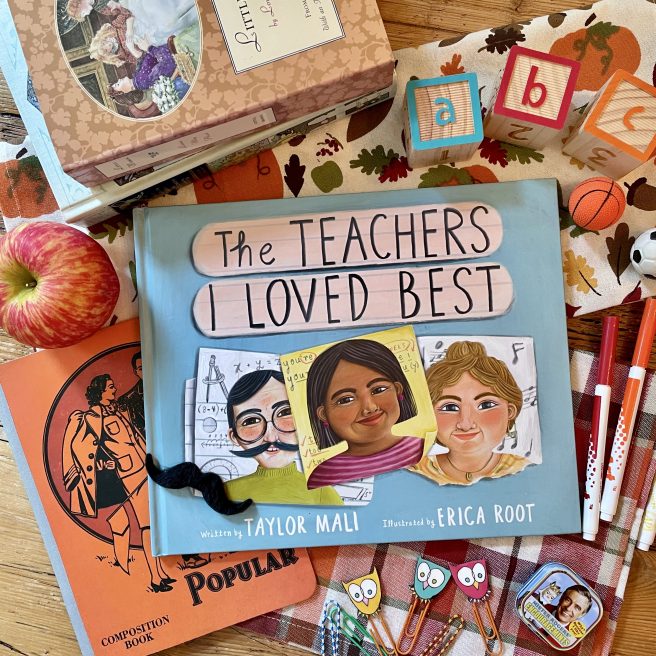
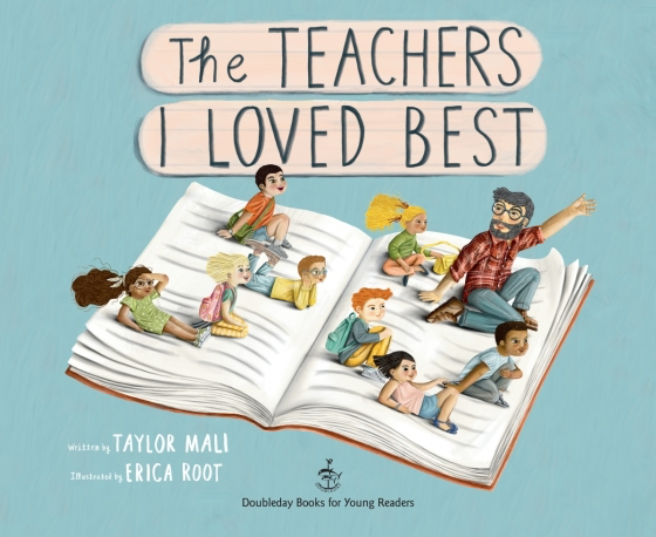
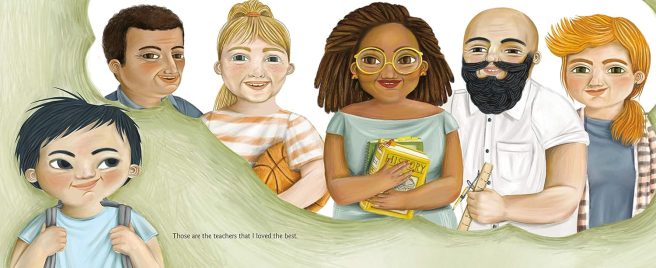
Reading The Teachers I Loved Best by Taylor Mali and Erica Root (Doubleday BFYR, 2023) brought to mind my own favorites, making me appreciate them even more.
In his uplifting rhyming ode, Mali celebrates the extra-special, dedicated educators (classroom teachers, principals, librarians) who leave a lasting impression on all of us. “A great teacher is anyone who makes you work hard — harder than you ever thought you could — who makes you want to be better than just . . . plain . . . good.”
He goes on to laud their willingness to go above and beyond to bring out the best in their students, whether coaching from the sidelines to instill confidence, gently pushing to keep them on track, or being demanding “with the goal of commanding understanding.” The teachers he truly loved most were the ones who challenged and inspired him to give his all every single day.
He mentions his science teacher, who had the class dramatize the way the solar system worked, an art teacher he madly loved who dressed in “white paint-splattered smocks all of the time,” and every music teacher he ever had who encouraged him despite his bad, off-key singing voice.

 Jama's Alphabet Soup