When Swedish artist Johannes Wessmark was a boy, he preferred to clean his own room to make sure it was done the way he liked it. He sorted all his toys in a straight line, ordering them by color.
He also drew and painted a lot – in much more detail than other kids his age. Though he grew up in a big, active family, he mostly preferred peace and quiet, observing on the sidelines rather than interacting.
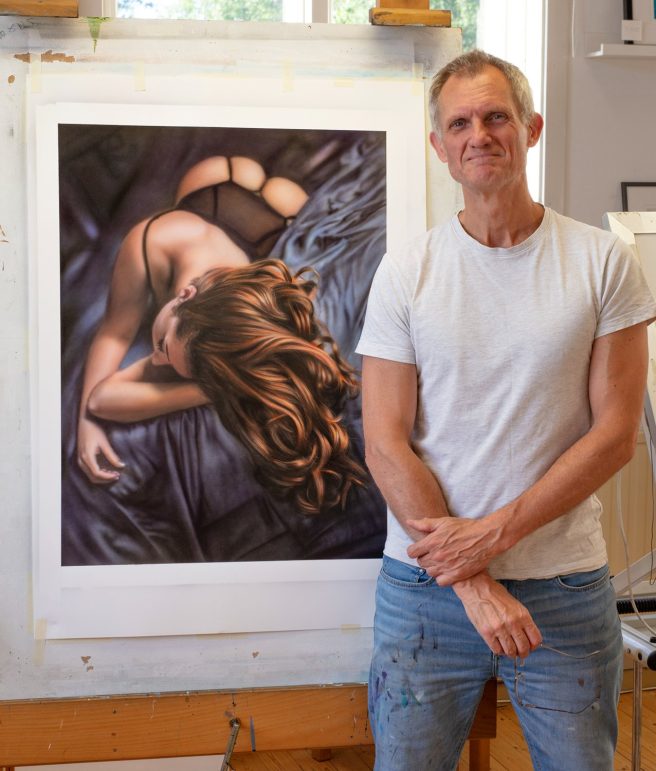
Johannes Wessmark in his studio.
His mother supported and encouraged his creative talent, once buying him a book entitled, “The Boy Who Wanted to Paint the World’s Most Beautiful Painting.” Call it mother’s intuition or uncanny prescience; today Wessmark is one of the world’s leading hyperrealistic artists.
Wessmark admits he’s not as overtly pedantic in ordering his life now, but technical precision and attention to detail remain important characteristics of his work.
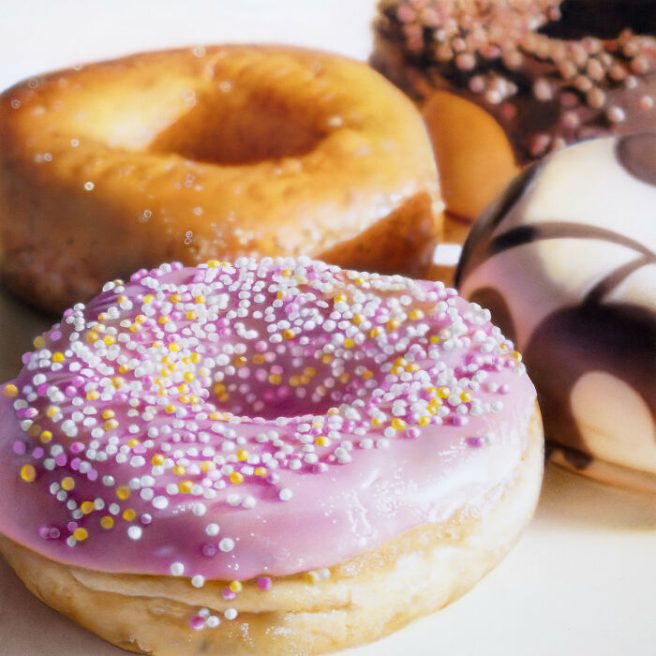
I “discovered” Wessmark’s amazing photorealistic paintings while searching for – of all things – donuts (you’re not surprised?). Of course I assumed this beautiful stack was a mouthwatering photo.
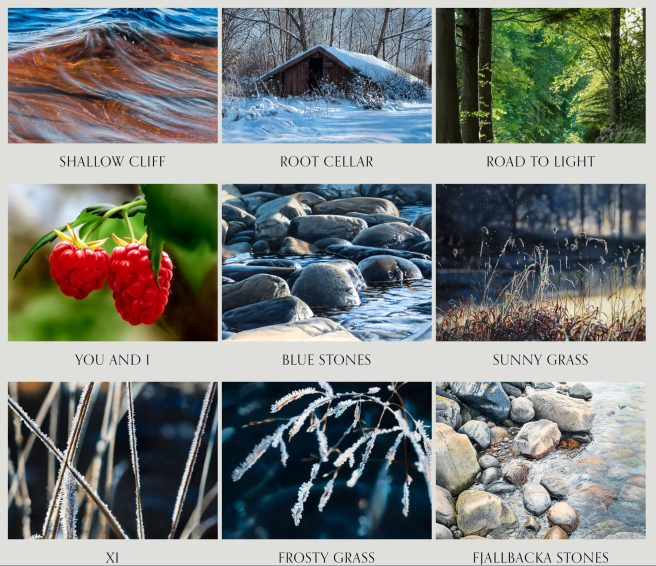
When I discovered it was actually a painting, naturally I hungered for more. I’ve since learned that although Wessmark excels in still lifes, he especially loves painting figuratives and landscapes. In particular, beautiful women in water. With his figurative motifs, he wishes to convey a feeling of calm and relaxation.
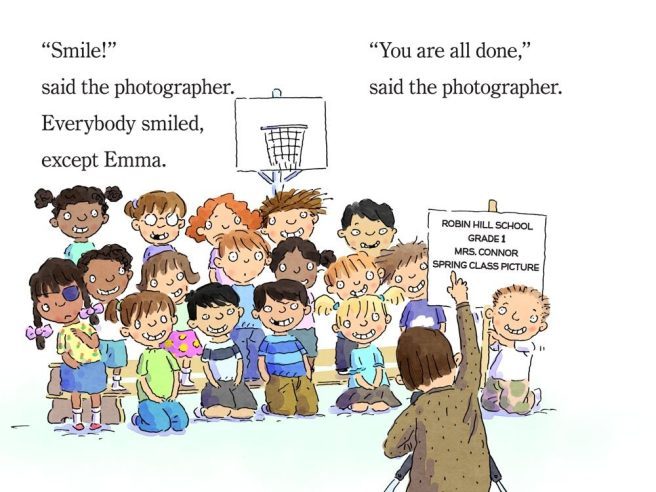
~ from Class Picture Day by Margaret McNamara and Mike Gordon (2011).
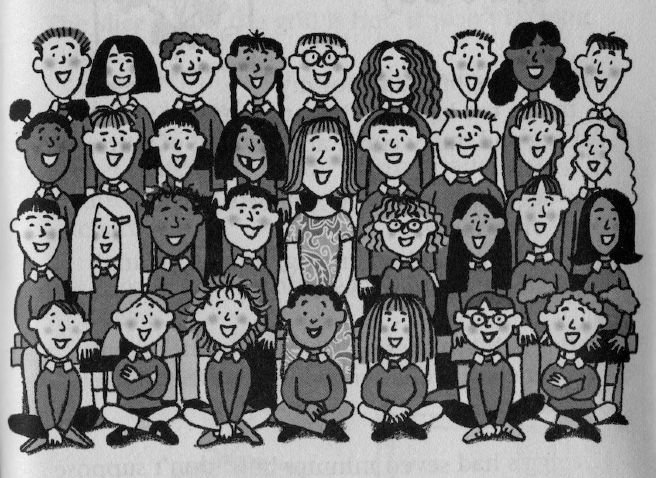
Class pictures are a lot of fun. As the poem describes, there are interesting stories behind those seemingly innocent smiles.
It’s actually kind of miraculous to see a school photo where everyone is behaving themselves. Sometimes there’s a kid who makes a face right as the camera clicks, another who decides to call out something at the last minute – hence an open mouth – or another who blinks. Those who photograph children have to be extra patient; being able to bring out the best in one’s subjects is a true talent.
#63 in an ongoing series of posts celebrating the alphabet.
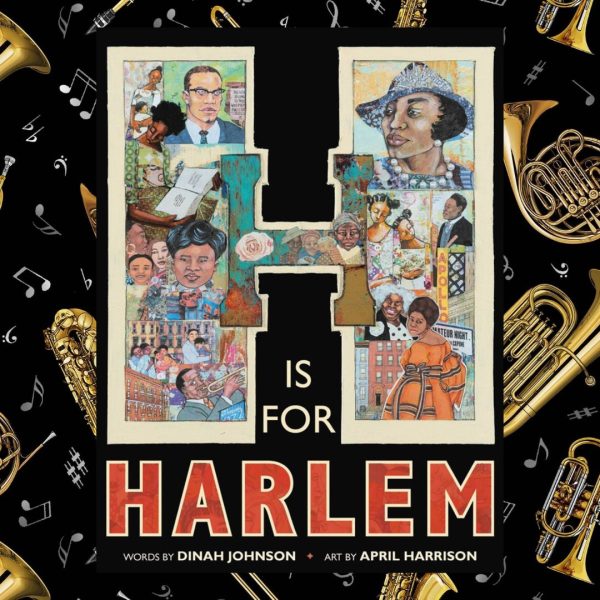
If I had to choose one word to describe H is for Harlem, it would be “alive” – deliciously, soulfully, jubilantly alive.
Generous in its carefully curated offerings and beautiful in its execution, this sumptuous abecedarian celebration of Harlem’s rich cultural history pulsates with energy, inviting readers to explore, discover, and marvel.
As author Dinah Johnson writes, “Harlem is a place like no other in the world . . . It is truly multicultural. But for a long time people have called Harlem the mecca of Black America, a place where African American culture is living and breathing, shining and indestructible.”
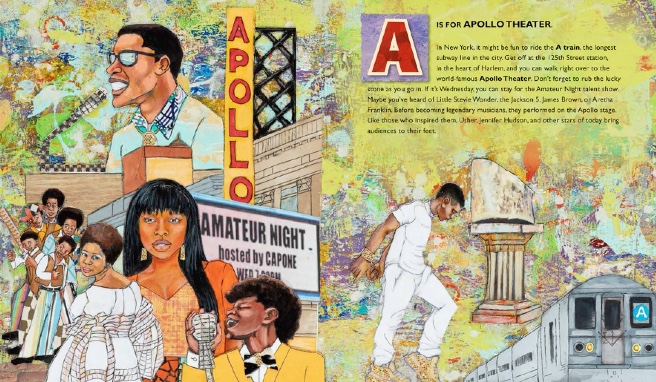
From “A is for Apollo Theater” to “Z is for Zora Neale Hurston,” we learn about Harlem’s unique treasures – seminal people, places, organizations, communities – making up the fascinating tapestry of this storied New York neighborhood.
Johnson describes the well known (Harlem Globetrotters, Malcolm X, Harriet Tubman) as well as the less familiar (Mabel Fairbanks, Impact Farm, Opportunity Magazine), with just enough facts to whet the appetite, encouraging further research.
Since I especially love music, I was happy to read about the iconic Apollo Theater, the Boys Choir of Harlem, and the National Jazz Museum in Harlem. It was exciting seeing some of my faves mentioned: Aretha Franklin, Stevie Wonder, Jackson 5, Jennifer Hudson, Louis Armstrong, Ella Fitzgerald, Wynton Marsalis. Just imagine the convergence of such genius and talent, the creative cross-fertilization among all the arts that continues today!
Johnson also tucked in some new-to-me nuggets along the way. Are you familiar with Cicely Tyson’s role in inspiring the creation of the Dance Theatre of Harlem? Though I was familiar with Zora Neale Hurston’s novels, I didn’t know she was also an anthropologist, or that she is credited by some to have been the first African American to debut a Broadway play.
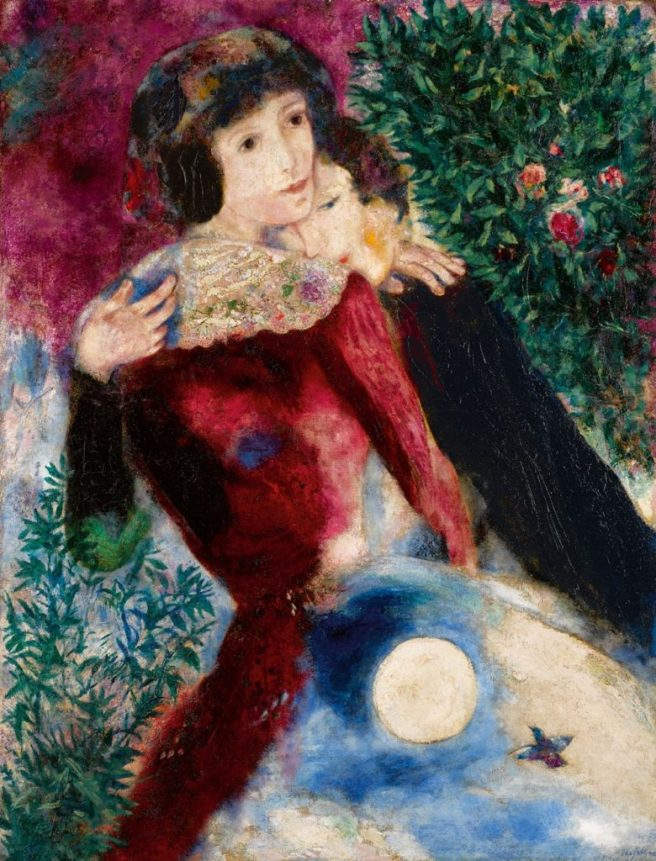
Just for you:A perfect evocation of love in anticipation of Valentine’s Day. ♥️
“Les Amoureux” by Marc Chagall(1928).
TOUCH THE AIR SOFTLY
by William Jay Smith

Now touch the air softly, step gently, one, two …
I’ll love you ’til roses are robin’s egg blue;
I’ll love you ’til gravel is eaten for bread,
And lemons are orange, and lavender’s red.

Now touch the air softly, swing gently the broom.
I’ll love you ’til windows are all of a room;
And the table is laid, And the table is bare,
And the ceiling reposes on bottomless air.

I’ll love you ’til heaven rips the stars from his coat,
And the moon rows away in a glass-bottomed boat;
And Orion steps down like a river below,
And earth is ablaze, and oceans aglow.

So touch the air softly, and swing the broom high.
We will dust the grey mountains, and sweep the blue sky:
And I’ll love you as long as the furrow the plough,
As however is ever, and ever is now.

~ from The Girl in Glass: Love Poems (Books & Co., 2002)
*
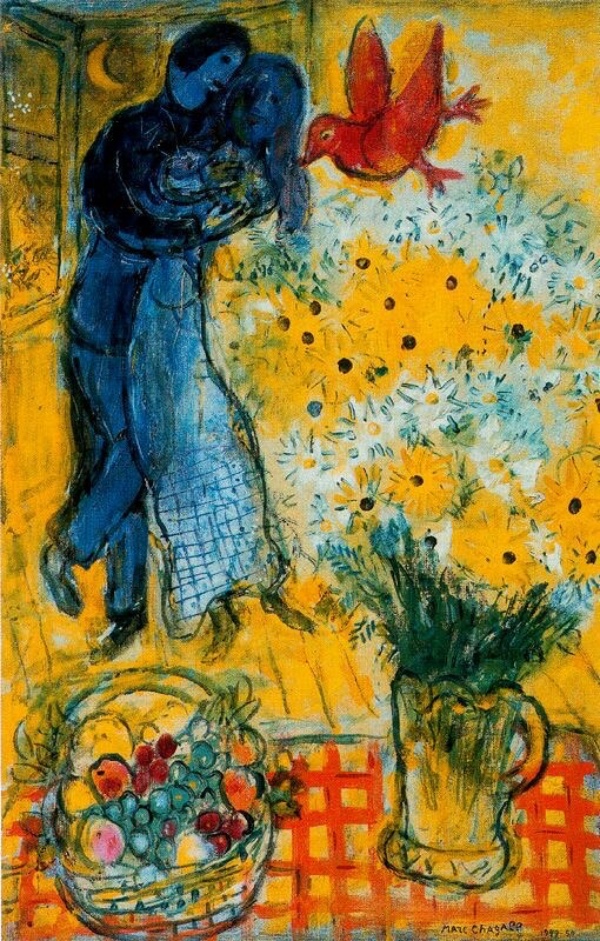
“Lovers with Daisies,” by Marc Chagall (1949-59).
I was totally enchanted by every word of this lyrical gem, which is alternately titled “A Pavane for the Nursery.” Something about, ‘step gently, one, two’ struck me as an ingenuous invitation to delight.
This poem has been set to music by several composers, is a popular choral piece, and is often sung or recited at weddings.
A former U.S. Poet Laureate, William Jay Smith once said, “Great poetry must have its own distinctive music; it must resound with the music of the human psyche,” and this poem certainly bears that out.
Smith favored traditional poetic styles to free verse, hence his use of a rhymed metrical-stanzaic structure here. His pronouncements are charming as well as disarming despite the formal style. Who can resist “the moon rows away in a glass-bottomed boat,” or “we will dust the grey mountains and sweep the blue sky”?
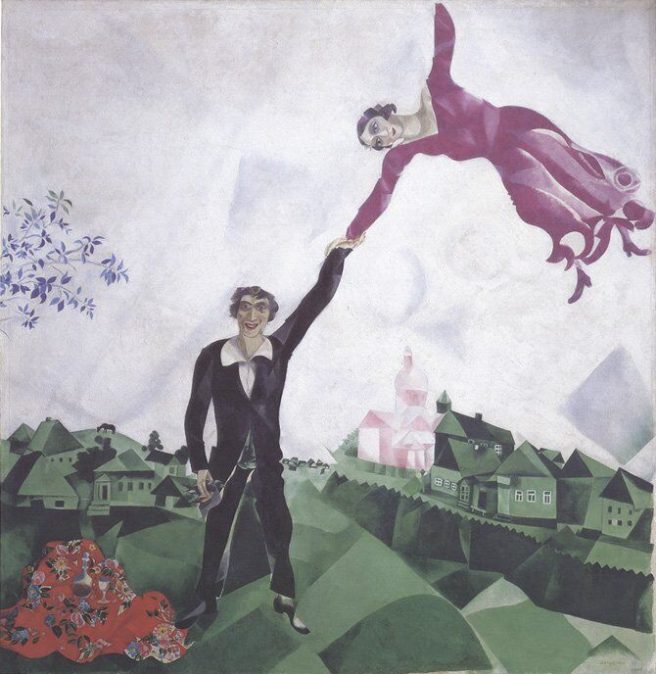
“La Promenade,” by Marc Chagall (1918).
Brooms are symbols of good luck, as they can be used to “sweep away” evil spirits or bad fortune. According to an old Welsh custom, newlyweds should enter their new home by stepping over a broom so luck will follow them. Similarly, if a bride and groom jump over a broom during their marriage ceremony, good luck and fortune will flourish in their union.
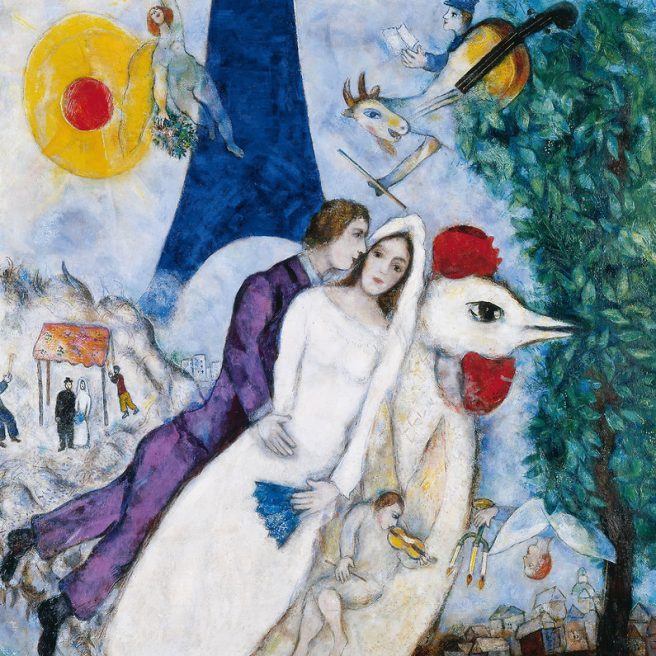
Upon reading this poem, I thought immediately of Marc Chagall. After all, he’s considered “the ultimate painter of love.” He masterfully captured the euphoria of love with his levitating lovers, who blissfully float on air, defying gravity, soaring beyond earthly realms as one.
“Bride and Groom of the Eiffel Tower,” by Marc Chagall (1938-39).
His wife Bella was not only the love of his life, but the muse who inspired his best work. He said, “Is it not true that painting and color are inspired by love? In art, as in life, all is possible when conceived in love.”
I thought Chagall’s flying lovers a good match for Smith’s poem, for it is the life-sustaining purity of air that blesses those united in love, enfolding them in their own universe.
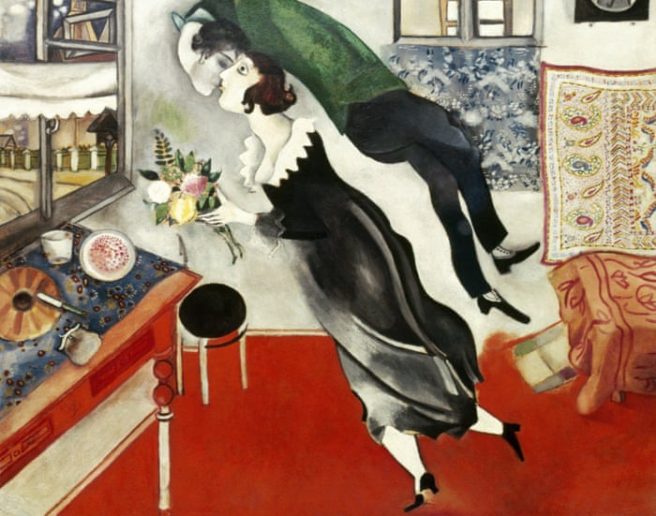
“Birthday” by Marc Chagall (1924).
After listening to several renditions of this poem put to music, I decided my favorite is by Minnesota folk musician Peter Mayer. His crisp, warm, fluid acoustic treatment is perfection.
♥️ HAPPY VALENTINE’S DAY! ♥️
*
The lovely and talented Carol Varsalona is hosting the Roundup at Beyond LiteracyLink. Waltz on over to check out the full menu of poetic goodness being served up around the blogosphere this week. Enjoy your weekend and watch out for cupid’s arrows next week. 🙂
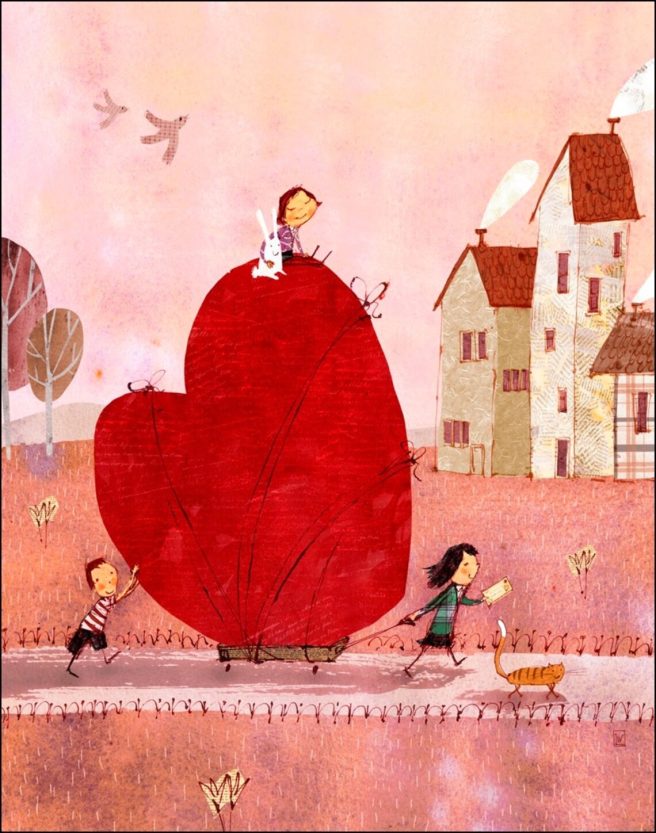
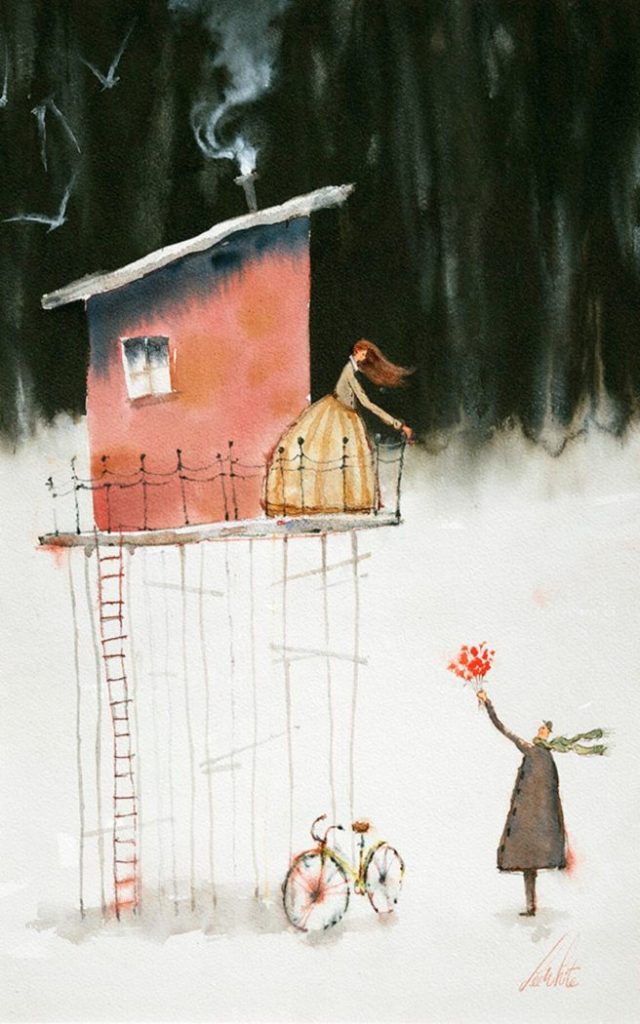
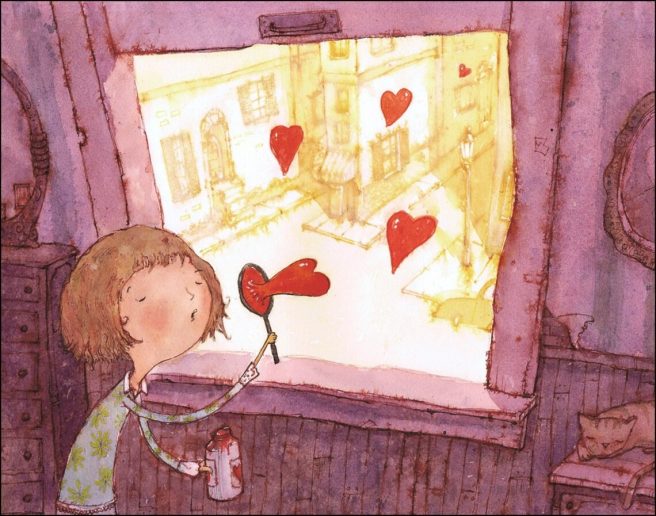
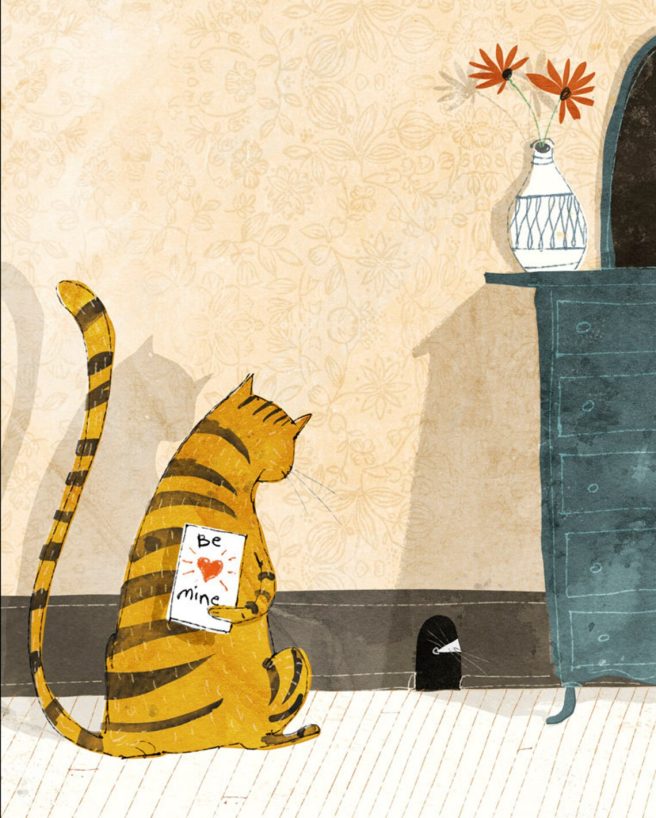
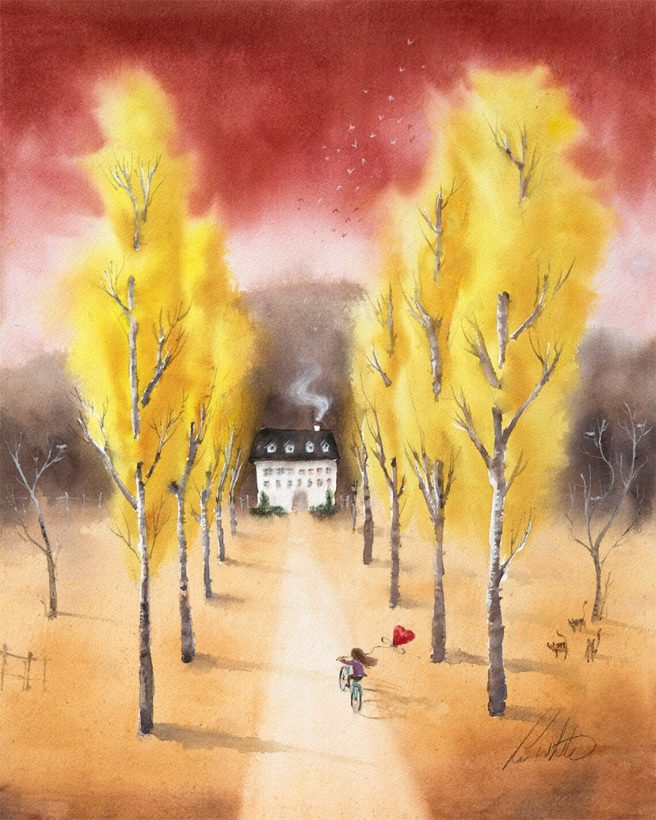
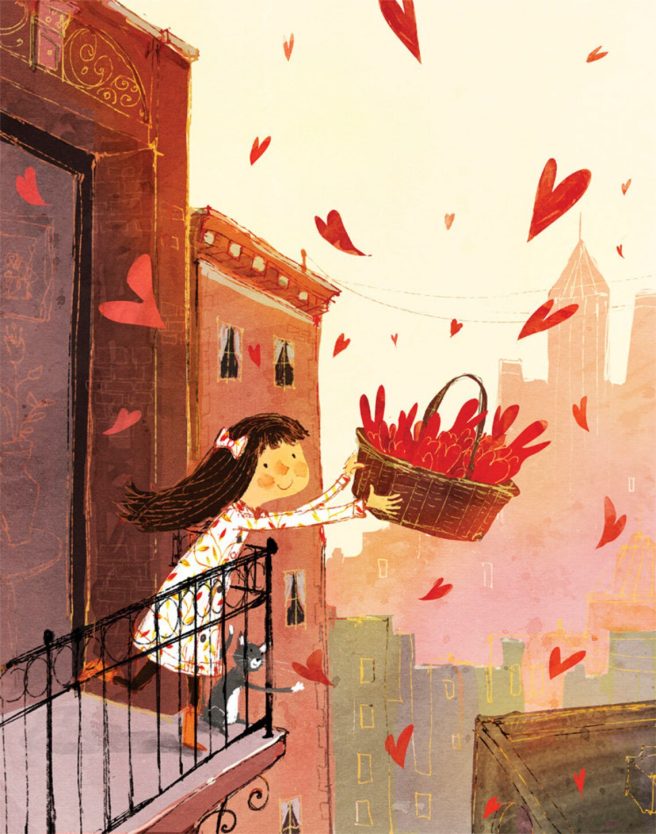
1. Happy February! We’re celebrating the month of love with some of Lee White’s Valentine’s Day prints and cards.
You may be familiar with Lee’s work as a children’s book illustrator (Kate, Who Tamed the Wind; The Maine Coon’s Haiku, I Lived on Butterfly Hill). He’s also done commercial projects for clients such as Disney, Verizon, National Geographic and Marks & Spencer, and teaches painting via The Society of Visual Storytelling, an online art school for artists of all skill levels.
Lee works mainly in watercolor, but likes to include other media such as ink, colored pencil and collage.






 Jama's Alphabet Soup