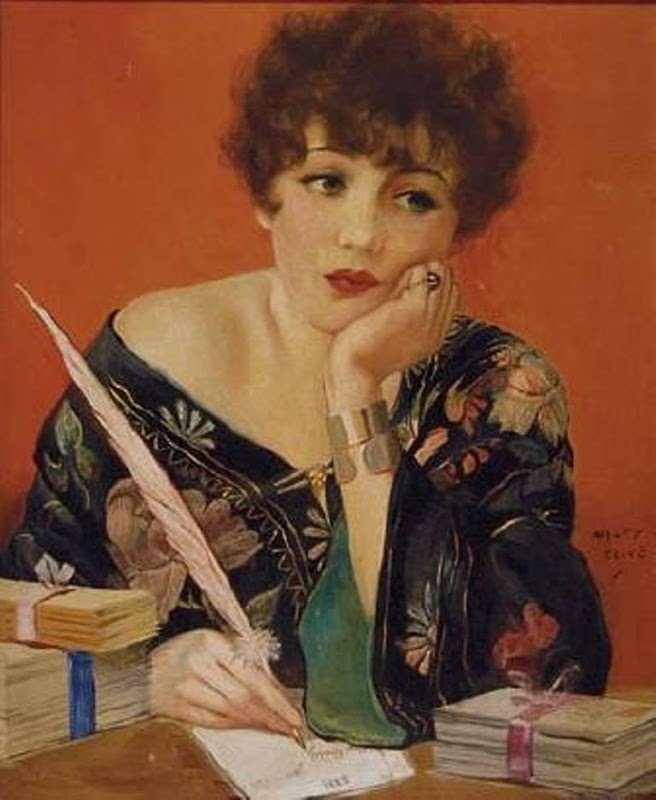
“Woman Writing Letter at Desk” by Henry Clive (ca. 1940s).
EXCHANGE OF LETTERS by Wendy Cope
'Man who is a serious novel would like to hear from a woman who is a poem' (classified advertisement, New York Review of Books).
Dear Serious Novel,
I am a terse assured lyric with impeccable rhythmic flow, some apt and original metaphors, and a music that is all my own. Some people say I am beautiful.
My vital statistics are eighteen lines, divided into three-line stanzas, with an average of four words per line.
My first husband was a cheap romance; the second was Wisden’s Cricketers’ Almanac. Most of the men I meet nowadays are autobiographies, but a substantial minority are books about photography or trains.
I have always hoped for a relationship with an upmarket work of fiction. Please write and tell me more about yourself.
Yours intensely, Song of the First Snowdrop
Dear Song of the First Snowdrop,
Many thanks for your letter. You sound like just the kind of poem I am hoping to find. I’ve always preferred short, lyrical women to the kind who go on for page after page.
I am an important 150,000 word comment on the dreams and dilemmas of twentieth-century Man. It took six years to attain my present weight and stature but all the twenty-seven publishers I have so far approached have failed to understand me. I have my share of sex and violence and a very good joke in chapter nine, but to no avail. I am sustained by the belief that I am ahead of my time.
Let’s meet as soon as possible. I am longing for you to read me from cover to cover and get to know my every word.
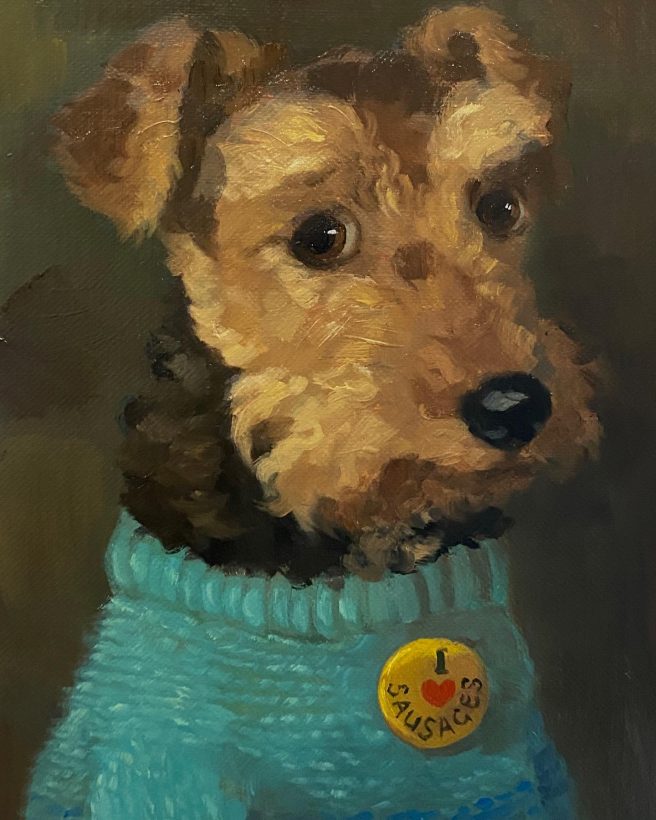
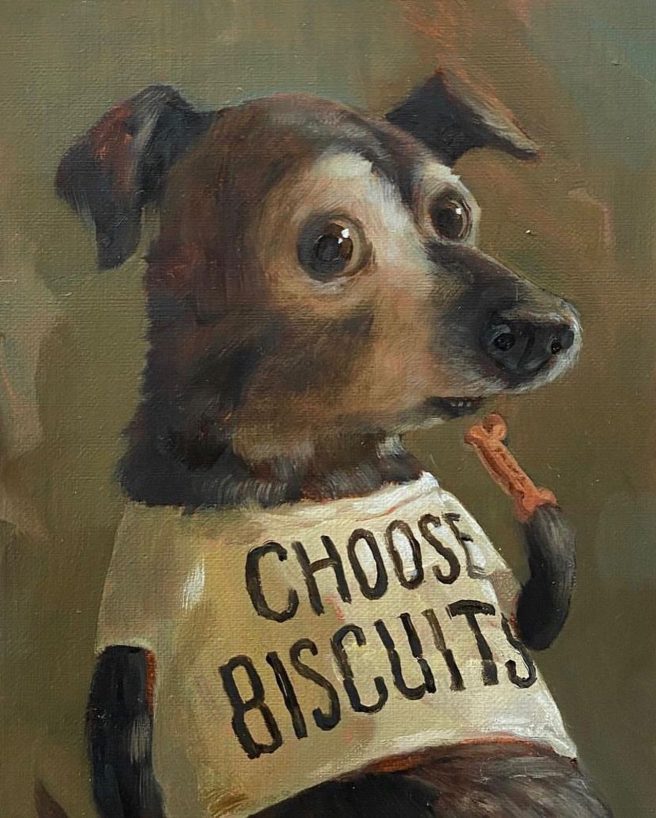
Awwww . . . will you just look at that face? Who could resist a dog who loves sausages? If he came to my house, I’d served him bangers and mash for breakfast, toad in the hole for lunch, and a mixed platter of bratwurst, chorizo, and Cumberland for supper. I hope he likes me just as much as I like him. 🙂
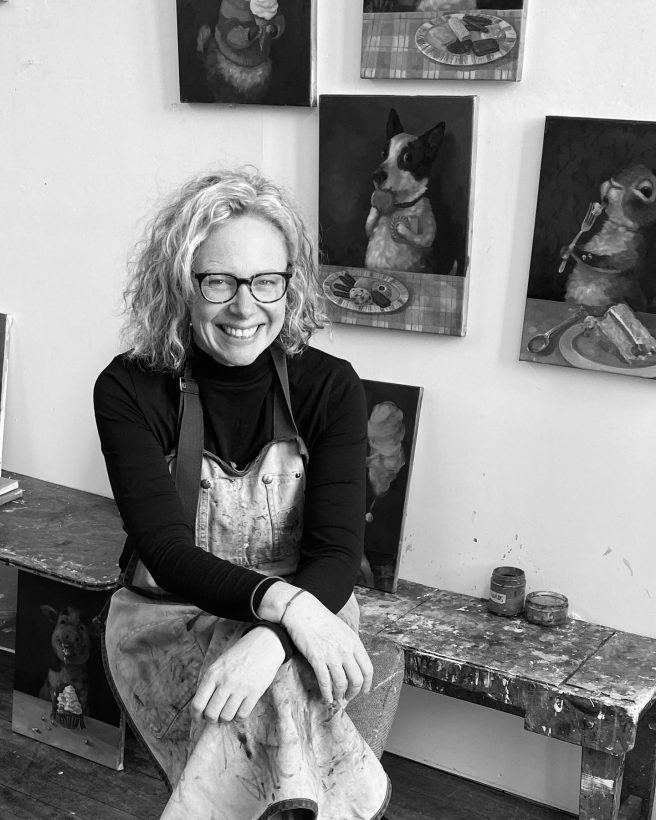
British artist and illustrator Alison Friend.
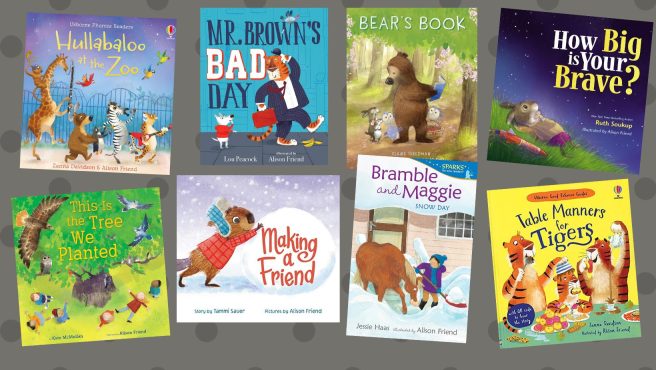
Our sausage loving friend was created by UK artist Alison Friend (perfect name). You may know her as the illustrator of over 20 children’s books (Bramble and Maggie series, Making a Friend (Tammi Sauer), Bear’s Book (Claire Freedman), Mr. Brown’s Bad Day (Lou Peacock)).
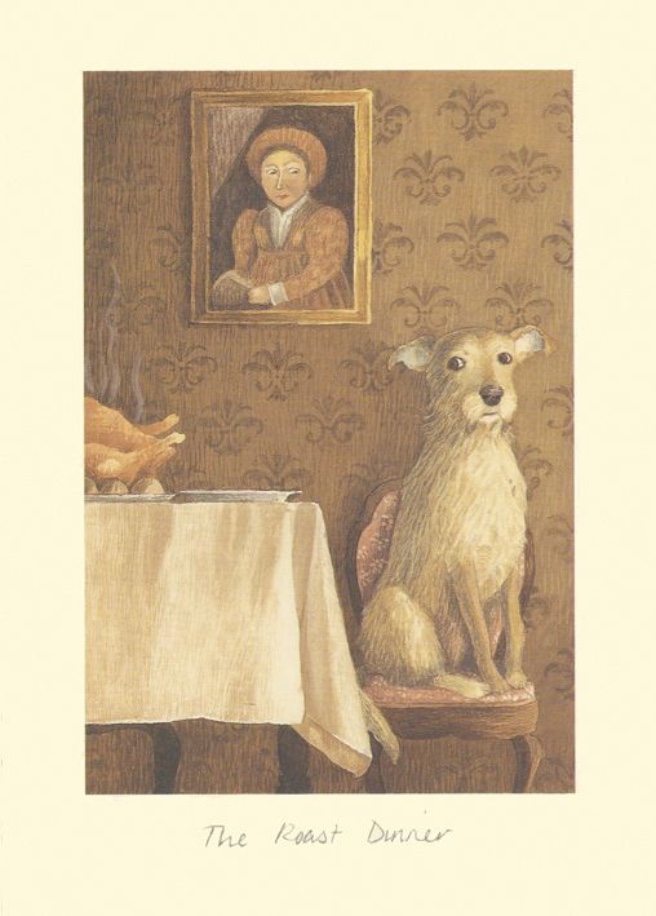
I first saw her art on greeting cards she designed for the publisher Two Bad Mice, which preceded her picture book work. Painting animal portraits was a natural progression from creating anthropomorphic characters for children’s stories. She’s a lifelong animal lover and began drawing in childhood.
First greeting card I saw featuring Alison’s art.
Born in l973, Alison graduated with a degree in Fine Art and Printmaking from Nottingham Trent University in England. She was also the first female stonemason for the City of Nottingham. She currently lives in the Lake District.
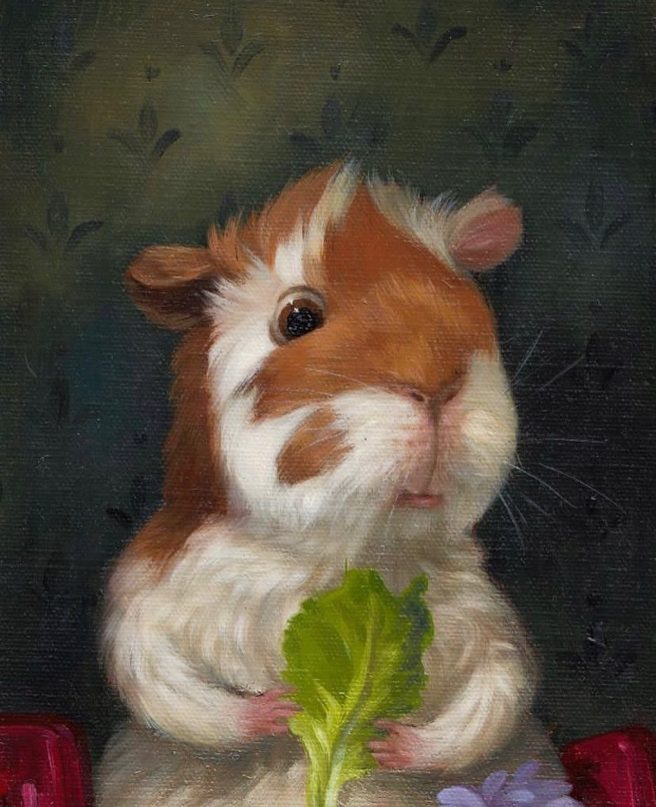
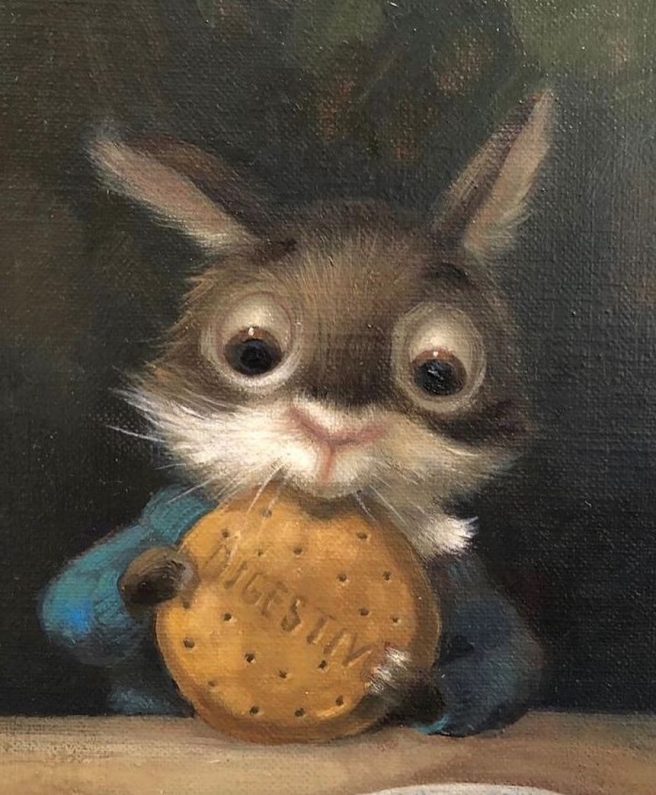
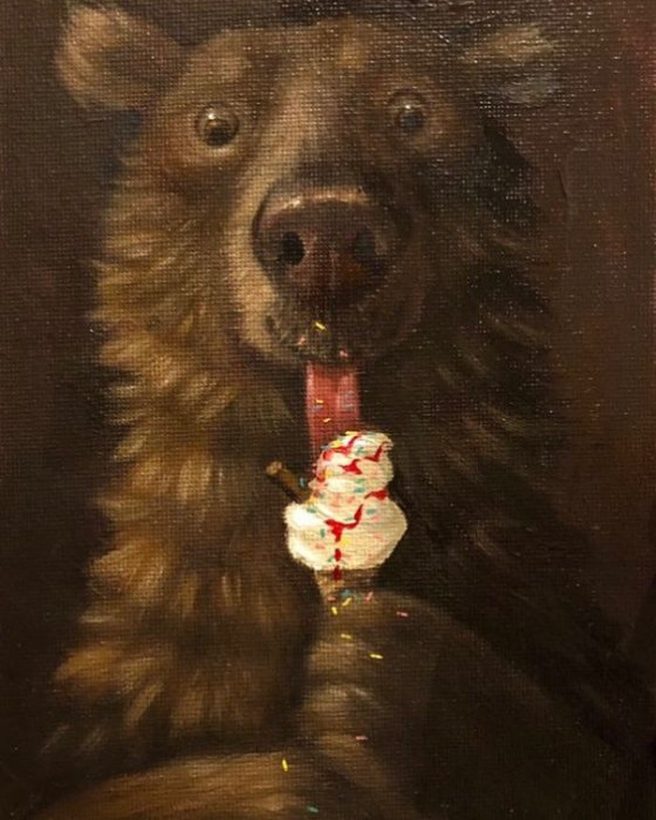
Her animal paintings blend realism with humor. She’s brilliant at capturing facial expressions and conveying the emotions of her subjects. Check out the cheeky grins, side eyes, mischievousness, surprise, innocence, and earnestness. The longing gazes and overall adorableness melt the heart. So much personality! It’s amazing how endearing these animals are; people connect with them right away.
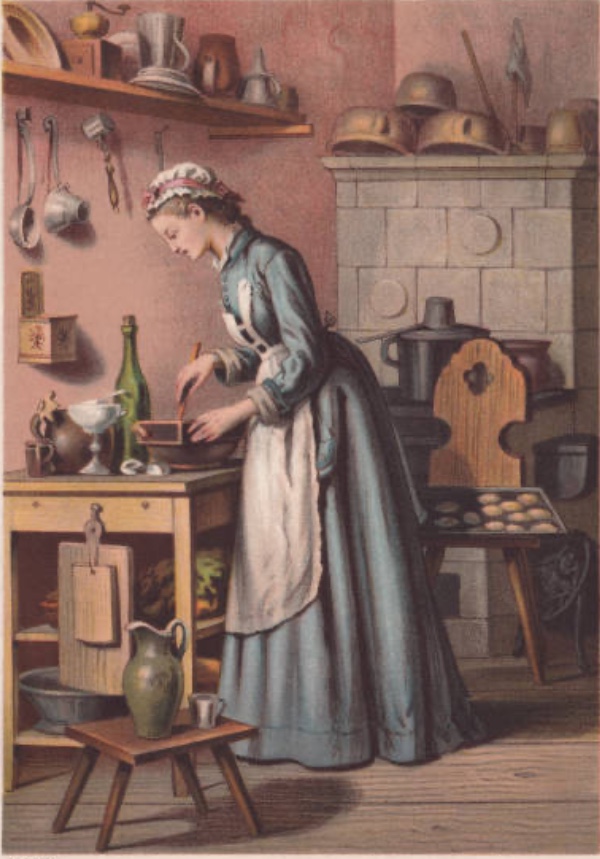
American Fireside Poet James Russell Lowell elevates a humble cookie to romantic delectability in his amusing recipe poem. I wish Eleanor would make some of her macaroons for my birthday. 🙂
Chromolithograph after a drawing by Hugo Bürkner (1878).
ELEANOR MAKES MACAROONS
by James Russell Lowell

Light of triumph in her eyes,
Eleanor her apron ties;
As she pushes back her sleeves,
High resolve her bosom heaves.
Hasten, cook! impel the fire
To the pace of her desire;
As you hope to save your soul,
Bring a virgin casserole,
Brightest bring of silver spoons,—
Eleanor makes macaroons!

Almond-blossoms, now adance
In the smile of Southern France,
Leave your sport with sun and breeze,
Think of duty, not of ease;
Fashion, ’neath their jerkins brown,
Kernels white as thistle-down,
Tiny cheeses made with cream
From the Galaxy’s mid-stream,
Blanched in light of honeymoons,—
Eleanor makes macaroons!

Now for sugar,—nay, our plan
Tolerates no work of man.
Hurry, then, ye golden bees;
Fetch your clearest honey, please,
Garnered on a Yorkshire moor,
While the last larks sing and soar,
From the heather-blossoms sweet
Where sea-breeze and sunshine meet,
And the Augusts mask as Junes,—
Eleanor makes macaroons!

Next the pestle and mortar find,
Pure rock-crystal,—these to grind
Into paste more smooth than silk,
Whiter than the milkweed’s milk:
Spread it on a rose-leaf, thus,
Cate to please Theocritus;
Then the fire with spices swell,
While, for her completer spell,
Mystic canticles she croons,—
Eleanor makes macaroons!

Perfect! and all this to waste
On a graybeard’s palsied taste!
Poets so their verses write,
Heap them full of life and light,
And then fling them to the rude
Mumbling of the multitude.
Not so dire her fate as theirs,
Since her friend this gift declares
Choicest of his birthday boons,—
Eleanor’s dear macaroons!

(February 22, 1884)

~ from Heartsease and Rue (Houghton Mifflin, 1888)
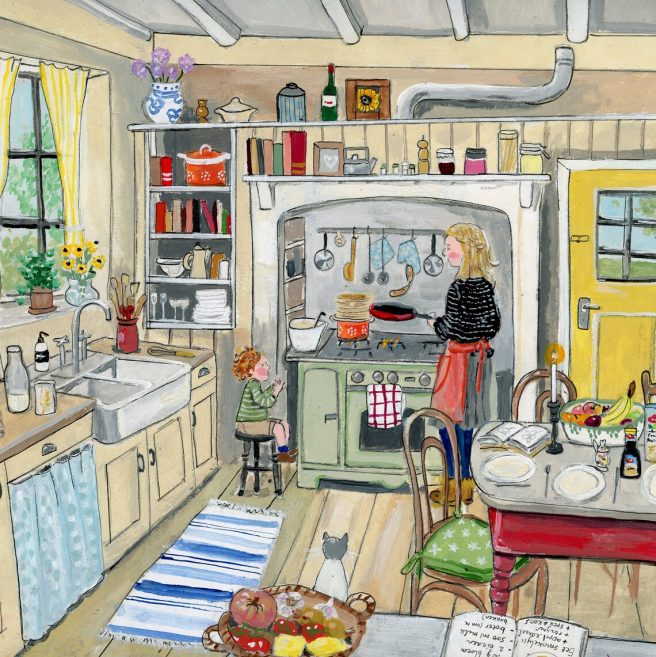
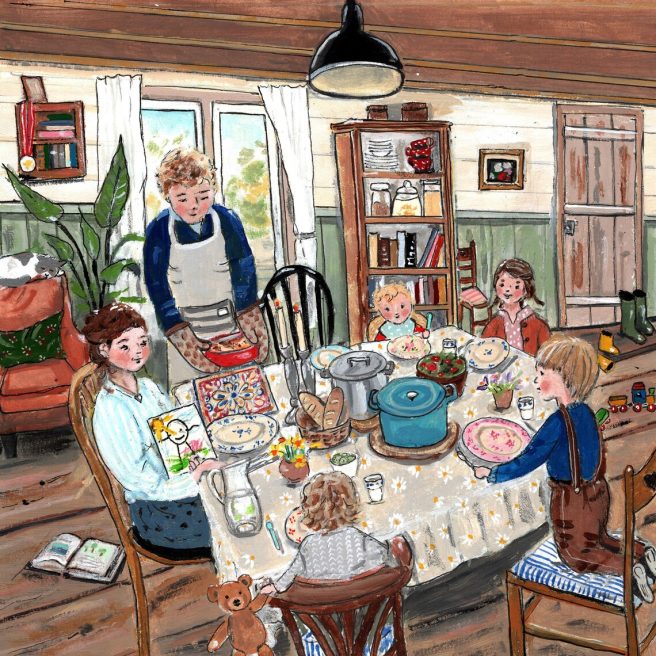
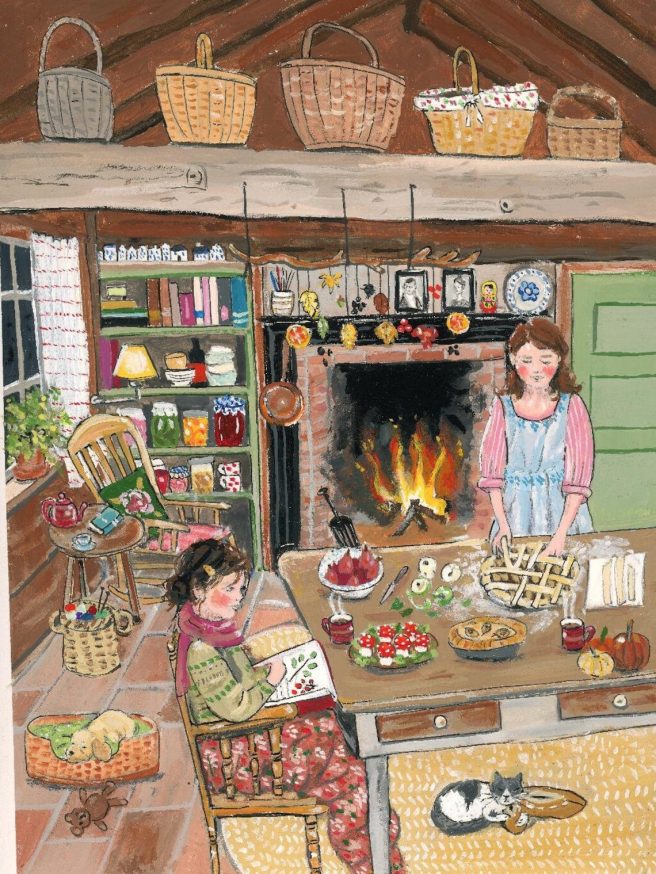
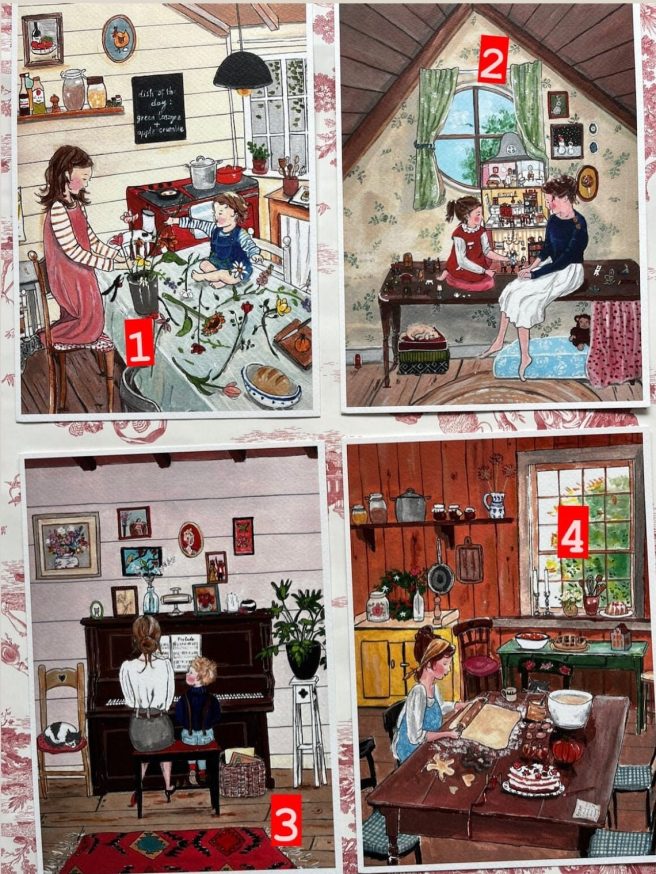
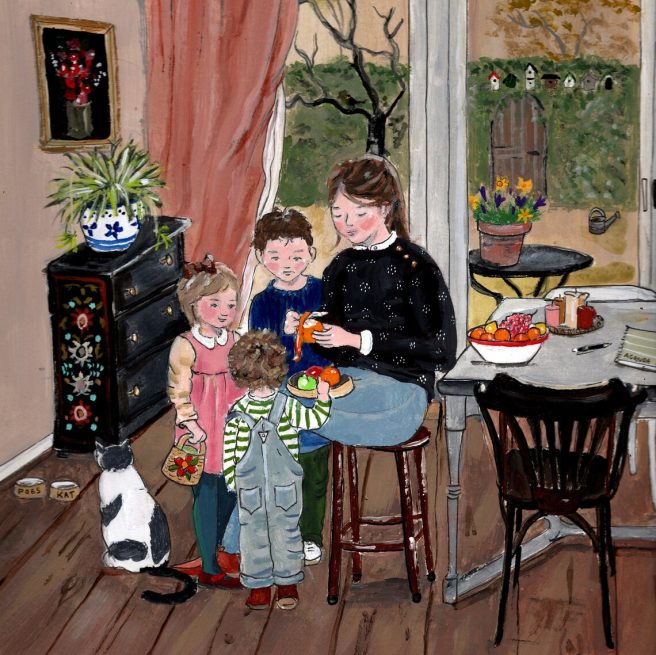
We’re flippin’ out over Gwen van Knippenberg’s charming art. Known for their beautiful colors and minute detail, Gwen’s feel-good paintings capture the cozy comforts of home and family life, the joys of nature and gardening, and the sheer enchantment of simple things.
Based in the Netherlands, Gwen recently became a full-time artist after spending many years at home raising her four children. I love studying the people in her pictures and imagining their stories. She depicts children with a sweetness and warmth that’s so life affirming.
Naturally my favorites are the kitchen scenes, showing families cooking, baking, or eating together. Can’t you just imagine the heavenly aromas of the delicious homemade treats they’re making?
Look at the hug yourself adorableness of this baby and teddy in a washtub! And how good those clothes hanging on the line must smell after drying in the fresh air!
Spoon up a hearty bowl of metaphors, savor a simile, sip a warm couplet of cocoa.
Yes, it’s poetry for breakfast! As the most important meal of the day, nothing hits the spot like “the best words in the best order.”
For our first poem of 2024, here’s a soul nourishing treat by Maryland poet Merrill Leffler. We’re looking forward to serving up another year of chewy verse to satisfy your cravings every Friday. Enjoy!
*
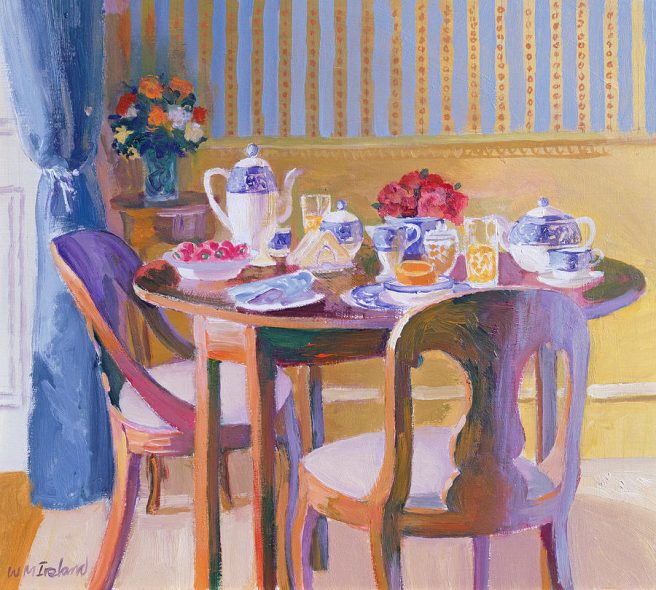
“Breakfast Table” by William Ireland.
BREAKFAST
by Merrill Leffler

In memory of William Stafford

This morning I’ll skip the bacon
and eggs and have a poem over light —
two or three if you don’t mind.
I feel my appetite coming on.
And even a stack of flapjacks
which I love — with butter
and boysenberry jam spreading
their fingers of sweetness over
the ragged edges — won’t do me now.
When this hunger’s on, only a poem
will do, one that will surprise my need
like a stranger knocking
at the door (a small knock — at first,
I hardly hear it) to ask directions,
it turns out, to this house. He’s looking
for me. Who are you I ask? Your brother
he says, the one you never knew you had
or the one who you’ve been trying to remember
all your life but somehow couldn’t recall
until now, when he arrives.
And there he is
before me smiling, holding out his arms
— and all this by chance. Do you
believe it?
So serve me up a poem friend,
but just go easy on the tropes,
for instance, synecdoche and such. A simile
or two is fine and metaphor’s all right.
A rhyming quatrain, maybe on the side
would be ok, but not too much —
they sometimes give me gas.
God I love a breakfast such as this.
It gives me a running start and keeps me going
through to dark when I’m as hungry as a horse.
But that’s another poem. Let’s eat.

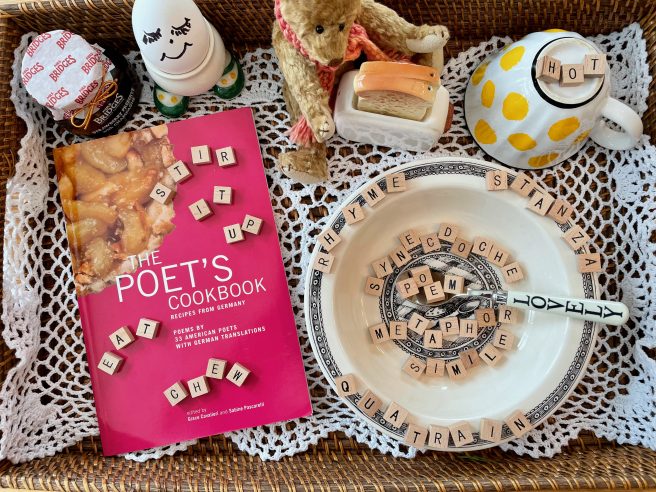
~ from The Poet’s Cookbook: Recipes from Germany, edited by Grace Cavalieri and Sabine Pascarelli (Forest Woods Media Productions, Inc., 2010)
*
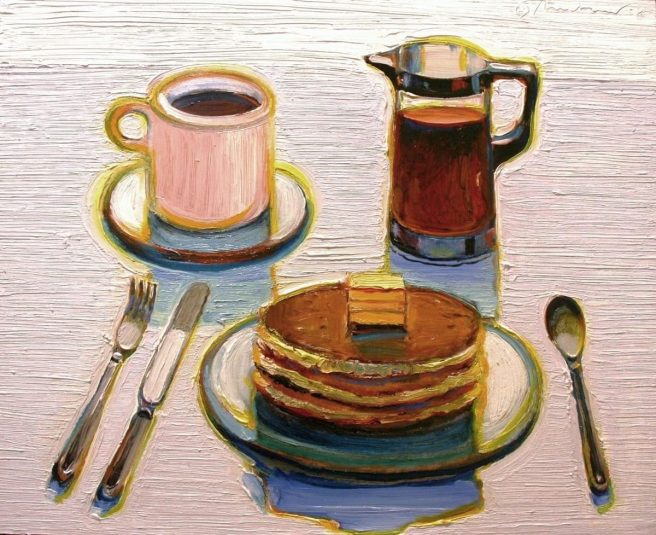
“Pancake Breakfast” by Wayne Thiebaud.
So clever and delightful! They say man can’t live by bread alone, and this poem feeds both mind and heart.
It gives us what we didn’t even know we needed.
Don’t you love how Leffler speaks of poems in terms of “a stranger knocking at the door”? That little nudge of sudden recognition, then the realization (and joy) that something you’ve thought or felt has been given voice? Like a long lost relative, there is a marvelous kinship, this knowing — a poem is a loving human embrace put into words.
I like the warmth and playfulness, the wit of the extended metaphor — all delivered with friendly familiarity. Leffler tickles my fancy and leaves me hungry for more. What’s for lunch? 🙂
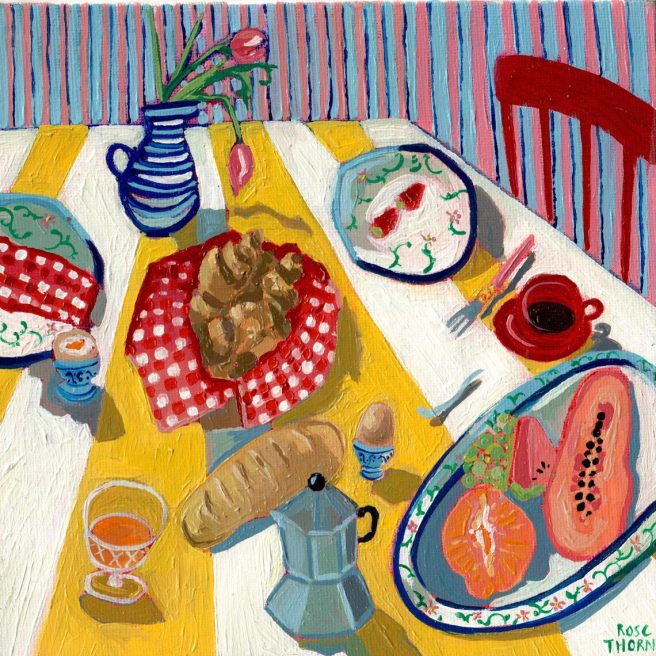
“French Breakfast” by Rose Thorn.
*
Merrill Leffler is the author of three books of poems: Mark the Music (2012), Take Hold (1997), and Partly Pandemonium, Partly Love (1984). The publisher of Dryad Press, which has been publishing literary books since 1975, he has also guest edited issues of such literary journals as Poet Lore, Shirim, and Beltway Poetry Quarterly. One of the founders of The Writer’s Center in Bethesda, Leffler taught literature at the University of Maryland and the U.S. Naval Academy until the early 1980s, and for more than 20 years was a science writer at the University of Maryland Sea Grant Program, which focuses on issues related to the Chesapeake Bay ecosystem. He lives with his wife Ann Slayton in Takoma Park, Maryland, where he served as Poet Laureate, 2011-2018.
*
The ever marvelous Mary Lee Hahn is hosting the Roundup at A(nother) Year of Reading. Stop by to check out the full menu of poetic goodness being served up around the blogosphere this week. Have a good weekend!

 Jama's Alphabet Soup