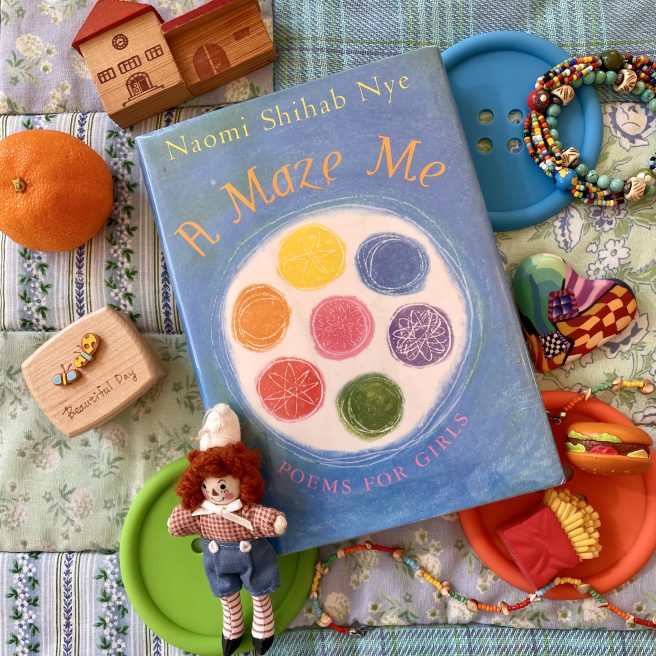
a pair of amazing poems by Naomi Shihab Nye (+ a giveaway)

Don’t you love it when a special book finds you just when you need it the most?

Recently Naomi Shihab Nye’s luminous collection, A Maze Me: Poems for Girls (Greenwillow, 2005), caught my attention while I was looking for poems about hope. I had shared “Sifter” here when Nye was first named Young People’s Poet Laureate back in 2019, but hadn’t read any other poems from the book.

Though I’m a longtime Nye fan, I somehow missed this one. Big mistake, huge oversight. Better late than never, but I truly wish I’d read this book 20 years ago.

Can’t remember the last time I was so moved, delighted, inspired, and yes, amazed by a collection of poems for tween girls. Nye actually had me at her Introduction, where she discusses her unsettling junior high years, a time when she was the only one among her friends who didn’t want to leave childhood behind for the grim restrictions of adulthood. She wanted to remain open, observant, impressionable, safe, “amazed forever.”
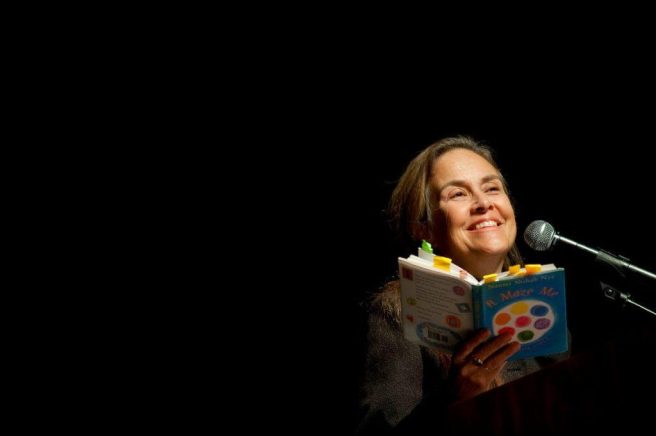
photo of Naomi Shihab Nye by Rajah Bose.

Her poems took me right back to my own tweenhood, a very odd, awkward experience where the only memories I have are of a favorite black velveteen skirt, the SRA Reading Lab (I was stuck at Green while my classmates zoomed up to Aqua), and slipping on a freshly mopped floor while being chased by my algebra teacher (whom I had teased). But I loved the Beatles, and that was enough for me.

Here are two of my favorite poems from A Maze Me: the first is about how small things can have a big impact; and the second describes the person I’m still striving to become.

*

Continue reading
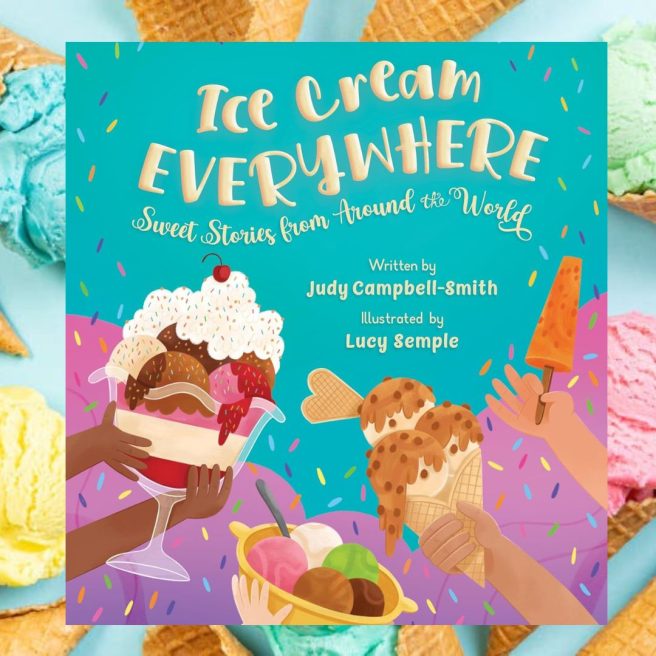
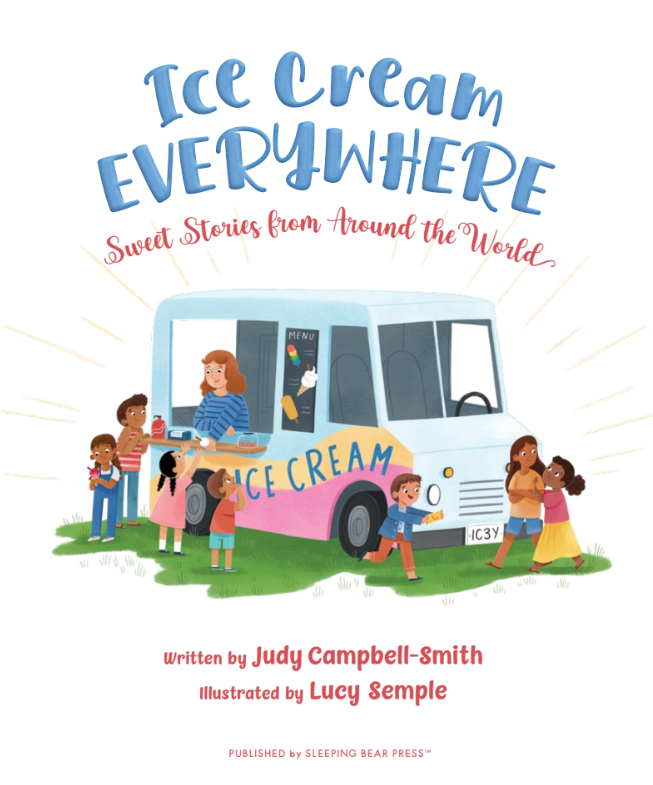
[lickable review] Ice Cream Everywhere by Judy Campbell-Smith and Lucy Semple

Many of my fondest food memories revolve around ice cream:

Lining up for a Milk-Nickel in the school cafeteria. Frequenting Dairy Queen for Dilly Bars and chocolate sundaes. Savoring Frosty Malts while watching Elvis Presley movies at the neighborhood theatre. Visiting my first Baskin-Robbins (butter pecan!). Raiding our home freezer for Creamsicles, Fudgsicles and Drumsticks. Jumping up and scrounging for coins when hearing the ice cream truck on our street.

Ice cream has got to be the happiest of treats because it brings out the kid in everyone. No matter the form or flavor, where or when you eat it, ice cream is pure joy.

Joy is the unifying theme in Judy Campbell-Smith’s scrumptious new picture book, Ice Cream Everywhere: Sweet Stories from Around the World, illustrated by Lucy Semple (Sleeping Bear Press, 2024).

On Judy’s menu: twelve different kinds of ice cream — most of which were new to me — from faraway places like Cuba, Argentina, India, Japan and New Zealand. Did you know that in Germany, ice cream can look like noodles, or that there’s a Turkish ice cream with a chewy, stretchy texture that allows sellers to do tricks with it? Or how about the unique Libyan treat, baklava gelato, a product of Italian colonialism? Fascinating stuff!

Tasty ice cream facts go down easy thanks to Campbell-Smith’s appetizing blend of fiction and nonfiction. Each double page spread features an appealing vignette of a child eating the highlighted ice cream + a few sidebar tidbits (history, tradition, context). Each is introduced as a different kind of joy.

Continue reading

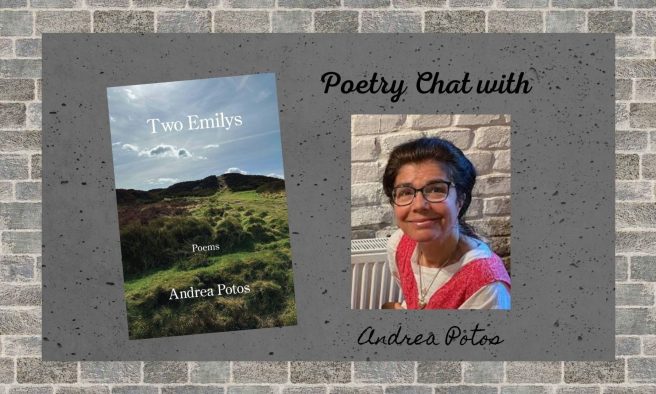
[chat + recipe + giveaway] Andrea Potos on Two Emilys

We’re happy to welcome Wisconsin poet Andrea Potos back to talk about her recently published chapbook, Two Emilys (Kelsay Books, 2025).

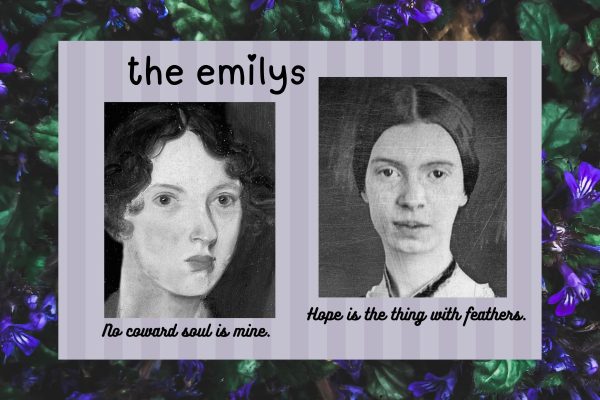
As you may have guessed, the “Emilys” in question are revered literary icons Emily Brontë and Emily Dickinson, contemporaries from opposite sides of the Atlantic who continue to mystify us with their creative genius. Though one was British and the other American, their lives had interesting parallels.

Both were unmarried and largely reclusive. They cherished home as sanctuary, wrote on scraps of paper while cooking and baking, were known for their bread recipes. The Emilys were religious skeptics living within religious families, and fascinatingly enough, they were ultimately Victorian badass writers “masquerading” as domestic spinsters, sublimating their passions and unfulfilled desires into art.

In Two Emilys, we travel with Potos to Haworth and Amherst via evocation, dream, memory, and imagination. She addresses her muses with awe and reverence, while acknowledging a unique kinship as fellow wanderer, keen observer, lover of beauty, and sister poet dedicated to her craft.

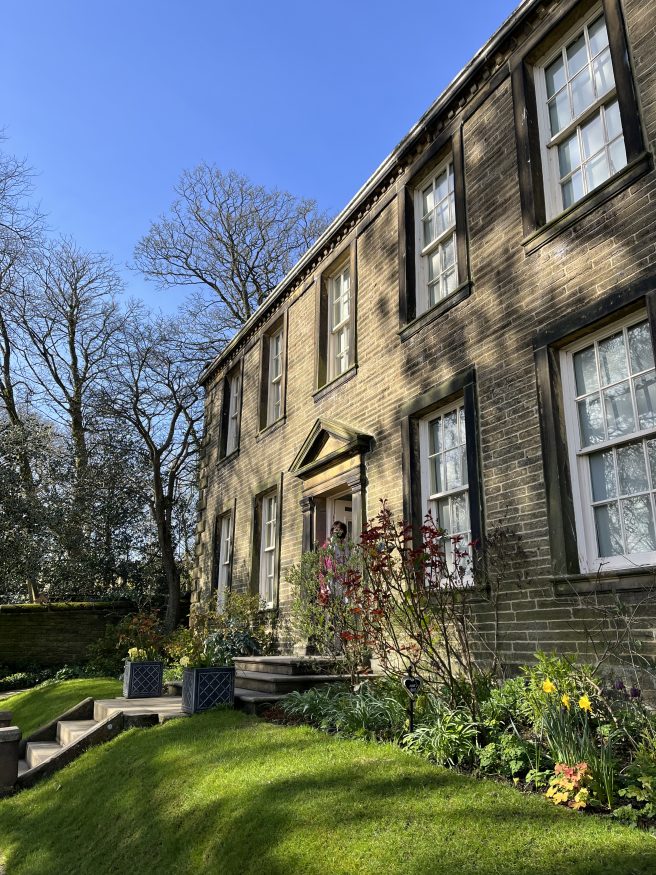
Andrea at the Brontë Parsonage, Haworth.

These poems are sheer loveliness to read with moments ethereal, delicate, sometimes humorous, warmed by genuine admiration. We thank Andrea for dropping by to tell us more about the book and for sharing all the wonderful photos + a delicious recipe. 🙂

*

Continue reading

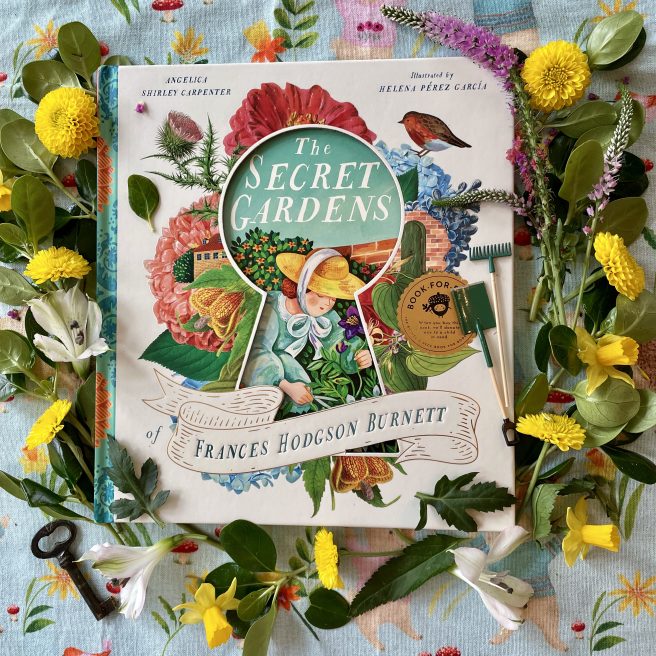
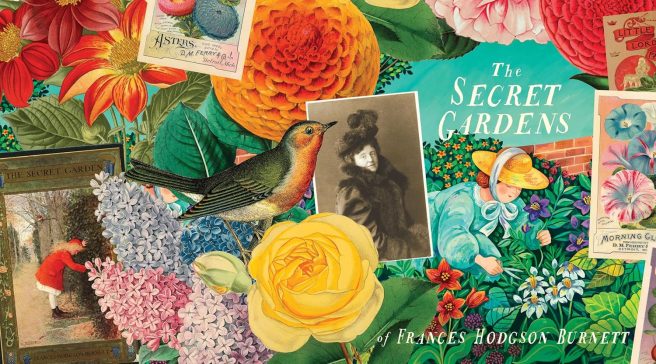
[review + recipe] The Secret Gardens of Frances Hodgson Burnett by Angelica Shirley Carpenter and Helena Pérez García

“As long as one has a garden one has a future; and as long as one has a future one is alive.” ~ Frances Hodgson Burnett

Since The Secret Garden has always been one of my favorite children’s books, I was especially excited to see Angelica Shirley Carpenter and Helena Pérez García’s recent picture book biography about Frances Hodgson Burnett.

Learning how Burnett coped with hardship and adversity in her own life shed new light on my appreciation of the novel. Now I understand why gardens were so important to her, not only as places of beauty and inspiration, but of comfort and healing. I also found it intriguing that she had a luxurious lifestyle that was shocking by Victorian standards (a twice divorced smoker who spent time away from her children). 🙂

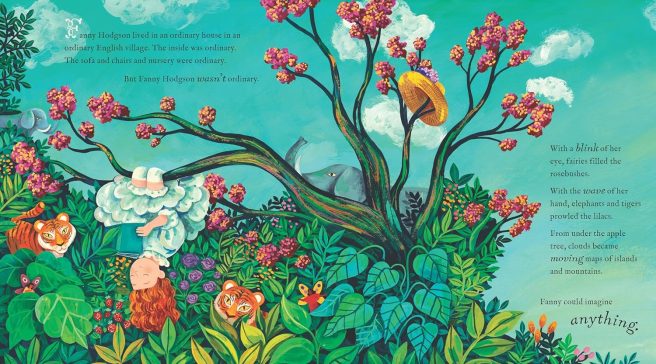
We first meet Fanny Hodgson as a girl who lived in “an ordinary house in an ordinary English village.” But Fanny herself was anything but ordinary because of her vivid imagination. In her world, “fairies filled the rosebushes” and “elephants and tigers prowled the lilacs.”

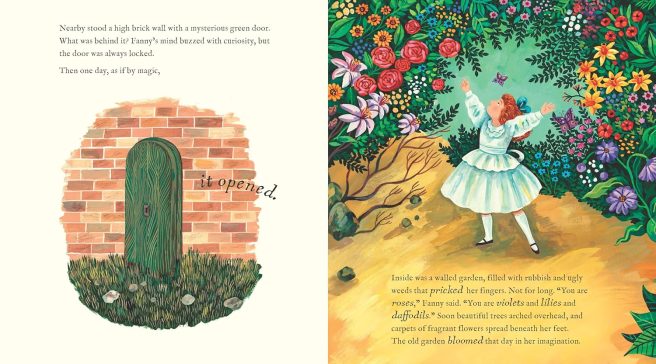
Her idyllic existence was upended when her father died (she was around six), and her family was forced to move to Manchester so her mother could run his store. The dull and grey city was a stark contrast to the beloved garden she’d left behind, but Fanny’s imagination sustained her, as she envisioned roses, violets, lilies and daffodils abloom in an old abandoned garden actually “filled with rubbish and ugly weeds.”

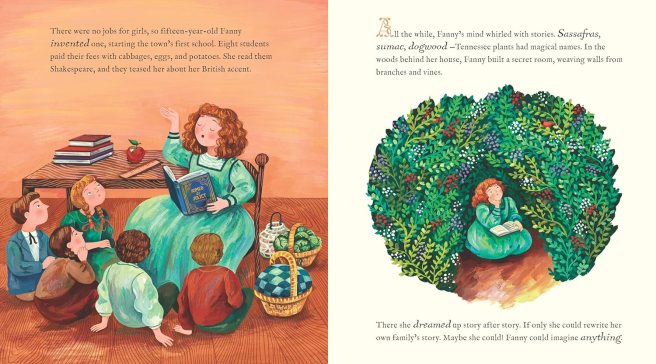
After a few years, her mother had to sell the store as businesses in Manchester failed. Short on money, Fanny’s family then relocated to a small village in Tennessee at the suggestion of her uncle, who thought her brothers could find work there. Unfortunately, they weren’t able to earn as much money as they’d hoped, so sometimes the family went hungry. Fifteen-year-old Fanny wanted to help, but there were no jobs for girls.

Undeterred, she put her imagination to work once again and invented her own job, opening the town’s first school. Her eight students paid with “cabbages, eggs, and potatoes,” and she read them Shakespeare. She also built a “secret room” in the woods behind her house, “weaving walls from branches and vines.”

There, in her cozy sanctuary, she dreamed up stories. She knew that magazines paid for stories; could she sell one of hers? She earned money for writing supplies by picking and selling wild grapes at the market. She wrote a love story and sent it out — and to her surprise, sold it for thirty-five dollars — enough to feed her family for weeks!

Continue reading

“Pieces of Silver” by J.I. Kleinberg (+ a giveaway)

“They dined on mince and slices of quince, which they ate with a runcible spoon.” ~ Edward Lear (The Owl and the Pussy-Cat, 1870).

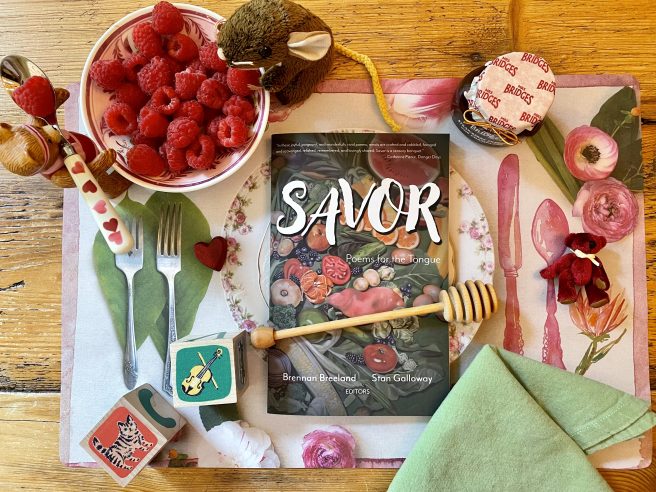
For your delectation today, a sample poem from a new food poetry anthology, Savor: Poems for the Tongue, edited by Brennan Breeland and Stan Galloway (Friendly City Books, 2024).

I’m slowing making my way through this exquisite word banquet featuring 72 diverse poets from around the globe. Talk about food for thought and a feast for the senses!

From the sweet memories of grandmother’s kitchen to the spicy tang of street food in bustling cities, from the bitter taste of loss to the umami of love rekindled over shared meals, this collection plates up a spectrum of human experiences.

The table is set. Let’s eat!

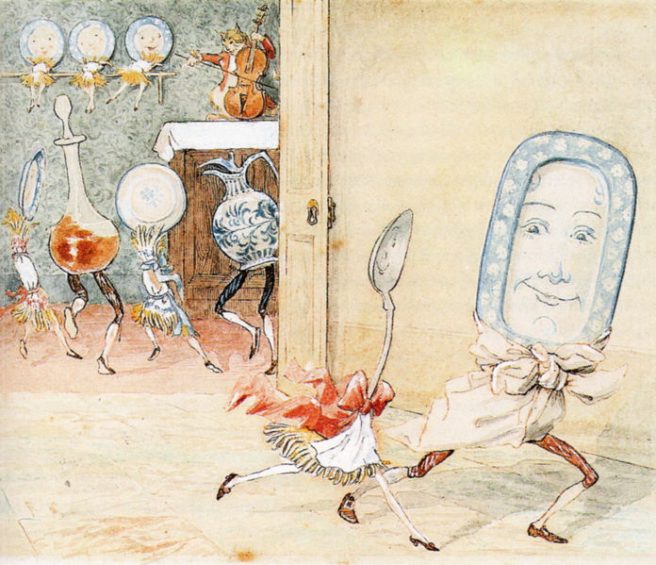
Randolph Caldecott (“And the Dish Ran Away with the Spoon,” from Hey Diddle Diddle and Bye, Baby Bunting, 1882).
PIECES OF SILVER
by J.I. Kleinberg

I wonder how it is to be a spoon. To slip one curve
beneath, to gentle from its bowl a berry, slide edge-wise
into ice cream, into the warm cavern of a mouth.
How it is to both resist and hold flavor in the declension
of the body, to separate and deliver, to stir in clinking dance.
Friend to hand and tongue, to absinthe, to dish --
remember the cow? remember the moon?

Dulled-edged, round-toothed knives school in the drawer,
silvery herring, decorous for butter and condiments,
honey and peas, familiars to plate and tablecloth.
I wonder how it is to be a real blade -- remember the mice?
-- honed to hurt, to shear, stab, cleave. How it is to slice,
paper-thin, a gift for the tongue: fresh tomato, ripe peach.
How it is to be fanged, incisive, to be a surgeon for the truth.

How far we are now from nursery rhyme, from spooning
in the velvet-lined night. Implement taunts us, stainless
both praise and accession. Forklift, pitchfork, runcible spoon.
The drawer turned upside down, tarnished words noisy and futile.
Emily Post cannot resolve this clattered escalation of utensils.
Switchblade, forked tongue. What price a place at the table?

~ from Savor: Poems for the Tongue, edited by Brennan Breeland and Stan Galloway (Friendly City Books, 2024).
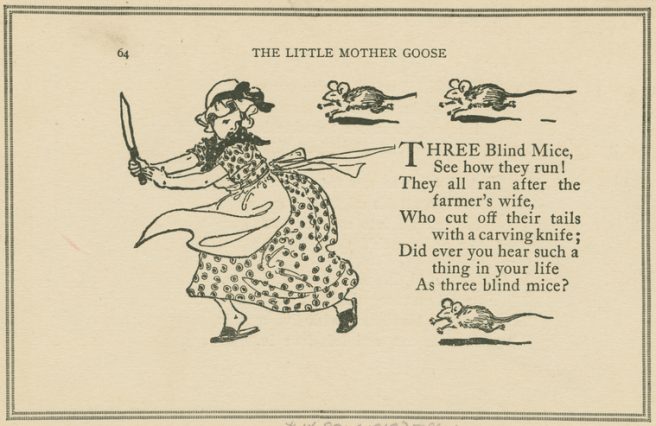
Jessie Willcox Smith (The Little Mother Goose, 1918).

*

Continue reading