
You know the old saying, "You are what you eat"?
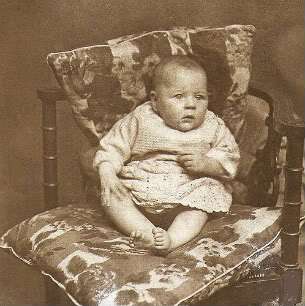
This is my dad, James:
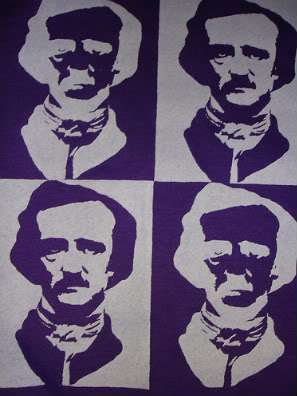
I bet you think I’m going to share a Poe poem today.
I can’t because I’m not wearing black, and my raven’s out sick.
No, today, I’m wearing blue Winnie the Pooh pajamas that glow in the dark. My mentioning this might raise your expectations just a tiny bit — will this post contain a flash of brilliance from A.A. Milne?
When I first read Kenneth Koch’s “You Were Wearing,” I smiled at all the cultural references. I was drawn in right away by the poem’s freshness and curious details, and suitably teased by the suspense. I love Koch’s spontaneity, side-swiping humor and unpredictability. I also love that if you look beneath the light, casual tone, you find a more perplexing message (which I’m still pondering). Koch is a master at enrobing the profound with playfulness.
Just like the narrator and girl in the poem, as readers we approach pieces of writing clothed in expectation of the experience to come. What habits of understanding are you wearing today?
*
YOU WERE WEARING
by Kenneth Koch
You were wearing your Edgar Allan Poe printed cotton blouse.
In each divided up square of the blouse was a picture of Edgar Allan Poe.
Your hair was blonde and you were cute. You asked me,
“Do most boys think that most girls are bad?”
I smelled the mould of your seaside resort hotel bedroom
on your hair held in place by a John Greenleaf Whittier clip.
“No,” I said, “it’s the girls who think that boys are bad.”
Then we read Snowbound together
And ran around in an attic, so that a little of the blue enamel was scraped off my George Washington, Father of His Country, shoes.
Mother was walking in the living room, her Strauss Waltzes comb in her hair.
We waited for a time and then joined her, only to be served tea in cups painted with pictures of Herman Melville
As well as with illustrations from his book Moby-Dick and from his novella, Benito Cereno.
Father came in wearing his Dick Tracy necktie: “How about a drink, everyone?”
I said, “Let’s go outside a while.” Then we went onto the porch and sat on the Abraham Lincoln swing.
You sat on the eyes, mouth and beard part, and I sat on the knees.
In the yard across the street we saw a snowman holding a garbage can lid smashed into a likeness of the mad English king, George the Third.
~ from Thank You and Other Poems (Grove, 1962).
Today’s Poetry Friday Roundup is at Carol’s Corner. I wonder what she’s wearing. ☺
Egads, what is it now?
As Gilda Radner used to say, “There’s always something.”
Of the thousands of thoughts I have each day, I would say at least 3/4 of them stem from fear, anxiety or worry. They run the gamut from silly mind clutter, like:
Is the eye doctor going to dilate my pupils?
What if I wear the wrong thing to the party on Saturday?
Am I getting even more freckles?
to work-related, self esteem issues:
What if I never publish another story ever again?
Why can’t I find the right plot for this story?
Shouldn’t I be a better writer by now?
All the way up to some heavy duty fears:
Why is North Korea so focussed on nuclear weapons?
Will we ever recover from this recession?
We’ve been lucky so far, but what if something bad happens to us?
Is the end of the world coming soon?
I never really took stock of how much time and energy I spend worrying about things that never materialize or over which I have no control, until I read this poem by Jeanne Marie Beaumont. The list of things sounded so familiar. I guess none of us are immune. We cope with anxiety in different ways, but we all want answers, reassurance. Wouldn’t it be grand if someone with real authority could just come up to us and say:
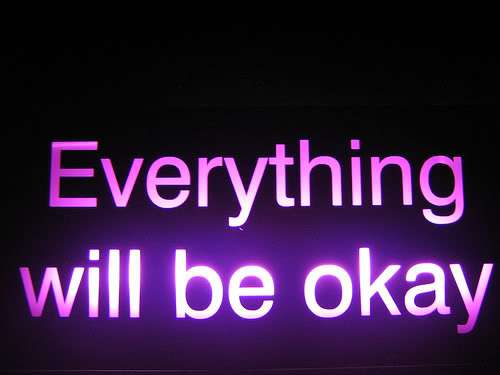
photo by dinning under a windmill
My only comfort is knowing there are other worry worts like me out there. *gulp* Aren’t there? What if no one reads this post? What if no one cares?
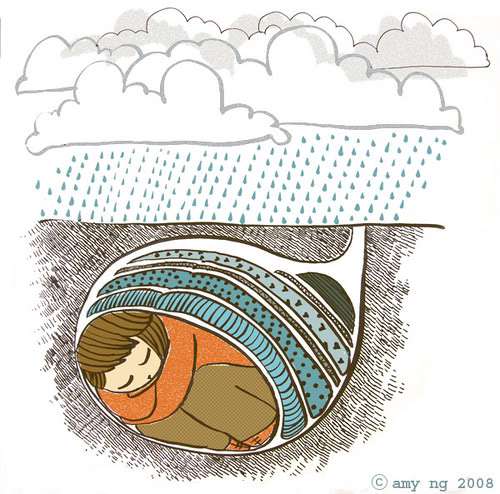
See what I mean? It’s enough to make you want to curl up into a little ball and never come out:
AFRAID SO
by Jeanne Marie Beaumont
Is it starting to rain?
Did the check bounce?
Are we out of coffee?
Is this going to hurt?
Could you lose your job?
Did the glass break?
Was the baggage misrouted?
Will this go on my record?
(Rest is here.)
Just in case you can relate, here are some worry dolls from Guatemala. The Mayans believe that if you tell your worries to them, then put the dolls under your pillow at night, by morning they will have taken your worries away.
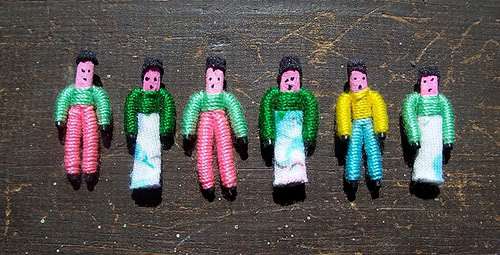
photo by catclawtub
Yeah, right. What if the dog eats the worry dolls while I’m asleep? Jama, you don’t have a dog. Okay, why don’t I have a dog? I like animals, why don’t they like me?
 Egads.
Today’s Poetry Friday Roundup is being hosted by Brian Jung at Critique de Mr. Chompchomp. OMG! Will he bite us?
P.S. I think writers are more predisposed to worry than most people. We are in the business of creating stories based on a lot of “what-if’s.” Always looking for conflict, needing to add dramatic tension. Thinking of worst possible scenarios for our characters. What say you? You ARE out there, aren’t you?
*Worry coccoon courtesy of Amy Ng.

Sidney Greenbush = adorable.
I’m just about ready to send off some questions to Sidney Greenbush, one of the identical twins who played Carrie Ingalls on the popular TV series, "Little House on the Prairie."
When I told Sidney that lots of children’s book writers are also big Little House fans, she agreed to drop by for an interview. We’ve already gotten some great questions as a result of my post last week, but in case you missed it, and have something you want to ask Sidney, leave a comment here by the end of the week, or email me: readermail (at) jamakimrattigan (dot com).
Don’t miss your chance. Thanks!

Phew! We finally have three winners in the Abigail Spells book giveaway!
There was a bit of a kerfuffle over picking the winners, as usual. But it wasn’t about who was going to draw the names. All the bears in the house (upwards of 300), read the book, and voted unanimously to keep Abigail Spells in the house.
That’s right. They simply can’t bear to part with any of the three copies they’ve been circulating amongst themselves. So, I had to resort instead to a highly scientific method:
 Jama's Alphabet Soup