thematic book roundups archive

1. Pie Picture Books

2. Soup Picture Books

3. Cookbooks for Kids

4. Egg Picture Books

5. Pancake Picture Books

6. Autumn Garden Picture Book Soup

7. Apple Picture Booksand More Apple Picture Books

8. Literary Cookbooks for Kids, Part One

9. Literary Cookbooks for Kids, Part Two

10. Books about Hawaii for Children and Adults

11. Doughnut Books

12. Pasta and Noodle Books

13. Cake Picture Books

14. Picture books featuring Chinese and Korean Culture

15. Gardening Picture Books

16. Picture Book Picnic

17. Picture Book Restaurants, Part One

18. Picture Book Restaurants, Part Two

19. Picture Books about bakers

20. Picture Books for Asian-Pacific American Heritage Month, Part 1 (Korea)

21. Picture Books for Asian-Pacific American Heritage Month, Part 2 (China)

22. Picture Books for Asian-Pacific American Heritage Month, Part 3 (Japan)

23. Picture Books about France, Part One

24. Picture Books about France, Part Two

25. Thanksgiving Feast, Part One

26. Thanksgiving Feast, Part Two

27. 2010 Picture Books about Babies

28. Vegetable Picture Books

29. Ice Cream Picture Books

30. Holiday Gift Books for Literary Foodies

31. Latke Picture Books

32. More Soup Picture Books

33. Eight More Upper Crust Pie Picture Books

34. Ten Food Poetry Anthologies for Hungry Readers

35. A Mixed Platter of Literary Cookbooks for Holiday Gift Giving

36. A Baker’s Dozen of Cookie Picture Books

37. Three “Blue” Picture Books

38. A Trio of King Charles III Picture Books

———————————————————

a baker’s dozen of upper crust pie picture books

Today we’re dishing up some picture book pies just in case you’ve got any hungry ankle-biters or restless munchkins hanging around.

There’s certainly no shortage of lovingly baked pie books cooling on library shelves, and I sampled as many as I could. When it’s too hot to play outside, invite the little ones to stick their fingers into these cool offerings. They’ll be left pie-eyed with wonder.

 APPLE PIES

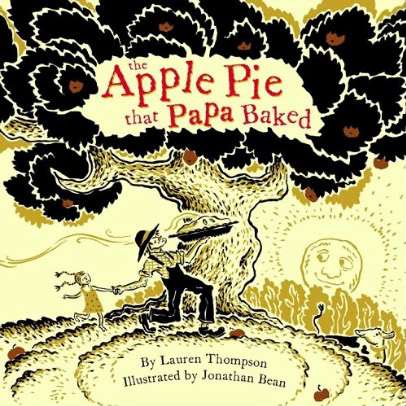
1. The Apple Pie That Papa Baked by Lauren Thompson, pictures by Jonathan Bean (Simon & Schuster, 2007). A cumulative tale featuring a loving father and daughter, showing how the wonders of nature play a role in creating the end product. With three-color folk art illustrations remniscent of Wanda Gag and Lois Lenski. See these brilliant reviews by Fuse 8 and Jules of 7-Imp for more details.

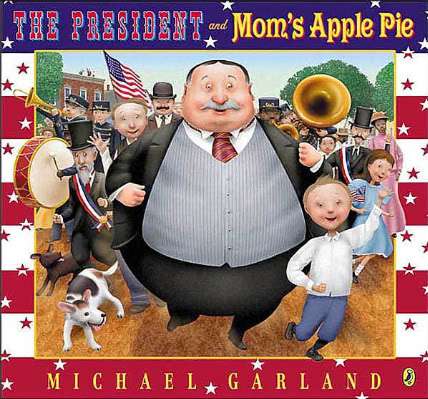
2. The President and Mom’s Apple Pie by Michael Garland (Dutton, 2002). President William Howard Taft, a man of substantial girth, visits small town America in 1909. After stepping off the train, he smells something positively delicious in the air. His nose leads him to some mighty fine grub before discovering Mom’s culinary masterpiece cooling on the window sill. Exuberant illustrations carry the reader through the fun and excitement of the day.


Lots more pie!

free range pickins: eggstra-large, grade A egg picture books!

Good morning my little chickadees!

Guess what’s for breakfast? A dozen good eggs that are worth peeping into. Just for your dining pleasure, I’ve gathered up some of my favorite eggy picture books. Not an easy task, mind you, with so many good ones in the hen house.

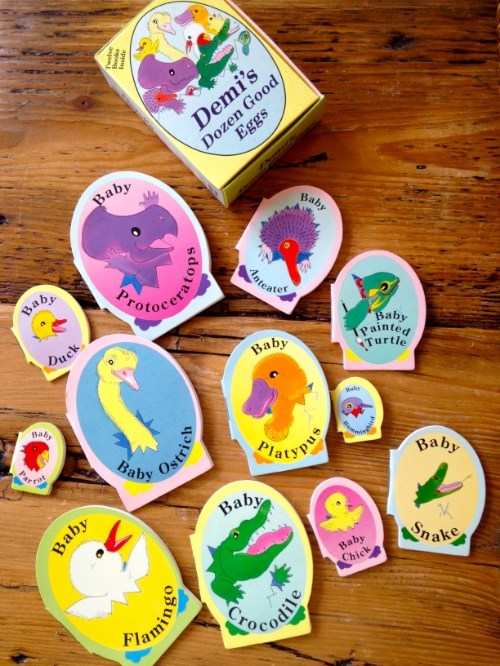
Before I get to the even dozen, a word about the cute miniature boxed set pictured above, Demi’s Dozen Good Eggs. Each of the twelve egg-shaped books features a different baby animal, and they are sized proportionately: the biggest book is the baby protoceratops, then ostrich, flamingo, crocodile, platypus, on down to baby anteater, painted turtle, snake, duck, chick, parrot, and finally, hummingbird. Each book contains a simple story about the featured animal, with pen and ink drawings. (A nice choice for the novelty book collector.)

TODAY’S BREAKFAST MENU (all books suitable for children ages 4-8 and peckish adults):

1. The Surprise Visitor by Juli Kangas (Dial, 2005). A charming story about a mouse named Edgar Small, who tries fo find a home for the lovely blue egg which has rolled up to his doorstep. Endearing woodland animals deny parentage, but help Edgar tend to the “roundish thing” by adding personal touches. Reassuring and absolutely adorable.

2. The Chicken-Chasing Queen of Lamar County by Janice N. Harrington, pictures by Shelley Jackson (FSG, 2007). Definitely one of my top three favorite picture books from last year. Great reviews from Jules of 7-Imp and Fuse #8, for this Cybils 2007 winner. The paint and mixed media illustrations have to be seen to be believed, and the girl narrator’s voice is real real real. Outstanding!

3. Rechenka’s Eggs by Patricia Polacco (Philomel, 1988). A timeless classic about Babushka, who paints marvelous eggs for the Easter festival, and Rechenka, the injured goose that she rescues. The newfound friends gently build bridges of understanding with a miracle or two thrown in. A Reading Rainbow Selection featuring the intricate designs of Ukranian egg painting, which can be enjoyed year round.

4. An Egg is Quiet by Dianna Aston, pictures by Sylvia Long (Chronicle Books, 2006). A sublime nonfiction picture book that is suitable for older kids, too. It celebrates the beauty, diversity and wonder of a large variety of eggs, from hummingbirds to dinosaurs to gulls to vultures. Beautiful watercolor paintings. Kris Bordessa writes about illustrator Sylvia Long here.

5. Chicks and Chickens by Gail Gibbons (Holiday House, 2003). Another nonfiction picture book featuring a healthy serving of facts and diagrams about chickens and people interacting with them. Learn about the life cycle from egg to embryo to hatchling to adult, as well as different breeds of roosters.

6. Big Chickens by Leslie Helakoski, pictures by Henry Cole (Dutton, 2006). Time to crack up in this giggly tale about four chickens who fly the coop when a wolf comes calling. They are terrified by everything they encounter, until they stumble upon the threat in his own “back yard.” Rhyme and repetition make this a great read aloud.

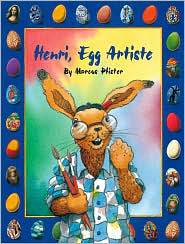
7. Henri, Egg Artiste by Marcus Pfister (North-South Books, 2007). Henri becomes tired of decorating eggs in the same old way and becomes inspired by some of the great masters, including Monet, Van Gogh and Da Vinci. Not just an Easter book!

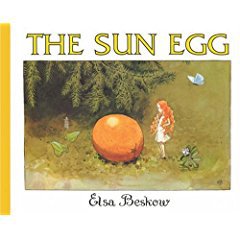
8. The Sun Egg by Elsa Beskow (Floris Books, 2007). I’m cheating a little here, because the egg in the title is really an orange, but I had to include this wonderful Swedish fantasy about a woodland fairy who finds what she thinks is a “sun egg.” A lovely adventure ensues with all her tiny friends. The illustrations are worth the price of the book alone, and will make you want to become tiny, too.

9. My Life as a Chicken by Ellen A. Kelley, pictures by Michael H. Slack (Harcourt, 2007). Follow the perilous adventures of Pauline Poulet, who flees the hen house when the farmer starts looking at chicken recipes. She encounters a fox, a pirate, and a typhoon in this rawkous, squawking frolic just this side of crazy feathers. Great rhythm, rhyme, and energy keep this tale a-sizzle in the frying pan.

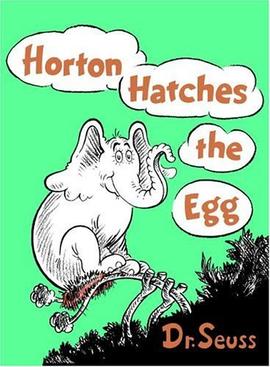
10., 11., and 12. SEUSS SCRAMBLE: Horton Hatches the Egg (1940), Scrambled Eggs Super (1953), and Green Eggs and Ham (1960), all published by Random House. Nobody can crack an egg like Dr. Seuss. You’re probably familiar with Horton’s undying loyalty while sitting on lazy Mayzie’s egg, and Sam-I-am’s enthusiasm for green eggs and ham (4th bestselling children’s book ever). In Scrambled Eggs Super, Peter T. Hooper decides it’s time to put a stop to boring, plain old scrambled chicken eggs. He searches far and wide for some wacky, exotic animal eggs — like the Single-File Zummzian Zuks, who stroll through the mountains with eggs on their thumbs! Endlessly zany and satisfying.

BONUS BOOK: When Chickens Grow Teeth, a French tale from Guy de Maupassant retold by Wendy Anderson Halperin (Orchard Books, 1996). Oo la la la la! Big, brawny Antoine, cafe keeper and lover of cream puffs, is bedridden after falling from a ladder, and is forced by his shrewish wife to hatch chicken eggs under his arms. A tender story with gorgeously detailed ink and watercolor illos, brimming with the warm, rustic flavor of the French countryside. Bon Appetit!

What are your favorite egg books?


“I did toy with the idea of doing a cookbook. The recipes were to be the routine ones: how to make dry toast, instant coffee, hearts of lettuce and brownies. But as an added attraction, at no extra charge, my idea was to put a fried egg on the cover. I think a lot of people who hate literature but love fried eggs would buy it if the price was right.”  ~ Groucho Marx

yummy soup picture books to feed your kids

So, what’s next after your kids have slurped down their chicken noodle?

I’ve tossed some of my favorite picture books into the kettle today, to make a fine literary soup. I think the appealing variety of ingredients will satisfy:
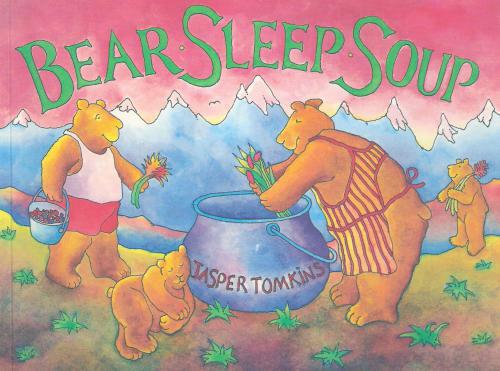
1.  BEAR SLEEP SOUP by Jasper Tomkins (Green Tiger Press, 1989), ages 4-8.

I’ve been a Jasper Tomkins fan ever since I purchased his first book, The Catalog (Green Tiger Press, 1981). I can’t be objective about his work at all, since his books always seem to hit me in the right place. They’re quirky, whimsical, and endearing without being overly cute. The Jasper Tomkins experience is kind of like having a puppy lick your face while you’re rolling on the ground. In Bear Sleep Soup, baby bear fails to eat the special fall soup her family prepares, so she remains wide awake while everyone else is hibernating. How will she pass the winter?

       
2.  MARTHA SPEAKS, and sequels, MARTHA CALLING  and MARTHA BLAH BLAH (not pictured), by Susan Meddaugh, (Houghton Mifflin, 1995, 1996, 1998), ages 4 to 7.
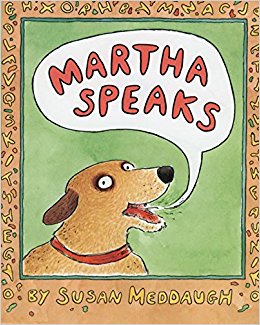
This is kind of where it all started for me, with the alphabet soup thing. Martha the dog eats some one day, and the alphabets travel to her brain instead of her stomach. The result: a talky dog. In the first two books, Martha uses her adept phone skills to nab a burglar and win a radio call-in show. In Martha Blah Blah, we see what happens when the soup company leaves out half the alphabet. An interesting look at the dog’s point of view and the power of words, with funny cartoon captions. 
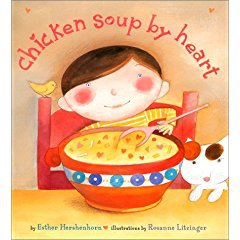
3. CHICKEN SOUP BY HEART by Esther Hershenhorn, illustrated by Rosanne Litzinger (Simon & Schuster, 2002), ages 4-8.

When Rudie’s elderly sitter, Mrs. Gittel, gets the flu, he decides to make a pot of her famous soup. After all, she’s the Chicken Soup Queen, and if he makes her recipe to perfection, it’ll surely help her get well. Good thing he remembers the secret ingredient: stories about the soon-to-be-soup-eaters. As Rudie stirs these in, we are warmed with stories of their unique friendship. Mrs. Gittel’s chicken soup recipe is included.

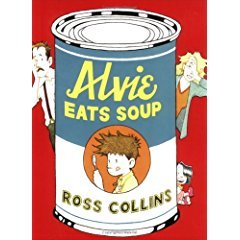
4. ALVIE EATS SOUP by Ross Collins (Arthur A. Levine Books, 2002), ages 4-8.

Alvie might easily be my alter-ego. Here is a boy who only eats soup. His first word wasn’t “Mommy.” It wasn’t “Daddy.” It was “Mulligatawny.” There was no bribing him or depriving him. Soup it had to be. Panic ensues when Granny Franny comes to visit. She’s a world famous chef. Can’t let her know about Alvie’s picky eating habits. If they order a whole bunch of food, maybe she won’t notice what Alvie’s not eating. Lively cartoonish drawings (with captions!) makes for a bowl full of fun.
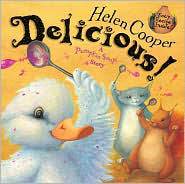
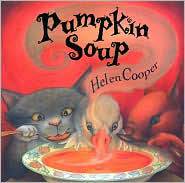
5. PUMPKIN SOUP, and DELICIOUS!, by Helen Cooper (FSG, 2005, 2007). ages 4-8.

I love stories about friendship, and this series of picture books (there’s also a third, called Pipkin of Pepper, not pictured here), is truly heartwarming. In Pumpkin Soup, Duck, Cat, and Squirrel make pumpkin soup the same way together every day. Cat slices the pumpkin, Duck adds the salt, and Squirrel stirs in the water. But one day, Duck decides he wants to be the one to stir. They argue, and Duck leaves in a huff. Will the three remain friends? In Delicious!, a big problem arises when there are no ripe pumpkins available to make the soup. Cat and Squirrel try to appease Duck with mushroom and fish soup, but he’s a picky eater, and won’t even try their pink (beet) soup. Both books contain appropriate soup recipes.
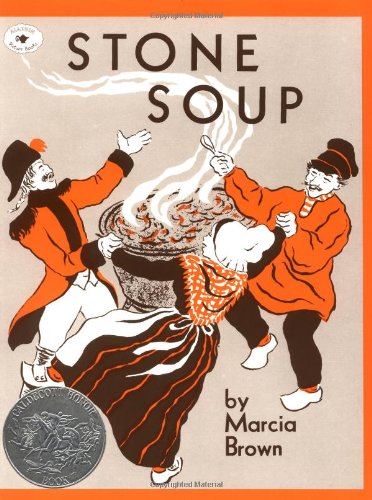
6. The folktale, Stone Soup, is probably the most well-known soup story in children’s literature, with over two dozen picture book adaptations to its credit. When three hungry soldiers approach a village, the stingy people there scramble to hide all their food, since they are suspicious of strangers. Clever and undaunted, the soldiers announce they will make soup out of stones. The villagers are fascinated, and little by little, they furnish the ingredients for enough soup to feed everyone.

The Marcia Brown version (Atheneum), which won a Newbery Honor Medal in 1947, is still the best, and should be included in every child’s collection. The old fashioned 4-color illustrations evoke just the right tone of timelessness. I like some of the multi-ethnic versions, too, particularly CACTUS SOUP, by Eric Kimmel, pictures by Phil Huling (Marshall Cavendish, 2004). It is set in San Miguel during the Mexican Revolution, and features a soup made from a single cactus thorn, along with chile peppers and stewing hens.
Also notable is STONE SOUP by Jon Muth (Scholastic Press, 2003), which is set in China. I love the ginormous soup pot and the fascinating ingredients:  pea pods, lily buds, taro root, winter melon, mung beans, yams, and cloud ears, among others. And since I have a thing for poet monks, Hok, Lok, and Siew are appealing characters. Other retellings feature nails and buttons instead of stones, proving that when you set out to make soup, anything on hand will do. The making and sharing of soup might just be the most convincing literary symbol of cooperation and resourcefulness. Stone Soup is the ultimate equal opportunity tale, embracing all cultures, using many different ingredients blended together in a universal bowl.
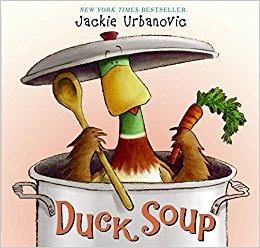
7. Finally, we can’t forget the newest addition to the soup story kettle, DUCK SOUP (HarperCollins, 2008), by the one and only Jackie Urbanovic, who will be here tomorrow!  Maxwell the duck is busy making an original recipe, when he decides something is definitely missing. While he’s out in the herb garden, his friends, Brody, Dakota and Bebe, come to visit. They see a feather floating in the pot, but no Max. Their frantic search for him is hilarious. A great read-aloud!

HAPPY STORY SLURPING!!

cool cookbooks for kids

“Cooking remains one of the few essential household activities that adults and children, or older and younger children can share in modern urban life.”  ~Barbara Walker (The Little House Cookbook)

Some of my fondest childhood memories center around baking with my cousins, Patti and Cindy. (I don’t have any sisters, and my mom wasn’t into baking.)  I even wrote a story about our famous sponge cake, which was so hard and rubbery it bounced off the counter.  But we had so much fun, and through that experience, I learned about the incredible power of eggs!

Now that winter has knocked on the door, you might be looking for a creative and educational indoor activity to keep the munchkins occupied. Cook, I say, cook! The process is its own reward, but in the end, there’s something good to eat! In this age of pre-packaged, microwave ready and take-out food, it’s wise to practice what Barbara Walker calls an “essential household activity.”

Here are some cookbooks for kids published just this year, and one all-time classic.  Great gifts that keep on giving.

1. My A to Z Recipe Box:  An Alphabet of Recipes for Kids, by Hilary Karmilowicz , illustrated by Melissa Sweet (Chronicle Books, 2007), ages 5 and up.


These are cards, not a book, but I am totally enamoured by the “A to Z” part.  And I couldn’t resist recipes like “Ants in My Applesauce,” and “Zany Zucchini Sticks.” This box is wonderful incentive for kids to continue collecting recipes, since it comes with extra cards. I’ve given this for several birthday gifts already, with good feedback.

2. Spatulatta Cookbook, by Isabelle and Olivia Gerasole (Scholastic, 2007), ages 8 and up.


Have you visited Isabelle (11) and Olivia (8), at their fabulous website, spatulatta.com? These young chefs are fabulous hosts, offering recipe videos by kids for kids, cooking tips, craft ideas, and lots more. Just this fall, 50 of their recipes were compiled into a spiral-bound cookbook, just in time for holiday gift giving. Head on over there and order an autographed copy today!


3. 
Fun in the Kitchen:  By Kids for Kids Easy to Make Recipes (Green Tiger Press, 2007), ages 8 and up.


I’ve been a fan of Green Tiger Press since the 70’s, when I used to look forward to their wonderful mail order catalog of stationery and calendars, etc. featuring wonderful children’s book illustrators, past and present. Today Green Tiger is a children’s book imprint, affiliated with Laughing Elephant (which I mentioned here), a company based in Seattle, which has expanded its line to include adult gift books, luggage labels, and a wide variety of greeting cards. This year they have reprinted over a hundred recipes which originally appeared in the Children’s Activity Magazine of the 1950’s, with new illustrations by Sonia Roetter. The recipes have been tested and look very doable.

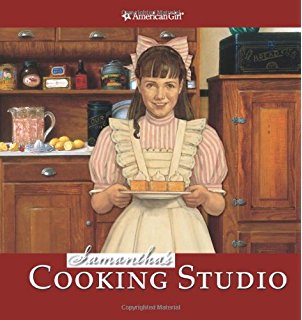
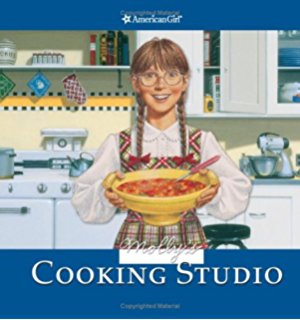
4. Felicity’s Cooking Studio, Molly’s Cooking Studio, Samantha’s Cooking Studio, and Kit’s Cooking Studio, (American Girls Collection, 2007), ages 9 – 12.


For the American Girl fans on your gift list, here are four cookbooks containing 20 easy-to-follow recipes, packaged with a cookie cutter, 20 table talk tokens, and 10 reusable place cards. Felicity shares colonial recipes, while Molly features recipes from the 1940’s, Samantha from the turn-of-the-century, and Kit, from the Depression era. Each book also contains a chapter on throwing a themed party.

5. Pretend Soup and Other Real Recipes:  A Cookbook for Pre-Schoolers & Up, by Mollie Katzen and Ann Henderson (Tricycle Press, 1994), ages 4 and up.


This is THE classic kids’ cookbook, still popular and in-print after 14 years. You may know Mollie Katzen from her Moosewood cookbooks, featuring recipes served in the Moosewood Restaurant in Ithaca, New York. It’s the kind of book that makes you want to cook, just by reading the recipes and seeing the pictures.  And if your kids don’t like it, keep it for yourself!!

BON APPETIT!!