more literary cookbooks for kids (and hungry adults), part two


So, I see you’re here for the Second Batch.

Now we know you love to eat books. Don’t deny it. I saw you drooling and licking some of the cookbooks from the First Batch. Oh, you don’t actually eat the books, you just like to make and eat the food from the books?

Alrighty then, dig in:

THE LOUISA MAY ALCOTT COOKBOOK, compiled by Gretchen Anderson, pictures by Karen Milone (Little, Brown, 1985). How I love this little book; it contains 28 recipes grouped with scenes from Little Women and Little Men. What is especially notable is that the recipes were initially researched, tested, and compiled by Ms. Anderson when she was just nine years old! She did this for a school project, combining her love for Alcott’s books with her favorite hobby, cooking. So, we start out with the famous Christmas morning scene, where the March girls decide to take their breakfast to a poor family. To authentically recreate this, you might try Buckwheat Cakes, Muffins, or Farina Gruel. Or, remember when Marmee was sick in bed with a cold and the girls fixed her breakfast? They made an Omelet with Baking Powder Biscuits.
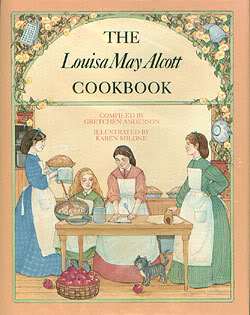
 Now, if you’re like Jo, with the best of intentions, but a disaster in the kitchen, you’ll need more practice (with the Fire Department on alert). But if she could make Molasses Candy, so can you. The recipes from Little Men are solid, traditional American fare, such as Gingerbread, Steak and Potatoes, and Apple Pie. Can’t go wrong with those, and all the recipes are rated for level of difficulty. A word about Karen Milone’s pen-and-ink drawings: brilliant! Aside from book scenes, she’s diagrammed some of the cooking techniques — little eggs cracked in bowls! Little rolling pins! Squee!
Continue reading

my favorite literary cookbooks for kids (and short grown-ups), part one


So, are you ready to get delicious?

Okay, I know you’re already scrumptiously talented and have excellent taste when it comes to all things bookish, but I thought I’d tempt you today with some seriously divine, ambrosial offerings — literary cookbooks.

At this very moment, I’m strapped down to my desk chair, because just thinking about excerpts from beloved, classic books alongside recipes derived from or inspired by the stories, propels me into a state of acute culinary bliss. *Butt rises in chair* See, this topic is actually dangerous — but for you, I’ll take my chances.

I’ve been collecting literary cookbooks for quite some time. While not all the dishes I’ve tried have knocked my socks off, I’ve always been happy just reading the recipes, and appreciating the connections they have with the works. For me, this is a satisfying way of enhancing the enjoyment of a story, since it deepens my understanding of character, historical context, and setting. And if the recipes just happen to be good, it’s all gravy.

Though all of these cookbooks are based on children’s books, they are actually suitable for cooks and would-be cooks of all ages. They’re great for adults who like to revisit old favorites, and will provide hours of fun for grown-ups and kids to work together in the kitchen. And, unlike recipes from ordinary cookbooks, these are seasoned with just the right dash of literary flair.

Continue reading

pip pip hooray: a-peeling apple picture books!

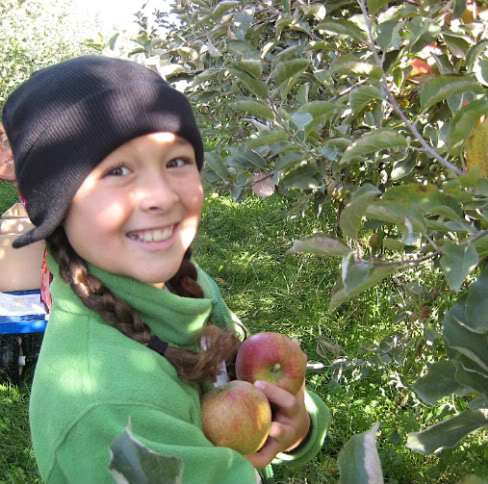
My great-niece, Melia, apple picking in Oregon.

My great-niece, Melia, apple picking in Oregon.

Thanks to you, I just polished off a piece of apple pie.

I wanted to write about apples today, and I needed a boost to get into the right mindset. Just trying to keep it real :)!

I love apples so much that my very first theme on this blog was Apple Month (October 2007). I shared poems, recipes, and various facts, trivia and folklore. Apples, which date back to prehistoric times, are the perfect fruit — extremely versatile, and the most varied on earth (2500 varieties in the U.S. alone). They were first cultivated in Egypt, and became a favorite of the ancient Greeks and Romans.

Thank you, early American settlers, for bringing apple seeds with you from Europe! Records from the Massachusetts Bay Colony indicate apples were grown in New England as early as 1630. Missionaries, traders, and Native Americans then carried seeds westward, and of course, John Chapman was responsible for extensive plantings of trees in the Midwest.

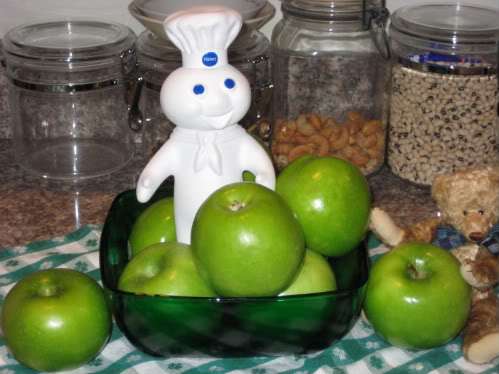
These Granny Smiths sacrificed themselves for my pie.


These Granny Smiths sacrificed themselves for my pie.

Though apples aren’t overflowing with vitamins and minerals like some other fruits, they do shine when it comes to Vitamin C, potassium, antioxidants, and fiber. They boost lung function and keep blood sugar stable. And did you know that apple juice was one of the earliest prescribed antidepressants?

*Sips some apple cider*

Right about now, I’m craving a few apple picture books. These are sweet, juicy, crunchy, life-affirming, beautiful, and inspiring. Share them with your kids, and enjoy them in one long peel.

Continue reading

autumn garden picture book soup (part two)

So, have you tried the Autumn Garden Soup recipe yet?

Oh, it’s still simmering. Yes, well, we can’t rush that, can we? Good soup needs a little time and always packs a better punch with that added dash of anticipation.

Good thing we’ve got another kettle on the back burner. Many of the same ingredients, but in picture book form. (Oh, what a clever idea!) Some of us find joy wherever we can 🙂

Have a beautiful fall day, friends. Make nice with spice, and savor the flavor.

Grab your ladles!

pancakes picture book short stack


Ah, the wonder of pancakes!!

Does any other breakfast treat arouse as much unabashed joy and anticipation among diners of all ages? Whether you call them hotcakes, griddle cakes, flapjacks, flatcars, or heavenly hots, the reaction is the same. Almost every culture in the world has its own version of the pancake (crepes, blinis, galettes), and they’re all special. They’re also pretty ancient, dating back to Roman times.

As far as children’s books, pancakes outnumber bagels, pies, and cookies. They are the perfect example of how a beloved food establishes instant reader interest and connection, reinforced by the power of sensual description.


The first pancake stories, which have a long history and dubious European origin, fall into the Aarne-Thompson 2025 folktale classification of fleeing food. Earliest recorded versions, such as “The Runaway Pancake,” date back to 19th century Germany and Norway. During this same period, the gingerbread man stories became popular in America. I suppose, then, we could rightly call pancakes the first “fast food.”

But I won’t let them get away from you today. Here are some of my favorite pancake picture books, hot off the griddle, and guaranteed to make your kiddos, ages 4-8, flip!

Get ’em while they’re hot!