a little smackerel from jeannine atkins

“By-and-by Pooh and Piglet went on again. Christopher Robin was at home by this time, because it was the afternoon, and he was so glad to see them that they stayed there until very nearly tea-time, and then they had a Very Nearly tea, which is one you forget about afterwards, and hurried on to Pooh Corner, so as to see Eeyore before it was too late to have a Proper Tea with Owl.”  ~ from THE HOUSE AT POOH CORNER, by A.A. Milne (E.P. Dutton & Co., 1928). 
The other morning I was feeling a little odd. 

It was almost eleven and I needed a little smackerel of something.

Just in time, I received this lovely email from author Jeannine Atkins:

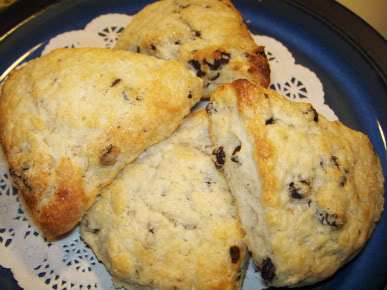
Jama, this is my favorite scone recipe, which I doubled and brought into my children’s literature class after reading WINNIE-THE-POOH and feeling like we needed ‘a little something.’ One student said he was happy to ‘walk into class and see two big cookie-like things on the table.’

Rum-tum-tiddle-um-tum!

Scones!

No tea party would be complete without them. Whether you pronounce it skon to rhyme with John (as in most of the UK), or skoan to rhyme with Joan (as in the U.S.), there’s no denying their appeal. Split them in half while they’re still warm, lay on the butter, strawberry jam, and clotted cream (if you’re lucky), and you’ve got home and heaven in one little cake!

Scones, originally from Scotland, are perfect anytime — breakfast, elevenses, very nearly tea, or proper afternoon tea. Make them plain with cream, milk or buttermilk, add fruit or even chocolate chips — then roll and cut them into little rounds, or pat the dough onto a sheet, and cut in wedges. They can be baked or dropped on a griddle. Your tum-iddle-um will thank you.

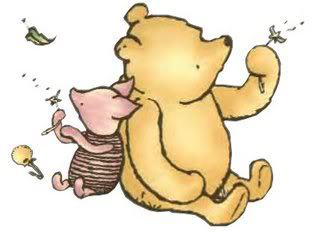
When Jeannine’s students walked into the classroom, they probably felt like this:

When you’ve been walking in the wind for miles, and you suddenly go into somebody’s house, and he says, ‘Hello, Pooh, you’re just in time for a little smackerel of something,’ and you are, then it’s what I call a Friendly Day.

Very friendly Jeannine has written quite a few fabulous books herself, the latest of which is Anne Hutchinson’s Way (FSG, 2007). In this historical fiction picture book (illustrated by Michael Dooling), Anne leaves England with her husband and ten children for the Massachusetts Colony, seeking religious freedom.
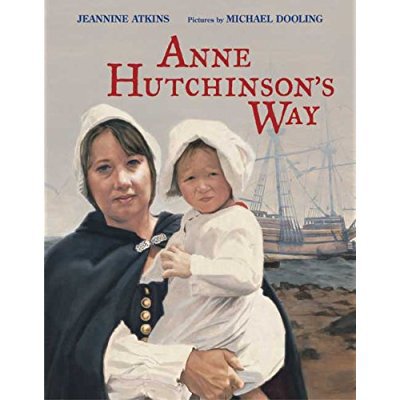

When she disagrees with the minister’s ways, Anne holds meetings in her own home to preach the gospel herself. Told from her daughter Susanna’s point of view, this inspiring story of a strong woman who believed in the freedom of speech, was recently named a 2008 Amelia Bloomer Project Recommended Title, one of 32 books which encourages girls to be “smart, brave, and proud.”

Jeannine has written several other wonderful books about strong girls and women, such as Aani and the Tree Huggers (Lee and Low, 2000), Girls Who Looked Under Rocks: The Stories of Six Pioneering Naturalists (Dawn, 2000), and How High Can We Climb: The Story of Women Explorers (FSG, 2005). All reflect Jeannine’s love of history, research, and personal interest in feminism.

So, next time you crave a little something, mix up a batch of Jeannine’s scones, pour yourself a cup of your favorite tea (maybe Republic of Tea’s  All Day Breakfast or Assam Breakfast ), and curl up with one of her books. It’ll get you humming, and may even inspire you to greater things. What could be friendlier?

DRIED FRUIT SCONES
from Jeannine Atkins
1-1/4 cups all purpose flour
3/4 cup whole wheat flour
1/4 cup light brown sugar
2 tsp cream of tartar
1 tsp baking soda
1/2 tsp salt
1/2 cup butter, cut in bits
1-1/4 cups mixed dried fruit: chopped apricots, dried cranberries or cherries, and raisins
1/2 cup heavy cream
1 large egg

Preheat oven to 400 degrees. Grease baking sheet. Combine dry ingredients, then cut in butter with pastry blender or two knives until mixture resembles cornmeal. Mix in fruit. Combine cream and egg, then pour into the flour mixture. Stir with a fork just until the dough forms a ball. Pat this into a round and squash about 8 inches wide. Cut about halfway through into twelve wedges and put it on the baking sheet. Bake about twenty minutes until golden.

Visit Jeannine’s Website and Blog for more about her books!


friday feast: the most famous tea party ever


Where:  Griffin’s Wharf, Boston Harbor

When:  Thursday, December 16, 1773, 7-10 p.m.

Who:  116 colonists, many of whom belonged to The Sons of Liberty

Why: Taxation without representation

Attire:  Mohawk Indian garb

Libations: 45 tons of Chinese tea, worth approximately $1 million (today’s rate), sold by the British East India Company

Servers: Three American ships — the Dartmouth, Eleanor, and Beaver

After Effect: the American Revolution


Don your tricorns and feathered headdresses! Sharpen your tomahawks!

Today we’re serving tea flavored with liberty, freedom, and independence. Drink it from a bottomless cup passed down to us by our founding fathers. Since we actually sip liberally from it every day, it’s good to reflect on its making.

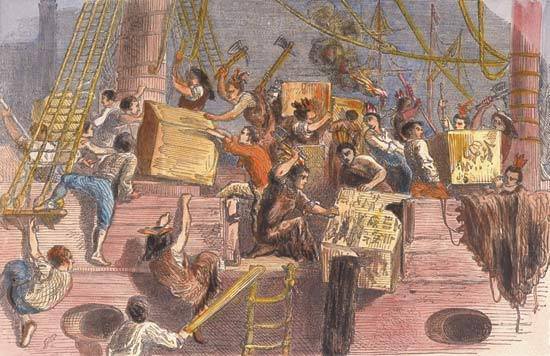
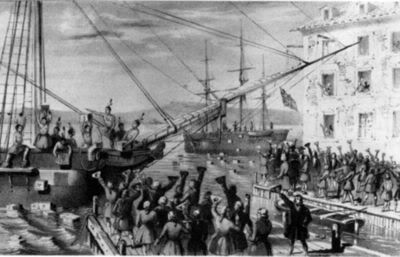
Did you know that the Boston Tea Party wasn’t carried out by an angry, unruly mob? According to John Adams, a group of sober citizens emptied the contents of 342 chests of tea into the harbor with “great order, decency, and submission to government.” A large number of silent onlookers witnessed this historic event, and when it was over, the wharf was swept clean and the streets became as quiet as a Sabbath evening.

This brave act of defiance spawned similar tea parties in New York, New Jersey, and Maryland. A second Boston tea party also took place in 1774, where 16 chests of tea from Britain’s oldest tea merchant, Davison, Newman & Co., were similarly destroyed.

Many poems were written during these turbulent times, to rouse support for tea boycotts. They were published in newspapers, printed in broadsides posted on street posts, and circulated among the masses in the form of pamphlets. Citizens were urged to give up their “precious Bohea and Hyson” teas, in favor of red clover or redroot infusions.

The following anti-tea poem, published in several American newspapers during the period leading up to the Revolution, captures the prevailing spirit and sentiment of the colonists. It is interesting since it is told from the woman’s point of view.

A LADY’S ADIEU TO HER TEA-TABLE

FAREWELL the Tea-board with your gaudy attire,
Ye cups and ye saucers that I did admire;
To my cream pot and tongs I now bid adieu;
That pleasure’s all fled that I once found in you.

Farewell pretty chest that so lately did shine,
With hyson and congo and best double fine;
Many a sweet moment by you I have sat,
Hearing girls and old maids to tattle and chat;

And the spruce coxcomb laugh at nothing at all,
Only some silly work that might happen to fall.
No more shall my teapot so generous be
In filling the cups with this pernicious tea,

For I’ll fill it with water and drink out the same,
Before I’ll lose LIBERTY that dearest name,
Because I am taught (and believe it is fact)
That our ruin is aimed at in the late act,

Of imposing a duty on all foreign Teas,
Which detestable stuff we can quit when we please.
LIBERTY’S The Goddess that I do adore,
And I’ll maintain her right until my last hour,

Before she shall part I will die in the cause,
For I’ll never be govern’d by tyranny’s laws.

One hundred years later, “A Ballad of the Boston Tea Party,” by Oliver Wendell Holmes, was read at a meeting of the Massachusetts Historical Society. Here is part of Holmes’ account:

An evening party, — only that,
No formal invitation,
No gold-laced coat, no stiff cravat,
No feast in contemplation,
No silk-robed dames, no fiddling band,
No flowers, no songs, no dancing, —
A tribe of red men, axe in hand, —
Behold the guests advancing!

(The poem can be read in its entirely here.)

The Boston Tea Party was one of several crucial events leading up to the American Revolution. The Tea Act, which actually lowered the price of tea, but did not eliminate any levies on it, was designed to prevent the East India Company from going bankrupt, not to benefit the colonists. This was a party held not on price, but on principle.

So let’s toast those brave Bostonians of long ago! After all, how often does tea so dramatically change the course of history?

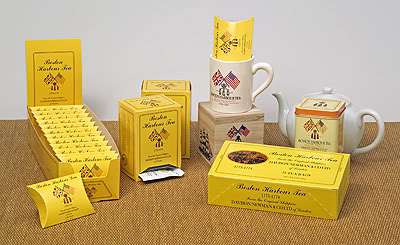
To really get into the spirit of things, try some Boston Harbour Tea, manufactured by Davison, Newman & Co., who is still in business today! It’s a select blend of Ceylon and Darjeeling teas with a sweet aroma and brisk flavor. (Drink this with caution if you tend toward inciting revolutions.)

For more about the Boston Tea Party, visit the BTP Historical Society website. Lots of interesting facts there, including a roster of tea party participants, personal accounts, and a look at one of the original tea chests.

Check in with cloudscome at a wrung sponge for today’s Poetry Friday Roundup. A very special Crown of Sonnets, “Cutting a Swath,” is being presented by seven of the blogosphere’s most accomplished poets. Don’t miss it!

April is Tea Party Month here at alphabet soup! Post or send me your favorite tea time recipes, sweet or savory: readermail (at) jamakimrattigan (dot com). Do join us!

oh, did i miss something?


Not to worry, dahling!

Nibble on these to get in on the action:
Kelly at Big A little a is soliciting pieces for the May and June issues of The Edge of the Forest. She is looking for feature articles, reviews and interviews. Zip on over for all the details and read the fabulous March/April issue!
Don’t miss the Melanie Watt Blog Tour! Mountains of morsels for all you Scaredy Squirrel fans. Yesterday, Melanie chatted with Jen Robinson about how the books appeal to different age levels. Scaredy has even taken on a new coolness with teens! In case you missed the posts from earlier this week, here is the full schedule:

Monday, 4/7
Big A, Little a
Featured Topic:  An Interview with Scaredy Squirrel

Tuesday, 4/8
Book Buds
Featured Topic: Scaredy Squirrel past, present and future

Wednesday, 4/9
Jen Robinson’s Book Page
Featured Topic: How the Scaredy stories work at different age levels

Thursday, 4/10  [2 blogs]
Hip Librarians Book Blog   
Featured Topic: Talking with Mélanie Watt about writing

Metrowest News
Featured Topic: Kids’ questions for Scaredy Squirrel

Friday, 4/11
MotherReader  
Featured Topic: Mélanie Watt talks about Scaredy Squirrel

It’s time to sign up for Mother Reader’s Third Annual 48-Hour Book Challenge, June 6-8, 2008! Here’s your chance to read read read all the book book books you’ve been wanting to, and review them like crazy. Full details about this once-yearly-wildly-anticipated event here.
Authors and Illustrators for Children, a national non-profit organization dedicated to enhancing the world for children, is sponsoring "This I Dream," a series of essays written by prominent children’s book authors and illustrators, who share their hopes, dreams, and wishes for the next generation. Read about Virginia Euwer Wolff’s dreams for education, and George Ella Lyon’s dreams for peace. More essays to follow each month with original art. Essays are free for download to share with teachers, librarians, parents, principals, students and politicians! Posters are available for puchase.(Source: Alice’s CWIM blog.)
Laura Purdie Salas has just posted a ginormous list of online resources for children’s writers. This lavish banquet will keep you chewing for hours on end.   

Ooh la la! Jules and Eisha of 7-Imp fame are guest blogging over at Practically Paradise (School Library Journal). Yesterday, Jules interviewed Eisha, and today, well . . . go over and find out!                                                                                                      
Read these especially appetizing posts, Directions for Writing Recipe and How-to-Make Poems, Parts I & II, over at Wild Rose Reader. Elaine shares some wonderful poems written by her former students. Yes, I’m partial to the recipe format! The results are delightful and satisfying. Leave a comment at any one of Elaine’s poetry posts this month to be entered into weekly poetry book drawings.
And don’t forget the Tea Party right here at alphabet soup all month long! Stop in often for a sip and a bite, post a favorite tea time recipe, or email your recipe to: readermail (at) jamakimrattigan (dot com), and I’ll be happy to post it. Come on, you guys, bring on the grub!


three for tea

 
It’s spring!

     
         Our azaleas are blooming!

Look who stopped by for tea:


                  Sidney, the wild turkey
        (only visits when Thanksgiving is far off),


         Cinnamon, who’s losing his winter coat,


              and Chipperdee, aka Houdini.

Flower tea and acorns for everyone!


tea with miss potter

“I do not remember a time when I did not try to invent pictures and make for myself a fairyland amongst the wild flowers, the animals, fungi, mosses, woods and streams, all the thousand objects of the countryside.” ~ Beatrix Potter

Good morning!

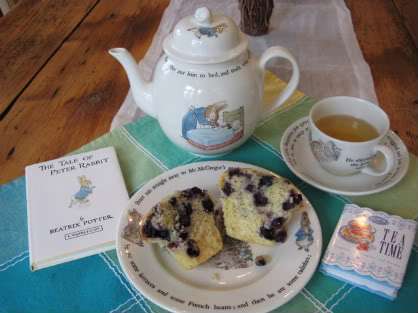
Here’s a bracing cup of English Breakfast tea and a warm blueberry muffin to start your day!

The light, misty rain we’ve been getting recently reminds me of England. While sipping my tea, I remembered visiting Beatrix Potter’s Hill Top Farm located in Near Sawrey, in the Lake District. To get there, we drove through rolling farmland and wooded hillsides, everything so green, with stone houses nestled around every turn.

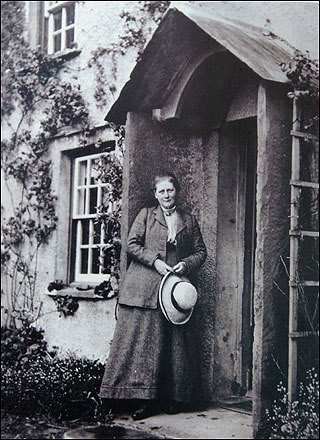
Potter at Hill Top (1913)

I might have read Peter Rabbit as a child, but only came to know the rest of Potter’s work as an adult. Making the pilgrimmage to Hill Top, which Potter purchased with money earned from her first few books, was my inner child’s dream come true. This was where Jemima Puddleduck, Tom Kitten, and Samuel Whiskers were born, and where Potter began to reclaim her life after her fiance, Norman Warne, died suddenly of leukemia.

More Beatrix, with poems, references and a recipe!