I saved a table for you right here out on the lanai. Please take a seat and make yourself comfortable! What a lovely day. Can you feel that gentle ocean breeze caressing your cheek?
Hope you’re hungry, because today I’ve got soup! I would be very remiss if my first recipe of the new year wasn’t a bowl of soup, especially since January is National Soup Month and all.
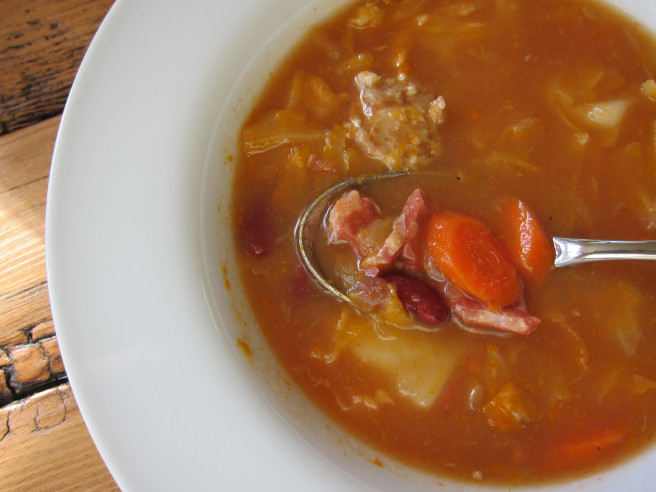
Since we’re all about Hawai’i, I’m serving a local favorite: Portuguese Bean Soup. My long-time friend, Lynn, gave me this recipe eons ago, and it’s still one of my all-time favorite homemade soups. It’s usually made with Portuguese sausage, which is widely available in Hawai’i, but I’ve substituted other spicy sausages with good results. Feel free to experiment with your own favorites.
The recipe is easy to make, but requires planning ahead because it needs to simmer for several hours. Once all the ingredients are in the pot, you just need to give it a little stir now and then. It’s the perfect weekend meal, a nice hearty bowl of goodness for a cold winter’s day. I made a big pot recently and it was “real ono.” Enjoy!
PORTUGUESE BEAN SOUP
1 16-oz can kidney beans, with liquid
2-3 lbs. ham hocks
2 cloves
2 stalks celery, chopped
1 15-oz can tomato sauce
2 peppercorns
8-9 cups water
1 onion, chopped
2 bay leaves
1 tsp. worcestershire sauce
2 T catsup
1-2 T sugar
garlic salt and pepper (to taste)
Combine above in large pot. Simmer 2-1/2 hours. Remove meat from bones and cut into small pieces. Then add 1 ring sausage (spicy), 1 potato, 2 carrots (pared and sliced), and 1 small cabbage (chopped). Cook another 1-1-/2 hours. Add 1/2 cup salad macaroni (which has been pre-soaked in water 1/2 hour), 1/2 hour before the soup is finished.
What’s the perfect way to savor the colors and flavors of autumn?
Make some soup!!
*alphabet soup kitchen helpers jumping up and down with glee*
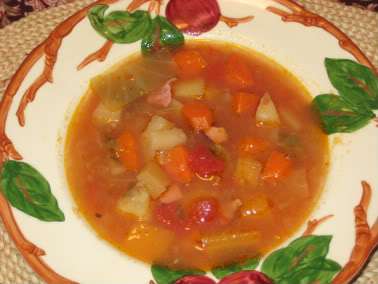
Several years ago, I found a wonderful recipe for vegetable soup in The Washington Post. It was a from-scratch version of the canned soup I loved as a child. Since it calls for some hearty root veggies, it’s the perfect accompaniment to cooler autumn days. Simple, straightforward and unpretentious, it’s back-to-the-basics nourishment that can be adapted in numerous ways with optional ingredients.
It could be my imagination, but whenever I eat this soup, I feel and think better. Vegetarians can add beans for more protein, while carnivores can opt for sausage, ham, or smoked turkey. Whatever your preference, the results are guaranteed to satisfy your creative urges as well as your hunger pangs. Perfect with some crusty bread and whipped butter. Yum!
AUTUMN GARDEN SOUP (10 to 12 servings)
(this batch with smoked turkey, Canadian bacon and chickpeas)
1/4 cup olive oil
2 medium yellow onions, diced
6 cloves garlic, finely chopped
4 stalks celery, trimmed and diced
3 carrots, peeled and diced
3 cups (1/2 medium head) shredded cabbage
2 medium potatoes (preferably Yukon Gold),
peeled and cut into 1/4-1 inch cubes
2 medium turnips, peeled and diced
3 parsnips, peeled, trimmed and cut into 1-inch chunks
2 cups canned plum tomatoes, undrained, lightly crushed
(28-oz can)
1/3 cup coarsely chopped fresh parsley leaves
9 to 10 cups low sodium chicken stock or broth
Salt and freshly ground pepper to taste
In a large nonreactive pot or casserole, heat the oil over medium-low heat. Add the onions, increase the heat to medium and cook, stirring frequently until the onions have just begun to soften, about 2 to 3 minutes.
Add the garlic and cook, stirring constantly for 45 seconds. Add the celery and carrots and cook, stirring, for 1 minute. Add the cabbage and cook, stirring occasionally, until it has just begun to wilt down, 3 to 4 minutes. Add the potatoes, turnips, and parsnips and cook, stirring, for 1 minute. Add the crushed tomatoes and their juices, the parsley, broth and several pinches of salt. Cover partially and bring to a gentle boil.
Reduce the heat to medium-low and adjust the heat so that the contents simmer gently. Cook, stirring occasionally, for 2 hours. You may need to add more broth during the last hour of cooking if the vegetables are not completely covered and simmering; may add up to 1-1/2 cups additional broth, then bring to a simmer and continue cooking. Season the soup with freshly ground pepper and salt to taste.
*This soup freezes well — divide into individual food-safe storage containers if you wish, and store for up to 6 weeks.
**To vary the flavor, you may add any of several vegetables, cooked meats or starches during the last minutes of cooking. Do not add optional ingredients if you plan to freeze the soup; their texture and flavor would pale considerably.
VARIATIONS:
Kielbasa. In a skillet over medium heat, heat 2 T vegetable oil. Add 1/2 pound kielbasa cut into 2-inch sections and sear until browned and warmed through. Cut, on the diagonal, into thick slices and add to the soup for the last 20 minutes of cooking.
Sweet or hot sausage. In a skillet over medium-high heat, brown 1/2 pound of sweet or hot link sausage. Remove from heat, add 1 cup chicken broth, cover, and return to medium heat until cooked through, about 20 minutes. Cut the sausage into chunks and add to the soup for the last 20 minutes of cooking.
Pasta. In a pot of salted water, boil 1/4 cup small dried pasta shapes until almost tender. Drain well and add to the soup for the last 5 minutes of cooking.
Cheese. Sprinkle 1 to 2 T freshly grated Parmesan or Gruyere cheese over each bowl of soup before serving.
Cooked beans. Stir 1 cup cooked chickpeas or Great Northern white beans into the soup for the last 20 minutes of cooking.
Smoked turkey. Add 1/2 pound diced smoked turkey to the soup for the last 15 minutes of cooking.
Canadian bacon. Add 1/2 pound diced fully cooked Canadian bacon to the soup for the last 20 minutes of cooking.
Fennel. Trim 1 fennel bulb, discarding the fronds and any light green sections, and dice the bulb. In a skillet, saute the diced fennel in 1 T of olive oil for 3 minutes. Add the fennel to the soup for the last 30 minutes of cooking.
Smoked ham. Add 1/2 pound diced smoked (fully cooked) ham to the soup for the last 20 minutes of cooking.
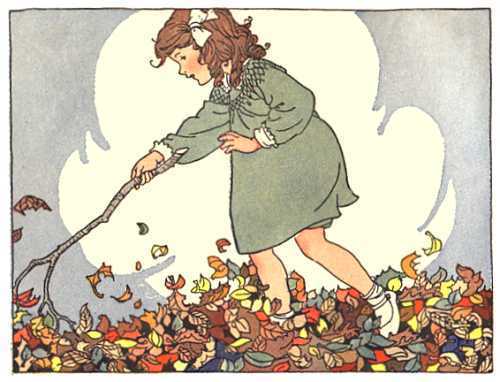
Happy children, or you
Dolls, bears, other stuffed animals and toys
Leaves, twigs, sand, pine needles, mud, etc. Mud Pies and Other Recipes: A Cookbook for Dolls All the time in the world
Imagination.
I first saw this cookbook over 30 years ago. I was thrilled to find it, but disappointed that I wasn’t 8 or 9 at the time. It’s charming, a bit quirky, wholly original, and definitely timeless.
Pudding with First Pebble Press edition, published in 1983
Very often when I am feeling stuck with my own writing, I’ll thumb through this book. It wakes me up to new possibilities and turns my stilted, rutty thinking inside out. We all need this from time to time.
From the foreword:
This is a cookbook for dolls. It is written for kind climates and summertime.
It is an outdoor cookbook, because dolls dote on mud, when properly prepared. They love the crunch of pine needles and the sweet feel of seaweed on the tongue. The market place, then, will be a forest or a sand dune or your own back yard.
There are recipes for Appetizers, Soups, Salads, Sandwiches, Main Dishes, Pastries, Desserts, and Beverages — tempting favorites such as Wood Chip Dip, Tossed Leaves, Gravel En Casserole, and Pencil Sharpener Pudding. This is serious play, and children will love scavenging for ingredients and laying out a fine table for their favorite toys. The recipes are simple but never silly.
Consider Mud Puddle Soup:
Find a mud puddle after a rainstorm and seat your dolls around it. Serve.
Or Putty Fours:
If plumbers or painters are working in your neighborhood, ask them for some putty — enough to fill four acorn cups. These delicate cakes may take days to harden, so plan your party well ahead. Serves 4.
Who could resist Fried Water or Roast Rocks? And Erik Blegvad’s pen and ink drawings throughout are the perfect sides for these doll friendly dishes.
Yesterday, Pudding and I made Boiled Buttons in the alphabet soup test kitchen. We were thrilled with the result, and will serve it at our next teddy bear soiree.
BOILED BUTTONS
This is a hot soup that is simple but simply delicious. Place a handful of buttons in a saucepan half filled with water. Add a pinch of white sand and dust, 2 fruit tree leaves and a blade of grass for each button. Simmer on a hot rock for a few minutes to bring out the flavor. Ladle into bowls. Get out there and play!
“Ginsberg is both tragic and dynamic, a lyrical genius, con man extraordinaire
and probably the single greatest influence on American poetical voice since Whitman.” ~ Bob Dylan
“Follow your inner moonlight; don’t hide the madness.” ~ Allen Ginsberg
So. When was the last time you howled at the moon?
Or ran “starving, hysterical naked,” around Whole Foods, shopping for peaches, penumbras and images?
When was the last time you killed a porkchop? Or spied Spanish poet, Garcia Lorca, down by the watermelons?
I mean, don’t you usually see Walt Whitman “poking among the meats in the refrigerator?”
And you call yourself a poet?
This whole bohemian/beatnik/hippie/non-conformist thing has always perplexed me. Growing up to Allen Ginsberg, the Beatles, Bob Dylan, e.e. cummings, Ken Kesey, and Tom Wolfe, made me yearn to become “one of the best minds of my generation.” Supposedly, that would call for eschewing the bath, speaking in metered obscenity, taking to the road, and, of course, inhaling.
Freeing oneself, unleashing creativity, is something all writers and artists aspire to. And the bohemian life, where one is unfettered by petty concerns, such as earning a living or abiding by the law, has long been romanticized in literature and the media. At least that’s the impression I always got. Any room in the car, Neal Cassady? Pass the Jack Daniels, Bob. There was a time I’d jump at the chance.
Allen Ginsberg toured with Bob Dylan’s Rolling Thunder Revue in 1975-76
But now, being cool sounds like too much work. Oh, I still love jazz. And black turtlenecks. And I still dream about living in Greenwich Village, or Soho, or wherever else the cutting edge artists hang out these days. But there are conditions. No cold water flats or cigarette smoke. No dirty mattresses, drunken neighbors, or neon signs. No all night parties, leeches, or hypodermic needles.
According to Ann Charters (The PortableBeat Reader, Viking 1992), “The New York Beat writers were a wild group with firsthand experience of life on the fringes of society. Pushing themselves with various drugs to the emotional edge and beyond, Burroughs, Ginsberg, and Kerouac created visionary works of autobiographical fiction and poetry unprecedented in American literature.”
Wow. Conscious raising, no doubt. Lasting influence, definitely. So how does an average suburbanite like me, living in mainstream society, pick up the gauntlet? Why does notable innovation always seem to come from the fringe?
When I consider the Beat lifestyle — the protests, arrests, murders, drugging, promiscuity, and total disregard for authority, I know I could never be like them. Yet the ideals they stood for — free expression, beatitude and transcendence, anti-commercialism, no big business or industrialization, friendship and brotherhood, are all ideals I believe in. I just wish that instead of railing against everything they didn’t want, they had a clearer idea of what they did want. Idealism, without purpose or direction, is a heavy cross to bear. That could drive anyone to drink.
So in honor of the “starving artist” who may live inside of you, I share today some soup that really beats. You didn’t think I’d forget to bring the soup, did you? Picture Jack Kerouac and Allen Ginsberg sitting in their run-down, dingy apartments, or in numerous cafeterias around Times Square sipping from cracked coffee mugs, puffing endlessly on cigarettes.
What do you think they ate most of the time?
Hello. When Jack Kerouac banged out On the Road in a 20-day marathon, he lived on coffee and Lipton’s pea soup!
And Ginsberg had several references to soup in his poetry:
“I sup my soup from old tin cans
And take my sweets from little hands
In Tiger Alley near the jail
I steal away from the garbage pail.”
(from The Shrouded Stranger)
InHowl, he describes some of the so-called “best minds”:
“. . . who lounged hungry and lonesome through Houston seeking jazz or sex or soup,
. . . who ate the lamb stew of the imagination or digested the crab at the muddy bottom of the rivers of the Bowery,
. . . who cooked rotten animals lung heart feet borsht & tortillas dreaming of the pure vegetable kingdom,
. . . who jumped off the Brooklyn Bridge this actually happened and walked away unknown and forgotten into the ghostly daze of Chinatown soup alleyways and firetrucks,
. . . ah, Carl, while you are not safe I am not safe, and now you’re really in the total animal soup of time . . .”
Alas, on the morning of March 19, 1997, Allen Ginsberg made a big pot of fish chowder. He shared it with a few friends, then put the rest in the freezer. Two weeks later, he died of liver cancer. He loved soup so much that he installed a special ledge outside his kitchen window so he could cool his 12-gallon stockpot. The remaining two jars of this poetic fish chowder can be found at the Jurassic Museum in Los Angeles.
What have you written lately that would merit freezing your soup someday for posterity?
FOR ALLEN GINSBERG
by XJ Kennedy
Ginsberg, Ginsberg, burning bright,
Taunter of the ultra right,
What blink of the Buddha’s eye
Chose the day for you to die?
Queer pied piper, howling wild,
Mantra-minded flower child,
Queen of Maytime, misrule’s lord
Bawling, Drop out! All Aboard!
3 slices bacon, minced
1 organic onion, diced
2 ribs celery, diced
1 1/2 tsp chopped fresh thyme leaves
1 bay leaf
1 T flour
1 pound red boiling potatoes, cut into 1/3-inch cubes
2 cups chicken broth
2 (8-oz) bottles clam juice
sea salt, to taste
ground black pepper, to taste
1 pound cod, cut into 3/4-inch pieces
1/2 cup frozen corn
1 cup half and half, heated
Heat a heavy pot over medium heat and add the minced bacon. Cook until the bacon is golden brown and crispy, about 10 minutes. With a slotted spoon, remove the crispy bits and reserve, leaving the fat in the pot.
Add the onion, celery, thyme, and bay leaves to the pot and cook, stirring occasionally, for 8 to 10 minutes, until the vegetables are softened but not browned. Sprinkle in the flour and cook, stirring, about 2 minutes.
Add the potatoes, chicken broth and clam juice and bring to a boil. Then reduce the heat to low and simmer until the potatoes are tender yet still firm, 5 to 7 minutes.
Season generously with salt and pepper. Add the cod and corn. Do not stir. Cook for 5 minutes. Remove the pot from the heat, cover and allow the chowder to sit for 10 minutes (the fish will finish cooking during this time).
Return the chowder to heat and stir in the cream, gently to avoid breaking the fish into small pieces. Season to taste. Bring chowder to serving temperature over gentle heat, uncovered. Sprinkle reserved crisped bacon on top.
NOTE: Soy milk may be substituted for those with milk allergies/lactose intolerance. This makes the chowder less “rich,” but still tasty.
WARNING: Though howling is recommended during preparation, this may result in an uncontrollable desire to play the bongos in the nude.
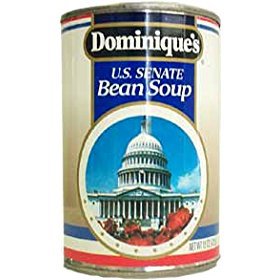
This tempting blend of water, navy beans, onions, ham hocks, celery, garlic, parsley, salt and pepper, has nourished our congressional leaders for over a hundred years. Big bipartisan pots of this soup simmer in all 11 Capitol dining room kitchens even as we speak!
Who started it? Well, you know how it is. Whenever there’s something good, politicians fight to take credit. But Joseph G. Cannon, U.S. Speaker of the House (1903-1911) seems the most likely culprit. He apparently entered the dining room one day, looked at the menu, and sputtered: “Thunderation, I had my mouth set for bean soup! From now on, hot or cold, rain, snow or shine, I want it on the menu every day.” And so it has been, ever since, with its virtues extolled by the likes of President Gerald Ford, Representative Sonny Bono, and Senator Bob Dole.
I’m so glad Speaker Cannon had his little tirade. Years ago, I ate this soup in the Senate Dining Room with Senator Sparky Matsunaga (1916-1990) of Hawaii. “Sparky,” as he was fondly known, always invited visitors from Hawaii to lunch, sometimes reserving two or three tables at a time. We (my mom, dad, and about four other guests), sat at a round table with the senator, who cautioned us about the dangers of tannins in tea.
A veteran of WWII (Bronze Star and Purple Heart), Sparky sought redress for interned Japanese Americans, and was instrumental in passing legislation for civil rights, space exploration, renewable energy resources, and most notably, for the establishment of the U.S. Institute for Peace. Himself a poet, who wrote haiku while hunkered down in Italian foxholes, Sparky also authored legislation to create the position of Poet Laureate of the United States. He told us he only slept about 3 hours a night. Then he promptly removed the teabag from his cup to avoid any bitter aftertaste.
Could he have accomplished all this without bean soup?
Consider what Senator Everett Dirksen (R-IL), once said in his Homage toBeans:
There is much to be said for the succulent little bean — any kind of bean, be it kidney, navy, green, wax, Kentucky, chili, baked, pinto, Mexican, or any other kind. Not only is it high in nourishment, but is particularly rich in that nutritious value referred to as protein — the stuff that imparts energy and drive to the bean eater and particularly the senators who need this sustaining force when they prepare for a long speech on the Senate floor.
Now, the man pictured above has served in the U.S. Senate since 2004. Chances are good that he’s already eaten his fair share of bean soup. He has also helped out in soup kitchens. But the campaign trail is rigorous and demanding, so leguminous reinforcements are probably in order. Then he’ll definitely be ready for the big job. Soup is served at all official dinners at the White House, be it turtle, clam, corn, potato, or squash. When it’s his turn, he’ll be able to serve visiting dignitaries, and the entire nation, a hearty soup for change.
He’ll follow in the footsteps of FDR, who loved crab soup with a splash of sherry; Dwight Eisenhower, who made his own vegetable soup with nasturtium stems; JFK and Jimmy Carter, who always ordered soup for lunch; Ronald Reagan, who loved hamburger soup with hominy; George H.W. Bush, who liked New England clam chowder; and Bill Clinton, who favored vegetable beef.
Think about it. Soup might just be the only thing Republicans and Democrats can ever agree on. And with the way things are going now, we need a President who is way full of beans.
What can you do? Make this soup as often as possible. Invite friends over to discuss the issues, and then vote for the candidate of your choice. Hopefully one day Capitol Hill will amount to more than a hill of beans, without all the gas.
U.S. CAPITOL BEAN SOUP (serves 6-8 people)
1 pound dry white beans, soaked overnight
1 meaty ham bone, or 2 smoked ham hocks
3 quarts water
3 onions, finely chopped
3 cloves garlic, finely chopped
4 stalks celery, with leaves, finely chopped
1/4 cup parsley, finely chopped
salt and pepper to taste
Garnish: minced parsley or chives
Strain the water from the soaked beans and put in a big pot with 3 quarts of water and the ham bone or hocks. Bring to a boil, then reduce heat and simmer for 2 hours.
Stir the chopped vegetables and herbs into the pot, and cook over low heat for another hour until the beans are nicely tender.
Remove the bones from the pot, cut off the meat into small bits, and return the meat to the pot, discarding the bones.
When ready to serve, ladle into bowls and garnish with pinches of herbs.
TIP: Flavor enhanced if soup is eaten while watching Oprah.
(Thanks to Pat Solley at soupsong.com for the recipe and delicious political tidbits!)







 Jama's Alphabet Soup