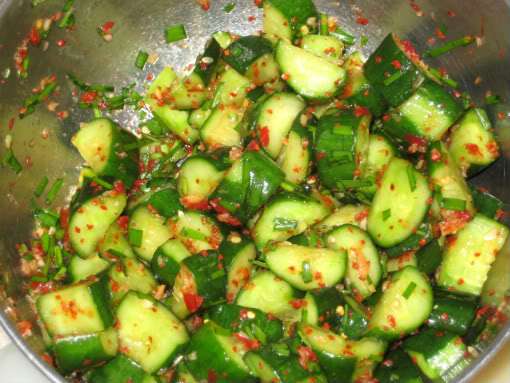
For those of you who’d like some homemade kimchee to go with Linda Sue Park’s recipe for bee-bimbop, here’s my mom’s recipe for cucumber kimchee. I always look forward to having some when I visit my family in Hawai’i. Thanks, Margaret — you’re the best Korean cook!
KOREAN CUCUMBER KIMCHEE
4-5 cucumbers (preferably Japanese cucumbers, which are smaller and crunchier)
about 1/4 cup kosher salt or Hawaiian sea salt/coarse
2 tsp minced garlic
2 tsp minced ginger
15 stalks chives, cut into 1/8″ lengths (do not chop)
1 T chili garlic sauce (can be found in Asian markets)
1 T ground Korean red pepper (dried)
sugar
1. Wash unpeeled cucumbers. Cut off ends and cut into 3/4″ bite-size quarter chunks.
2. Place in bowl and spread sea salt lightly. Toss and stir to distribute salt. Allow to sit about 1/2 hour. Rinse cucumbers in cold water and taste. If too salty, rinse cucumbers again in cold water. Drain in colander.
3. In mixing bowl, combine red pepper, dash of sugar, chili garlic sauce, garlic, ginger and chives. Add cucumbers and mix. Refrigerate. Ready to eat same day or several days later.
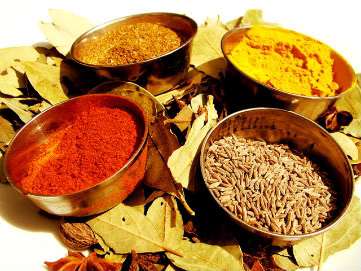
Friends, can you smell that positively divine aroma of fresh ginger, turmeric, cumin, chilies, and mustard emanating from your computer screen?
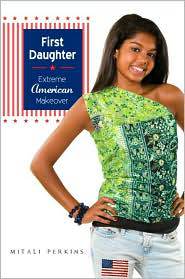
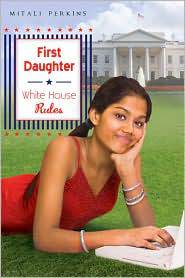
Thanks to First Daughter Sameera “Sparrow” Righton and her creator, Mitali Perkins, we can enjoy some authentic Indian food at our Asian PacificAmerican Heritage Month potluck today!
I admit I didn’t know quite what to expect. I had enjoyed The Not-So-Star-Spangled Life of Sunita Sen and Monsoon Summer. Positively adored Rickshaw Girl, which, as you probably know, has received loads of well deserved accolades, the latest of which is the 2008 Jane Addams Honor Award.
In 16-year-old Sparrow, I found a highly intelligent, compassionate, resourceful humanitarian, who just happens to be the President’s adopted daughter. In Extreme AmericanMakeover, we see how Sparrow’s strong sense of self prevails, despite a physical makeover and attempts to “Americanize” the Pakistani heritage out of her while her dad is running for office.
Once her dad wins the election, they move into the White House, where things get even more interesting. In the second book, we see just how many of the White House “rules” Sparrow adheres to, as she interacts with her cousin Miranda, plays Cupid for her mom’s personal assistant, hangs with her SARSA friends at the Revolutionary Cafe, longs for her soulmate, Bobby, deepens her friendship with not-so-privileged Mariam, and of course, continues to blog. Despite the restrictions of a high profile lifestyle, somehow Sparrow manages to stay true to herself and positively affect those around her.
And how about those oatmeal scotchies! We first tasted them in Extreme AmericanMakeover, but in White House Rules, these frosted wonders take on a life of their own. After the Swedish Ambassador raves about them, they become a staple at White House teas, enabling Miranda to earn some needed funds. Never underestimate the value of farm fresh milk! All I know is, I MUST make those cookies. Good thing Mitali has linked to some scotchies recipes here.
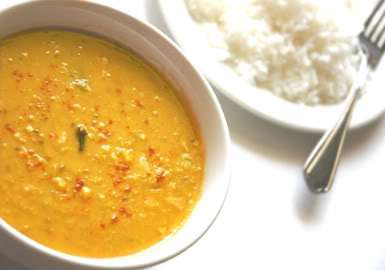
Speaking of recipes, Mitali has brought a childhood favorite today. She says, “We used to eat this almost every day when I was growing up. I LOVED it as a kid, mixed with steaming basmati rice and a side of hot mango pickle, and still do!”
So go ahead, whip this up. You know you want to. And while it’s simmering, peek into the White House to see what Sparrow is up to. I want her there come November.
BENGAL RED LENTILS (MASOOR DAL)
1-1/2 cups red lentils
3-1/2 cups water
6 sliced serrano chilies
1/4 tsp turmeric
1-1/2 tsp salt
4 T vegetable oil
1 cup minced onions
1 cup chopped tomatoes
1 T grated fresh ginger
1 T panch phanon mix (equal proportions of whole cumin, fenugreek, anise, mustard, and Indian black onion seeds mixed and sold as one spice; you’ll need to get this at an Indian store and it’s called “five spice mix”)
4 dried small red chilies (depending on how spicy you want it)
3 cloves crushed garlic
1. Rinse lentils well, add water, serrano chilies, turmeric and salt. Bring carefully to boil and cook over low to medium heat, partially covered, for 25 minutes. Cover and cook another 10 minutes. Adjust salt.
2. While lentils are cooking, cook onions in a frying pan in two tablespoons of oil until they are golden brown (approximately 10 minutes), stirring constantly. Add tomatoes and ginger and continue cooking until the tomatoes turn into a delicious and fragrant mush (approximately 8 minutes). Stir constantly so that tomato mixture doesn’t stick. Turn heat to low if necessary.
3. Scrape out the tomato mixture into the lentils and stir it in. Let lentils sit while you make the spiced oil.
4. Do a quick rinse of the frying pan, without soap, and dry thoroughly. Add the remaining two tablespoons of oil and heat over medium high heat. When oil is hot add panch phanon mix and heat until the seeds begin to pop, about 15 seconds. Add red chilies and fry for another 15 seconds, until they turn a little darker. Turn off heat and add the crushed garlic and let sizzle for about 30 seconds. Stir this mixture into the lentil/tomato mixture and serve with rice. Adjust salt.
Well, here we go with a back-to-back quack! (Click here if you missed Part 1.)
I hope you brought your appetite. For our second course with the multi-talented Jackie Urbanovic, we’ll be getting down to the nitty gritty detail of just how she makes her pictures. We’ll also hear about her consuming passion for comics, and for the first time ever on any blog, we’ll find out what she eats!
Quello again, Jackie. Could you describe how you did the illustrations for your two books featuring Max the duck?
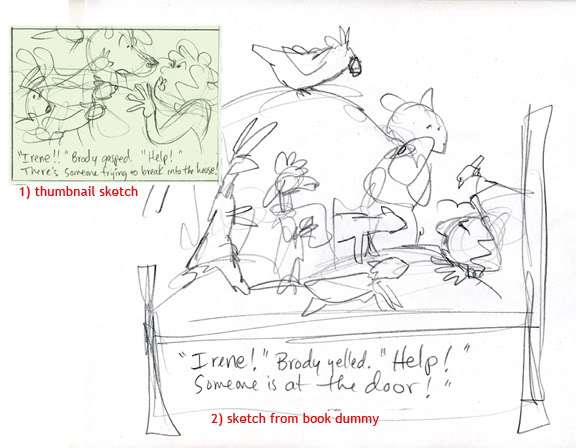
First, I look at the big picture. I begin with thumbnail sketches — tiny sketches for every page being roughly 2″ x 3″ in size. I doodle the entire story in sequence. I begin this small so that I can quickly see the pacing and movement of the entire book at once. This allows me to plan where the climatic points will fall and to begin deciding what will be illustrated and what will be left to the words. It also lets me make sure that the story is fitting well into the 32 pages I have. I may do a set of thumbnails 2 or 3 times as a way to experiment and quickly try out different possibilities.
Second, I begin what’s called a book dummy. This is a larger set of sketches, folded like a book, at the same size as the book will be. The drawings are still doodles, but now there is room to see a bit more detail and to hand write the text in place. At this stage I make more changes because I can now see with more clarity if my original ideas work once they are full-sized.
Third, I work on creating my characters –deciding how they will look. This can be a few hours or a few days of work. I begin with looking at reference photos of the type of animals or people I’m working on and sketching them just to learn what they look like. Then I begin a process of caricaturing and simplifying them — exaggerating their features and making them into a personality a reader can recognize. I do a lot of experimenting. Then I mail these sketches as well as the book dummy to my editor, who looks them over. We discuss what works and what could be better.
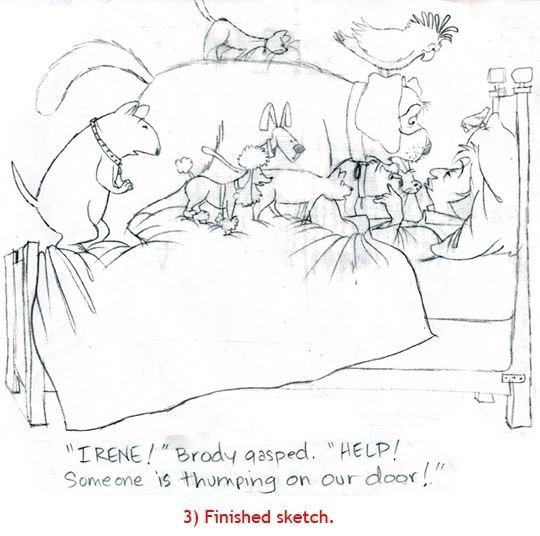
Fourth, I do another set of revisions based on my editor’s responses. This is sometimes another book dummy, but most often it is a set of finished sketches with the revisions incorporated.
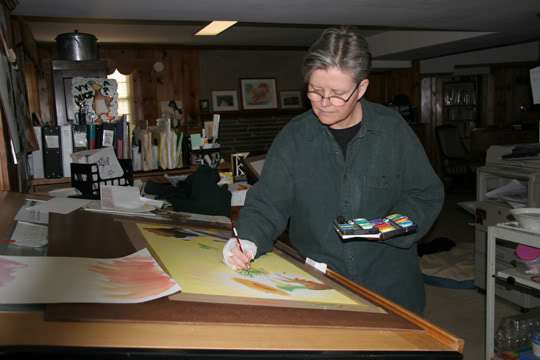
Fifth, after we’ve gone through all the revisions, I enlarge each sketch 40% and trace the image onto watercolor paper using a light table. The light table allows me to see through the paper. I enlarge the sketch so that I have room to put in more detail and to be more free with my brush strokes.
Sixth, I wet each piece of paper and secure it to a masonite board using a wide paper tape. Once the paper dries, it stretches out taut. Now, when I paint, the paper won’t buckle.
Seventh, I paint on 3 to 6 pages at a time, moving from one to the other. While one painting is drying, I can work on the next. This also gives me the chance to put a half finished painting aside for awhile when I’m not sure about how it’s working. If I leave it for an hour or two and come back to it, I can often see what needs to change.
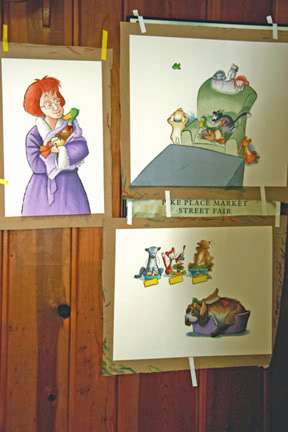
Lastly, I re-draw over the light pencil outlines with a brown watercolor pencil, dipped in water, for my final outline. As I finish each painting, I cut it off the board and tape it to the wall. This way I can compare the colors and textures from the earlier paintings to the later ones, making sure they stay consistent.
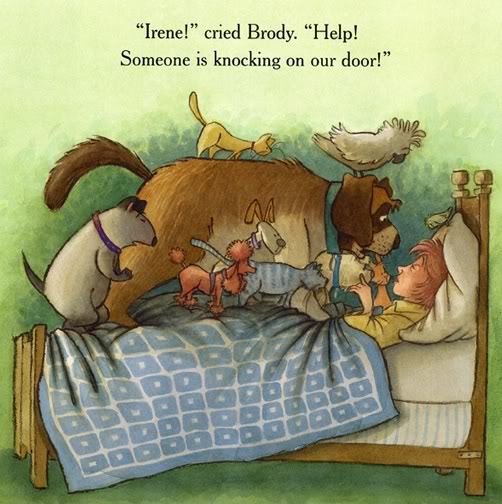
Finished art from Duck at the Door
Thanks so much! The average person merely sees the final product, not realizing how much detailed work and patience is involved in creating it. Let’s shift gears a little. The comic strip, Maggie, Inc., is a brilliant example of your passion for the genre. Did you draw comics/cartoons as a child? What were some of your favorite comic books? Would you like to do a graphic novel someday?
I love doing the Maggie, Inc., comic strip. There’s so much fodder for ideas and humor in my everyday life and that of my self-employed friends. My friend, Michelle Massman, came up with the idea and everyone I knew shared their stories with me. Yes, I drew cartoons as a child. I even created my own comic strips. I loved reading Uncle Scrooge comics the best. I also enjoyed reading Val, Archie, Batman, Superman, The Phantom — and I adored Mad Magazine. I also admired the drawing on the comic strips Pogo and Lil’ Abner, but I couldn’t understand the stories. A dear friend, Steve Thompson, brought those strips and others to my attention again as an adult. (He is the official Pogo historian and publishes the Fort Mudge Most, the Pogo/Walt Kelly fan magazine.)
I still read comics, comic strips and graphic novels. Here’s a partial list of my current faves:
Scary Grandmother by Jill Thompson Elfquest by Wendy and Richard Pini Howard the Duck by Steve Gerber Groo the Warrior by Sergio Aragones
Usagi Yojimbo books by Stan Sakai
The Asterix books by Goscinny and Udzero Nausicaa (and any books or films) by Miyazaki Calvin and Hobbes by Bill Watterson Mutts by Patrick McDonnell Zits by Scott and Borgman
The cartoons and books of Jules Feiffer, Shel Silverstein, William Steig, Sempe, Posy Simmonds, Carol Lay, Peter Kruger, and Ronald Searle . . . and old comic strips: Gasoline Alley, Pogo, Little Nemo,Krazy Kat, Polly and her Pals.
My childhood dream was to become a comic book artist. I didn’t stray too far from that original dream, as picture books are a similar way to tell stories. And I would love to do a graphic novel someday.
This is so fascinating to me. Of course I read some comics as a child, but I am learning now about an entire industry that is exploding with exciting innovation and unleashed creativity. Speaking of innovation, Max the duck’s cooking has been described as creative and experimental. Yesterday you mentioned your love of cooking. Please describe your fondest food-related memory from childhood.
I love to cook and eat! I love discovering new foods and new recipes. I enjoy listening to the Splendid Table on NPR. I’d like to travel more just to sample the cuisine of many different cultures. And I’m fascinated with the politics of food and food production.
All of the women in my family are and have been tremendous cooks. My mother and grandmother grew their own vegetables and made many things from scratch: pickles, horseradish, raisin bread, kugelis, sausage, jams, coconut cream pie. I remember my mom and grandma both used to cook chicken with potatoes and carrots in a shallow pot with a little water. It would cook slowly on the stove all day until everything was very soft. And the smell in the house was absolute heaven.
Okay, my mouth is officially watering, and I’m growing weak at the mention of coconut cream pie. Describe your favorite meal. Is there one particular food that inspires your best work?
My favorite meal . . . hmmm, that’s like asking me my favorite book. Don’t get me started! Let’s see — I love a good spinach pie with a side of tabouli along with some feta cheese and olives. Or something Thai or Vietnamese, or a good deli sandwich with pickles and fries, or, I could go on and on. Eating anything I really enjoy inspires me, especially when I can eat it with my family or friends. And while I’m not sure Gobstoppers inspire my best art, I do munch on them constantly while I work.
What can you tell us about the recipe you’re sharing today?
I recently experienced this recipe from my cousins Tomas and Jen. It’s a Lithuanian dish. It appeals to me because it harks back to my heritage. Had I seen it in a cookbook I would NEVER tried making it because it was such an odd combination of foods. But, fortunately, they brought the dish to my house first and I absolutely loved it. I guarantee it tastes much better than it sounds!
TOMAS AND JEN’S (AND NOW, JACKIE’S) FAMOUS COLD BEET SALAD
4 cans beets
1/2 jar dill pickles
1 can white beans or chickpeas
small red onion
mayonnaise to taste
Chop the beets, pickles and onion into small pieces. Mix with beans and mayonnaise. Serve cold.
Thank you so much, Jackie, for sharing this interesting, insightful, and wholly satisfying two course meal with us. Where else could we have gotten beets and gobstoppers on the same plate? It’s been great learning about you and your creative process!
For info on school visits and some of the books Jackie has illustrated for other authors, visit her website.
If you’d like to learn more about Jackie’s comic strip, Maggie, Inc., click here.
For a cool interview with Jackie’s mentor, Jane Resh Thomas, click here.
Guess who came to dinner last night? Almanzo Wilder! Well, sort of.
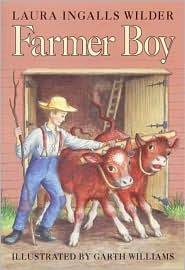
Since this is autumn and harvest season and all, I was in the mood to reread FARMER BOY. Of course I was shamelessly salivating all the way through, as Laura described meal after meal full of farm-fresh produce. I marveled at Almanzo’s ability to polish off huge quantities of food, and still have room for pie (usually more than one piece)! It was all I could do to keep myself from running to the farmer’s market, loading up on everything, then gorging myself.
I resisted this compulsion until I came to this passage
“He knelt on the ice, pushing sawdust into the cracks with his mittened hands, and pounding it down with a stick as fast as he could, and he asked Royal,
‘What would you like best to eat?’
They talked about spareribs, and turkey with dressing, and baked beans, and crackling cornbread, and other good things. But Almanzo said that what he liked most in the world was fried apples ‘n’ onions.
When, at last, they went in to dinner, there on the table was a big dish of them! Mother knew what he liked best, and she had cooked it for him.”
Apples and onions? How wholesome! How healthy!! I could do that! This one simple dish really spoke to me. Onions from the dark earth mingling with apples that grew high in the sky. I loved that beautiful completeness, one which I discovered over and over again in the book.
The story takes place in 1866, when Almanzo was nine, one year before Laura was born. The Wilders had a dairy farm up in Malone, New York, which in its prosperous years provided a sharp contrast to Laura’s pioneering childhood. Food was plentiful on the Wilder farm; lots to go around for Almanzo and his older brother, Royal, and sisters, Eliza Jane and Alice. But Almanzo was always hungry,and his insides gnawed and twisted as he waited for his turn to be served. Being the youngest, he always had to wait the longest for his food. Laura masterfully builds up this anticipation (the most effective of literary appetizers), so that when we finally read about the meal, it fills us up to the brim.

 Jama's Alphabet Soup