dining out with marilyn singer

#13 in the Poetry Potluck Series, celebrating National Poetry Month 2011.


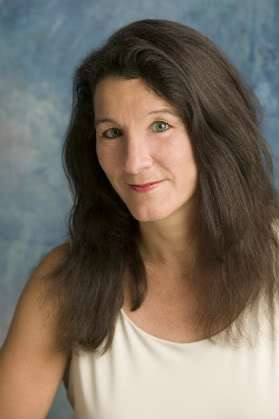
Marilyn at her home in Connecticut.

I’m thrilled to be rolling out the green carpet today to welcome the one and only Marilyn Singer, winner of the 2010 Cybils Poetry Award for her ingenious and innovative book, Mirror Mirror: A Book of Reversible Verse (Dutton, 2010)!

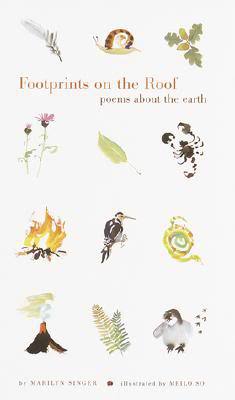
Some of you may be familiar with one of Marilyn’s older titles, Footprints on the Roof: Poems About the Earth (Knopf, 2002), in which she celebrates the beauty, power, joy and wonder of our terrestrial home. An avid nature lover, she embraces phenomena both large and little with a keen eye, unending curiosity and an open heart.
“Dining Out” is the perfect contribution to our poetry feast. I love the ingenuous gratitude expressed in this delightful paean to biodiversity, the cycle of life, and global interdependency. The open ended free verse form gives us the opportunity to pause and reflect, as we taste each word and savor its meaning. Love the feeling of personal connection, harmony and wholeness.

Marilyn: I remember thinking about how little attention we pay to where our food and drink come from and how joyful it feels when we realize that, yes, we are eating and drinking the earth.
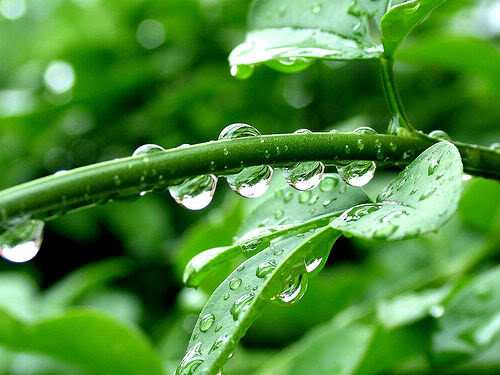

yadavop/flickr

DINING OUT
by Marilyn Singer


Each day I eat the earth 

          I drink the rain 

They taste celery-bitter 

                watermelon-sweet 

Their flavor 

                    subtle 

                              bold 

          is stored 

in every grain of rice         

          in every stalk of wheat 

in every root 

              leaf 

              shoot 

harvested in Chile 

          or in China 

                    or at Fanelli’s farm 

Each day I eat the earth 

          I drink the rain 

And my tongue

            is never bored

© 2002 Marilyn Singer. All rights reserved.
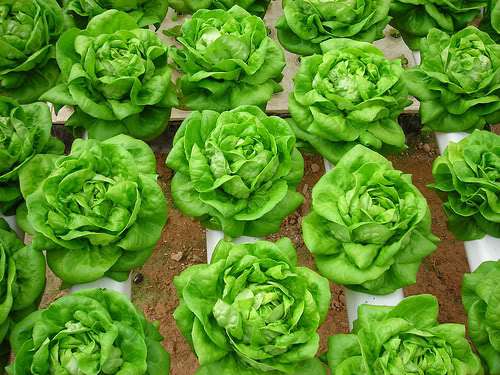

schwaen/flickr

To enhance the nourishment afforded by her poem, Marilyn invites us to share her love for good food, prepared simply. Many of us already frequent our local farm markets, enjoy growing our own fruits and vegetables, and/or advocate Community Supported Agriculture (CSA). It does make a difference when we know where our food comes from — there’s nothing more delicious, nutritious and satisfying than fresh, seasonal produce, and when it comes to salads, the possibilities are endless.
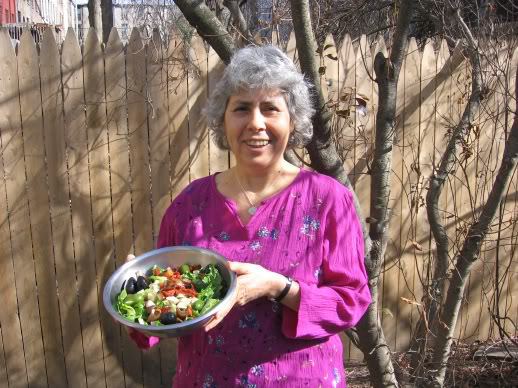

A recent lunch included mesclun, romaine, pepper jack cheese, sun-dried tomatoes, olives, cippolini onions, and avocado. Yum!

Marilyn: I like visiting farms and seeing fruits and vegetables growing. I don’t eat things with feet, but I do eat plenty of the things THEY eat. Here’s one of my favorite lunches:

In a bowl, put a serving of mesclun or a mixture of lettuce (romaine or Boston), radicchio, and endive. Add canned fish (which don’t have feet) such as tuna, mackerel or trout in olive oil. Then mix in whatever in the pantry takes your fancy—canned mandarin oranges, canned artichoke hearts, pickled onions, olives, avocado slices, dried cranberries or cherries, or slices of fresh apple, mango, or other fruit. I don’t add dressing—the oil in the fish is enough—but you could squeeze some lemon juice over the salad.

Some good bread and a cup of tea on the side, and voila—a delicious, healthy, and earthy meal!
——————————————————————————
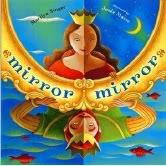
Award-winning author and poet Marilyn Singer writes picture books, short stories, fairy tales, fantasies, realistic novels for children and young adults, nonfiction, and mysteries, but enjoys writing poetry most of all. She’s published about 90 books, including 20 poetry collections, which have received such accolades as the Lee Bennett Hopkins Poetry Honor Award (Creature Carnival), ALSC Notable Book (Central Heating), and NCTE Notable Book (Turtle in July). Besides the 2010 Cybils Award, Mirror Mirror: A Book of Reversible Verse, has been showered with a boatload of other honors: Horn Book Fanfare List, NYPL Best 100 Children’s Books, Booklist Editor’s Choice, Publishers Weekly Best Children’s Books of 2010, and Washington Post Top 15 Children’s Books of 2010, among others.

Born in the Bronx, Marilyn currently lives in Brooklyn, NY, and Washington, Connecticut, with her husband Steve and lots of animals: their standard poodle, a cat, two collared doves, and a starling named Darling. She enjoys ballroom/Latin dancing, dog training, reading, hiking, bird-watching, gardening, playing computer adventure games, and going to the movies and the theatre. She’s also a major Star Trek fan.

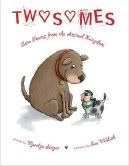
Recent books: Tallulah’s Tutu (Clarion, 2011), Twosomes: Love Poems from the Animal Kingdom (Knopf, 2010).

Coming Soon: What is Your Dog Doing? (Atheneum, June 2011), A Full Moon is Rising (Lee & Low, May 2011).

Marilyn also co-hosts Poetry Blasts at various conferences with Barbara Benco. Her official website is here.

♥ I highly recommend this Reading Rockets video interview, because Marilyn discusses her early influences, offers suggestions about how to share poetry in the classroom, and reads several poems from Mirror Mirror. Great way to celebrate National Poetry Month!

♥ Check out this post at The Miss Rumphius Effect, where Marilyn talks about Footprints on the Roof.

♥ Marilyn’s poem, “A Stick is an Excellent Thing,” was recently featured as part of GottaBook’s 30 Poets/30 Days this month.


Copyright © 2011 Jama Rattigan of jama rattigan’s alphabet soup. All rights reserved.

tabatha yeatts: of cheese and concerti

#11 in the Poetry Potluck Series, celebrating National Poetry Month 2011.

Why, yes. That would be Herr Mozart himself, escorting the lovely Tabatha Yeatts, who’s bringing a tasty bit of music history to the party today.

Please help yourself to a cup of rich, steamy Viennese coffee and make yourself comfortable. Nothing like the combination of coffee, chocolate, cinnamon and cream to alert you to the beauty in the world.

via Jeremy Choo

You may know that besides being a brilliant composer, dear Wolfie was somewhat of a prankster. He took great pleasure in razzing those he loved best. He was great friends with Austrian horn player Joseph Leutgeb, whom he met while Leutgeb played in the Archbishop of Salzburg’s private orchestra. Mozart composed concerti especially for Leutgeb, and some of the scores are “embellished” with coarse jokes, crude asides and blatant name-calling — all in the spirit of fun.

Consider this bizarre narrative, parts of which were strategically placed in Mozart’s autograph score for his Horn Concerto No.1 in D major, written in 1791:

For you, Mr. Donkey—Come on—quick—get on with it—like a good fellow—be brave—Are you finished yet?—for you—beast—oh what a dissonance—Oh!—Woe is me!!—Well done, poor chap—oh, pain in the balls!—Oh God, how fast!—you make me laugh—help—take a breather—go on, go on—that’s a little better—still not finished?—you awful swine!—how charming you are!—dear one!—little donkey!—ha, ha, ha—take a breath!—But do play at least one note, you prick!—Aha! Bravo, bravo, hurrah!—You’re going to torture me for the fourth time, and thank God it’s the last—Oh finish now, I beg of you!—Confound it—also bravura?—Bravo!—oh, a sheep bleating—you’re finished?—Thank heavens!—Enough, enough!

Tsk, tsk. Boys will be boys. Good thing Herr Leutgeb had a good sense of humor, fully realizing how much Mozart respected his extraordinary musicianship (further evidenced by the difficulty of the composition). There’s a little more to this story, but first let’s hear from Tabatha:

I enjoy writing about history and spotlighting a particular moment. My daughter plays French horn and I have heard her practice Mozart’s horn concertos many times. I offer my sincere respect to horn players.


MOZART SENDS CONCERTOS TO THE HORN PLAYER JOSEPH LEUTGEB
by Tabatha Yeatts

Leutgeb accepted these gifts
as the challenges they were —
tributes wrapped in golden paper,
fastened with knots that would take
months to untangle.

He laughed as he read them.
The audacity!
He imagined his friend
sharpening the nib of his pen,
finishing the rondo with a flourish:
“Play that,
if you can!

When you have conquered these notes,
wrestled them to the ground,
beaten them with only your
hands and heart, and
your fierce and delicate mouth
to sustain you,
I will come discover myself
in your bell-smooth,
heart-ringing voice.”

© 2011 Tabatha Yeatts. All rights reserved.

Leutgeb must have indeed had a fierce mouth, for the French horn he played back then was valveless. He would have had to produce different pitches by varying lip pressure and/or changing the position of his hand in the bell of the instrument. The four horn concerti and quintet Mozart wrote for Leutgeb remain among the finest ever composed for the instrument. Nice to know that close friendships can inspire utmost brilliance for all parties concerned.

*sips a little more coffee and rubs hands together*

Much as I love hearing about Mozart’s little nasties, the part of the story I like best is about when Leutgeb moved from Salzburg to Vienna. In order to supplement his meager income as a musician, he opened a cheese shop! Wolfgang’s father Leopold lent Leutgeb some money to help him get started, describing the shop as “the size of a snail’s house.” No doubt there were traces of Kugelkase, Schloss, or Mondseer on Leutgeb’s breath as he raised his horn to his lips. ☺

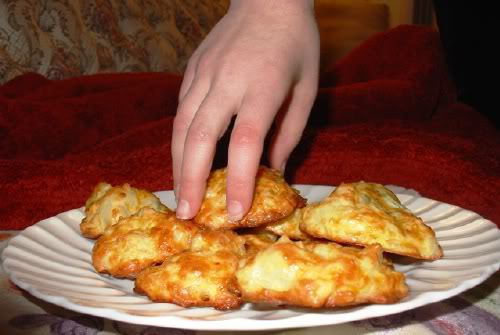
Naturally, Tabatha has brought us something cheesy to top things off. Possibly the best ingredient in these little savories is the “hot air” that fills them, so make sure you don’t use up all of yours when practicing your next horn concerto. Puff away and enjoy!


CONCERTO CHEESE PUFFS

1/2 c. butter

2 c. water

2 c. flour

1 t. salt

1/2 t. pepper

6 large eggs

2-1/2 c. shredded cheese (you choose what kind – I have used various combinations of sharp and regular cheddar, Monterey Jack, mozzarella, and Mexican blend, all with success)

1 t. baking powder

crushed garlic or garlic powder (optional)  

Combine water and butter in a saucepan; add salt and pepper. Bring to a rapid boil. Add flour all at once, beating vigorously with a wooden spoon until mixture forms a ball and comes away from sides of pan. Remove from heat; cool 5 minutes. Add eggs one at a time, beating vigorously by hand or in a food processor for ten seconds after each addition. Continue beating 1-2 minutes or process 20 seconds until smooth. Blend in shredded cheese, baking powder, and garlic to taste. Drop 2″ balls of dough onto lightly greased cookie sheets. Bake in a 400-degree F oven for 20 minutes or until puffed and lightly browned. (Optional: Just before serving brush tops with a little butter and sprinkle with grated cheddar cheese and garlic. Heat at 400 degrees for about five minutes or until cheese is melted.)
———————————————————————————

Tabatha Yeatts, a native of Blacksburg, Virginia, has published three biographies for young adults (Joan of Arc, Thomas Edison, Mae West), and two other nonfiction titles: Forensics: Solving the Crime (Oliver Press, 2001), and The Holocaust Survivors (Enslow, 1998). She’s also written dozens of articles and stories for such publications as The Christian Science Monitor, Cricket, and Logic Puzzles (I especially like her piece on Pippi Longstocking). She blogs regularly at The Opposite of Indifference, where she participates in Poetry Friday and Art Thursday. I love the rich combination of music, art, poetry, tidbits and observations she shares with her readers — always something fascinating to learn there. Tabatha currently lives with her family in Maryland, where the air is filled with the aroma of warm cheese puffs and the sonorous notes of the French horn. Find out more at her official website.


Copyright © 2011 Jama Rattigan of jama rattigan’s alphabet soup. All rights reserved.
a heart-touching visit with irene latham

#8 in the Poetry Potluck Series, celebrating National Poetry Month 2011.


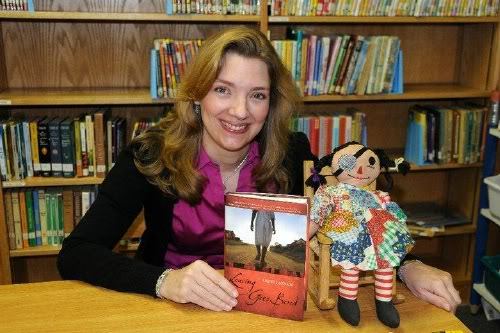
Irene with her debut middle grade novel, Leaving Gee’s Bend.

When poet and author Irene Latham was at a booksigning for her debut novel Leaving Gee’s Bend last year, she spied a postcard book containing pieces from the National Museum of Women in the Arts. She decided to use some of the paintings as prompts for the poem-a-day-challenge she usually does every April. Twelve of those poems are included in her second book of poetry, The Color of Lost Rooms (Blue Rooster Press, 2010), which explores the themes of love and loss within the context of history, nature and art. 

I find ekphrastic poems fascinating, a kind of triple treat. There’s the work of art itself (something we might encounter for the first time or be invited to ponder anew), the poet’s response to the art, and then the pleasure of comparing our own reactions with the poet’s. Irene says she really responds to visual art on an emotional level, and that the paintings she eventually wrote about chose her. I know just what she means. It’s wonderful wholly entering the world of a painting that speaks to you. 

Continue reading

margaret’s new year’s dishes

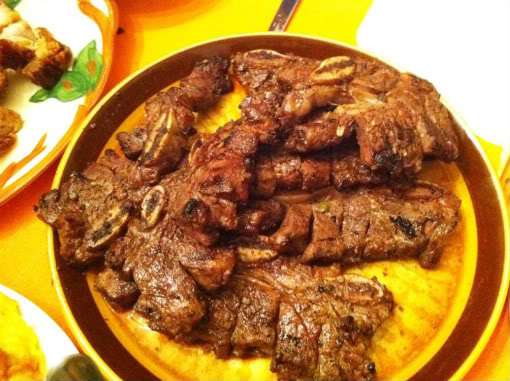
A couple of weeks ago, I posted a slideshow featuring some of the Korean dishes typically served at my family’s New Year’s celebrations in Hawai’i (and as featured in my picture book, Dumpling Soup).

Several of you asked for recipes, which my mom was happy to provide. Keep in mind these quantities are her best guestimates; feel free to adjust according to your taste and needs. Enjoy!

KOREAN KALBI (Grilled Shortribs)


Marinade Sauce for approximately 3 lbs. shortribs:

1 cup shoyu
1/4 cup brown sugar
1 T garlic, crushed fine
2 T ginger root, crushed fine
1 tsp black pepper
2 T toasted sesame seed
5 T green (spring) onions, chopped fine
1 T sesame oil
2 T Wesson oil


Continue reading

friday feast: practicing rapture with our surprise guest, susan rich!

#11 in the Poetry Potluck Series, celebrating National Poetry Month 2010

Sometimes the nicest things happen by accident.

Not too long ago, in one of my relentless searches for good food poems, I stumbled upon Susan Rich’s “A Poem for Will, Baking.” It brought me to my knees, as I remembered losing my aunt and my cousin’s grief. The poem also resonated with many of you, and later I was pleasantly surprised to hear from Susan herself.

When she asked whether we could combine forces for National Poetry Month, I knew she would be a perfect surprise guest. She’s written other food poems, some of which are included in her new book, The Alchemist’s Kitchen (White Pine Press, 2010). What I didn’t know was how succinctly her chosen “potluck poem” would define the provocative relationship between food and poetry.

Continue reading