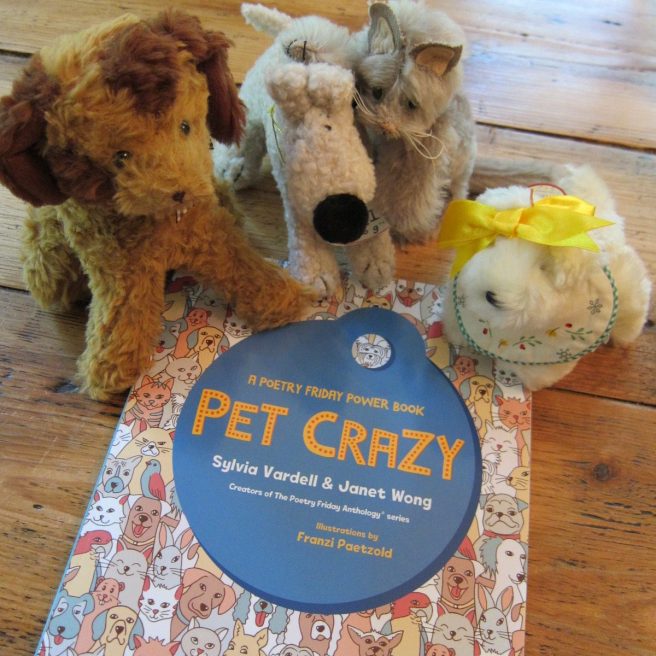
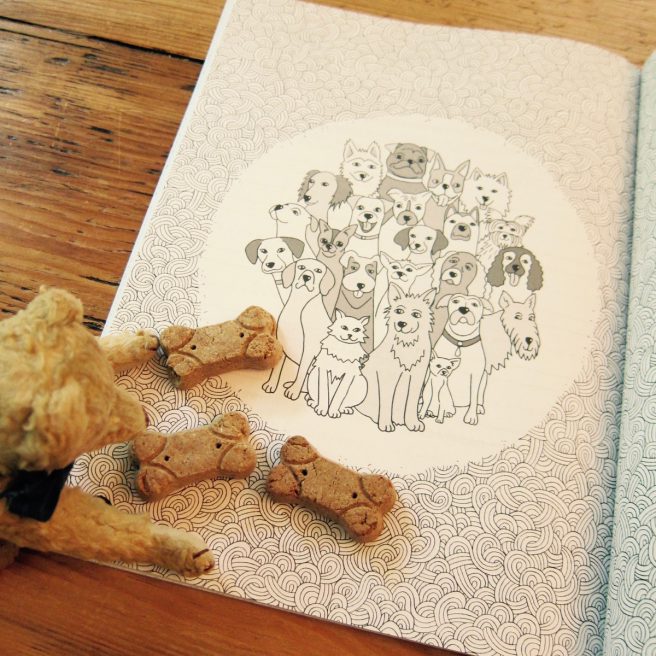
Jump, roll over, sit, and stay . . . it’s time to sniff out Pet Crazy, the third title in the popular Poetry Friday Power Book series created by poetry goddesses Sylvia Vardell and Janet Wong. Yip!
Just for this post, you may bark, meow, cluck, or tweet your approval at any time. Perfectly acceptable. After all, it’s hard to curb your enthusiasm for this fun and frisky interactive story-in-verse and writing journal rolled into one, just purrrrfect for kids in grades K-3 (or bears of any age).
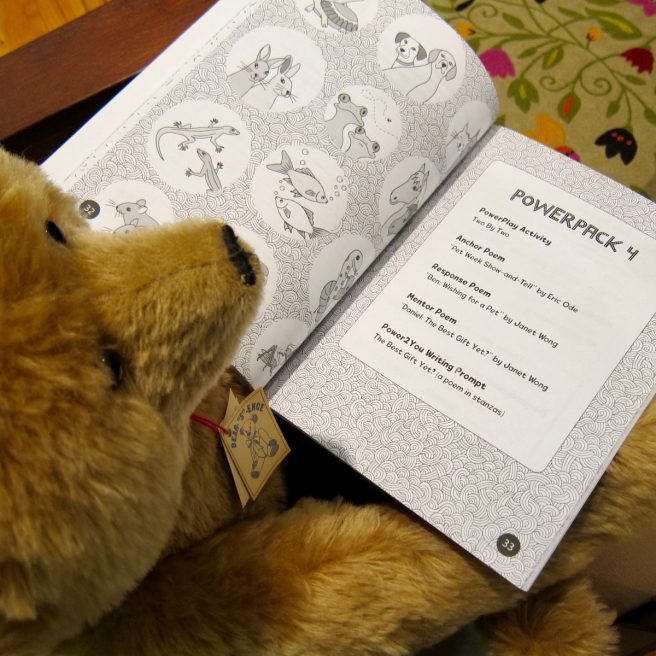
Pet Crazy includes 36 poems in all, with three poems featured in each of 12 PowerPacks.
PowerPacks include:
Powerplay Activity
Anchor Poem
Response Poem
Mentor Poem
Power2You Writing Prompt
The anchor poems in Pet Crazy were written by Kristy Dempsey, Janice Harrington, Carole Boston Weatherford, Eric Ode, Helen Frost, Tamera Will Wissinger, Elizabeth Steinglass, Laura Shovan, Padma Venkatraman, Eileen Spinelli, April Halprin Wayland and Don Tate. Five poems culled from the Poetry Friday Anthology series take their place alongside seven newly penned verses.
Janet Wong has written original response and mentor poems, cleverly weaving all into a charming story about young Ben, who yearns for a dog of his own, friend and cat lover Kristy, and Daniel, Ben’s best friend, who gives Ben an unusual pet for his birthday.
Today we’re pleased to welcome back New Hampshire-based author, poet, voice over artist and Poetry Friday friend Matt Forrest Esenwine to Alphabet Soup.
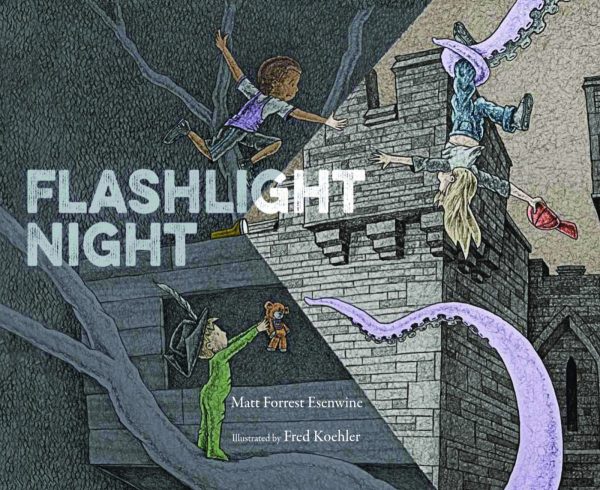
Since his very first picture book will officially hit shelves this coming Tuesday, September 19, we wanted to congratulate him and hear all about Flashlight Night, which was illustrated by Fred Koehler and published by Boyds Mills Press.
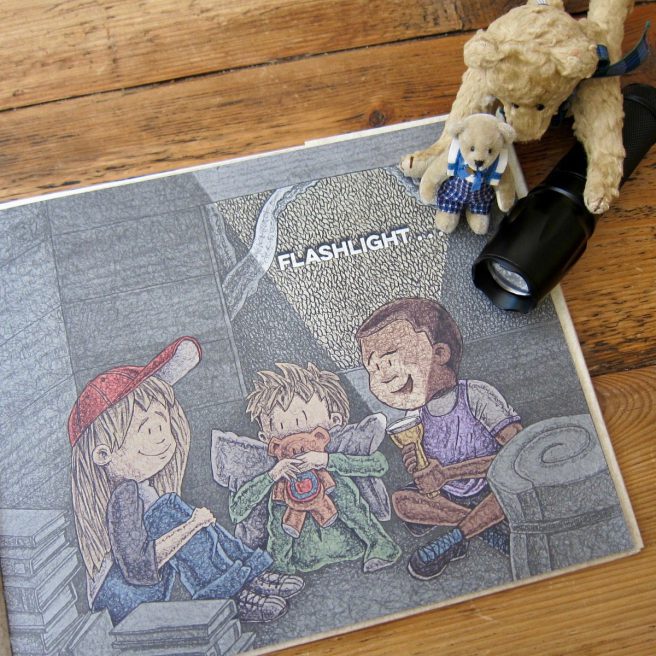
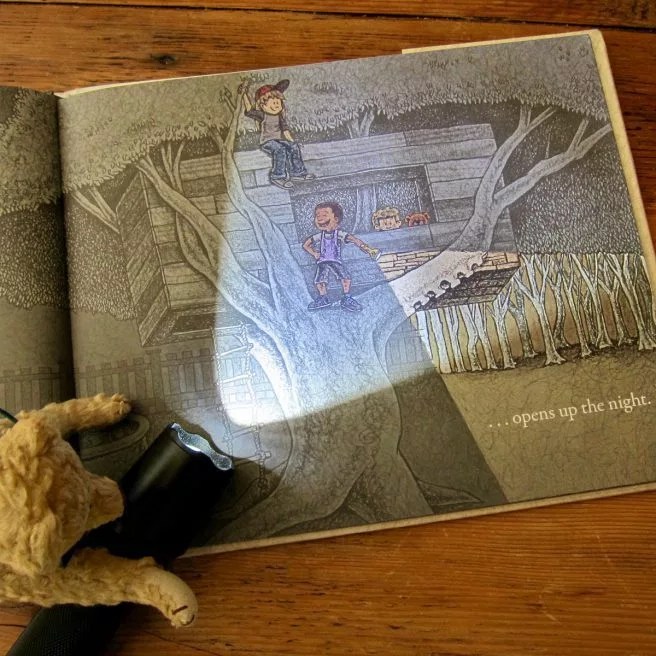
Written in rhyming couplets, the story follows three kids (two boys and a girl) who camp out in a tree house and roam around the back yard in search of adventure. The older boy leads the way with his trusty flashlight, that magically transforms everything in its beam to an imagined world of wonder, excitement and harrowing escapes.
FLASHLIGHT . . . opens up the night.
Leads you past old post and rail along a long-forgotten trail
into woods no others dare, for fear of what is waiting there
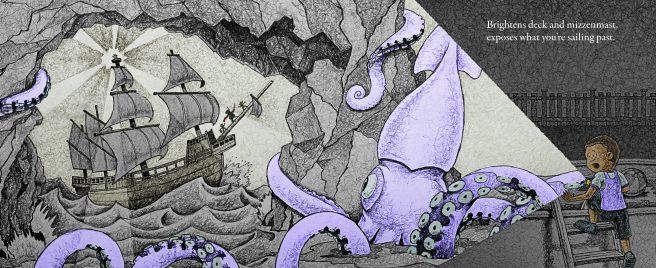
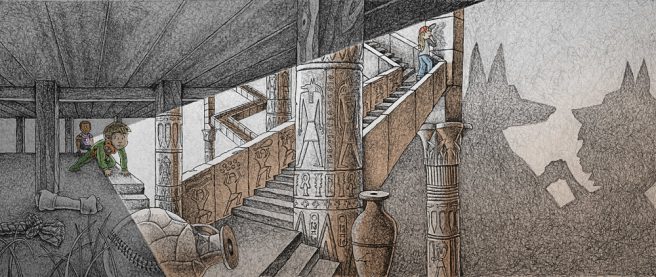
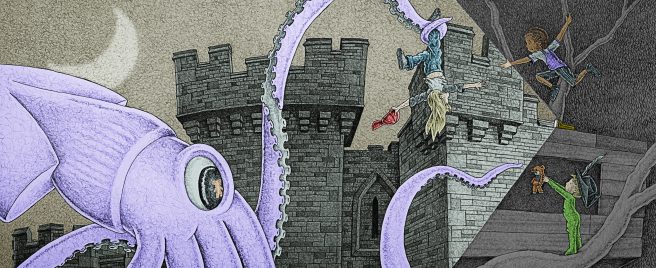
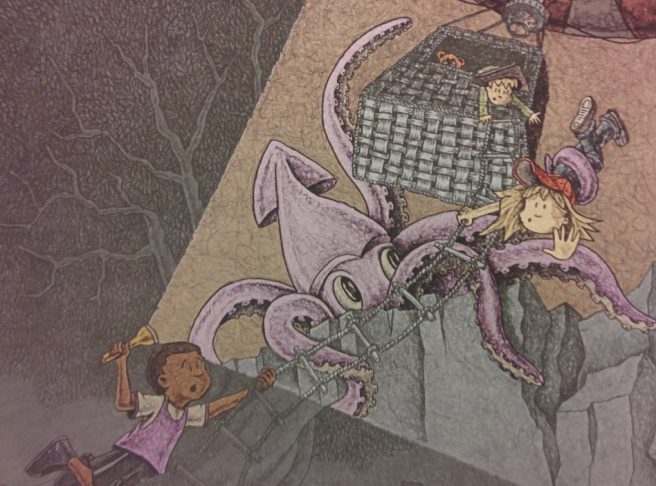
They venture “down a dark and ancient hall,” encountering an Egyptian tomb, then pass through “a peculiar door” and board a ship on the high seas, where they must battle a sword-brandishing pirate and a giant purple squid.
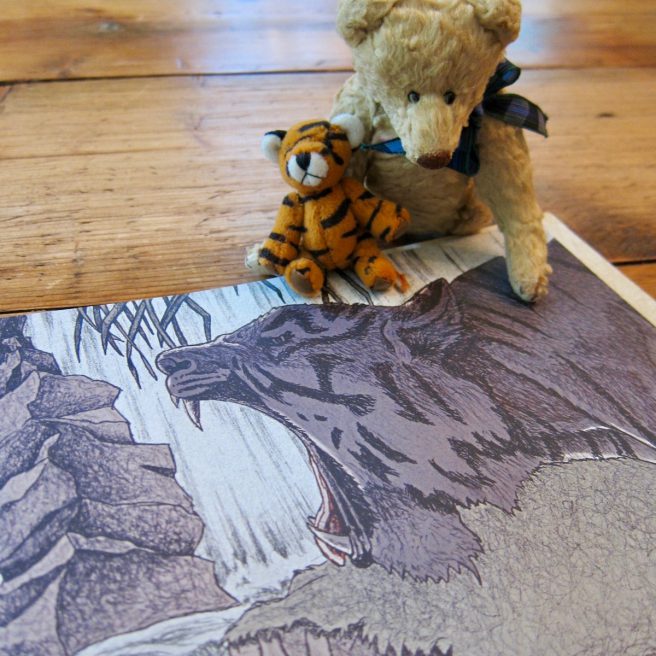
Koehler’s ingenious illustrations depict the dramatic transformations from real to imagined: a striped cat becomes a ferocious tiger, water trickling from a garden hose becomes a torrent of rushing water, the space beneath the deck is the long-forgotten tomb, the above-ground pool is the ocean.
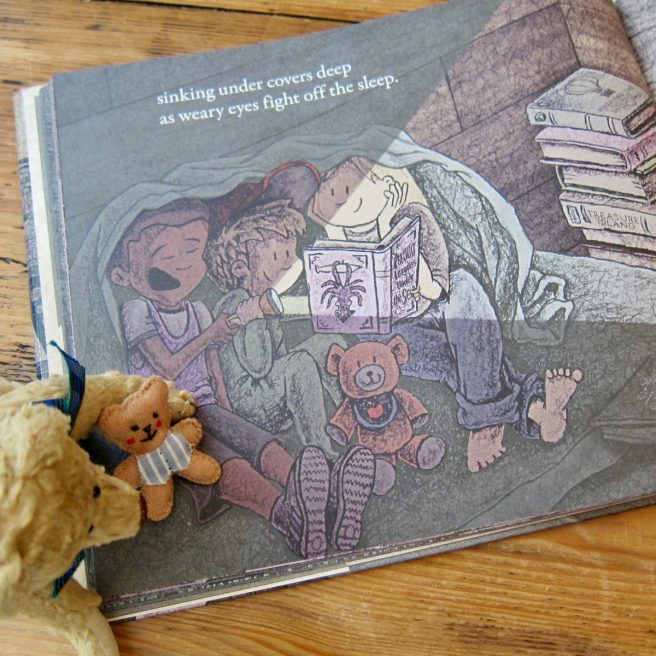
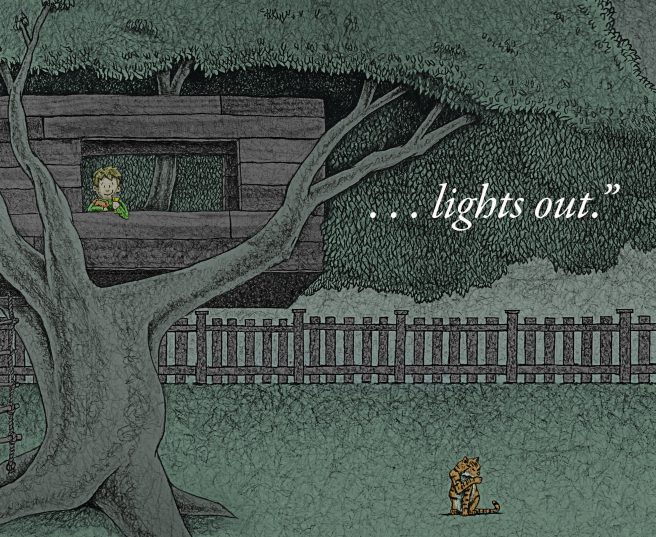
Each page turn heightens the suspense as the trio is ultimately rescued via hot air balloon. Once safe and sound back in their tree house, they resume reading together, the flashlight illuminating a stack of books that inspired their adventure.
Adventure lingers, stirs about — until a voice says, “Shhh . . .lights out.”
I love how Fred expanded on Matt’s spare, evocative text with vivid, action-packed scenes marked by enriching textures and a boatload of interesting details. Kids will enjoy studying the demarcation between light and dark, and I was happy to see a girl and an African American boy included. And yes, we especially like the younger boy in footie pajamas carrying his teddy bear. 🙂
Flashlight Night has already earned a coveted *starred review* from Kirkus, which praised its “delicious language and ingenious metamorphoses.” This book is a wonderful celebration of imaginative play, the magic of reading, and creating your own old-fashioned fun. No need for fancy, expensive electronic toys. Here’s to a flashlight, a few books, and the unlimited power of the imagination!
How did Matt conceive of this story? Did he enjoy many flashlight nights when he was a kid? And what delicious recipe is he sharing with us today?
We thank him for visiting and extend our heartfelt congratulations on a fabulous picture book debut. Hooray for Flashlight Night!
*
🔦 AUTHOR CHAT WITH MATT FORREST ESENWINE 🐙
How does it feel to have your first picture book out in the world? Was there a flashlight adventure from your own childhood that inspired this story?
It feels great! It’s also a bit surprising, to be honest, because I snuck into the world of children’s literature by way of poetry, so I had always thought my first book – should I be fortunate to even have a first book – would be a poetry collection.
There was no particular flashlight adventure on which this was based, although growing up in rural New Hampshire (and still living here!) has definitely influenced my writing.
Tell us briefly about your book’s path to publication, from initial spark to finished manuscript. Overall, was there anything that particularly surprised you?
I was driving home late one summer night in 2014, following an informal gathering of local SCBWI members, when the idea of a flashlight “opening up the night” suddenly came upon me. I suppose it had something to do with my lonely headlights piercing the darkness, all alone on a Massachusetts road.
I started putting some words and images together and came up with the opening stanza and most of the closing stanza right then. (At this point, I didn’t know if it was a poem or picture book). During the course of the following week, I continued working on it and had the first draft completed by the end of the week. A few more weeks of tweaking here and there, and it was done – which was probably the most surprising part of the entire process!
Which part of the writing process do you enjoy most? Do you have any particular writing rituals to get you started and/or keep you going?
Writing a poem is like creating a word puzzle, which is probably why I love it so much; as a kid, I used to create word finds and crosswords for my teachers to pass out in class (remember mimeographs and Xeroxes??). So now I get to play with words as a career, which is complete joy – no matter how mind-boggling or nerve-wracking the poem or story might be. I love finding the right words not only for descriptive purposes, but for alliterative and rhyming purposes, as well.
And the only ‘ritual’ I have with regards to writing is sitting in my chair, banging out text. When I was younger, I used to wait for inspiration to strike, but now that I’ve been doing this for so long, I realize Jane Yolen’s BIC Rule (Butt In Chair) is really the best advice!
Beginning picture book writers are often told to avoid rhyming texts. Do you have any tips for keeping sing-song rhythms and predictable rhymes in check?
As many others before me have stated, the story needs to come first. I’ve written a couple of manuscripts in prose, but most are in verse simply because the stories lend themselves to it. So if your story doesn’t need rhyming text, it can probably do without it. But if it is going to rhyme, one needs to try to avoid the simple, expected rhymes – and try to use more imaginative words when possible.
For example, in Flashlight Night, I could have used words like “boat,” “strange,” and “dark” to describe some of my scenes, but I instead chose “vessel,” “peculiar,” and “inky,” which are so much fun to say! So whether you are rhyming or not, spend some extra time with your text and see what you can do to enliven the vocabulary a bit. Even if a child is unfamiliar with a word, the definition can very often be gleaned based on the context of how it’s being used.
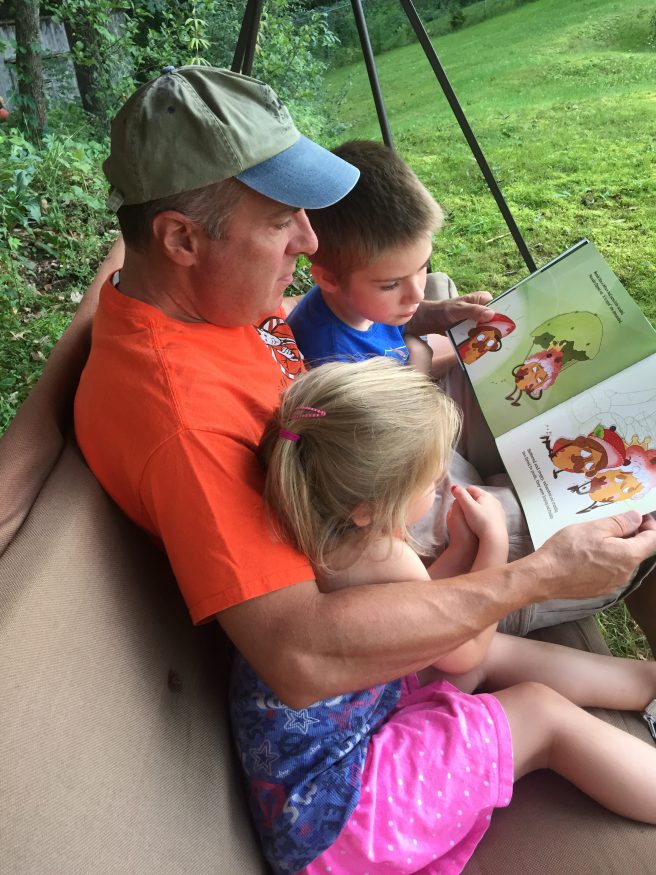
Matt reading a tasty picture book with his kids.
Once your manuscript was accepted, did you have to do many revisions? What are some of the things you learned from working with your editor?
It’s funny…Jane Yolen told me to be prepared for a long list of revisions, which is not uncommon, of course – yet my editor only requested 4 or 5 edits, which I took care of pretty quickly! While I tried to be ambiguous about certain scenes in order to allow an illustrator to have plenty of fun with the text, my editor, the wonderful Rebecca Davis at Boyds Mills Press, pushed me even more to find better words (see my comment, above, about word choice!). And our illustrator, Fred Koehler, went a completely different route with my original ending, so I ended up needing to alter the last couple of pages of text in order to get his vision and mine to marry.
Which children’s book authors and poets do you think have had the most influence on your work? Were there any particular picture books that inspired Flashlight Night?
I can’t say any one picture book specifically inspired Flashlight Night, but I will say that every poem, song, and story I’ve read has somehow influenced my style and interests. I attribute my love of rhyme and poetic structure to Robert Frost and William Shakespeare; my appreciation for children’s poetry to Dorothy Aldis and Shel Silverstein; my sense of humor to Monty Python and Stan Freberg; and my love of mystery to Chris Van Allsburg and Isaac Asimov.
Without a doubt, I am continually influenced by many of the wonderful folks in children’s literature today with whom I’ve had the pleasure of befriending: Lee Bennett Hopkins, Charles Ghigna, David Harrison, Jane Yolen. I recall Charles once telling me a couple years ago that he was my biggest fan – which totally floored me! Jane once made my heart soar when she said a particular short verse I’d written was ‘masterfully rhymed.’ And I remember when Nikki Grimes started following me on Twitter and told me she was a fan…and I couldn’t help wonder why, ha! I kept thinking, “You’re NIKKI GRIMES – why on earth would you be a fan of ME?!?”
I wouldn’t have even met my editor, Rebecca, had Lee not taken a vested interest in my career and introduced us a few years ago; for that, I’m forever in his debt.
Fred Koehler’s illustrations are brilliant. Did the two of you communicate at all about the art for the book (or did you include any illustration notes with your manuscript)? Was it his choice to include three children in the story and the stack of books at the end?
Fred & I didn’t communicate that much during the process, although Rebecca kept me in the loop as to what his vision was and how he was approaching the task. The only illustration note I included in my manuscript was to indicate at the very end that a child was reading a book under the covers; without that note, the story would not entirely make sense. So I think Fred did a fantastic job of taking my words and imagery and really making it his own. The book is truly greater than the sum of its parts!
Describe how it felt to see Fred’s illustrations for the first time. Which is your favorite and why?
The first illustration I saw was an initial sketch Fred made for Rebecca – before he even signed the contract – to show her his idea for the style of the illustrations and his concept for the sub-narrative of reality being the darkness while the fantasy is illuminated by the light. He ended up selling the picture before we met, so I’m disappointed I don’t have it, but it will always be a favourite of mine. My other favourite – which seems to be a favourite of everyone who sees the book – is the spread featuring the Kraken crawling through the stones.
Please describe what might be in Matt Forrest Esenwine’s flashlight beam at age 5 or 6. What’s in his beam now?
Hmmm…when I was 5 or 6 I was living in Pinardville, New Hampshire, a little area just outside of the state’s largest city, Manchester. It was suburbia, but we had a little bit of woods and a stream running behind our property, so I used to enjoy pretending I was a hunter or a policeman or Zorro, fighting off the bad guys!
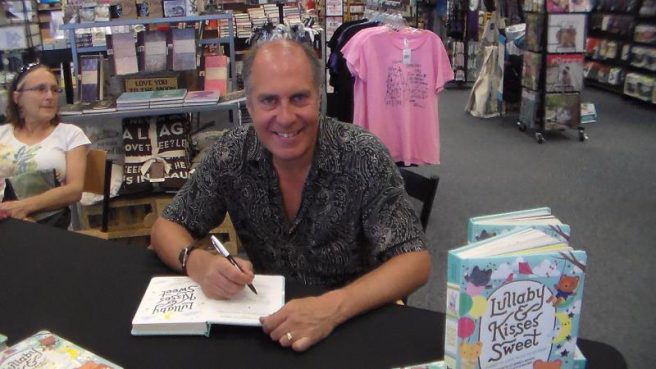
These days, I’m happy to say my flashlight beam and my reality have been merging: my dream of becoming published in children’s literature quickly became reality in 2015 when I had a poem published in Lee Bennett Hopkins’ Lullaby & Kisses Sweet (Abrams Appleseed), and between then and 2019, I’ll have had 24+ children’s poems published and two picture books – so that line separating reality from fantasy has grown quite thin!
What do you hope kids will take away from your book?
A sense of wonder (I know, a cliché answer, but it’s true!) and an inspired imagination.
Is there anything else you’d like us to know about Flashlight Night?
I would just add that this book is proof that with determination, hard work, and time spent learning one’s craft, dreams can be realized. I’ve been writing all my life and have had numerous adult poems published around the country, but I did not decide to approach children’s lit as a serious career change until 2010, so the fact that I’ve come as far as I have speaks volumes to the importance of time, talent, and tenacity. And as I always say, whatever I lack in talent I try to make up for in hustle!
What’s next for you?
My second picture book, Don’t Ask a Dinosaur (Pow! Kids Books), co-authored with Deborah Bruss (Book! Book! Book!, Big Box for Ben) comes out this spring! I also have a couple of poems in different places: ‘Soccer Sides’ can be found in Amy Ludwig VanDerwater’s Poems are Teachers (Heinemann), out this fall; ‘Bus Driver’ will appear in Lee Bennett Hopkins’ new anthology, School People (Boyds Mills Press, Spring, 2018); and three other poems will be included in three other anthologies scheduled for Fall 2018 and 2019.
I also have about 7 or 8 manuscripts I’m submitting to various publishers and agents at present, including one rhyming picture book inspired by a certain kid-lit/foodie blogger we both know!
Could you please share a favorite recipe, something you make with or for your kids?
The recipe [for Salted Chocolate Chip Cutouts] is something I came up with earlier this year. A friend of mine told me he loved my chocolate chip cookies and asked what I do to make them taste so good; I told him the only thing I do ‘differently’ is that I tend to use a dash more salt than normal, which helps balance the sweet-saltiness. So I started thinking about how to better define that balance – and one day when the kids & I were making sugar cookies (they both love baking), it hit me: Use salt on top instead of sugar!
Of course, you can’t use as much, because it would make the cookies way too salty — but by keeping salt out of the recipe, it helps underscore those two tastes.
It took awhile to get the dough just right (I wanted a classic chocolate chip cookie dough flavor, but it had to be able to roll out and maintain its shape) — but I think this fits the bill.
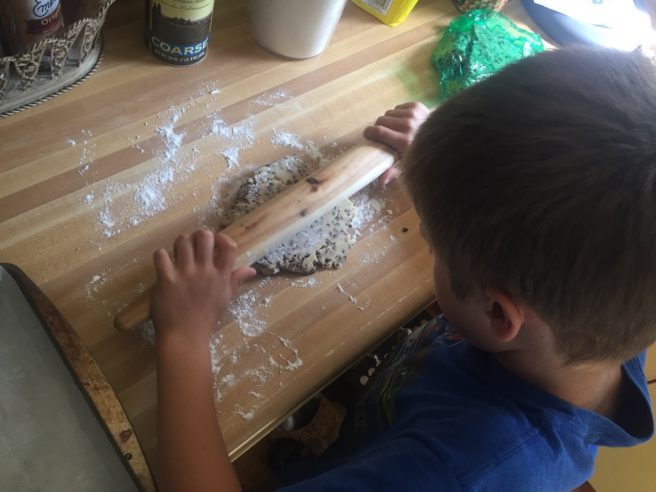
Matt’s son rolling out the dough.
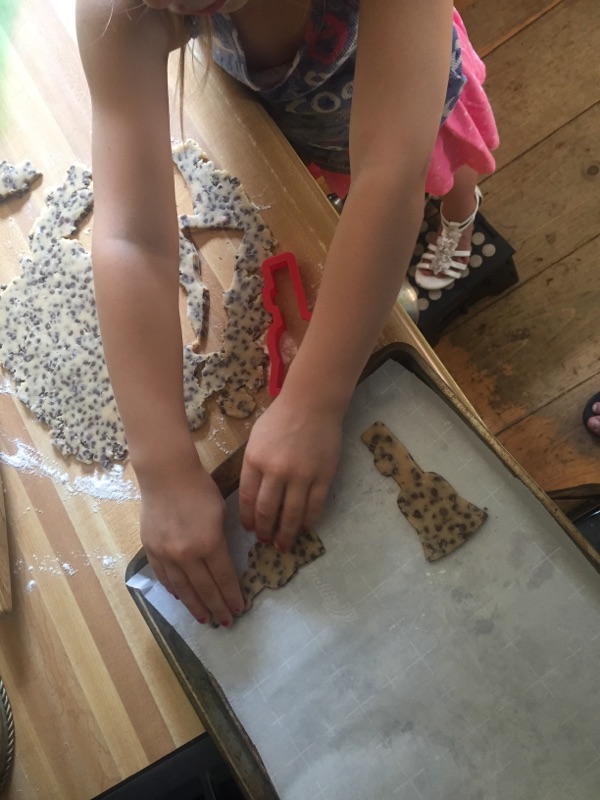
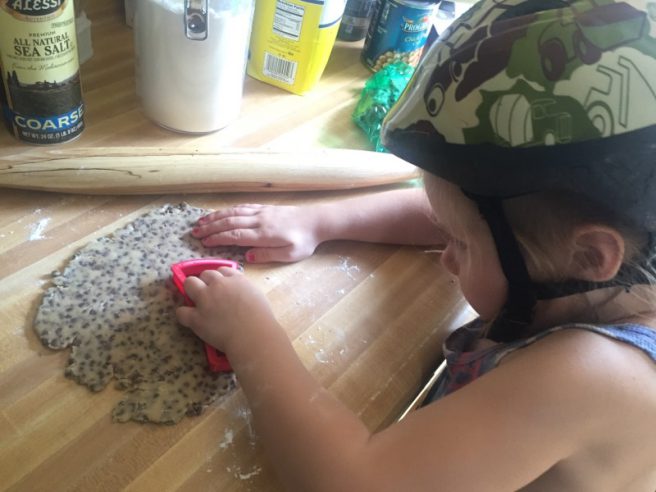
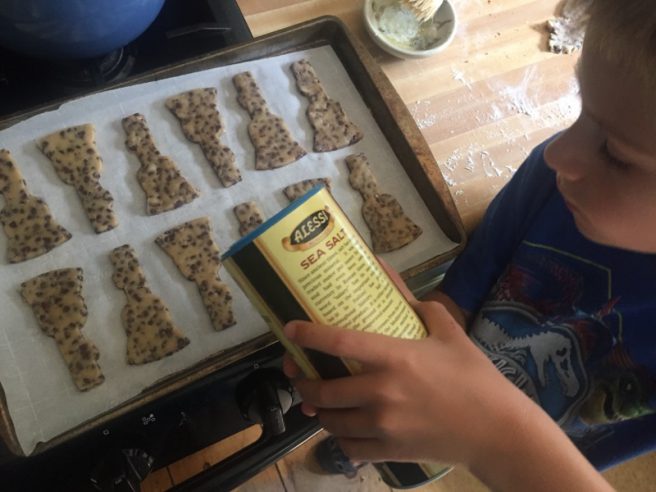
Matt’s daughter cutting out flashlight-shaped cookies.
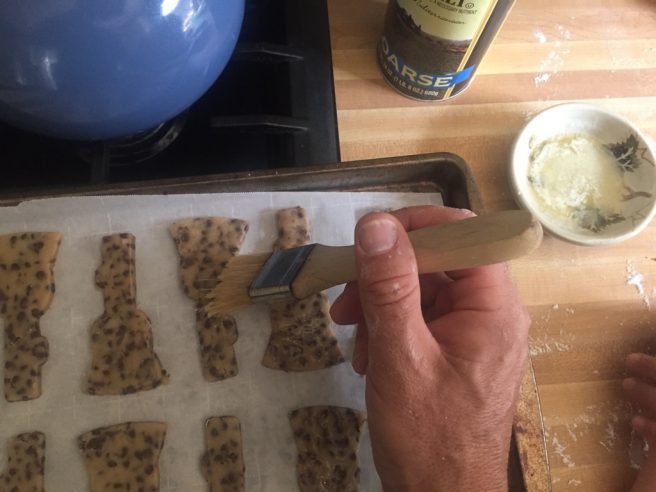
Brushing on butter.
Sprinkling on coarse sea salt.
Yum!
Matt's Salted Chocolate Chip Cutouts
Servings: makes about 3 dozen cookies, depending on size
This recipe uses salt not only as a flavor enhancer but as a garnish, so it’s important to use unsalted butter in the recipe so the cookies don’t come out too salty. Also be sure to not use too much salt on top – just a light sprinkling is all you need!
Ingredients
2 cups all-purpose flour
1 teaspoon baking soda
1/2 cup (1 stick) unsalted butter, softened, and 2 tablespoons melted, reserved
1/2 cup packed brown sugar
1/4 cup light corn syrup
1 tablespoon molasses
1 tablespoon water
1 teaspoon vanilla extract
1-1/2 cups mini chocolate chips
Coarse salt (like Kosher or sea salt)
Directions
Mix flour and baking soda in a small bowl and set aside. In a large bowl, beat ½ cup butter, sugar, corn syrup, molasses, water, and vanilla until blended. On low speed, add flour just until well combined – do not overmix – then stir in chips by hand. Dough will be a bit crumbly; that’s ok. Chill at least 30 minutes, or even a couple days in advance.
When ready to bake, heat oven to 350 F. Roll out dough on lightly floured surface to 1/8-inch (if in doubt, dough should be no thicker than the width of a chip), cut into shapes, and place 1-inch apart on ungreased cookie sheet. Be careful not to handle the dough too much, or the chips will start melting. Brush on the melted butter, then sprinkle with salt – but with not too heavy a hand! Bake until slightly browned: 6-7 minutes for softer cookies, 7-8 minutes if you prefer crispy. Let rest a few minutes, then transfer to a rack to cool.
*Recipe by author Matt Forrest Esenwine, as posted at Jama’s Alphabet Soup.
*
FLASHLIGHT NIGHT written by Matt Forrest Esenwine illustrated by Fred Koehler published by Boyds Mills Press, September 19, 2017 Picture Book for ages 4-8, 32 pp. *Starred Review from Kirkus*
🐙 Visit Matt’s blog, Radio, Rhythm, and Rhyme, for all the latest news about Flashlight Night: reviews, bookstore appearances, giveaways, etc.
🐙 Check out the Flashlight Night Blog Tour, which continues next week:
The publisher is generously providing a copy of Flashlight Night for one lucky Alphabet Soup reader. For a chance to win, please leave a comment at this post no later than midnight (EDT) Wednesday, September 20, 2017. You may also enter by sending an email with “FLASHLIGHT” in the subject line to: readermail (at) jamakimrattigan (dot) com. Giveaway open to U.S. residents only, please. Good Luck!
*
The ever charming and talented Michelle Heidenrich Barnes is hosting the roundup at Today’s Little Ditty. Sail over and check out the full menu of poetic goodness being shared in the blogosphere this week!
*
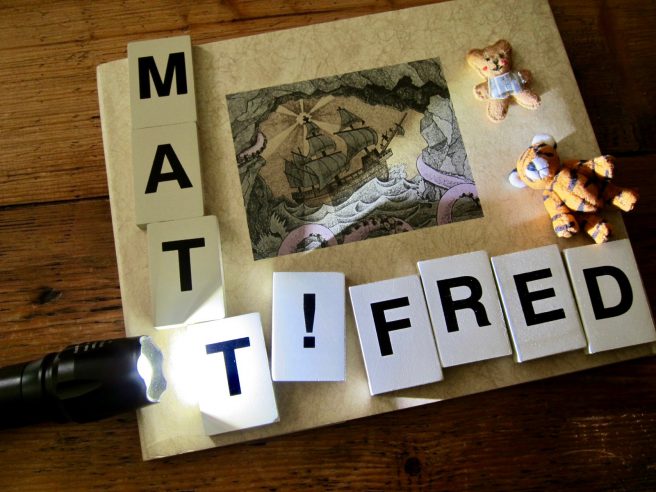
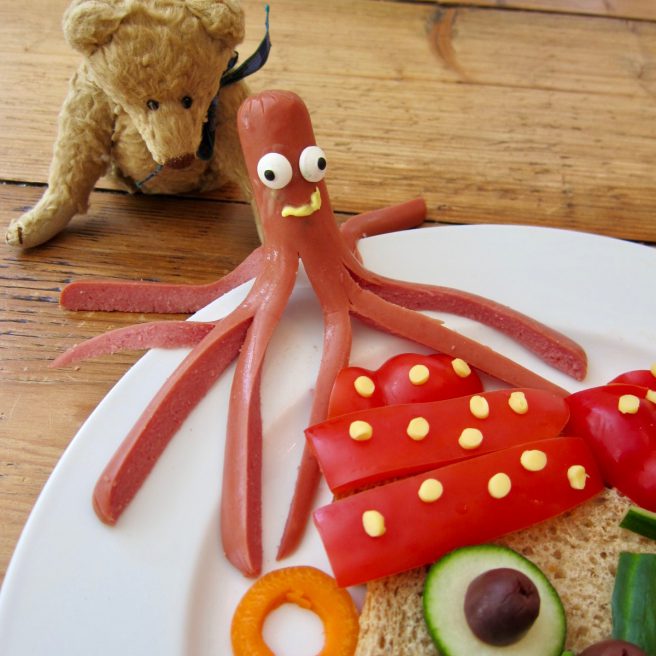
Mr Cornelius made a Pirate Snack to celebrate Flashlight Night.Uh-oh!
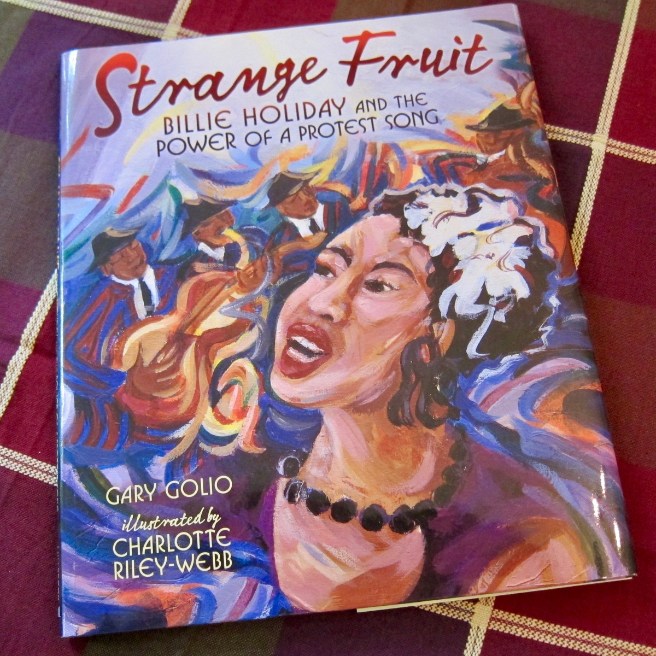
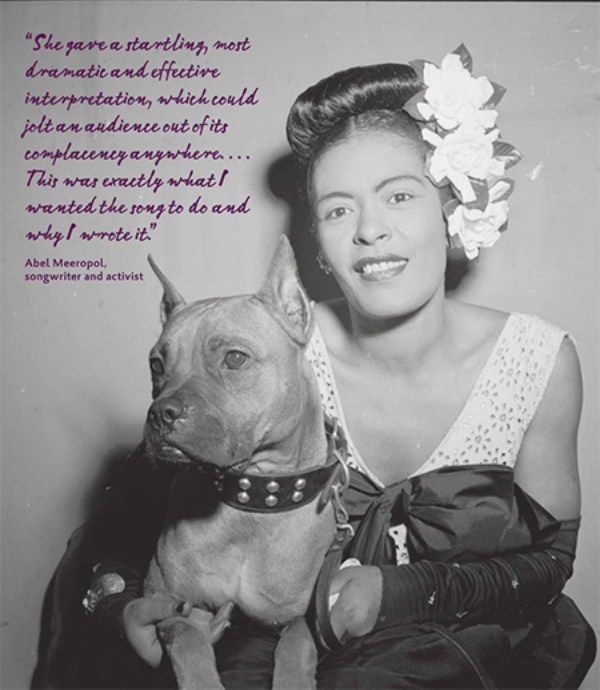
The first time I heard Billie Holiday’s rendition of “Strange Fruit” I was confused. What was she . . . could she be . . . NO! . . . and then the awful realization that she was singing about lynching — one of the most horrific, unconscionable atrocities in American history.
Strangely enough, before I read Strange Fruit: Billie Holiday and the Power of a Protest Song by Gary Golio and Charlotte Riley-Webb, I hadn’t really thought of “Strange Fruit” as a protest song, at least not the kind of protest song popular at Labor Union rallies à la Woody Guthrie, or sung in unison at 60’s civil rights marches or counterculture anti-war sit-ins. Protest songs roused and inspired people to stand up to social injustice; they unified, mobilized and galvanized.
Mister and Lady Day
Of course “Strange Fruit” did all of these things, but I think it should be in a category of its own. It shocked and outraged people, leaving many anguished and ashamed. It was, and still is, hard to listen to, and it was hard on the singer, as it brought to bear her own struggles with racism, violence, drug and alcohol addiction — all the ugliness she had experienced as an African American woman. Billie’s performances of “Strange Fruit” could be thought of as visceral theater. Singing it became an act of courage, as she was sometimes “verbally or physically harassed” afterwards.
Were you a daydreamer when you were growing up? Was there a special place you frequented to be alone with your thoughts?
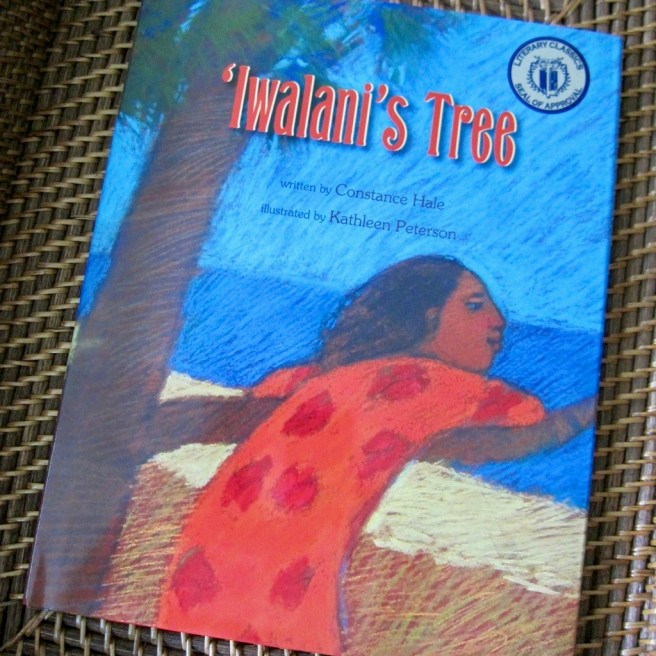
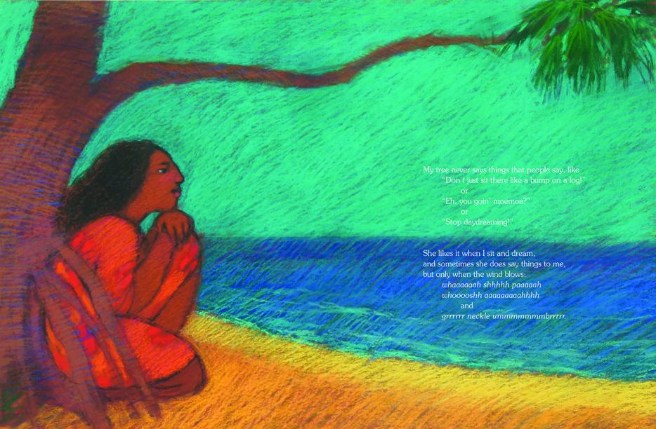
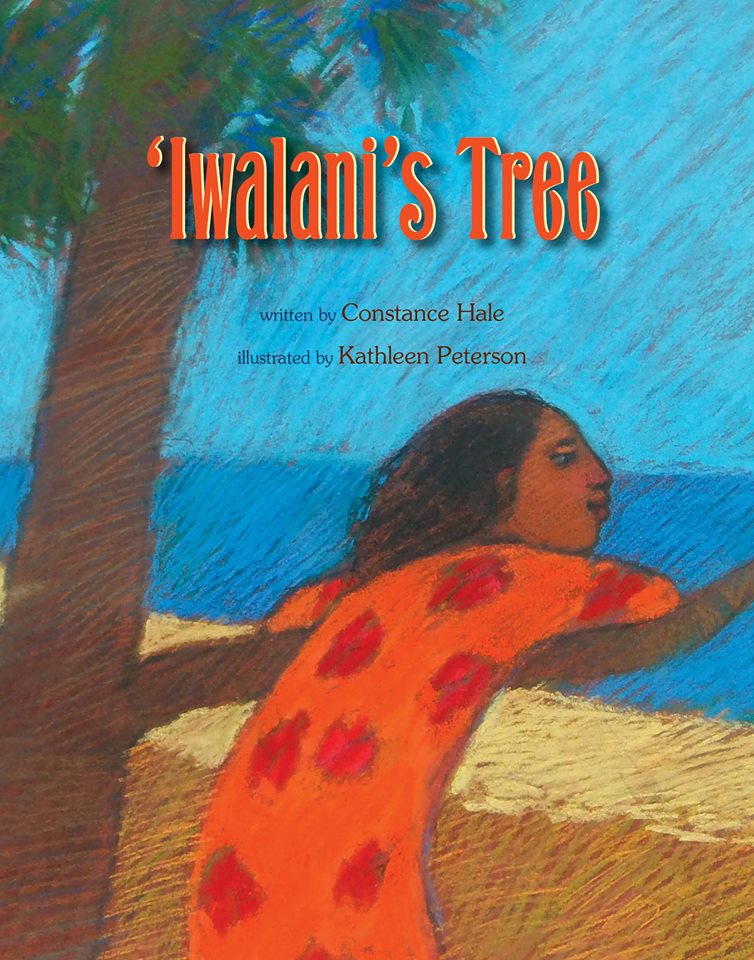
Told as a gentle free verse poem, ‘Iwalani’s Tree is an enchanting story about a girlfrom O’ahu’s North Shore who has a special bond with an ironwood tree that’s her secret friend, muse, elder, and solace.
I like to lean on a low branch of a tree
that stands way way down the beach,
toward Ka’ena,
just on the spot
where the land becomes sand.
Some people call it a paina,
some call it an ironwood.
It has fuzzy brown bark,
a trunk strong and good,
and long willowy needles
that whisper in the wind.
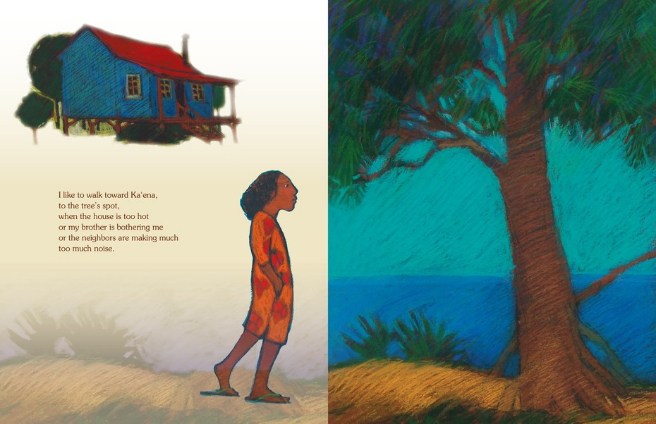
She goes on to explain that the tree is a kind of refuge, a place to go “when the house is too hot/or my brother is bothering me/or the neighbors are making much too much noise.” She leans against its trunk and plays beneath its branches, carrying on conversations with the tree, who never demands or judges, only listens.
In the tree’s presence, ‘Iwalani’s dreams take flight. What better place than in the cool shade, with only the “Sounds of the sea and the sand and the waves and the wind,” the tree whispering as the wind tickles its needles?
Sometimes, when there’s a brisk wind (he makani Mālua), the tree “yowls scary sounds.” Then, ‘Iwalani also hears the mongoose, owl, hawk, and wild boar. She asks the tree what it does all day and night, and the tree, who “speaks” only when the wind blows, tells ‘Iwalani she dreams — after all, she has “legs to rrrrun down the beach/and arms to rrrreach for the sea.” ‘Iwalani thinks that’s silly, but soon changes her mind.
One night there’s a big storm and ‘Iwalani wonders whether her tree will be able to withstand the harsh conditions.
Huge white waves smash onto the sand.
A howling wind tears the leaves off trees.
Lightning cracks the sky open like a coconut.
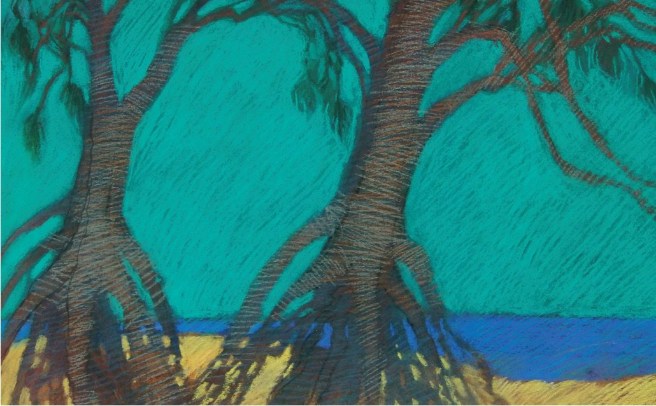
The next morning ‘Iwalani frantically races down the beach, relieved to find her tree still standing, but something has changed. So much sand has been pulled away, that the tree’s big roots are exposed. They resemble “giant knees and feet.” Having lost so much of its needles, the tree’s branches now resemble “giant elbows and fingers” stretching toward the sea.
So the tree was right all along; it really can have legs to run down the beach and arms to reach for the sea! ‘Iwalani continues to observe how the tree changes with each succeeding storm, only too pleased to while away the hours in its company, dreaming and dreaming.
Communing with nature affords ‘Iwalani many peaceful hours of introspection and a fresh appreciation of the world around her.
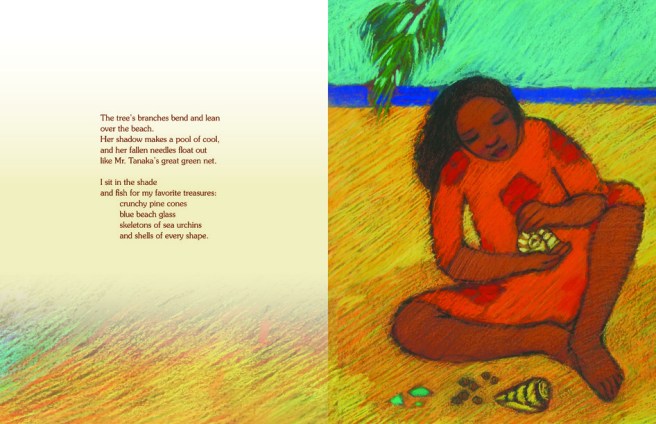
Hale’s soothing lyrical verse (which seamlessly incorporates a few Hawaiian words), and Peterson’s lush and evocative jewel-toned illustrations, celebrate Hawai’i’s natural beauty and the ongoing reverence locals have for ocean and shore. I like how the artist’s pastel strokes give the pictures a marvelous texture. This story is also an ode to the child’s imagination, the power of dreams, and the freedom to be oneself.
The lulling, meditative tone makes this a nice bedtime book. In a noisy, competitive world where children are sometimes over-scheduled and raised to believe bigger, faster, and flashier are better, this quiet, contemplative story offers an opportunity for parent and child to slow down and reflect.
The tree’s branches bend and lean
over the beach.
Her shadow makes a pool of cool,
and her fallen needles float out
like Mr. Tanaka’s great green net.
A good introduction to free verse with its sensory detail and poetic devices such as personification, imagery, rhyme, rhythm, onomatopoeia, assonance and alliteration, ‘Iwalani’s Tree also has great curriculm connections with science and geography. The author offers teaching guides for each of these disciplines at her website.
I especially enjoyed reading this story, since it transported me to my warm and friendly home state. I could just about feel those gentle trade winds caressing my cheek and hear the tree whispering in the wind:
whaaaaaah shhhhh paaaaah whooooshh aaaaaaaaahhhh
Quite hypnotic; it was easy falling under this story’s magic spell. I definitely felt calmer and more centered after reading it, and recommend it to those desiring a tranquil Hawaiian story with universal themes. Back matter includes information about the ironwood, legends about the ironwood and Ka’ena Point, and a pronunciation guide for the Hawaiian words used in the text. Don’t miss this rare gem!
*
‘IWALANI’S TREE written by Constance Hale illustrated by Kathleen Peterson published by BeachHouse Publishing, September 2016 Picture Book for age 4-8, 32 pp. *Literary Classics Seal of Approval **Study Guides for Poetry, Science and Geography available here.
*
Our fearless PF leader Mary Lee Hahn is hosting the Roundup at A Year of Reading. Drift over and check out the full menu of poetic goodness being served up in the blogosphere this week. Happy Weekend!
“Poetry is a mystic, sensuous mathematics of fire, smoke-stack, waffles, pansies, people, and purple sunsets. The capture of a picture, a song, a flair, in a deliberate prism of words.” ~ Carl Sandburg
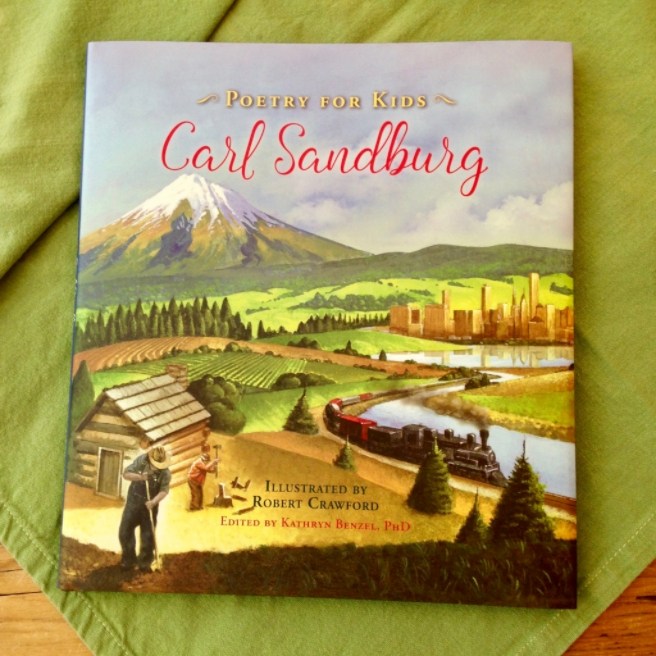
Carl Sandburg has been called the “Voice of America” and the “Poet of the People,” and in this new poetry collection, young readers can easily see why.
Edited by professor and Sandburg scholar Kathryn Benzel and illustrated by award winning artist Robert Crawford, Carl Sandburg (MoonDancePress, 2017), is the third title in the marvelous Poetry for Kids series.
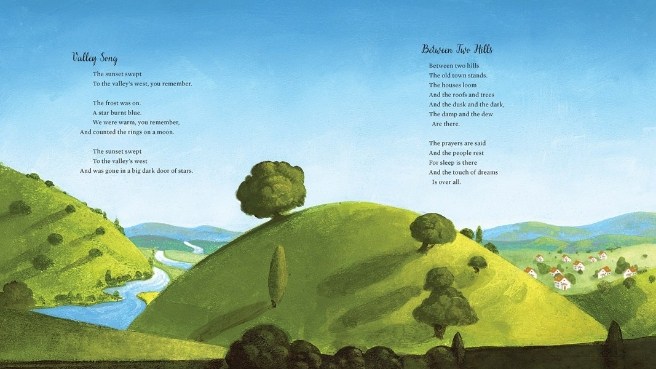
It contains 36 of Sandburg’s finest poems presented in two sections, Poems about People and Poems About Places. Widely anthologized favorites such as “Fog,” “Young Bullfrogs,” “I Am the People, the Mob,” and “Theme in Yellow” are featured alongside new-to-me gems, “Early Moon,” “River Roads,” “Harvest Sunset,” and “Haunts.”
Just as he rode the rails across country, Sandburg’s verses transport us from farm to prairie to big city, expressing his wonder, pride, and reverence for the beauty and expansiveness of our great nation. As someone who lived the American dream, born of humble beginnings and having worked from a young age at many odd jobs (shoe shine boy, milk and newspaper delivery, porter, farm laborer, bricklayer, coal-heaver) before becoming a journalist, editor, poet, and Pulitzer Prize winning author, Sandburg became a champion of the American worker, translating his wealth of first-hand experiences and hard-won lessons into passionate free verse.


 They venture “down a dark and ancient hall,” encountering an Egyptian tomb, then pass through “a peculiar door” and board a ship on the high seas, where they must battle a sword-brandishing pirate and a giant purple squid.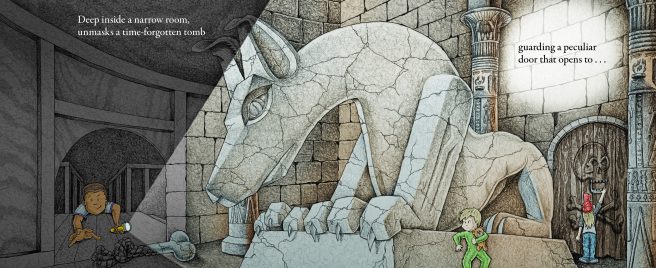

 The ever charming and talented
 Jama's Alphabet Soup