‘Tis the season of apples, pumpkins, black cats and twisted tales, so we’re getting our Fall on this week with a three course meal of old favorites.
I suppose one could say this post is equal parts miao, morbid, and mmmmm. 🙂
*
PRIMO: THE SONG OF THE JELLICLES
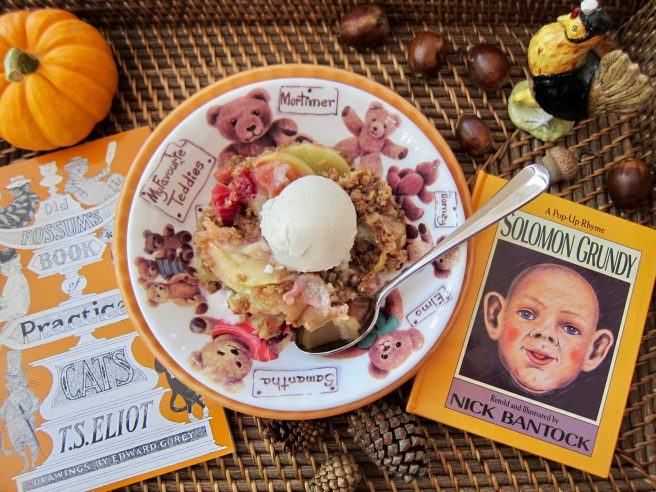
I love cracking open my Edward Gorey version of T.S. Eliot’s Old Possum’s Book of Practical Cats. Not only does it remind me of when we saw Andrew Lloyd Weber’s “Cats” in London many moons ago (I’ve been licking my paws and prancing about ever since), but of the pleasant after dinner walks Len and I used to take around our old neighborhood.
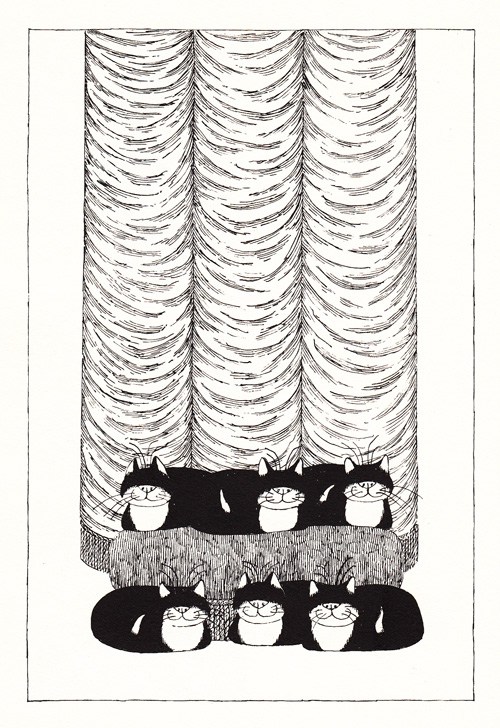
You see, two streets down and around the corner we were usually greeted by a Jellicle Cat. A fine fellow he was, all tuxedo-ed up for the ball under the bright moonlight. He was both sleek and adorable, having washed behind his ears and between his toes (he knew we were coming). A Fred Astaire of cats, we think of him still.
Hello my pretties! Ready for a spookalicious story?
*cackles and strokes chin wart*
No matter where we grew up, most of us can remember a mean or eccentric neighbor, a creepy old house that was supposedly haunted, or a place we were afraid (or not allowed) to frequent for one reason or another.
It was the kind of thing where we were both curious and terrified at the same time. We hungered for more even as we trembled in our boots. It’s wonderful how local lore and enduring legends figured in our childhoods, how we bore witness to the dynamic process of their evolution.
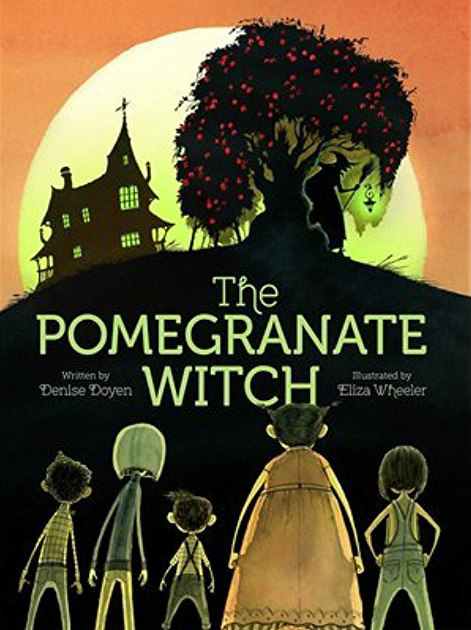
In The Pomegranate Witch (Chronicle Books, 2017), Denise Doyen and Eliza Wheeler serve up a deliciously eerie and suspenseful tale of five neighborhood kids who battle a green twiggy-fingered Witch for fruit from her haunted, zealously-guarded pomegranate tree.
Beyond the edge of town, where streetlights stopped and sidewalks ended, A small boy spied a farmhouse in a field long untended —
And before its sagging porch, amid a weedy foxtail sea, Found the scary, legendary, haunted pomegranate tree.
The gnarled tree loomed high and wide; its branches scraped the ground. Beneath there was a fort, of sorts, with leafed walls all around. Its unpruned limbs were jungle-like, dirt ripplesnaked with roots, But glorious were the big, red, round, ripe pomegranate fruits.
“Both the cook and the poet are makers. One holds a knife, the other a pen. One grinds fresh pepper over a mound of tender lettuce, while the other adds a period to the end of a sentence or a dash to the end of a line. With available ingredients — vegetables and herbs, rhymes and words — layers of flavor and meaning are infused in the pan and composed on the page.” ~ Nicole Gulotta (Eat This Poem, 2017)
Some of you may remember when Nicole Gulotta wrote a guest post for Alphabet Soup several years ago featuring an Apple Crumb Muffin recipe inspired by Amy Ludwig VanDerwater’s poem “Apple Pockets.”
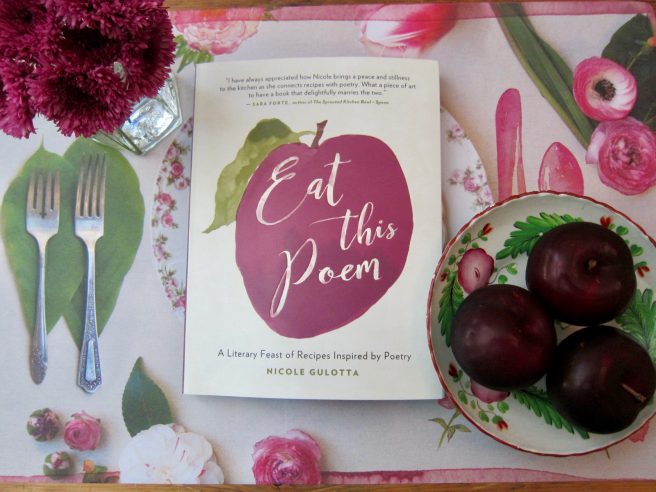
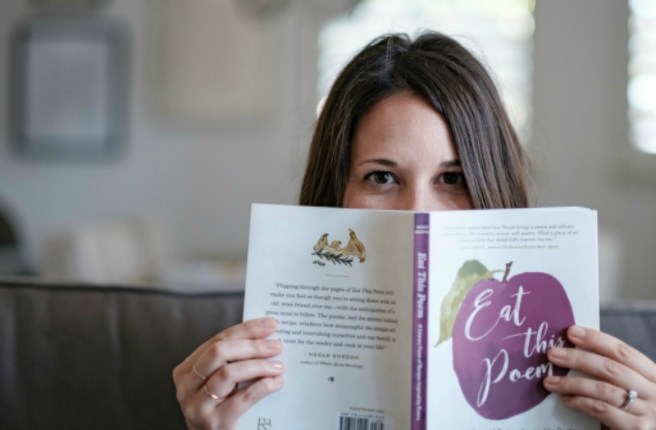
As a longtime fan of Nicole’s literary food blog, Eat This Poem, I was happy to see her first book come out earlier this year. This summer I finally had a nice chunk of time to give it a careful reading, savoring each word, each poem, each recipe.
Eat This Poem: A Literary Feast of Recipes Inspired by Poetry (Roost Books, 2017) features 75+ new recipes paired with poems by 25 of America’s most beloved poets (Billy Collins, Naomi Shihab Nye, Mark Strand, Mary Oliver, Wendell Berry). Just as she does at her blog, Nicole includes thoughtful commentary on each poem, followed by personal stories about the recipes.
All are presented thematically in five sections: On What Lingers, On Moments in Time, On Growth, On Gathering, and On Splendor. Recipe categories include Breakfasts, Salads, Soups, Snacks and Small Bites, Meat and Seafood, Vegetables/Vegetarian, Desserts and Drinks.
Enjoy Diane Lockward’s “Blueberry,” then read about Nicole’s Christmas morning family tradition of opening stockings by the fireplace while eating muffins (she then tempts us with a recipe for Blueberry Bran Muffins).
Contemplate Joy Harjo’s “Perhaps the World Ends Here” (one of the first food poems I ever shared at Alphabet Soup back in 2007), and then read about how Nicole’s great-grandmother used to slather a chicken in fresh oregano before roasting it for family dinners. Nicole’s recipe for Oregano Roast Chicken had me drooling (imagine the aroma of olive oil and savory spices wafting through your kitchen on a Sunday afternoon).
Do you know Sharon Olds’s bittersweet poem “First Thanksgiving” — about a mother anticipating her daughter’s return home after her first few months away at college? Nicole offers a recipe for Wild Rice with Chestnuts and Leeks, inspired by a semester abroad in London. In December, she took walks around the city the last week she was there to take it all in before returning home. She chanced upon a stall selling hot roasted chestnuts and tasted them for the first time, a wonderful moment that became an indelible memory.
“If ants are such busy workers, how come they find time to go to all the picnics?” ~ Marie Dressler
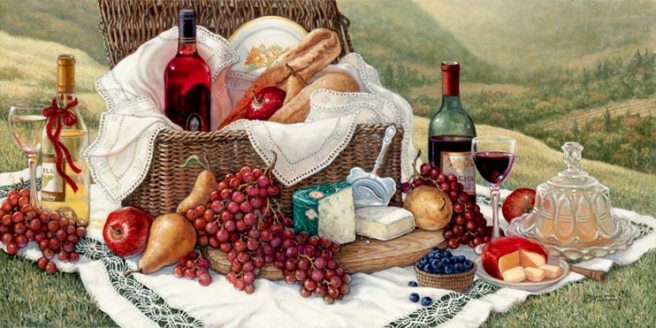
“Tuscan Picnic” by Janet Kruskamp”
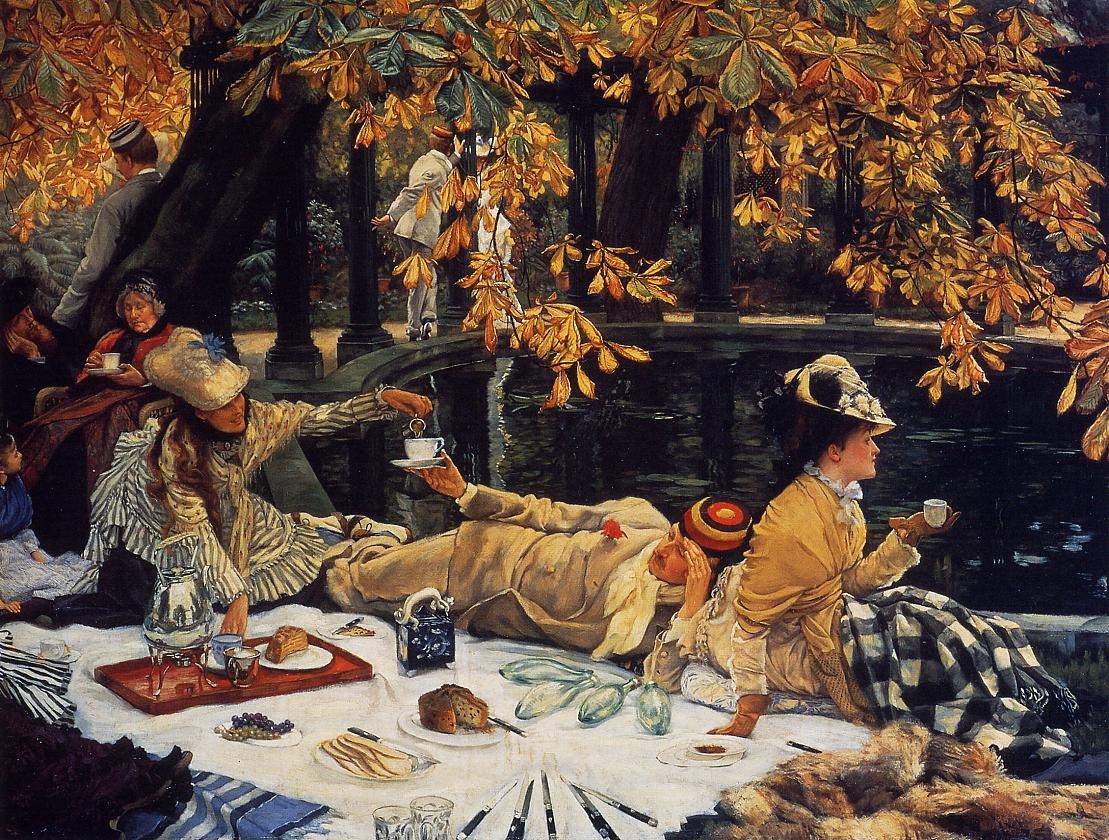
What a nice day for a picnic! Let’s pack our hampers full of delectable goodies to eat and drink, drive out to the beautiful, unspoiled countryside, and have a grand time.
Or maybe not.
*
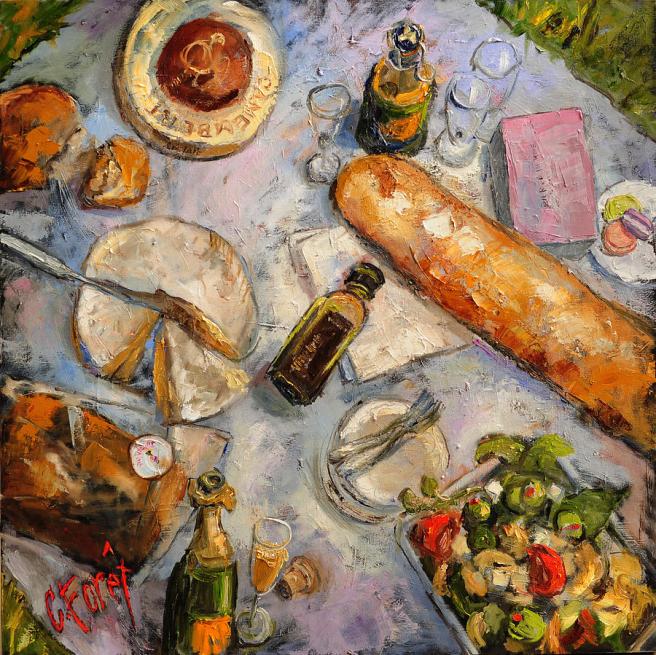
“Picnic at the Eiffel Tower” by Carole Foret
SO MANY THINGS CAN RUIN A PICNIC by Faith Shearin
So many things can ruin a picnic—
mosquitoes, for instance, arriving
in a gray hum or black flies or a wind
strong enough to blow napkins
over the lawn like white butterflies,
steaks stolen by dogs, unruly fire,
thunderstorms that come on suddenly,
clouds converging over a field,
where you have just unpacked
your basket. It’s amazing, really,
that people have picnics at all
considering how many plates
have fallen in the dirt and how many
hot dogs have erupted in black blisters,
how many children have climbed hills
alive with poison ivy and how much ice
has melted before the drinks
were ever poured. It’s amazing
how many people still want to eat
on a blanket anyway, are still willing
to take their chances, to endure
whatever may fall or bite. Either they
don’t consider the odds of success
or they don’t care. Some of them
must not mind the stains on their pants,
the heavy watermelon that isn’t sweet
once it’s carved. Some must understand
the way lightning is likely to strike
an open field. Even so—they wrap up
a few pieces of fried chicken, fold
a tablecloth until it is as small as hope.
They carry an umbrella or a jacket
that they accidentally drop on the ground
where it fills with bees. They leave
the houses they built to keep them safe
and eat uncovered, ignoring the thunder,
their egg salad growing dangerously hot.
It is a kind of love, is it not?
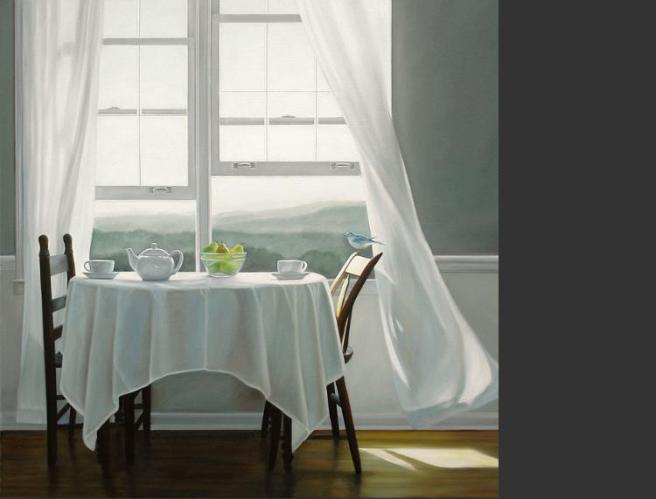
How the cup holds the tea,
How the chair stands sturdy and foursquare,
How the floor receives the bottoms of shoes
Or toes. How soles of feet know
Where they’re supposed to be.
I’ve been thinking about the patience
Of ordinary things, how clothes
Wait respectfully in closets
And soap dries quietly in the dish,
And towels drink the wet
From the skin of the back.
And the lovely repetition of stairs.
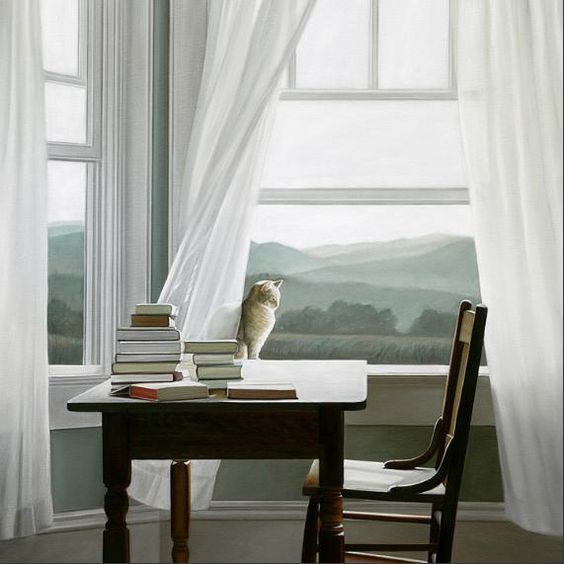
And what is more generous than a window?
And is it not a kind of love how a poem can hold the words you most need to hear? Vessel of heart, unadorned yet profound, luminous in its simplicity, Schneider’s poem speaks to the sacred in the everyday and is a beautiful paean to patience and gratitude.
If you’re a writer, you know all about waiting. And waiting. And waiting. Every step in the process has a distinct purpose and unfolds in its own time. Every story or poem waits its turn for someone to give it form, shape, and resonance. Just as I appreciate the cup that holds my tea, I marvel at how ideas know how to find just the right people, and how the hundreds of books on my shelves silently wait for me to reach for them. I am most grateful for the patience of stories waiting to be told, and smile at the thought of how happy characters must be when we finally open their books and let them speak.
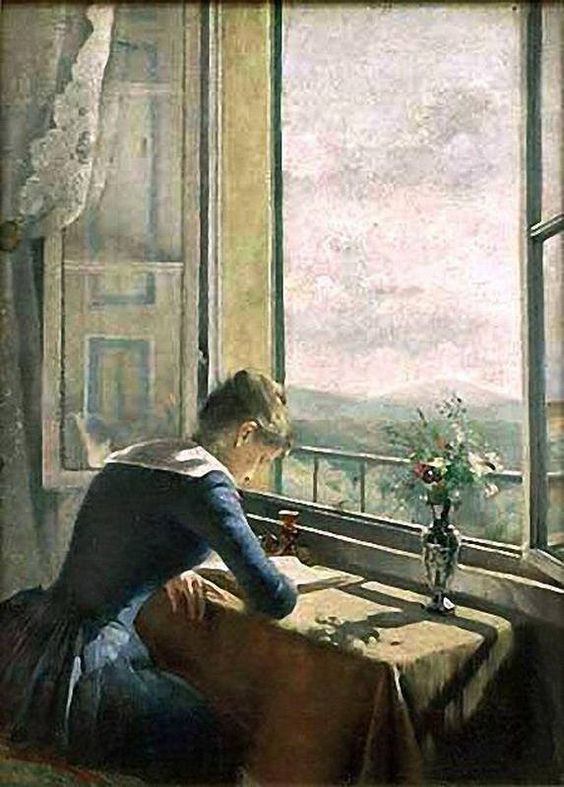
“Reading Woman by the Open Window” by Asta Norregaard (1889)
This poem gives me an inner sense of calm, making me feel centered and grounded. The outside world is chaotic and full of upheaval and uncertainty. It is good to know there are things we can count on, and that no matter what happens, there is art, the power of the imagination, unique voices and vision. One person’s poem can be another’s prayer.
*
A renowned teacher of writing, Pat Schneider is the author of ten works of poetry and nonfiction, including Writing Alone and With Others. Founder of Amherst Writers & Artists, she travels frequently to teach and has been leading workshops in creative writing at the Pacific School of Religion for almost thirty years. Garrison Keillor has read her poems sixteen times on “Writers Almanac.” Her most recent book is How the Light Gets In: Writing as a Spiritual Practice (2013). Find out more about Pat’s books and writing workshops at her Official Website.
*
🐶 PET CRAZY GIVEAWAY WINNER! 🐰
Thank you for commenting about your favorite pets last week. Enjoyed reading the rhymes and picturing a white stray cat named Silmarillion lapping milk, a hound who croons at the moon, and a dog who likes to lick his owner’s feet. There was also a Lizzy and a Lizzie, one a salamander, the other a fish . . . or a dragon? 🙂
Mr Cornelius picked the winner with the careful long distance supervision of Monsieur Random Integer Generator, who’s in Provence having his mustache trimmed.
So, with a little trumpet fanfare and a jiggedy jig (drumrolls are passé this season),
we are pleased to announce that the winner of a brand new copy of Pet Crazy is:
🎉 Jan Godown Annino at BookSeedStudio!! 🎈
Congratulations, Jan!!
Please send your snail mail address to: readermail (at) jamakimrattigan (dot) com to receive your book. 🙂
Thanks again to everyone for entering the giveaway!
*
The lovely and immensely talented Laura Purdie Salas is hosting the Roundup at Writing the World for Kids. Glide over and check out the full menu of poetic goodness being shared in the blogosphere this week. I can’t believe September is all but over already! Enjoy your weekend. 🙂



 The lovely and immensely talented Laura Purdie Salas is hosting the Roundup at
  Jama's Alphabet Soup