“Blue is therefore most suitable as the color of interior life.” ~ William H. Gass
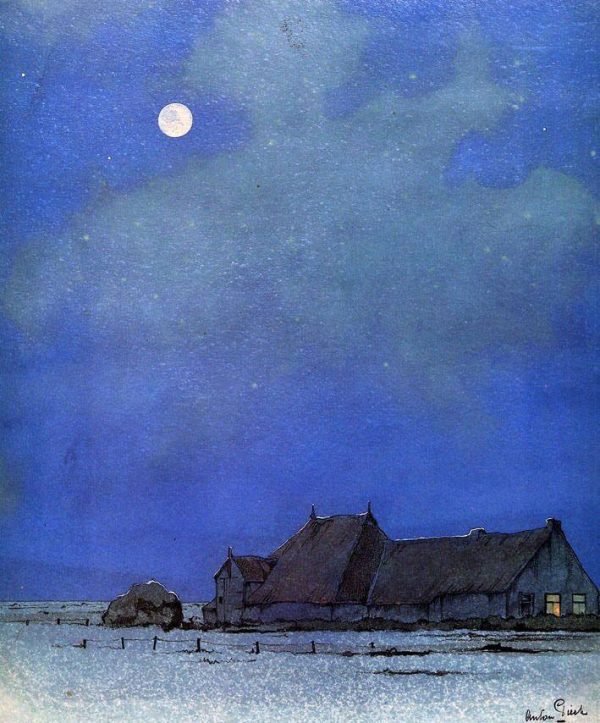
“Moonlit Night” by Anton Pieck (1941)
THE LAND OF BLUE by Laura Mucha
Across the valley, it waits for you,
a place they call The Land of Blue.
It’s far and near, it’s strange yet known –
and in this land, you’ll feel alone,
you might feel tears roll down your cheek,
you might feel wobbly, weary, weak.
I know this won’t sound fun to you –
it’s not – this is The Land of Blue.
It’s blue – not gold or tangerine,
it’s dark – not light, not bright or clean.
It’s blue – and when you leave, you’ll see
the crackly branches of the tree,
the golden skies, the purring cat,
the piercing eyes, the feathered hat
and all the other things that come
when you escape from feeling glum.
Across the valley, it waits for you,
a place they call The Land of Blue
and going there will help you know
how others feel when they feel low.
As the poet explains at her website, this poem was written for a poetry workshop in response to a painting she saw at the National Gallery in London. The painting featured two mountains with a “land of blue” in the distance. She thought perhaps people went there when they were sad.
Though initially written as a children’s poem, Mucha’s observations about sorrow — that experiencing it ultimately helps us develop compassion and empathy — certainly applies to adults as well. I was also reminded of how Mr Rogers stressed the importance of honoring children’s emotions and encouraging them to speak freely about what they were experiencing.
I do love how art begets more art (which is why I’ve always enjoyed ekphrastic poetry). In Mucha’s case, her emotional reaction to the painting inspired her to explore often untalked-about-feelings within the safe space of a poem.
Every day I look at a lot of art, listen to music, and read inspiring words, both poetry and prose. How effectively a piece is able to instantly make me feel something is a good gauge of its worth.
I agree with William Gass that blue is most suitable as the color of interior life. Picasso comes to mind, with his famous Blue Period.He was going through a profound depression after the suicide of his friend, but just as Mucha suggests about the nature of despondency, he was eventually able to move past his dark mood in a few years.
Although blueis quiteoften associated with coldness and melancholy, we see through the works of other artists that the “land of blue” may also be one of peace, serenity, calmness, reflection, and deep, abiding beauty.
“The kitchen is where we deal with the elements of the universe. It is where we come to understand our past and ourselves.” ~ Laura Esquivel
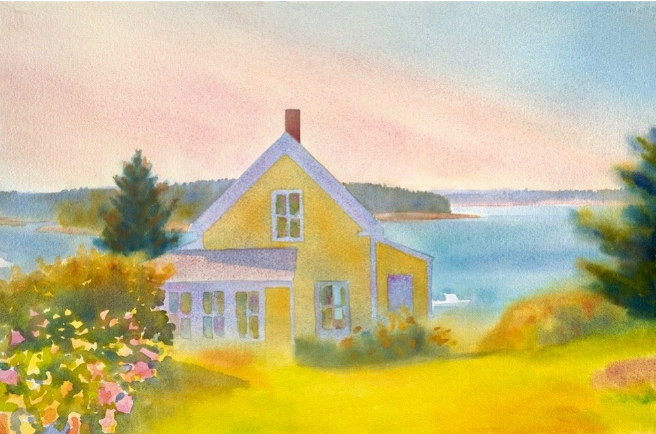
“Yellow House, Summer Afternoon” by Suzanne Siegel
Which room in your house says the most about you?
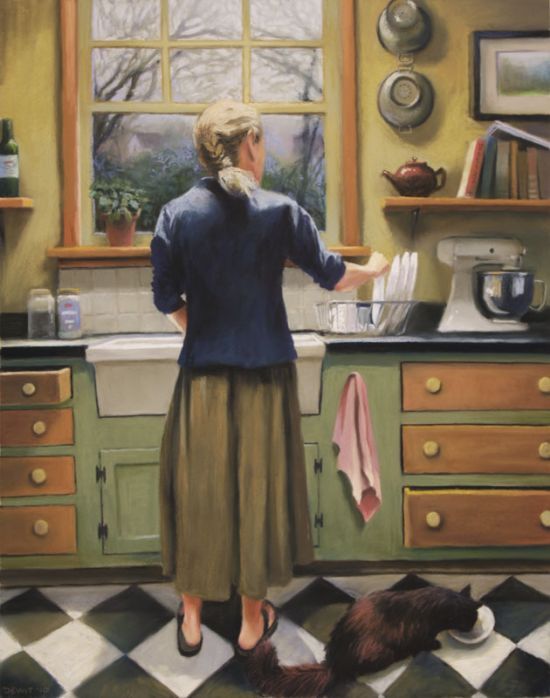
“Washing Dishes” by Deborah DeWit (2010)
THE YELLOW HOUSE, 1978 by Maggie Dietz
The kitchen in the house had a nook for eating, a groove
for the broom behind the door and the woman moved through
it like bathing, reaching ladles from drawers, turning to lift
the milk from the refrigerator while still stirring the pudding,
as if the room and everything in it were as intimate to her as her body, as beautiful and worthy of her attention as the elbows
which each day she soothed with rose lotion or the white legs
she lifted, again and again, in turn, while watching television.
To be in that room must be what it was like to be the man
next to her at night, or the child who, at six o’clock had stood
close enough to smell the wool of her sweater through the steam,
and later, at the goodnight kiss, could breathe the flavor of her hair —
codfish and broccoli — and taste the coffee, which was darkness
on her lips, and listen then from upstairs to the water running
down, the mattress drifting down the river, a pale moonmark
on the floor, and hear the clink of silverware — the stars, their distant
speaking — and picture the ceiling — the back of a woman kneeling,
covering the heart and holding up the bed and roof and cooling sky.
The kitchen (no surprise) is my favorite room in the house, with the dining room a close second. Someone wise once said that the kitchen is the heart of the home — so very true. It’s the place where family and guests gather most often, where delicious dishes (and sometimes ingenious ideas) are cooked up, where news of the day is shared, where we read our mail and shine our shoes.
It’s a place of culinary triumph and catastrophe, of hopes, laughter, test runs, and occasionally, bravery (yikes, yeast!). Whenever I make one of my mother’s or aunt’s recipes, I hear their voices cheering me on. I’m grateful for good times past, and the chance to make some new memories steeped in their legacies.
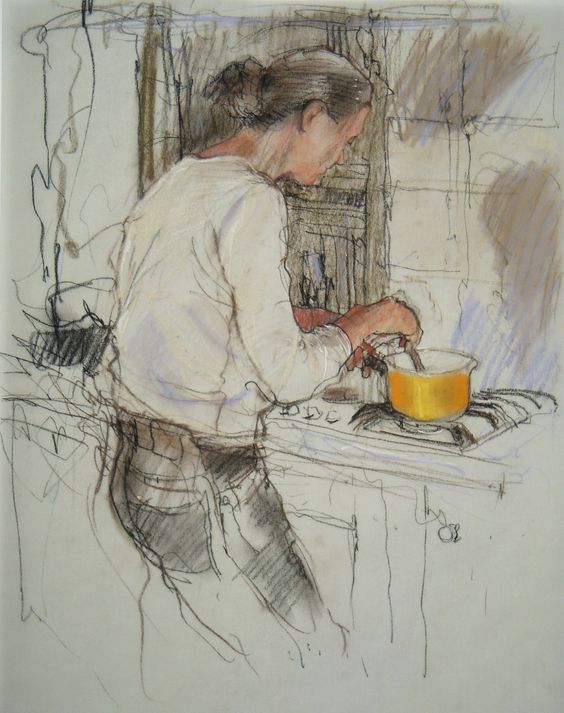
“Yellow Saucepan” by Felicity House
I have a particular fondness for our current kitchen because it’s the first one I designed myself from scratch. Nothing fancy, mind you, but much thought was given to work stations, varying counter heights, storage spaces, ease of maintenance, how I envisioned myself “moving” in the room. The maple cabinets are sage green and pale yellow milk paint, the island is natural cherry, and we have a black and white checkered floor (much like what’s pictured in Deborah DeWit’s painting).
But it’s not only my kitchen — I like yours too. If I visited your house, it would be the room I would be most curious to see, because it would tell me the most about you. 🙂
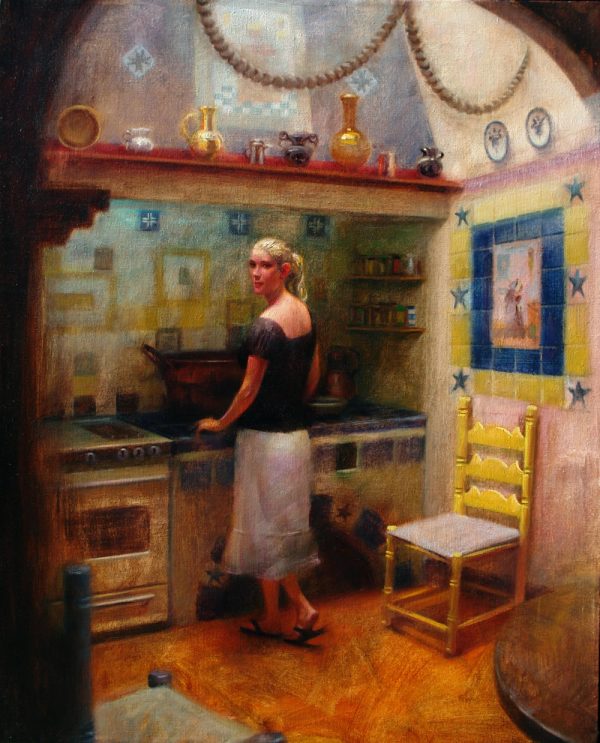
“The Spanish Kitchen” by Sergio Sanchez
The first two stanzas of Maggie Dietz’s poem drew me in right away. I do think most women — at least the ones who like to cook — have an intimate knowledge of almost every square inch of their kitchens. When they’re totally “in the flow” of cooking (which sometimes requires improvisation) or baking (with its streamlined precision), there’s a beautiful brand of zen to speak of. I appreciate the nod to domesticity in an age when women are expected to do it all.
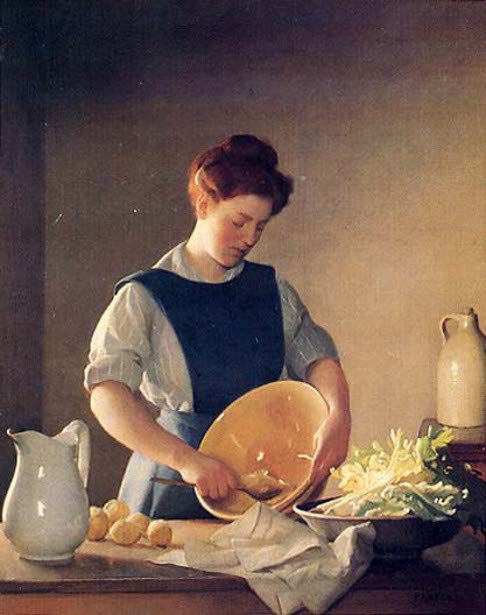
“The Kitchen Maid” by William McGregor Paxton (1869-1941)
I love all the telling, sensory details in Dietz’s poem, from the pudding stirring to the child smelling the “codfish and broccoli” flavor of the woman’s hair, to the “clink of silverware,” to the final image of “the back of a woman kneeling,/covering the heart and holding up the bed and roof and cooling sky.”
I like thinking that a favorite room is an extension of self, a reflection of personality. Here’s to thriving in one’s element, feeling empowered by it. There’s definitely something golden about being the mistress of one’s domain, wherever that may be.
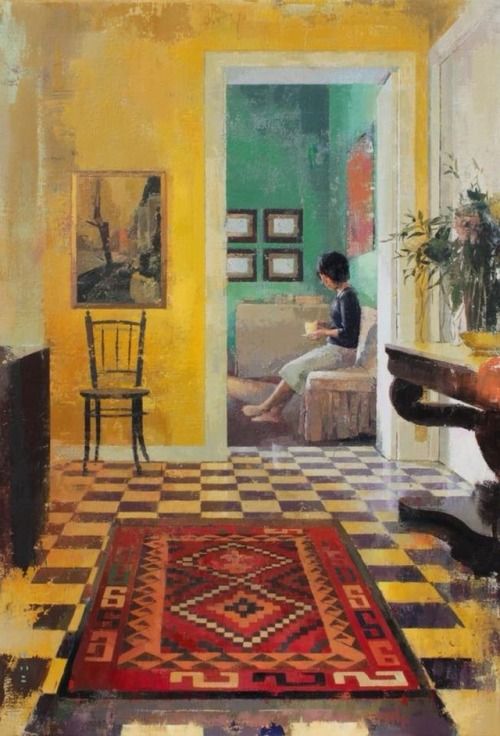
“Tea, Yellow House” by Keiko Ogawa
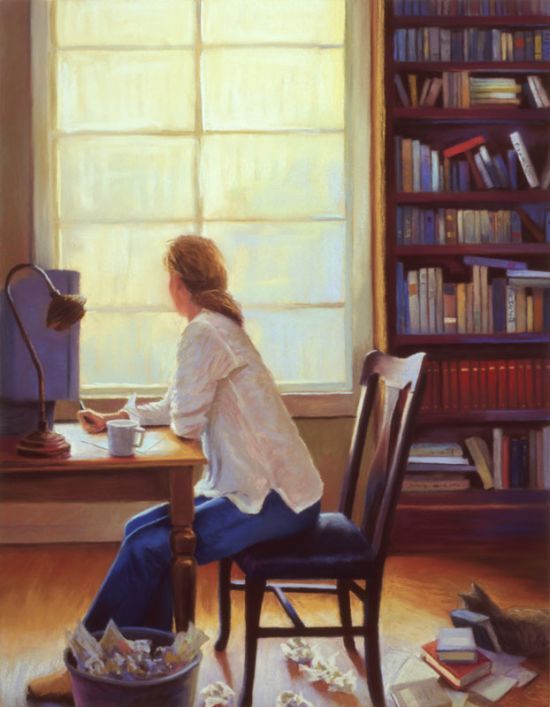
“The Right Word” by Deborah DeWit (2007)
What struck you most about this poem?
*
📕 BOOK GIVEAWAY WINNERS! 📗
*rubs hands together*
We are doubly excited because we have two winners to announce today!
Thanks to everyone for entering and leaving such nice comments at both posts. 🙂
Are you ready?
*drum roll, please*
*
*
*
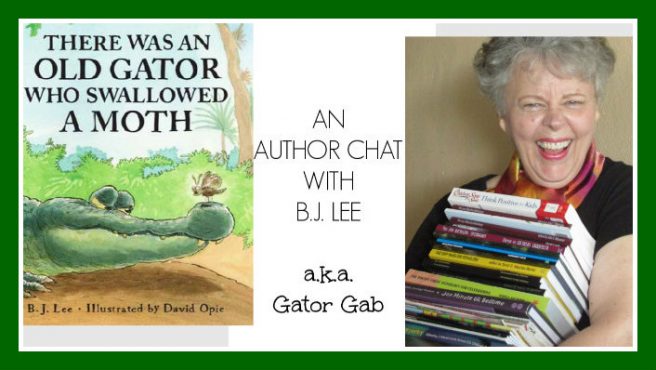
For a signed copy of THERE WAS AN OLD GATOR WHO SWALLOWED A MOTH, the winner is:
♥️ Big thanks to B.J. Lee for donating a signed copy of her new Gator book, and to Penguin/Random House for a brand new copy of Home Builders.
*
The lovely and talented Jone MacCulloch is hosting the Roundup at Check It Out. Mosey on over for the full menu of poetic goodness being served up in the blogosphere this week. Have a nice weekend!
*
Roger Duvoisin (One Step, Two, written by Charlotte Zolotow, 1955)
What we enjoy most about living in the woods is seeing our wild animal friends. You may remember my mentioning that we regularly feed the foxes, gently move land tortoises away from car danger, and always keep binoculars handy to help us identify new birds.
Any deer sighting is cause for celebration; when there are fawns we melt into puddles of adoration over the spots and white tails. Watching a juvenile sharp-shinned hawk zig and zag while learning to fly is both educational and amusing, and we love the haunting, ethereal hoots of owls late at night.
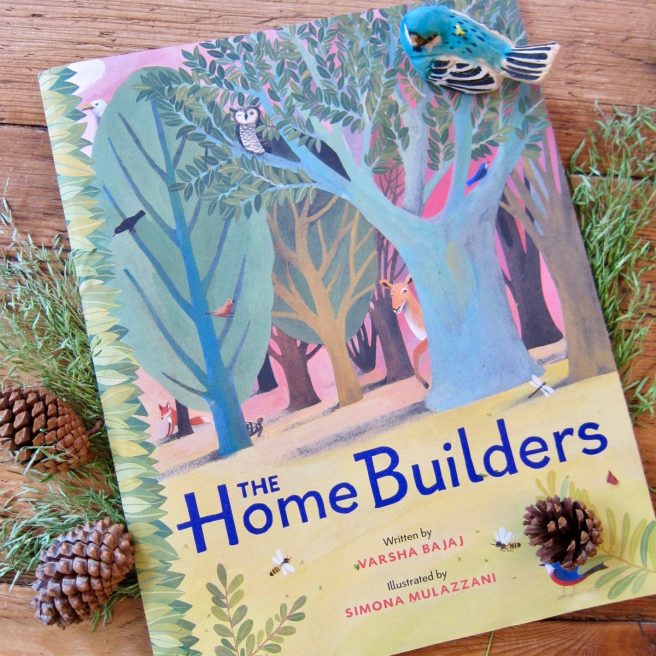
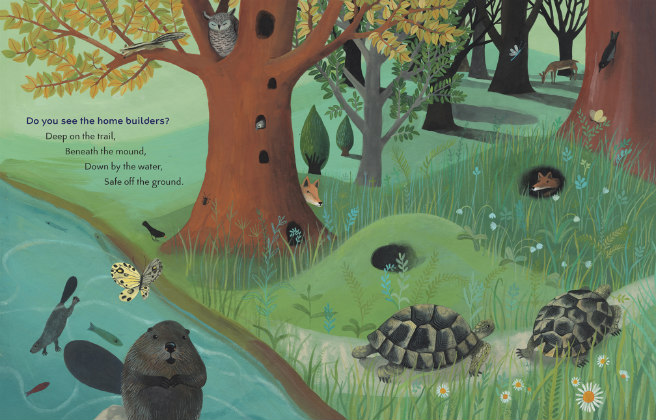
In The Home Buildersby Varsha Bajaj andSimona Mulazzani (Nancy Paulsen/Penguin YRG, 2019)we see how a variety of woodland creatures find shelter and build homes for their soon-to-arrive offspring. Many of the featured animals live in our back yard and woods, so we are familiar with the seasonal hubbub of activity described in this charming picture book.
B.J.’s a former librarian whose poems have appeared in oodles of periodicals and anthologies, including Highlights for Children, Spider Magazine, The Poetry Friday Anthology for Celebrations, One Minute Till Bedtime, The Best of Today’s Little Ditty, Dear Tomato, and the National Geographic Book of Nature Poetry.
Yes, this girl’s been busy scribbling away in her Florida hideaway, and her first picture book is rollicking good fun. She’s taken the classic “There Was An Old Lady” cumulative nursery rhyme and given it a Floridian spin — a cool way to introduce kids to some of the critters who hang out in her part of the country.
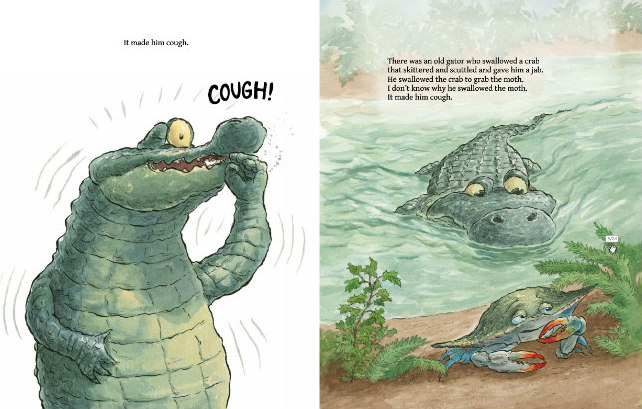
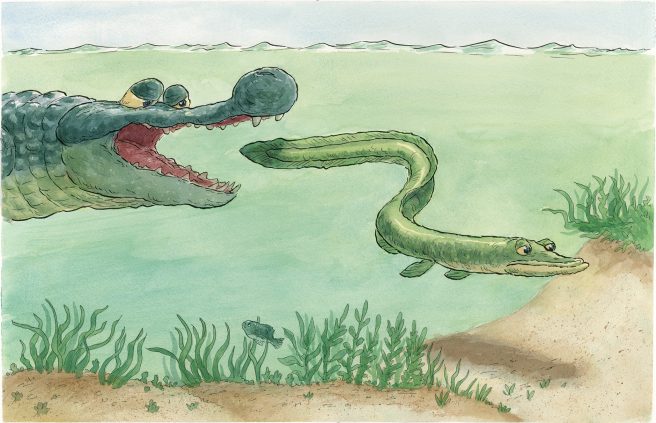
Seems B.J.’s Gator swallows a moth — who knows why — and it makes him cough. Only one thing to do: swallow a crab to grab the moth. But the crab “skittered and scuttled and gave him a jab.” What to do? Swallow an eel to nab that crab!
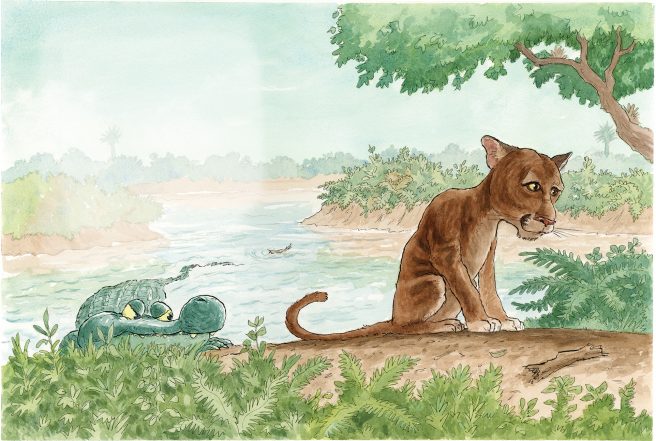
As you can imagine, this was just beginning of Gator’s problems. He keeps swallowing more creatures, bigger and bigger each time (have you seen the stomach on that guy?) until he actually gulps an entire lagoon! Hoo Boy!
You’ll have to read the book to find out what happens to this guzzling gator and all those bewildered animals in his belly. Kids will love turning the pages to see what animal’s next (ray! pelican! panther! manatee! shark!). Of course this story is a riot to read aloud with its catchy rhymes, repetition, bouncy rhythm and amphibious alliteration (cough, cough). And David Opie has amplified the hilarity with his emotive, dynamic illustrations.
Just had to ask B.J. all about her publishing journey, tinkering with the text, and yes, she’s sharing a recipe (did someone say PIE?)!
 The lovely and talented Jone MacCulloch is hosting the Roundup at

 Jama's Alphabet Soup