[author chat + recipe] Around the Table That Grandad Built by Melanie Heuiser Hill and Jaime Kim


This week most of us will be gathering with family and friends for some serious feasting. We’ll travel from points near and far, bringing homemade dishes, stories to tell, and lots of good cheer.

As we take our places around the table, we can express gratitude for our many blessings, strengthen bonds, forge new connections, and enthusiastically lick our chops. 🙂

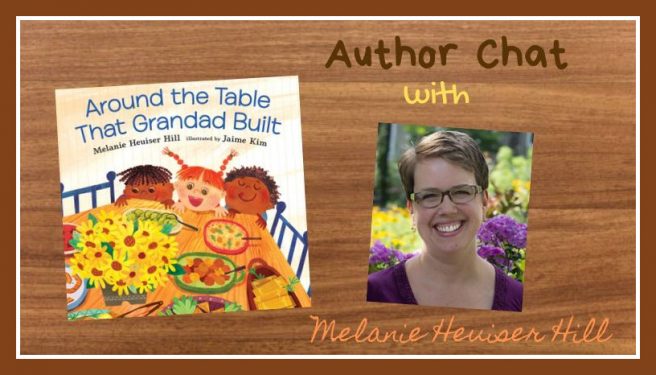
We’re especially delighted to welcome Minnesota author Melanie Heuiser Hill to Alphabet Soup today, as her debut picture book celebrates all the joyful deliciousness that comes with sharing a good meal with loved ones.

Around the Table That Grandad Built (Candlewick, 2019) is Melanie’s delectable take on the classic cumulative tale, “This is the House That Jack Built.”  A young girl first describes how her family sets the table with items that have special significance: “sunflowers picked by my cousins,” “napkins sewn by Mom,” “glasses from Mom and Dad’s wedding,” “forks and spoons and knives — gifts from Dad’s grandma long ago.”
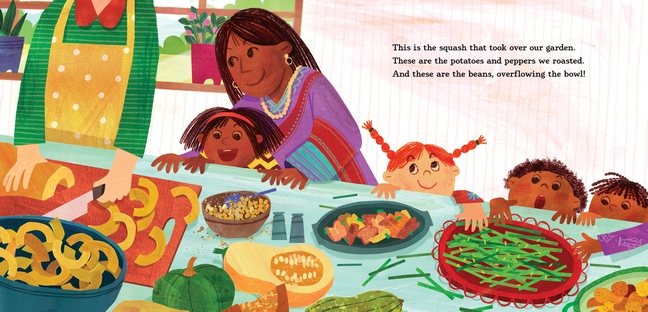


And then (my favorite part!) she describes the mouthwatering menu:

This is the squash that took over our garden.
These are the potatoes and peppers we roasted.
And these are the beans, overflowing the bowl!

Yum! And there’s more — foods to reflect the diversity of her family, including “toasty tamales” and “samosas, spicy and hot.” This is all topped off with Gran’s homemade bread, Dad’s huckleberry jam, their traditional rice pudding, and lots of P-I-E-S!! 🙂
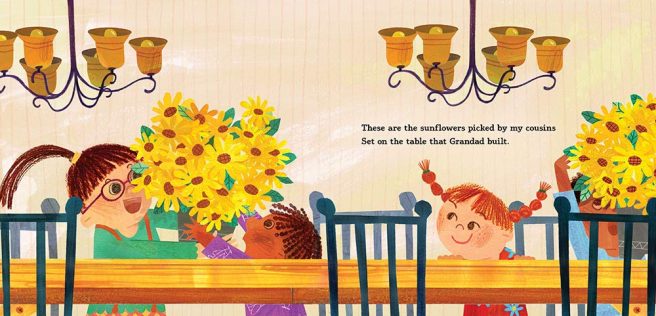


Jaime Kim’s exuberant mixed media illustrations, rendered in warm and cheery autumnal colors, burst with all the busyness and excitement of pitching in for a special feast.

Each step of the way, as Grandad’s handcrafted table is lovingly adorned by little hands laying on all the objects, ending with plates “red, orange, and yellow,” we can feel the wide-eyed, open-mouthed anticipation building.

By the time we see the finished table in all its glory, we share in the characters’ satisfaction of a job well done, where each has played a significant role. Build a table, build a meal, build a family.

Though this book is perfect for the holiday season, it speaks to any festive gathering of family and friends, where togetherness and convivialty reign supreme. Hungry munchkins will enjoy this lively read aloud as they identify and count objects, recognize colors, observe facial expressions, and pick out interesting details in all the pictures.

Now, let’s find out more from Melanie — can you smell her homemade bread baking in the oven? Mmmmm. 🙂

*
Continue reading

a childhood thanksgiving memory: “américa” by richard blanco

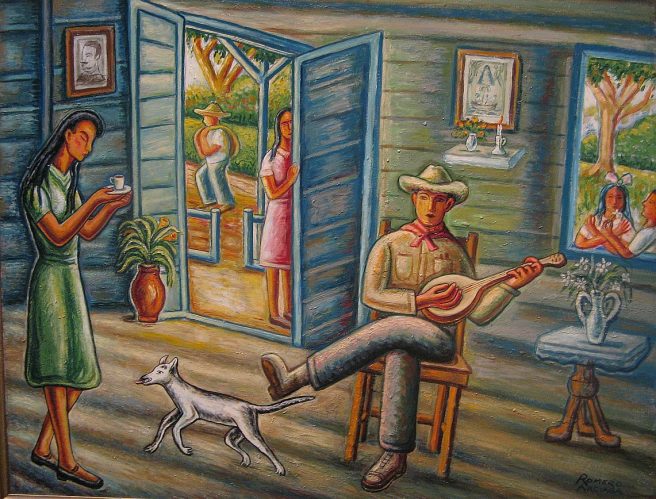
“The Cup of Coffee” by Cuban artist Lorenzo Romero Arciaga (1940)


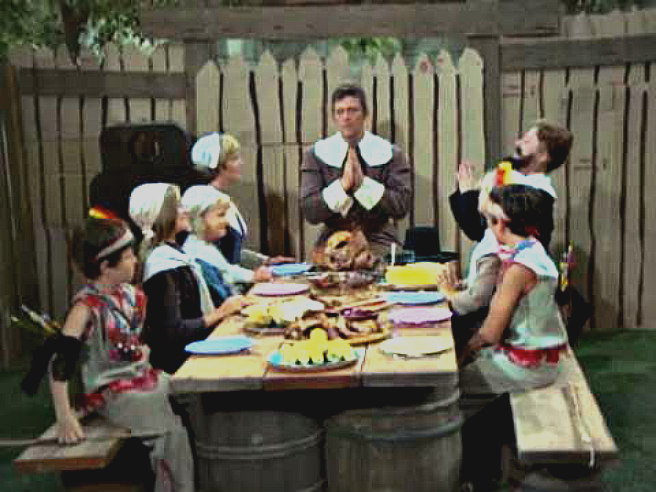
When Presidential Inaugural Poet, author and civil engineer Richard Blanco was growing up in Miami with his Cuban-exile family during the early 70’s, he longed to be a “true American” like one of the kids in “The Brady Bunch.”

He describes it as living between two imagined worlds:

One world was the 1950s and ’60s Cuba of my parents and grandparents — that paradise, that homeland so near and yet so foreign to where we might return any day, according to my parents. A homeland that I had never seen . . .

The other, less obvious world was America . . . Typical of a child, I contextualized America through food, commercials, G-rated versions of our history in textbooks and television shows, especially The Brady Bunch. More than a fiction or fantasy, I truly believed that, just north of the Miami-Dade County line, every house was like the Brady house, and every family was like them.

Much of Blanco’s poetry centers around his search for cultural identity. Over and over, he asks the questions, “Where is my home? Where am I from? Where do I belong?”

When he was a graduate student at Florida International University, he wrote the following poem, inspired by a childhood memory of wanting an “authentic” Thanksgiving meal.

*


Continue reading

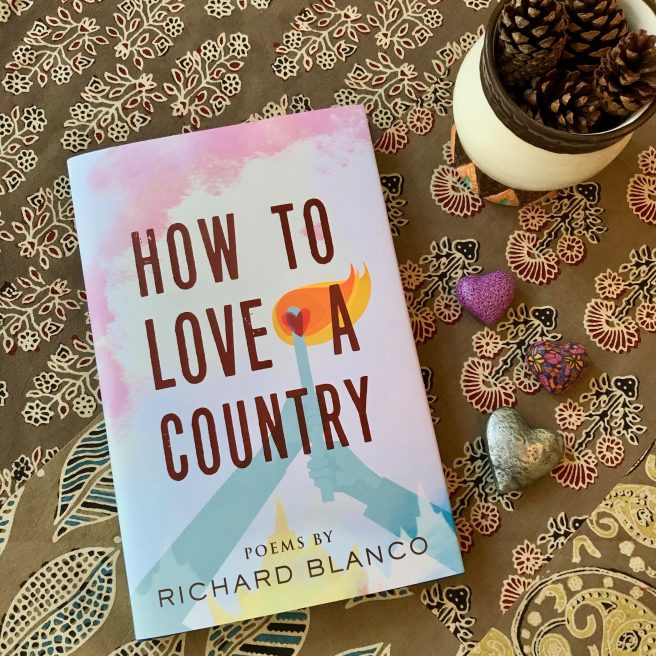
“November Eyes” from Richard Blanco’s How to Love a Country


Do you remember how you felt right after the 2016 Presidential election? How the world as you knew it suddenly upended? I was devastated and filled with such dread — but I never imagined it could get this bad.

In this powerful poem, Presidential Inaugural Poet Richard Blanco describes our new reality in painful detail.


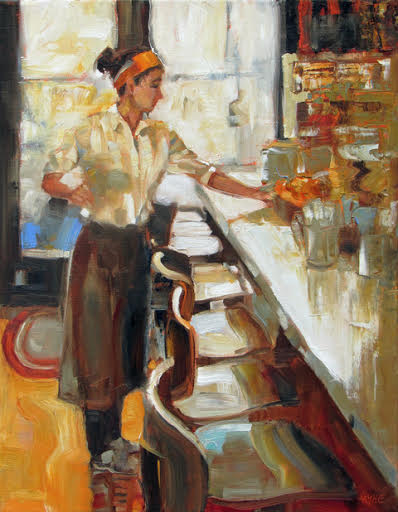
“Small Town Diner” by Layne Cook


NOVEMBER EYES
by Richard Blanco

I question everyone, everything, even the sun
as I drive east down Main Street — radio off–
to Amy’s diner. She bobby-pins her hair, smiles
her usual good mornin’ but her eyes askew say
something like: You believe this? as she wipes
the counter, tosses aside the Journal Times
the election headlines as bitter as the coffee
she pours for me without a blink. After a cup
and a blueberry muffin I remember my bills
are due by the fifteenth — so I cross on Main
to the post office. Those American flag stamps
are all Debbie has left. I refuse to buy them:
a never mind in my eyes which she dismisses
with a gesture of suit yourself. Bills can wait,
but not my dog’s treats or the milk I’m out of
— so I drive up Main again to the Food Basket.
Paper or plastic, Jan asks me at the checkout,
but it doesn’t matter. What matters is this:
she’s been to my bar-b-ques, I’ve donated
to her son’s football league, we’ve shoveled
each other’s driveways, we send each other
Christmas cards. She knows I’m Latino and
gay. Yet suddenly I don’t know who she is
as I read the button on her polyester vest:
Trump: Make America Great Again, meaning
she doesn’t really know me either. We manage
smiles when she hands me my change, but
our locked eyes say: nothing — so I dash off —
go see Tom at the bank to cash a measly check
from some grand magazine for some grand
poem of mine loaded with some grand words
like transcend, as if my inked verbs could bend
a river’s will, shuffle stars, change the fate of
our nation, or the blur in Tom’s eyes thinking
what I think of our reflection on the bullet-
proof window, asking: So now what, Mr. Poet?
I can’t answer. I can only remember today
I’m supposed to buy a rake, lightbulbs, nails
to hang my aging mother’s photos — so I swing
by Union Hardware, see Dan who knows me,
and what I need. He rings me up, doesn’t say
Goodbye, says Good luck, as if his eyes can see
the uncertainty in my own, worried about:
my immigrant cousin, factory jobs, groped
women, hijabs, blacklists, bans, the church,
the deep state, cops, race, and which lives
matter, hacked votes, refugee camps, dead
children, missiles, suicide bombers, carbon
footprints, polar bears, sunk islands, my gay
marriage, the bills for my preexisting ulcer
flaring, guns at malls, guns at schools, guns
at clubs, more guns, more corporate rights,
soulless cubicles, the empty Supreme Court
seats, the border wall, bullying, the demise
of language, news, the silence of suspicion,
the uneasy guessing, the surprise of who’s
who, the cheers and gloating, or jeers and
swearing, the final picking of sides, right or
left, red or blue state, city, or town, but no
grey today except for the November clouds
looming over Main Street with all the rest
of our unrest, arrested in our eyes clashing
against each other’s glares, ready for battle.

~ from How to Love a Country (Beacon Press, 2019)

*

Continue reading

[review + giveaway] Caravan to the North: Misael’s Long Walk by Jorge Argueta

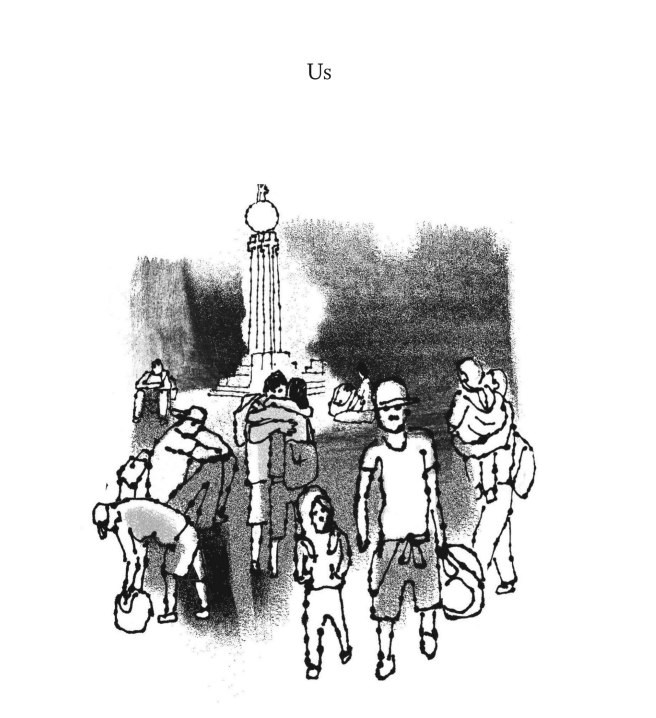
In October 2018, the night before a caravan of fellow citizens planned to leave San Salvador for the United States, eminent author, poet, and humanitarian Jorge Argueta spoke with many of them who had gathered at the Plaza Divino Salvador del Mundo, a large public square in the city.

As someone who had fled El Salvador over 35 years ago, Argueta understood only too well why they had chosen to risk their lives and that of their children to undertake the arduous 2,500-mile journey. He listened to their stories, offered encouragement and support, and was no doubt profoundly moved by the hope they carried in their hearts: hope for a safe haven from gang violence, hope to escape the demoralizing cycle of poverty, hope for a chance to rebuild their lives with honest work, hope for better futures for their children, hope for kindness and compassion from the strangers they would meet along the way.

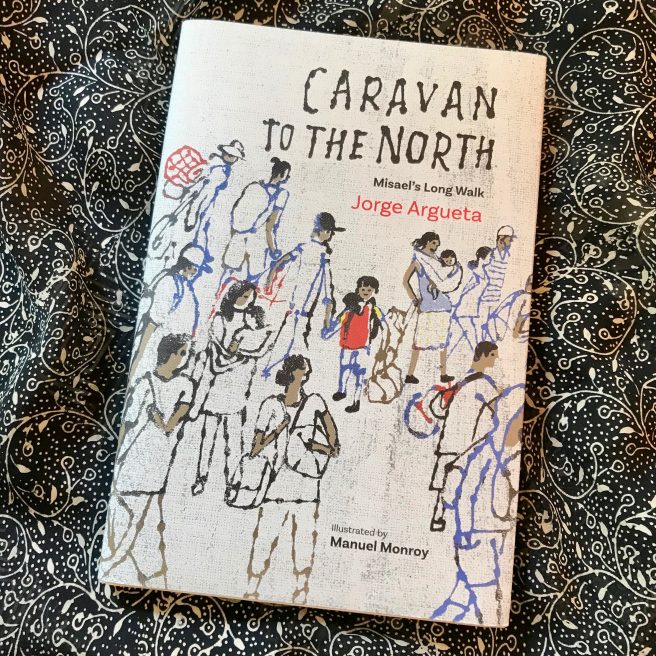
Inspired by these conversations, Argueta wrote a verse novel told in the voice of Misael Ramírez, a young asylum seeker who joined the caravan with his parents and brother Martín.

Caravan to the North: Misael’s Long Walk (Groundwood Books, 2019), is a realistic, heart-wrenching account of the physical and emotional hardships families like Misael’s endured as they left El Salvador with nothing more than a jacket and a small backpack of hopes and dreams to face the unknown.


Continue reading

[juicy review] How to Read a Book by Kwame Alexander and Melissa Sweet


For hungry minds, there’s nothing like feasting on a good book, from that delicious anticipation of first cracking open the cover, to devouring each and every word, to basking in the afterglow of a story well told.

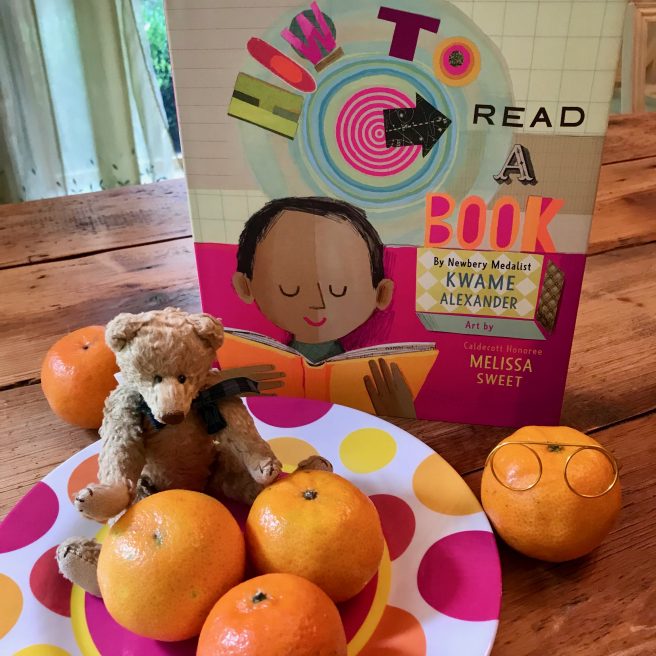
In How to Read a Book (HarperCollins, 2019), Newbery Medalist Kwame Alexander and Caldecott Honoree Melissa Sweet celebrate books with a tantalizing banquet of juicy words and captivating art, illuminating the sensory, intuitive, and wildly imaginative aspects of the reading experience.

In this lyrical ode, which began as a World Read Aloud Day poem and later appeared on a National Poetry Month poster, Alexander employs an extended food metaphor to mouthwatering effect. Reading a book, he suggests, is like consuming luscious, ripe fruit — something to savor with full presence of heart and mind.


First, plant yourself beneath a tree or (if you prefer) sit on a stoop like Langston Hughes:

Once you’re comfy,
peel its gentle skin,
like you would
a clementine.

The color of
sunrise,

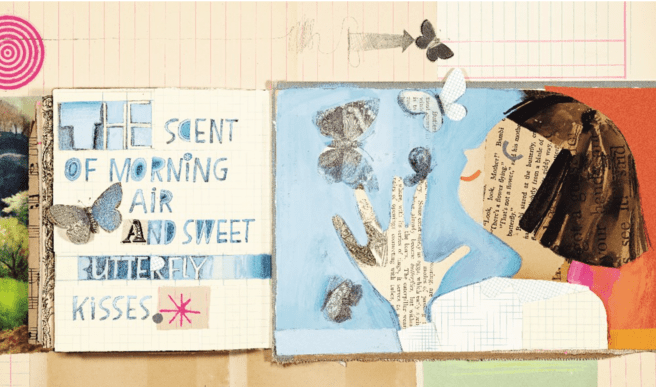
The scent of morning
air
and sweet
butterfly kisses.

Continue reading