serving up a pair of cool picture books about josé andrés and world central kitchen

“Chefs like me feed the few, but our destiny is to feed the many. To be an army of goodness where a plate of food becomes a plate of hope…a light in dark times. Together, we can change the world through the power of food.” ~ Chef José Andrés
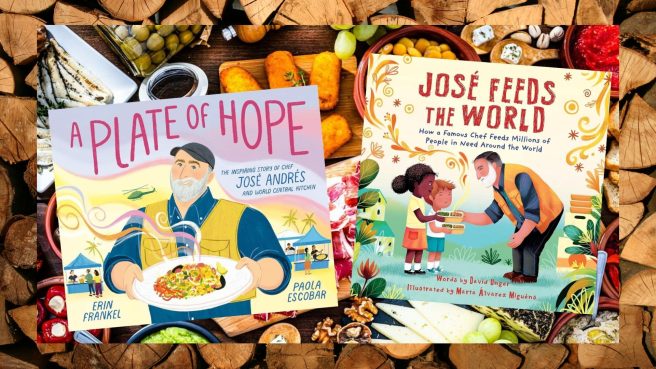
Since I’m a big fan of chef, restaurateur, and humanitarian José Andrés, I was happy to see both of these recently published picture books about his interesting life and amazing accomplishments.

Chef Andrés’s World Central Kitchen is truly a beacon of hope during tumultuous times of untold trauma, displacement and uncertainty due to natural and man-made disasters. Whether earthquake, hurricane, war, wildfire or pandemic, WCK is right there on the frontlines offering food, comfort, and a helping hand to local communities.

Chef Andrés received the Presidential Medal of Freedom on January 4, 2025. To date, WCK has served 450 million meals worldwide (photo via WCK.org).

You may know that in early January, Andrés received the Presidential Medal of Freedom, and that 2025 marks WCK’s 15th anniversary. Just recently, WCK provided free meals to firefighters, first responders and evacuees of the catastrophic wildfires in Los Angeles via food distribution centers as well as local restaurant and food truck partners.

So how did this incredible food aid/disaster relief nonprofit get started? What first inspired Andrés to become a chef, what continues to motivate him, and what are some of his core beliefs when it comes to food?

Chef Andrés and WCK volunteers cook paella in San Juan, Puerto Rico, October 2017 (photo by Eric Rojas/NYT).

Both books, A Plate of Hope and José Feeds the World trace José’s life from his childhood interest in cooking, to attending cooking school in Barcelona, to becoming an assistant chef at El Bulli, opening a tapas restaurant called Jaleo in Washington, D.C. (where he also volunteered at the DC Central Kitchen), to the 2010 Haiti earthquake, which motivated him to create World Central Kitchen.

When Hurricane Maria hit Puerto Rico in 2017, José and his WCK team got local people to volunteer after realizing they couldn’t do the work alone and there weren’t any other nonprofit organizations planning to feed the millions of people affected by the catastrophe.

As time passed, each new disaster presented different challenges requiring different solutions, and José found himself wanting to do more and more — establishing food distribution systems, flying in equipment to set up field kitchens, offering Meals Ready to Eat, etc. He also empowered local communities to use their skills and resources to help others as they had helped themselves.

Continue reading
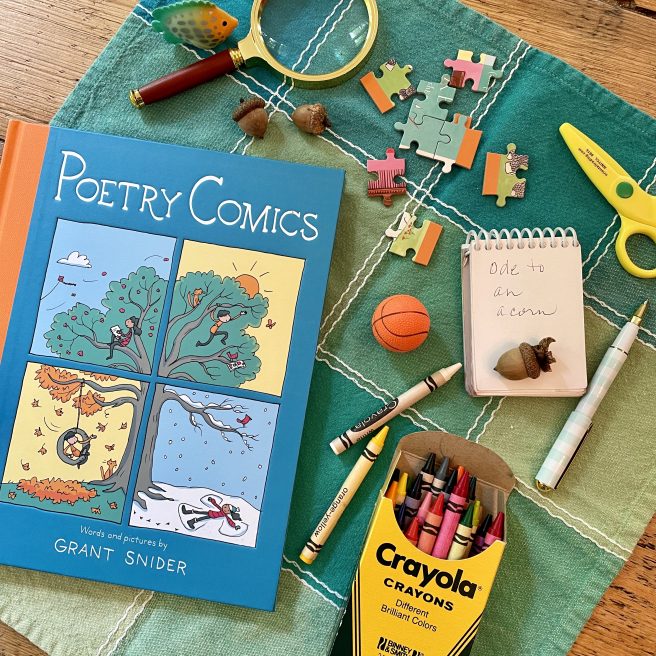
reveling in Grant Snider’s Poetry Comics

We don’t usually speak of poetry and comics in the same breath. We may like and enjoy both, but tend to approach each separately on its own terms. Purists may even consider poetry and comics to be on opposite ends of the literary spectrum (gasp!).

Yet Grant Snider sees things differently. The popular “Incidental Comics” creator was keen on finding a closer connection between poetry and comics, as both “contain condensed language, strong imagery, and ideally leave the reader with a new insight.”

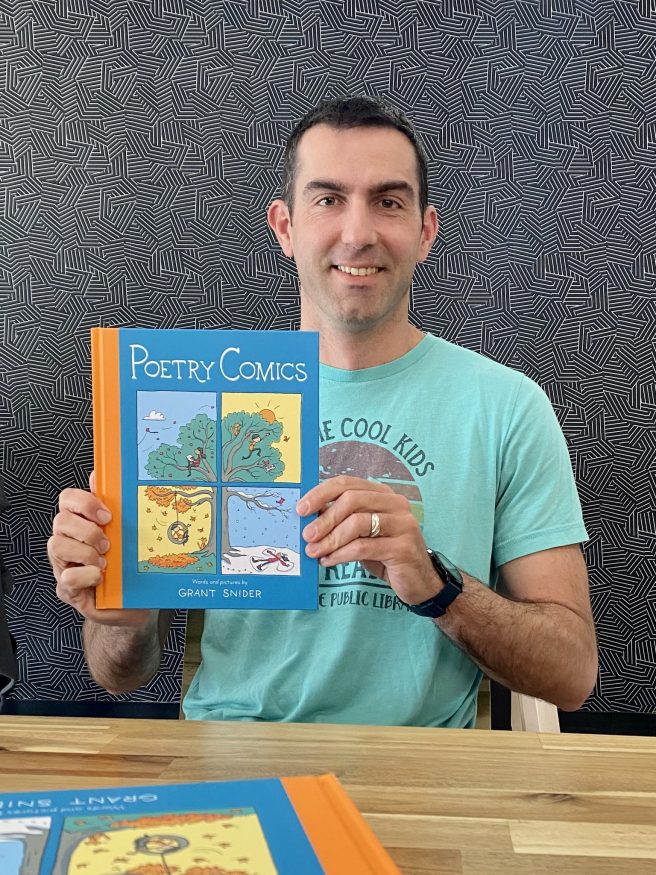
Author-illustrator, cartoonist, comic strip writer and orthodontist Grant Snider lives with his wife and five children in Wichita, Kansas.

Targeted for middle grade readers, Snider’s fun and inventive collection demonstrates this perfectly with an entirely new way of approaching and appreciating poetry. Did you ever think it would be possible to read a poem in a series of comic panels? Me neither. 🙂

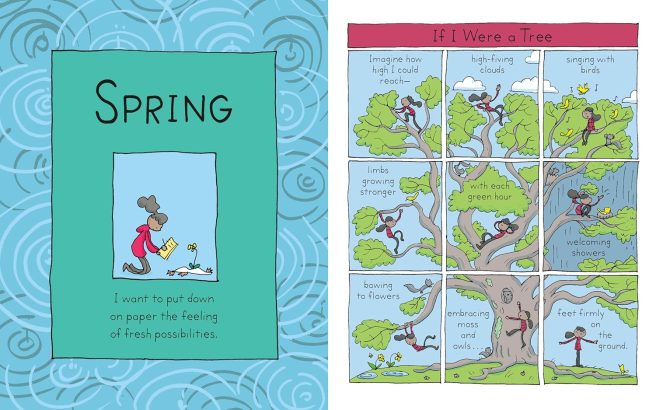
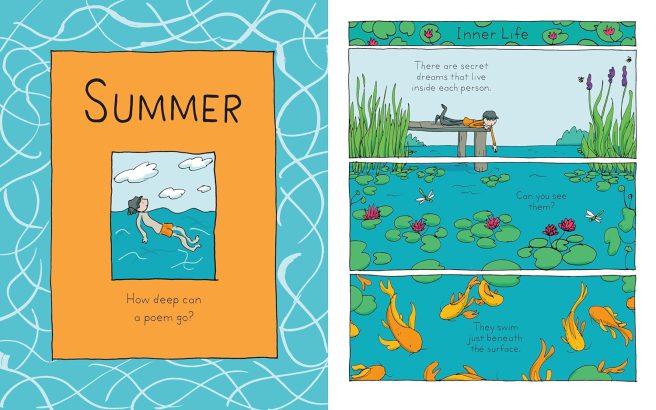
The poems in Poetry Comics (Chronicle Books, 2024) are organized by season, with each section offering insights into the poetry writing process. Title pages inspire and direct:

Spring: “I want to put down on paper the feeling of fresh possibilities.”

Summer: “How deep can a poem go?”

Fall: “I will wait for a poem to fall into my open arms.”

Winter: “A new page — my words huddle close to keep warm.”

Each season then ends with a variation of “How to Write a Poem.”

HOW TO WRITE A POEM #1

Find a quiet place.
A sharp pencil.
A blank page.
Sit still.
Keep quiet.
Wait.
A poem will rush in to fill the space.

Many of the poems are about nature (snails, tadpoles, butterflies, trees), while others examine universal human emotions and observations via kid-centric activities like running through sprinklers, waiting for the school bus, playing basketball, riding on roller coasters, climbing trees, reading good books, picking the perfect pumpkin, playing in the snow. Each poem is a sensorial impression of the here and now.

Continue reading

[happy review] Let’s Celebrate Korean New Year! by Michelle W. Park and Hyewon Yum

Tomorrow, millions of people around the world will be celebrating Lunar New Year. Although it’s commonly called Chinese New Year, there are other Asian communities who also observe this important holiday with their own set of traditions.

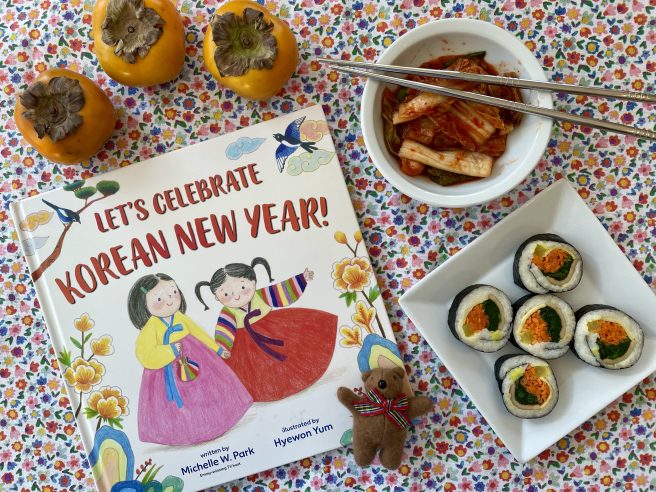
Since there are only a handful of picture books about Korean Lunar New Year in particular, I was especially happy to see this new title by Michelle W. Park and Hyewon Yum.

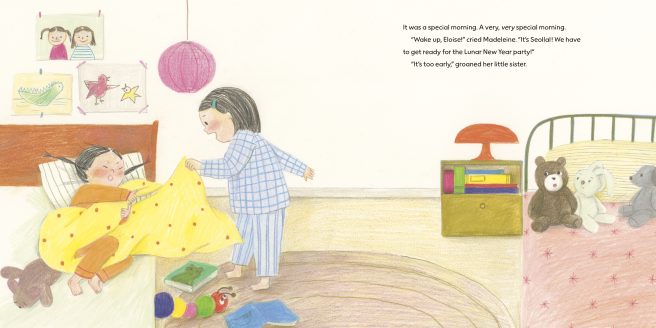
In Let’s Celebrate Korean New Year! (Random House BFYR, 2024), we meet Madeleine and Eloise, two sisters getting ready for their Lunar New Year party. As the big sister, Madeleine takes the lead in briefing Eloise about party attire, food, and games.

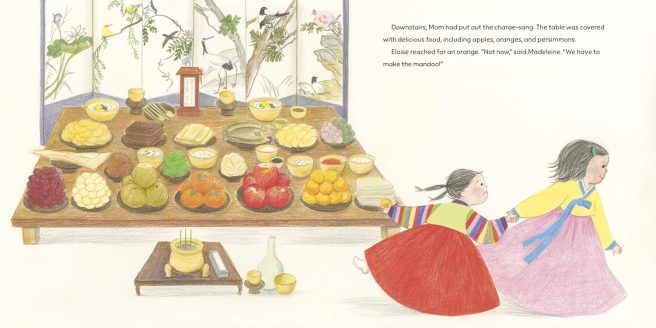
The story opens with Madeleine trying to rouse Eloise at dawn. Sleepy Eloise groans in protest, but Madeleine is raring to go. “First, we need hanboks!” She explains they need to wear traditional Korean clothing for the party, then helps Eloise put on her chima (skirt) and colorful jeogori (jacket).

Next, they race downstairs, where they see that their mom has already laid the charae-sang (ceremonial table) with delicious foods such as apples, oranges and persimmons as an offering to their ancestors. Before Eloise can grab an orange, Madeleine pulls her into the kitchen to help wrap dumplings.

Madeleine demonstrates how to fill a dumpling wrapper with a mixture of pork, glass noodles, garlic, scallions and soy sauce before carefully folding it. Unfortunately, Eloise’s earnest attempts aren’t very successful, with a ripped wrapper and too much filling. Impatient Madeleine takes over, assuring a disappointed Eloise that she can help next time.

Continue reading

[festive review + recipe] Peter Rabbit: Christmas is Coming (+ a blog break)

Most kids will say that presents are the best part of Christmas, but our mischievous friend Peter Rabbit begs to differ. While he loves presents, what he most looks forward to is all the food!

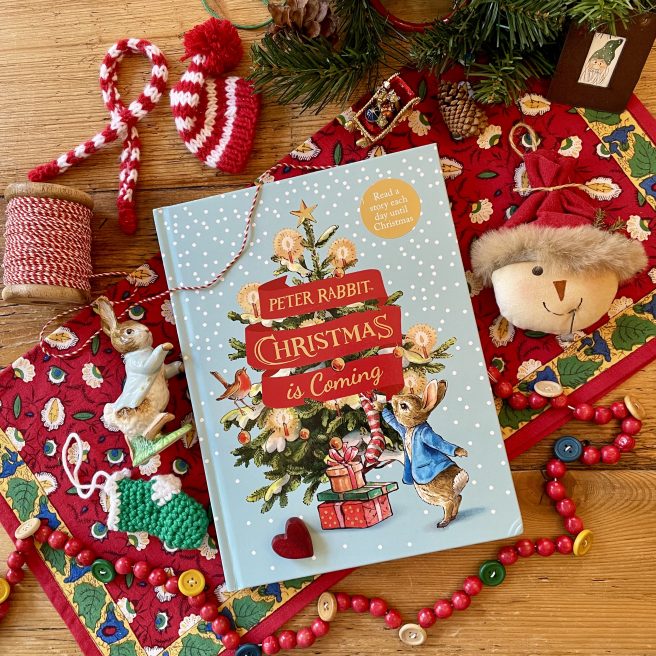
Luckily, there are many tasty treats to munch on in his advent storybook, Peter Rabbit: Christmas is Coming (Puffin Books, 2020). Written by Rachel Boden and illustrated by Neil Faulkner, this Beatrix Potter inspired delight is the perfect warm and cozy read for families to share as they count down to the big holiday.

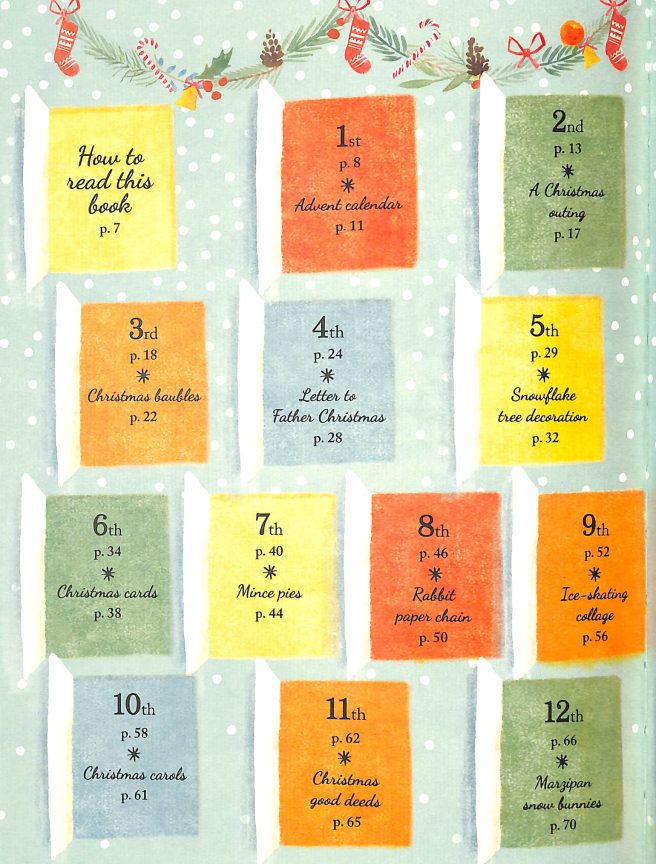
The treasury features 25 stories — one for each day of Advent + one for Christmas Day — paired with fun, easy “Christmassy” things to do or make suitable for kids 4+. The ‘stories’ are interlinked, so they can also be enjoyed by independent readers as one long chapter book. This will especially appeal to kids already familiar with the characters in the Peter Rabbit little books, since they feature in longer narratives.

In addition to Peter, his mum Mrs. Rabbit, and his sisters Flopsy, Mopsy and Cotton-tail, Peter’s cousin Benjamin Bunny plays a large role in all the action. When you have an enthusiastic partner in crime, almost anything can happen!

In the first story, Peter and Benjamin ‘argue’ over what is truly the best part of Christmas. Benjamin says presents (he wants a bouncy ball), while Peter is adamant about edibles:

I want roasted chestnuts and potatoes and parsnips and carrots and mince pies and cake and . . .

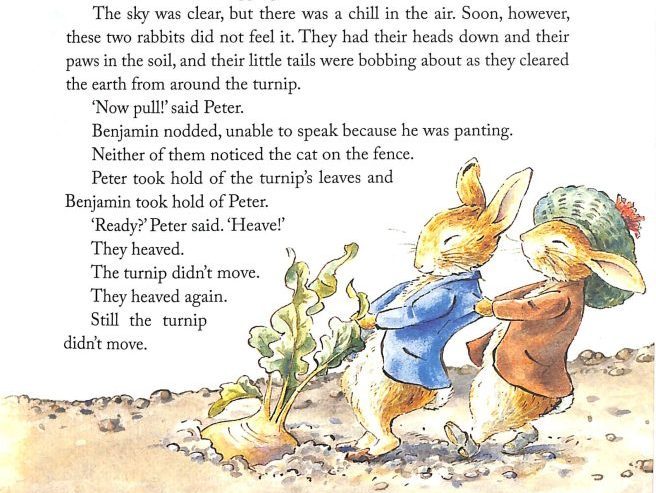
While this spirited sparring is going on, they make their way to Mr. McGregor’s garden (will they ever learn?), where they spy a row of turnips. Yes, they’re hard to dig up and heavy to carry — but Peter decides it’s worth the trouble since his mother could make a nice turnip soup.

After checking that the coast is clear (cat and Mr. M nowhere in sight), they furiously dig and dig and then tug, tug, tug at the turnip’s leaves. The turnip simply won’t budge. They keep tugging, unaware that the cat is sneaking up from behind.

Continue reading

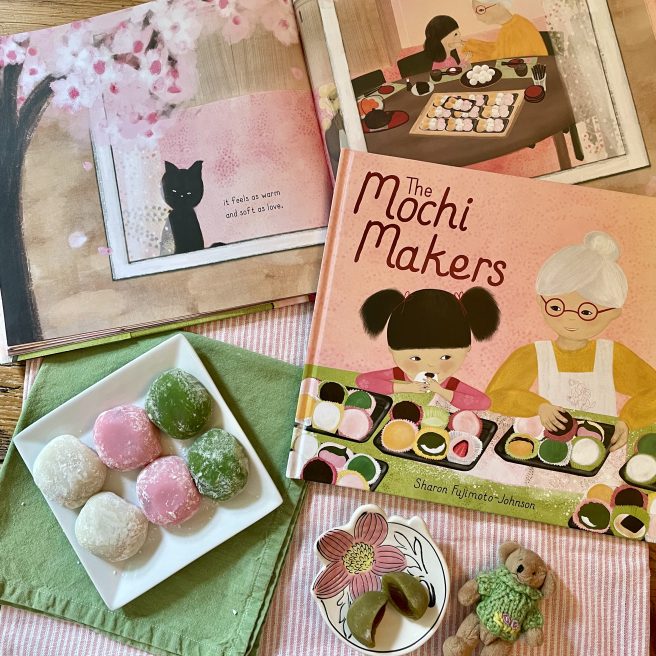
[chewy review] The Mochi Makers by Sharon Fujimoto-Johnson

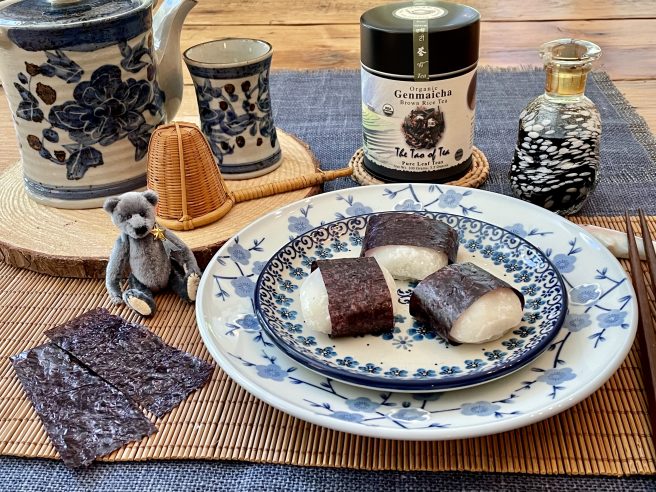
Soft, chewy, stretchy — pink, white, or green — I love mochi!

Whenever I bite into a Japanese rice cake, it takes me back to my childhood in Hawaiʻi. While we often enjoyed store-bought mochi as an everyday treat, it was most delicious when the extended family gathered on New Year’s Day to make a homemade batch.

My uncle (whose wife was Japanese) was in charge of cooking and pounding the rice with a wooden mallet. At first he did this by hand, but in later years he acquired a mochi machine that largely did the work for him. When the mochi dough was ready, my aunts coated their hands with potato starch and twisted off pieces to form small round cakes. Each family took home a good share. How I loved fresh, oh-so-soft mochi dipped in a little honey!

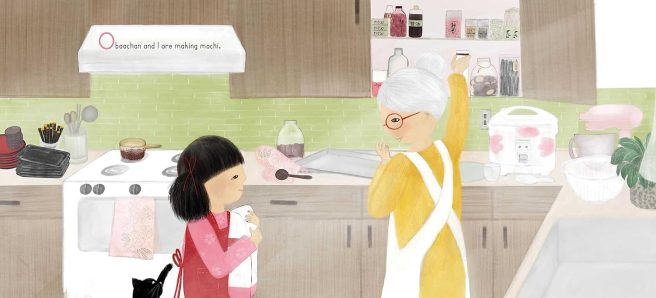
You can see why I was excited to read Sharon Fujimoto-Johnson’s debut picture book, The Mochi Makers (Beach Lane Books, 2024). In this gentle, heartwarming story, a little girl makes mochi with her grandmother, learns about her family’s heirloom recipe, and then shares trays of mochi with family, friends and neighbors.

Told from Emi’s point of view, the story outlines the steps she and Obaachan follow to make this special treat.

First, Emi and Obaachan wash sweet mochi rice — “Obaachan with her strong, wrinkled hands and me with my small, quick ones.” It doesn’t matter if Emi spills a few grains; Obaachan reminds her “we only need clean hands and whole hearts to make mochi.”

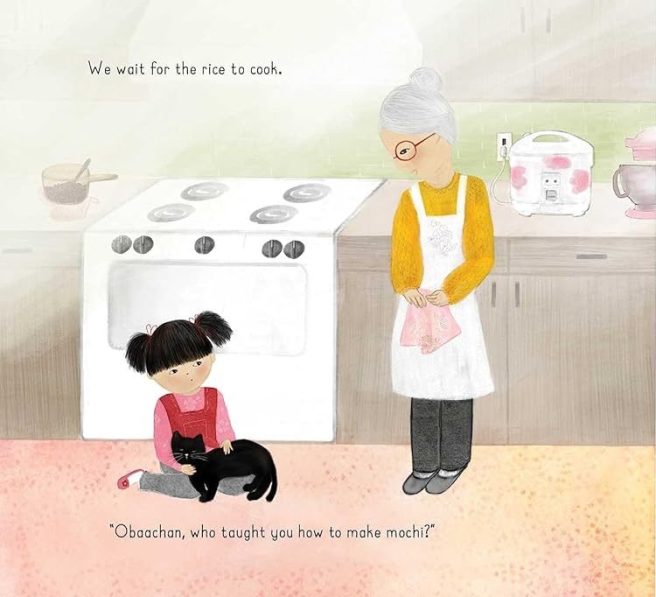
While the rice is cooking, Obaachan tells Emi that the recipe originated from Emi’s great-great grandmother. When Obaachan emigrated to America to marry Emi’s grandfather (Ojiichan), she brought the mochi recipe with her “in her heart and hands.”

When the rice is done, Emi and Obaachan transfer the steaming mass into a stand mixer, where it’s pounded into a sticky mound. Next, they coat their hands with potato starch, twist off pieces and make small round cakes.

Continue reading