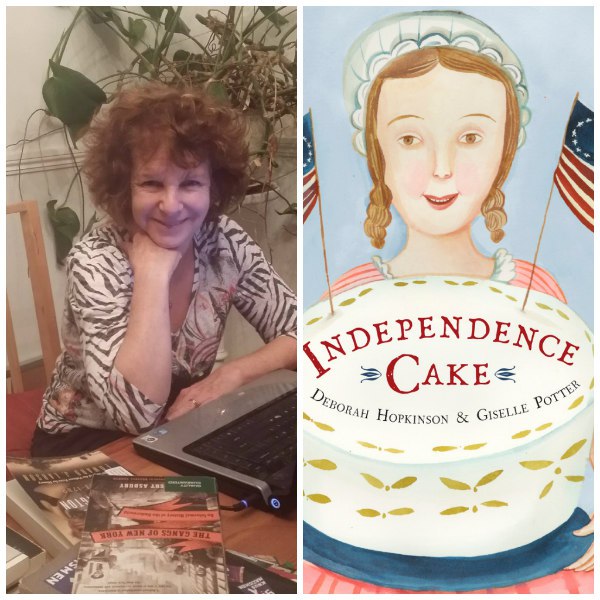
Award-winning author Deborah Hopkinson is here to talk about Independence Cake (Schwartz & Wade, 2017), her brand new picture book that officially hits shelves today.
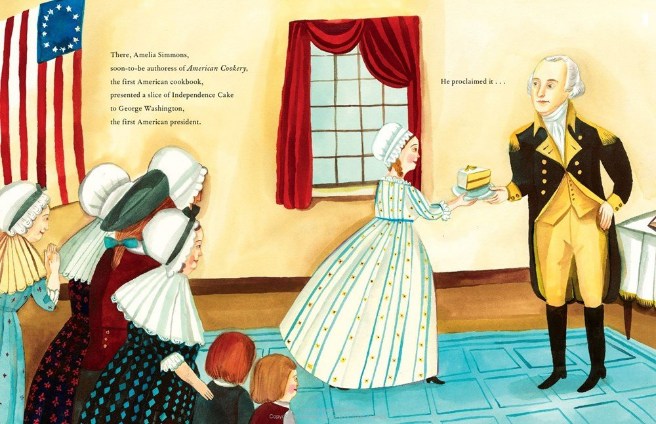
Illustrated by Giselle Potter, this scrumptious “revolutionary confection” is a fictionalized account of how Amelia Simmons, who would go on to write the first American cookbook, bakes 13 Independence Cakes to celebrate George Washington’s inauguration.
Since I loved Deborah’s Fannie in the Kitchen (2001) and Beatrix Potter and the Unfortunate Tale of a Borrowed Guinea Pig (2016), I am especially excited about this new book: American culinary history! English dishes! Tea biscuits and flapjacks! CAKE! Another serving of this tasty read, please.
*
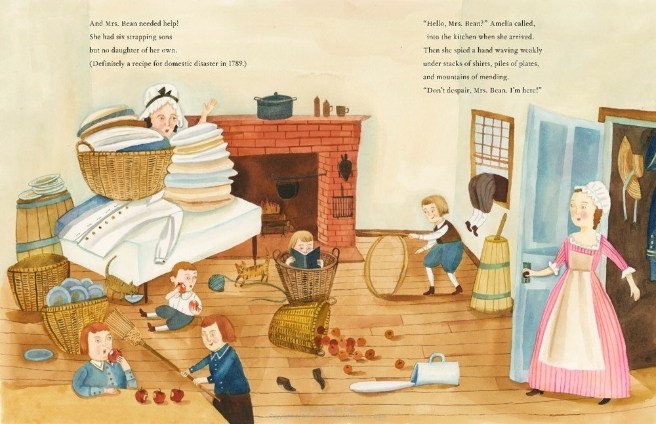
As an author for children and teens, I visit schools all over the country, and like to begin by asking students the difference between nonfiction and historical fiction. My new picture book, Independence Cake, is most decidedly fiction, as the subtitle makes clear: A Revolutionary Confection Inspired by Amelia Simmons, Whose True History is Unfortunately Unknown. In this light-hearted story with delicious illustrations by the incomparable Giselle Potter, we meet an orphan girl named Amelia, who is sent by the town to live with the fictional Bean family to help the exhausted mother of six sons and no daughter (“Definitely a recipe for domestic disaster in 1789”).
The real Amelia Simmons authored American Cookery, the first American cookbook. On the title page she identified herself as “An American Orphan.” Although historians know little about her, she may have been a “bound girl,” or indentured servant. In any case, the actual Amelia no doubt led a much harsher existence than her fictional counterpart.
In my story, Amelia’s reputation as a cook results in the town asking her to bake a special cake for George Washington at his 1789 inauguration. Amelia makes thirteen: one for each of the original colonies, which are carefully packed in wagons and driven off to New York to be pronounced “delicious” by the first president. (As the author’s note declares: this is entirely a confection!)
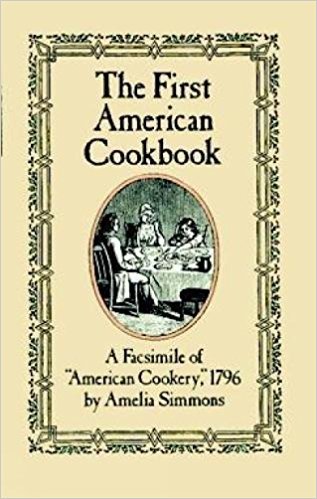 What is true about Amelia Simmons is that her cookbook expanded on traditional English cooking to include culinary influences and available ingredients in America. The legendary food historian Karen Hess, in an introduction to the second edition of American Cookery, published in Albany in fall 1796, speculated that the author may have lived near the Hudson Valley and been influenced by Dutch settlers. Simmons used terms such as “slaw” based on the Dutch “sla” for salad, and “cookey,” from “koekje.” In some recipes, Simmons substituted cornmeal for the oatmeal of English cooking, reflecting the influence of Native American traditions. Simmons seems to have been intentionally creating something new: the long subtitle of her cookbook notes that recipes are “Adapted to this Country, and All Grades of Life.”
The recipe for “Independence Cake” first appears in this second edition, directly following one for “Election Cake,” of which it is a variation; both contain raisins, brandy, and spices, similar to a traditional English fruitcake or plum cake. The cakes were part of the holiday spirit that surrounded early election days. Amelia’s patriotic fervor may have led her to call one “Independence Cake.”
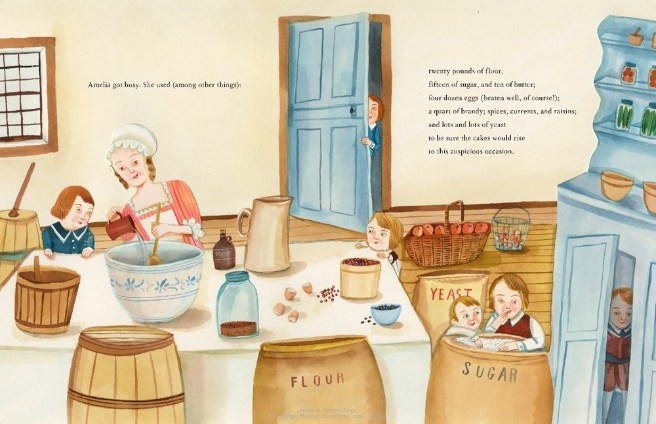
I like to imagine Amelia as an American version of Daisy in Downton Abbey – a cook eager to try new things and embrace the future, although clearly Amelia had a pinch of Mrs. Patmore in her too. Here’s a snippet from her book in which she opines about the character-building properties of cultivating apple trees:
“Apples…. ought to be more universally cultivated, excepting in the compactest cities. There is not a single family but might set a tree in some otherwise useless spot, which might serve the two fold use of shade and fruit; on which 12 or 14 kinds of fruit trees might easily be engrafted, and essentially preserve the orchard from the intrusions of boys, &c. which is too common in America.
If the boy who thus planted a tree, and guarded and protected it in a useless corner, and carefully engrafted different fruits, was to be indulged free access into orchards, whilst the neglectful boy was prohibited–how many millions of fruit trees would spring into growth–and what a saving to the union. The net saving would in time extinguish the public debt, and enrich our cookery.”
Although I wrote Independence Cake long before the 2016 presidential election, I noticed some bakers took the election season as an opportunity to share historical tidbits about the culinary tradition of election cakes. I’ve included a few below.
And speaking of elections, given Amelia’s interest, noted above, in extinguishing the public debt, she might well have wished for a political career herself.
Except, of course, in 1789 women couldn’t vote. But that’s another story.
To read more about the history of Election Cakes:
NPR: A History of Election Cakes
http://www.npr.org/sections/thesalt/2016/10/23/498974733/a-history-of-election-cake-and-why-bakers-want-to-makeamericacakeagain
Bon Appetit: “Election Cake” Makes a Modern Day Resurgence
http://www.bonappetit.com/entertaining-style/trends-news/article/election-cake-history
What’s Cooking America: Election Day Cake History and Recipe
https://whatscookingamerica.net/History/Cakes/ElectionCake.htm
*
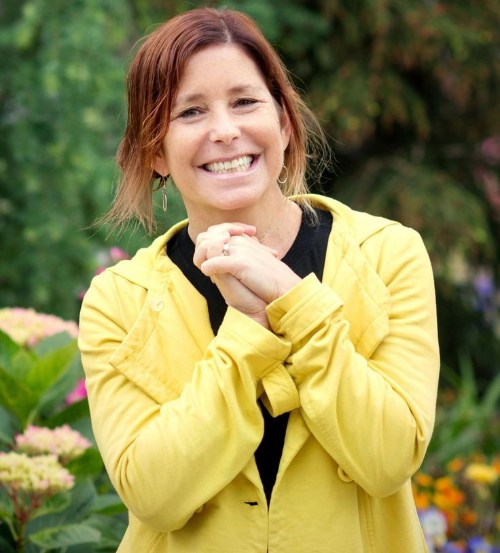
Deborah Hopkinson is the award-winning author of more than 45 books for young readers including picture books, historical fiction, and nonfiction. She has won the SCBWI Golden Kite Award for picture book text twice, for Apples to Oregon and A Band of Angels. Other titles include Sweet Clara and the Freedom Quilt, winner of the IRA Award; and Sky Boys, a Boston Globe-Horn Book Honor book. In addition to Independence Cake (May 2017), she just published a contemporary picture book, A Letter to My Teacher (April 2017).
Deborah’s nonfiction includes Titanic, Voices from the Disaster, which received a YALSA Excellence in Nonfiction honor and a Robert F. Sibert Honor and Dive! WWII Stories of Sailors and Submarines in the Pacific. Her nonfiction picture book, Keep On! The Story of Matthew Henson, Co-Discoverer of the North Pole, won an Oregon Book Award.
Visit Deborah Hopkinson online at www.deborahhopkinson.com, or follow her on Twitter @deborahopkinson and Instagram @deborah_hopkinson
*
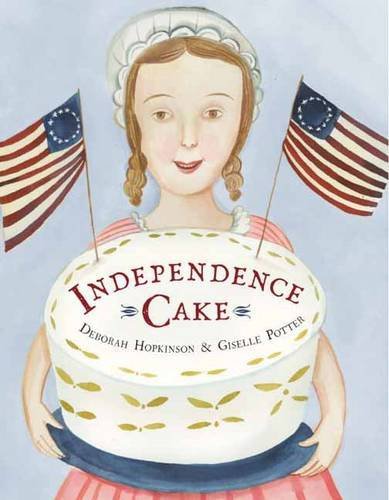
INDEPENDENCE CAKE: A Revolutionary Confection Inspired by Amelia Simmons, Whose True History is Unfortunately Unknown
written by Deborah Hopkinson
illustrated by Giselle Potter
published by Schwartz & Wade (May 2017)
Historical Fiction Picture Book for ages 4-8, 44 pp.
*Includes Authors Note and Original Recipe
**Starred Review from Publishers Weekly**
*
📕 MORE 📘
♥ Check out the other stops on Deborah’s Double Blog Tour!
♥ Enjoy this interesting blog post about Election Cakes (+ a recipe) at Revolutionary Pie.
♥ See my reviews of Fannie in the Kitchen (+ Griddle Cakes) and Beatrix Potter and the Unfortunate Tale of a Borrowed Guinea Pig.
Copyright © 2017 Jama Rattigan of Jama’s Alphabet Soup. All rights reserved.
Save
Save
Save
Save
Save
Save
Save
Save
 Jama's Alphabet Soup