“Simply put, mindfulness is moment-to-moment non-judgmental awareness.” ~ Jon Kabat-Zinn
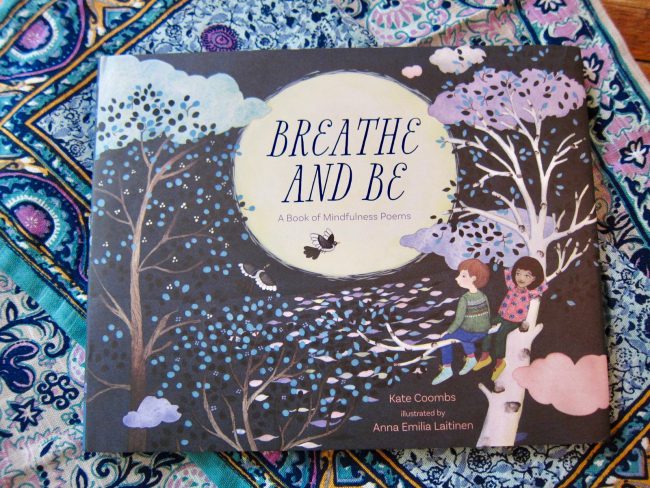
Today I’m happy to welcome back award-winning author and poet Kate Coombs to talk about her new poetry picture book, Breathe and Be: A Book of Mindfulness Poems (Sounds True, 2017).
Kate introduces the practice of mindfulness to children with fourteen poems that foster an awareness, appreciation and respect for nature through close observation and introspection, which in turn engenders a newfound sense of self.
With Anna Emilia Laitinen’s gorgeous watercolors, each double page spread is an invitation to pause, enter the world of the poem, and internalize the soothing imagery. Kate’s choice of the tanka (five lines divided into syllables of 5, 7, 5, 7, 7) is the perfect vehicle for brief but meaningful contemplation. The book begins with a centering awareness of breath and presence:
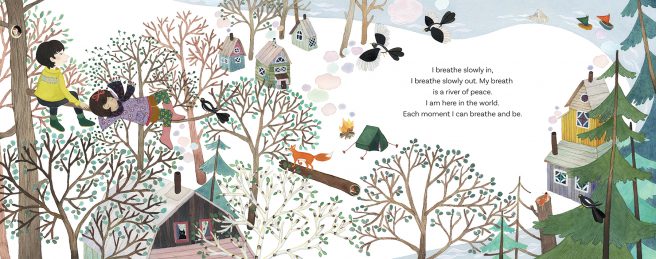
I breathe slowly in,
I breathe slowly out. My breath
is a river of peace.
I am here in the world.
Each moment I can breathe and be.
Subsequent poems illuminate various facets of mindfulness and meditation: objectively observing the flow of thoughts that “swim by like little fish,” finding a “quiet place” in the mind when seeking solace, imagining oneself as an element of nature (cloud, stone, river, seed, tree), and living in the moment:
Tomorrow’s an egg
that hasn’t hatched. Yesterday
is a bird that has flown.
But today is real. Here now,
this minute, the true wings.
Young readers will be able to see how nature can be a reassuring refuge in times of trouble, worry, sadness, or other emotional imbalance. By summoning the inner self, they can be a “calm umbrella” in the face of turbulence, or a strong, steadfast tree that remains patient in all seasons.
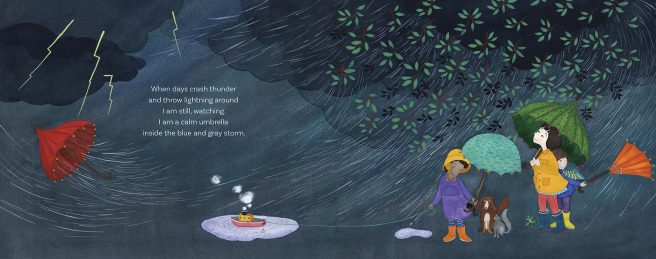
When days crash thunder
and throw lightning around
I am still, watching.
I am a calm umbrella
inside the blue and gray storm.
Envisioning each floating leaf in a stream as a negative thought drifting away can quiet overwhelming concerns. Above all, cultivating the ability to look within as well as without will enable them to “see the world new” and feel more “alive in this world.”
The illustrations feature a small group of multi-ethnic children in a northern landscape interacting with their surroundings atop tree branches and in hammocks, walking through the woods, and playing together by a campfire, on a hillside, in a boat, under a tent. There are trees in almost every picture and lots of small animals to delight and surprise. The peaceful image of toy boats drifting downstream, a tree-flock of fluttering birds, and a bevy of playful rabbits add to the charm, while butterflies and tadpoles signal transformation.
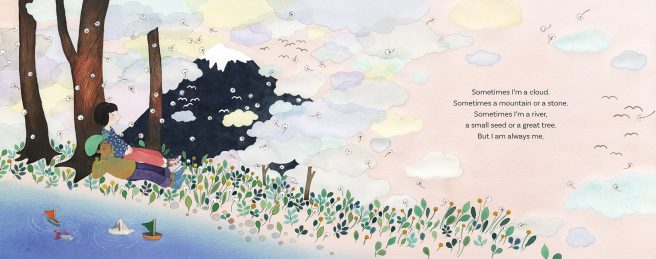
Sometimes I’m a cloud.
Sometimes a mountain or a stone.
Sometimes I’m a river,
a small seed or a great tree.
But I am always me.
A haven of stillness and beauty, Breathe and Be offers children and their parents a delightful, attainable path to inner peace and a renewed reverence for the natural world. After all, when was the last time you sat on a hillside to watch the clouds drift by, wiggled your toes in the sand, strolled through the woods to hear the whisper of leaves, or lazed in a hammock just “being”?
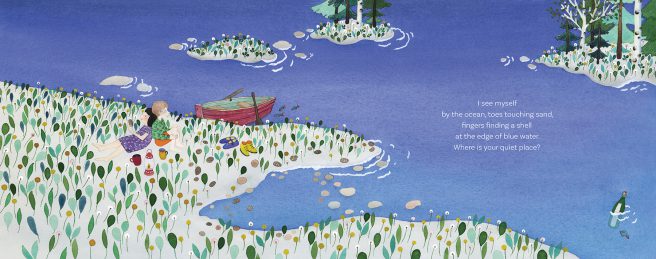
I see myself
by the ocean, toes touching sand,
fingers finding a shell
at the edge of blue water.
Where is your quiet place?
Let’s find out more about the book from Kate!
*
🌲 AUTHOR CHAT WITH KATE COOMBS 🐠
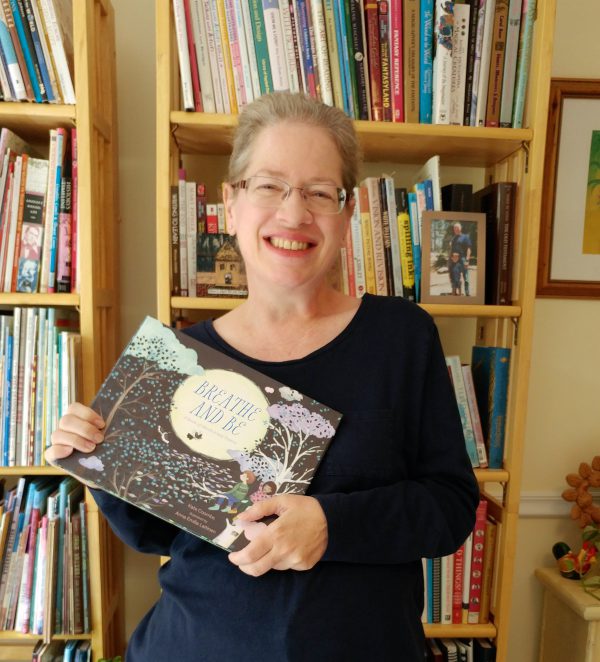
What inspired you to write a book of mindfulness poems for kids?
I actually wrote the book on spec! A writing friend of mine had become the children’s editor for Sounds True, which was just starting to publish children’s books such as Good Morning Yoga. She gave me a couple of topics and I was immediately intrigued by the idea of mindfulness. I started researching it and then wrote Breathe and Be. As you can imagine, it turned out to be a really rich experience.
Why did you choose tanka as your poetic form, and why did you write them in first person?
Mindfulness has its roots in Asian religion and philosophy, so I felt the tanka made a good fit. I thought about using haiku, but it just isn’t long enough for the kinds of things I wanted to say. I wanted each poem to be a comfortable, thoughtful little space to wander about in. I didn’t really notice that I wrote in first person! I think it probably made a good fit because mindfulness and meditation are very personal.
Please tell us a little about your writing process. Did you write most of the poems outdoors?
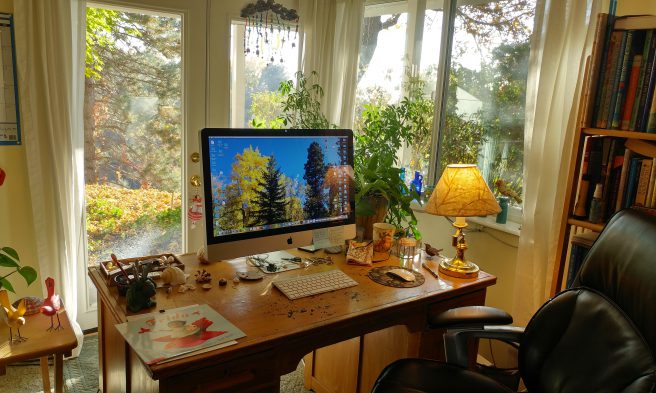
I did a lot of online research about mindfulness in addition to getting a few books, and I copied and pasted some of the ideas and lists and definitions I found into a document. Then I tried to turn each of the rather abstract ideas into an imagistic poem. Show, don’t tell! Although I didn’t write outside, my office windows overlook a tree-filled canyon, which is a good fit for this book full of trees.
When did you first learn to meditate? What is your daily practice like now?
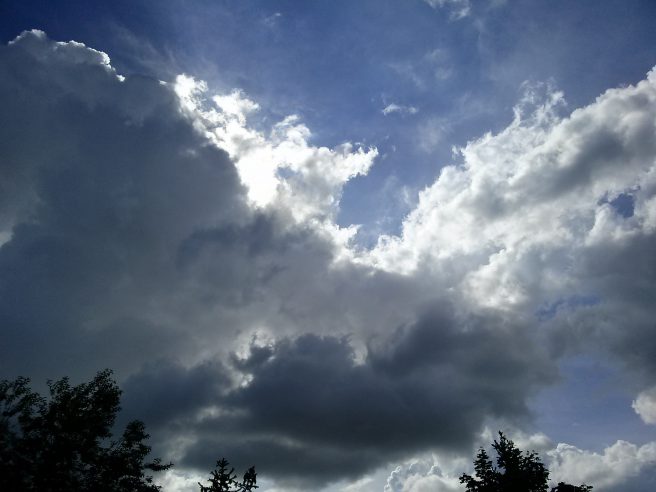
True confessions: I’m not the world’s best meditator. However, I have learned that being in nature helps me experience mindfulness. I think that’s why this book turned out to be such a celebration of the natural world. I have a pine and scrub oak forest in the small canyon out back, plus 30 houseplants and a balcony herb garden. I wouldn’t know how to live without plants and trees. But with them and other beautiful things, like water and clouds, not to mention birds and bugs, I can be mindful. You don’t need a yoga mat to find peace and focus in nature. Though you can always lie down on your back in the grass!
How has practicing mindfulness fueled your creativity?
Mindfulness pulled me in and trying to describe it fueled my creativity. I did start entering a state of mindfulness as I wrote about it. More and more, I experienced the poems mindfully. It’s the most unusual experience I’ve ever had as a writer, creating and then living in a beautiful, tranquil space.
Describe your “quiet place.”
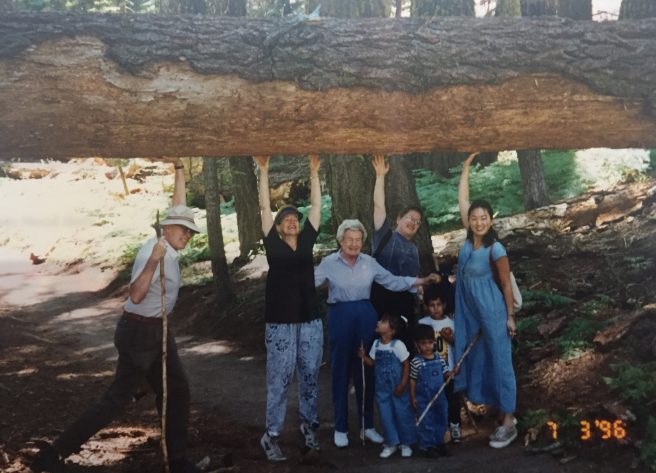
Both of my quiet places are featured in the book: a forest and an ocean shore. To be specific, my forest is in Sequoia National Park. Although I love simply walking the paths among the huge trees, my favorite spots are Round Meadow and Crescent Meadow in the Giant Forest area. Each meadow is filled with green growing things illuminated by sunlight, and each is surrounded by giant Sequoia trees, pines, and undergrowth. There is a combination of quiet and noise there, but the noises are the buzzing of bees and the wind through the grasses and branches. The sky is very blue.
My ocean shore is a beach along the Southern California coast just north of L.A., a little spot called Leo Carrillo that is part of a state park. When we were young we used to go boogie boarding there, but now I’m happy sitting and watching the waves, or walking along the damp sand just beyond the reach of the water, looking at little rocks and shells, the surf and sky, and seabirds, especially pelicans.
Please share your reactions to seeing Anna Emilia Laitinen’s illustrations for the first time. Which is your favorite spread and why?
I first saw the pencil sketches, and they were wonderful—I quickly fell in love with Anna Emilia’s beautiful work. I think its delicacy and peace match the quiet mood of the poems. Like Anna Emilia, I love nature, especially trees. The artwork makes me want to go for a walk in the woods.
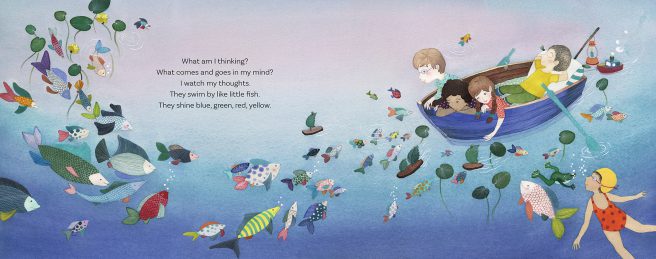
I like all of the spreads, but I’m particularly fond of the little fish, just their colors and the way they swirl across the pages, with the children looking a bit like fish themselves.
What thoughts, happy or sad, are floating by you at this very moment?
I’ve had a tough year, but a lot of happy things have come into my life recently, and this book being published is one of them. Even though I know it’s my book, it feels like such a gift because it brings me comfort and happiness when I read it or even think about it. So that’s how I’m feeling right now!
Anything else you’d like us to know about the book?
I found out that the tanka is actually the predecessor of the haiku. Haiku is a cool little format, especially for pinpointing moments in nature. However, the tanka has more leeway both in terms of length and subject matter. I’ve seen it written with a very boring diamond-shaped formula in schools, but the real deal is much better. I hope this book will help kids experiment with writing tanka.
What are you working on now?
I’ve been regrouping lately after experiencing some writer’s block. I’m revising a picture book about traditional Polynesian navigation and I have a few other nonfiction picture books in mind. I’m also revisiting a poetry collection that has languished for months. I have a couple of middle grade projects on the back burner, as well. So we’ll see what happens!
I do have another poetry collection coming out next fall. It’s called Monster School and is a lot of fun, hopefully a little scary, too.
Thanks so much, Kate!!
*
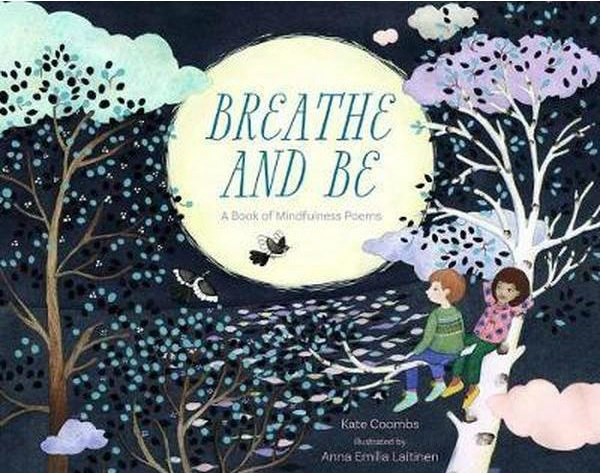
BREATHE AND BE: A Book of Mindfulness Poems
written by Kate Coombs
illustrated by Anna Emilia Laitinen
published by Sounds True, November 1, 2017
Poetry Picture Book for ages 4-8, 32 pp.
*Includes an Author’s Note with more info about mindfulness
♥ Check out this cool Story Hour Kit!
♥ Other posts about the book:
- Kate’s guest post at Amy Ludwig VanDerwater’s The Poem Farm, where she discusses the tanka form in more detail
- Interview at Live Your Poem (Kate responds to Irene Latham’s prompts)
- Interview at Laura Purdie Salas’s Writing the World for Kids
♥ Take a few minutes to bask in the beauty and stillness: Enjoy this lovely reading of Breathe and Be:
*
🌿 SPECIAL BOOK GIVEAWAY! 🌼
The publisher has generously donated a copy of Breathe and Be for one lucky Alphabet Soup reader. For a chance to win, please leave a comment at this post telling us about your favorite “quiet place” no later than midnight (EST) Wednesday, November 22, 2017. You may also enter by sending an email with BREATHE in the subject line to: readermail (at) jamakimrattigan (dot) com. Giveaway open to U.S. residents only, please. Good Luck!
*
 The lovely, talented, and tea-drinking Jane is hosting the Roundup at Raincity Librarian. Float over there on your autumn leaf of choice and check out the full menu of poetic goodness being shared in the blogosphere this week. Go in peace. 🙂
*Interior spreads posted by permission of the publisher, text copyright © 2017 Kate Coombs, illustrations © 2017 Anna Emilia Laitinen, published by Sounds True. All rights reserved.
**Copyright © 2017 Jama Rattigan of Jama’s Alphabet Soup. All rights reserved.
 Jama's Alphabet Soup