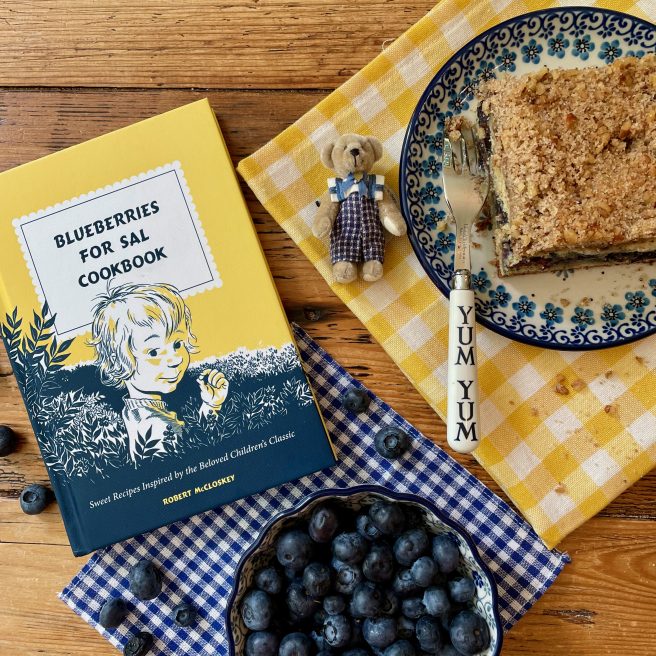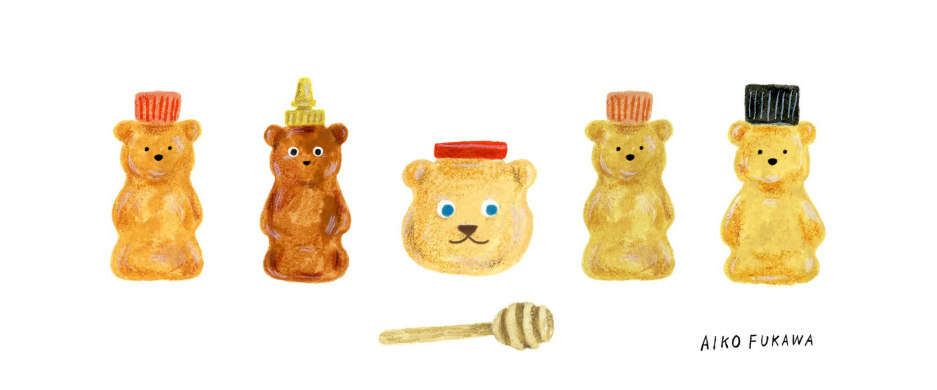
a scrumptious treat from the Blueberries for Sal cookbook

Little Bear and his mother went home down one side of Blueberry Hill, eating blueberries all the way, and full of food stored up for next winter. ~ Robert McCloskey

Kuplink, kuplank, kuplunk!

Sounds like Little Sal is tossing a few blueberries into her tin pail — and when I say “a few,” I mean the ones she hasn’t yet eaten, which number very few indeed.
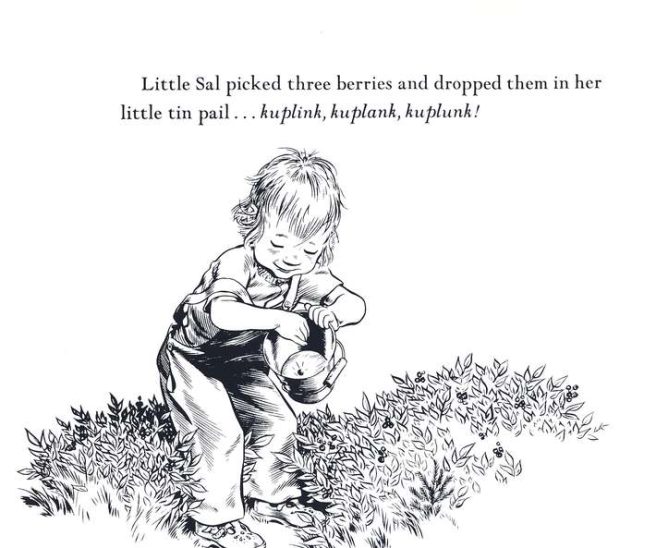
As we all know from reading Robert McCloskey’s classic picture book Blueberries for Sal, this adorable munchkin simply couldn’t get enough of those tender juicy orbs while out berry picking with her mom on Blueberry Hill.
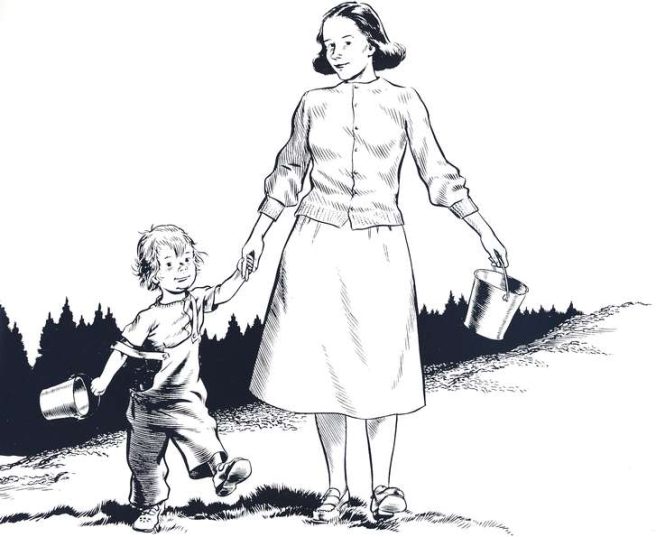
Can’t say I blame her: when I visited the Southern Coast of Maine ten years ago, I was finally able to try wild Maine blueberries for the very first time. So good! The lowbush berries like Sal ate are smaller and sweeter than the highbush variety widely available in supermarkets around the country. If I had gone blueberry picking with Sal and her mom, there wouldn’t be any berries in my pail at all. 🙂
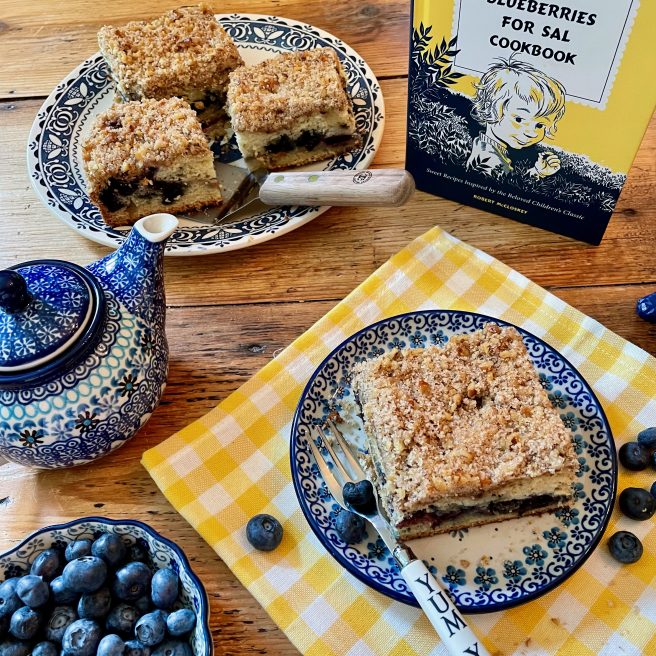
I was positively giddy when the Blueberries for Sal Cookbook: Sweet Recipes Inspired by the Beloved Children’s Classic (Clarkson Potter, 2023) was released in June. I thoroughly enjoyed perusing this adorable collection, which is basically a baker’s delight.

Continue reading
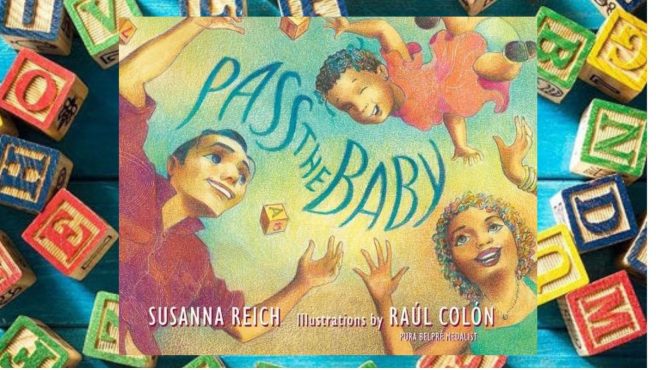
[bouncy review] Pass the Baby by Susanna Reich and Raúl Colón

Since I grew up with a large extended family, loud talky meals were par for the course. Along with lots of tasty food, my aunties served up a fair share of juicy gossip and heaps of hilarity whenever we got together.

My cousins and I knew the drill. If you were a baby or toddler, you could expect to be doted upon — hugged, held, kissed or tickled. An uncle might toss you up in the air, and if you weren’t careful, you could even get your cheeks pinched.

All part of happy family gatherings, where the youngest is usually the center of attention. And why not? Who doesn’t love a wriggly, giggly, drooly, pint-sized bundle of fun?

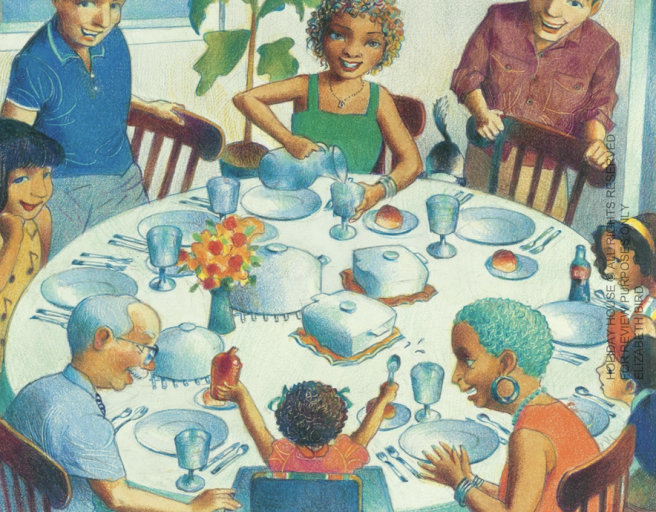
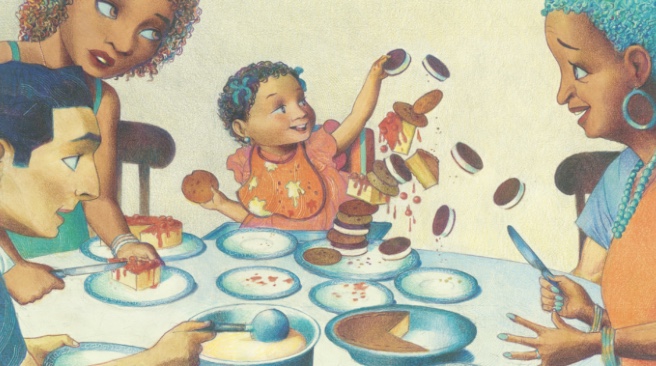
In Pass the Baby by Susanna Reich and Raúl Colón (Neal Porter Books, 2023), we’re invited to join a lively multiethnic blended family as they set the table, prepare the food, enjoy their meal, clean up the mess, and then collapse from exhaustion — all while playing with, feeding and entertaining the baby, as she’s passed from lap to lap.

Reich’s rollicking rhyming text pulls us right into the action from the get-go, filling us with excitement and anticipation as we sense Baby will be the star of the show.

Family dinner, set the table,
forks and spoons and napkins too.
Knives and plates and water glasses,
flowers, candles, bright and new.
Wait a minute, where's the baby?
Someone's playing peekaboo!

As the guests gather round and help with finishing touches, hungry Baby fusses a little. So begins her journey around the table, as she’s cuddled by different family members. An ebullient refrain underscores everyone’s uproarious delight:

Continue reading

[srsly hppy review] ZigZag by Julie Paschkis

#64 in an ongoing series of posts celebrating the alphabet

Hungry? Roll these words around in your mouth: sip, slurp, sliver, snap!

Pretty tasty, no?

What’s that? You want more? Okay, crunch on these: crack, creak, clack!

Ahhhhh. I can tell by that big smile on your face that you’re probably a fellow word connoisseur. Hearing them, saying them, reading them, writing them, and now, eating them — words, whether short, long or in-between, are the ultimate feast.

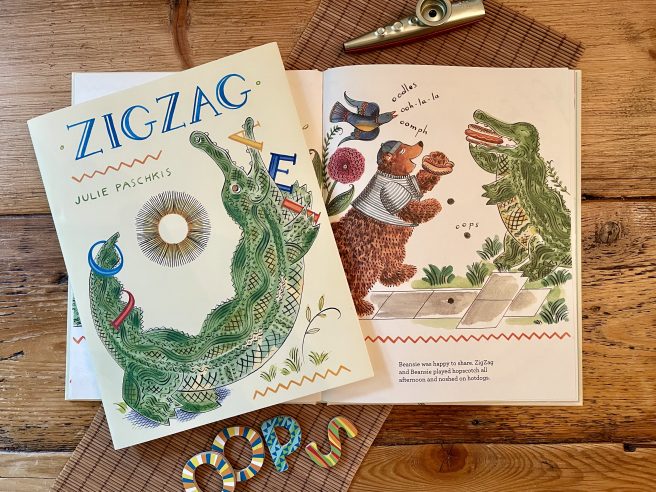
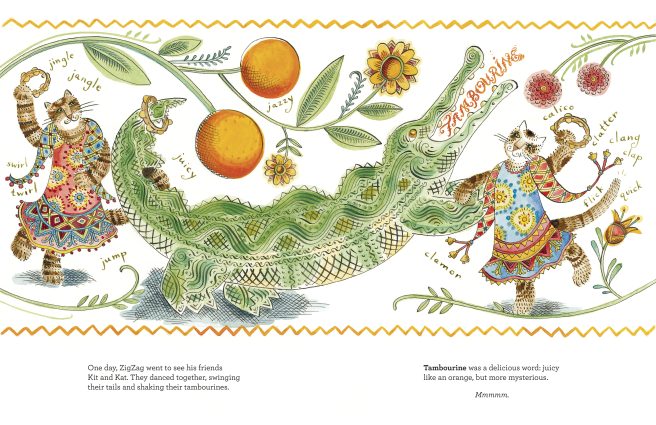
In Julie Paschkis’s Zigzag (Enchanted Lion Press, 2023) — a zippy, juicy, jazzy hullabaloo of a picture book — we meet a voracious crocodile who “liked to taste words.” He had quite the discerning palate, too.

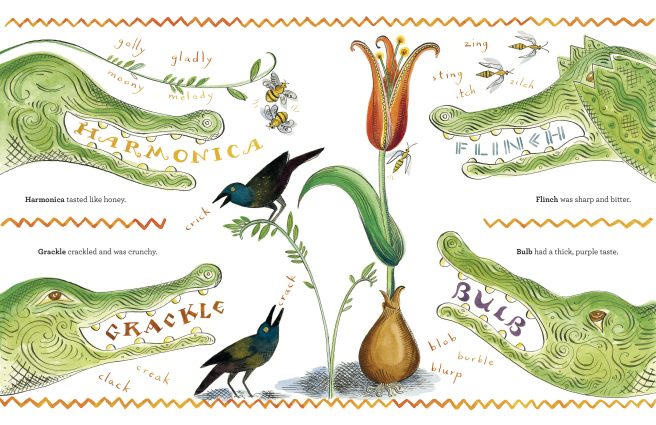
Harmonica tasted like honey.

Grackle crackled and was crunchy.

Flinch was sharp and bitter.

Bulb had a thick, purple taste.

All was peachy until the day Zigzag vigorously danced with his friends Kit and Kat. They swung their tails and shook their tambourines. Because tambourine just happened to be especially delicious (“like an orange, but more mysterious”), Zigzag forgot himself. Gulp! He accidentally swallowed the word with all of its vowels!

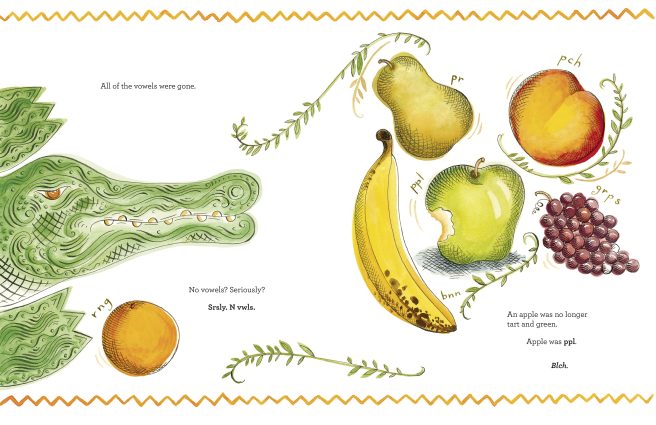
All that was left in Zigzag’s mouth was tmbrn. Talk about tasteless. But that was the least of his problems. Other foods didn’t taste good either: where was the roll-in-your-mouth flavor of a pr or a pch or grps?

Blch.

Zigzag had always loved to read, but now, all bks were brng. Even worse, he couldn’t slp at night. His bd felt too short.

Continue reading

[review + giveaway] Betty and the Mysterious Visitor by Anne Twist and Emily Sutton

If there is one thing I learned from living in England, it’s that the British love their gardens. Residents take great pride in cultivating their own personal Edens whatever their domicile: terraced or detached house, cottage, bungalow, mansion. Even the smallest patch of ground flourishes under their loving care.

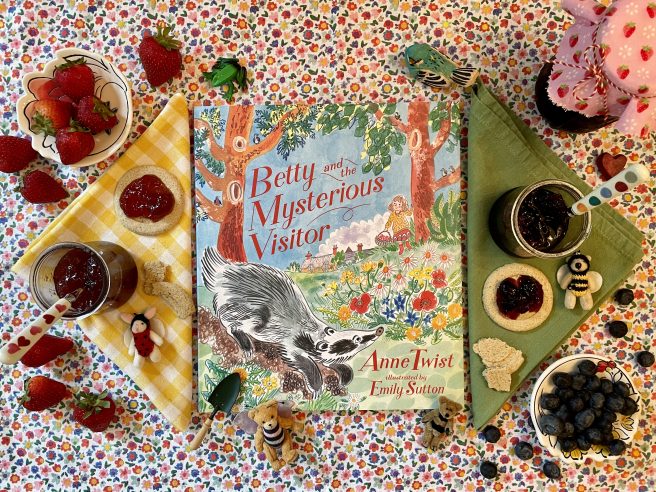
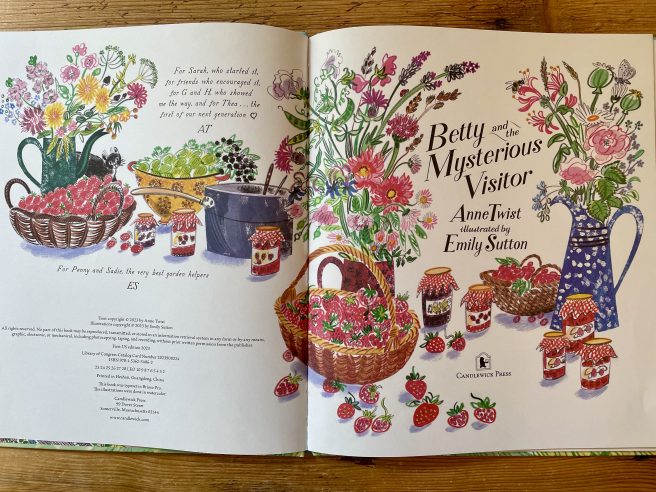
The infinitely charming new picture book, Betty and the Mysterious Visitor by Anne Twist and Emily Sutton (Candlewick, 2023), celebrates the specialness of a particular garden and the loving relationship between those tending it.

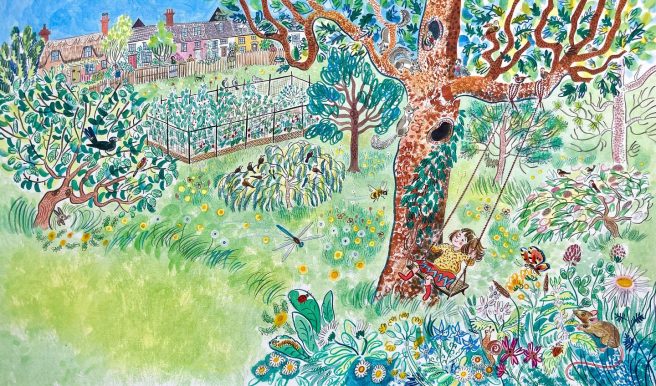
Every summer, Betty loves visiting Grandma at her cottage in the village of Wobbly Bottom. They spend hours in a large community garden adjoining Grandma’s back yard called Acorn Hollows, Betty’s favorite place in the whole world.

There, Grandma grows flowers as well as lots of berries — raspberries, blueberries, strawberries and gooseberries. Betty helps Grandma pick the fruit and cook it to make jam to sell at the farmers market.

But one morning, Betty discovers somebody has ruined the garden. “The grass was a mess, a higgle and puff. What had been smooth was now muddy and rough.”

Betty is quite sad and determined to find the culprit. That night, when she peers out her window, she sees a large creature “pushing its nose under the fence,” but she loses sight of it when the moon drifts behind a cloud.

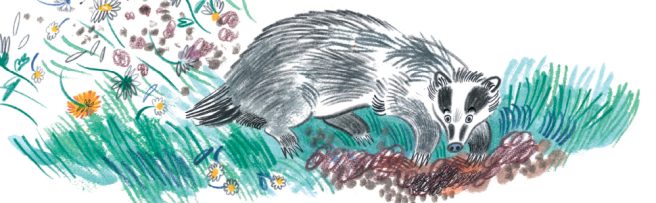
She tells Grandma what she saw the next morning, noting “it had a striped head.” Grandma thinks it’s a badger, an animal bound to come back once it’s found access to food. Sure enough, over the next few nights, the badger destroys more and more of the garden.

Continue reading

[splashy clean review] Josephine and Her Dishwashing Machine by Kate Hannigan and Sarah Green

“The woman of the future will have the memory of Josephine Garis Cochrane in grateful remembrance. It was she who invented the machine which has set woman free from the most slavish and disgusting task of housekeeping — dishwashing.” ~ The Daily Picayune, April 2, 1892.

First there’s a hum as the motor engages, the sound of water filling, then a swoosh as the pump starts up. After a couple of friendly knocks, my dishwasher settles into a comforting churn; sometimes a plate or two clinks with satisfaction. Ahhh!! Soon we’ll all be so clean and sparkly!

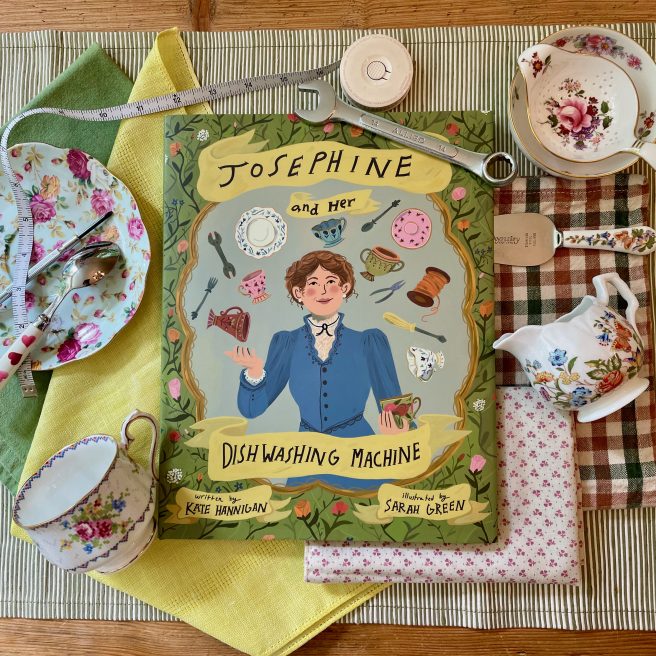
I like hearing the sudsy slosh and the jet spray during the rinse cycle. But as much as I’ve appreciated this efficient, time-saving appliance, I never really knew who invented it until I read Josephine and Her Dishwashing Machine by Kate Hannigan and Sarah Green (Calkins Creek, 2023).

In lively, rhythmic prose, Hannigan relates how Chicago socialite Josephine Garis Cochrane invented the first practical and successful hand-powered dishwasher despite societal hurdles, lack of professional training and financial hardship.

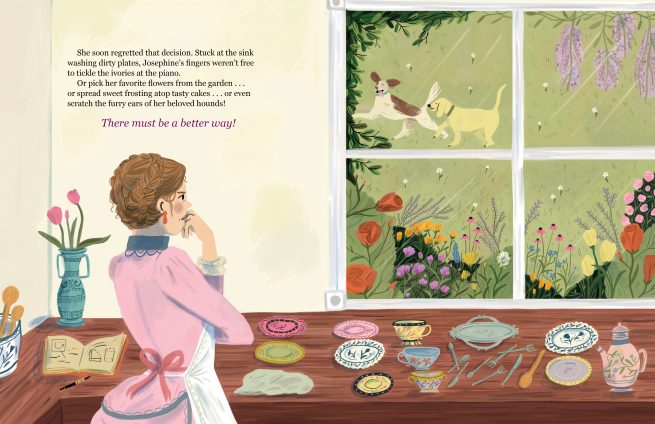
It all began one night after a dinner party when, much to her dismay, Josephine discovered cracks and chips in some of the china her household staff had washed. She then tried washing the dishes herself, but hated the laborious, never-ending drudgery that robbed her of precious time she’d rather spend doing pleasant things, like playing the piano, picking flowers, frosting cakes, or scratching “the furry ears of her beloved hounds.”

Convinced “there must be a better way,” she set about designing her own dishwashing machine. This wasn’t such a far fetched idea, as her great-grandfather, John Fitch, had secured a patent for the steamboat, and her father, John Garis, was an engineer who built bridges. This innovative spirit was also characteristic of the time period (Second Industrial Revolution), when many notable inventors were at work: Alexander Graham Bell (telephone), Margaret E. Knight (paper grocery bags), Thomas Edison (light bulb), Sarah E. Goode (convertible bed).

Continue reading