friday feast: upper crust picnic


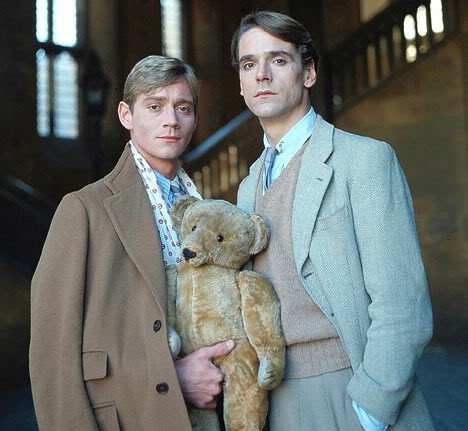
Anthony Andrews as Lord Sebastian Flyte, Jeremy Irons as Charles Ryder, and Aloysius

I’m simply over the moon that you could join me today, the last Poetry Friday of the July-August Teddy Bear and Friends Picnic. It’s the perfect time to salute Aloysius, the bear who appeared in the 1981 BBC television series, Brideshead Revisited, based on the novel by Evelyn Waugh.

As I mentioned in this post, seeing Aloysius prompted me to start collecting bears. I think it was the first time I realized that many adults still have their childhood teddies, and it’s absolutely nothing to be ashamed of!

Waugh based Aloysius on Archibald Ormsby-Gore (Archie), the real-life bear of poet, writer, and broadcaster, Sir John Betjeman, a friend at Oxford. Betjeman (tutored by C.S. Lewis), took Archie along to Oxford in the 1920’s, and died with him in his arms in 1984.

Archie has been described as being decidedly Protestant or Baptist, with strict moral codes, opposed to drinking and smoking. It’s a good thing somebear was of a responsible ilk, since Betjeman, apparently, was somewhat of a bounder.

The bear used in the series belonged to famous British teddy bear enthusiast and actor, Peter Bull, who initially named him Delicatessen. Seems Delicatessen spent his first 50 years on a grocery store shelf in Maine before its owner sent him to Bull for safekeeping. So the famous bear who starred in this very British series was an American, a 1907 Ideal Novelty & Toy Co. bear, to be precise, who changed his name to Aloysius, garnered international fame, and now resides in a museum near Oxford.

All this talk of England makes me want to watch the series, one of my all-time favorites, once again. I remember visiting Oxford in the late 70’s; the dreamy spires were magnificent, and just breathing the air made me feel smarter. In the world of Brideshead Revisited, the idle rich seem unhappily thwarted by Catholic guilt, and there is Aloysius, a symbol of Lord Sebastian Flyte’s refusal to grow up.

In the opening scene, Sebastian invites Charles Ryder to lunch in his rooms at Christ Church College (YouTube version here). There is lots of champagne, plover eggs in a mossy nest, and lobster thermidor. At one point, one of Sebastian’s guests, Anthony Blanche, recites from T.S.Eliot’s The Waste Land (thought to be shocking at the time) through a megaphone. This is based on a true incident enacted by future art critic Harold Acton, who wished to “excite rage in the hearts of Philistines.”

Exploring hands encounter no defence;
His vanity requires no response,
And makes a welcome of indifference.
(And I Tiresias have foresuffered all
Enacted on this same divan or bed;
I who have sat by Thebes below the wall
And walked among the lowest of the dead.)

*Fans self*

Today, let’s celebrate innocence in the midst of decadence. Just for you, I’m pulling out all the stops — lobster rolls, champagne, and John Betjeman’s poem about his beloved Archie.


Here’s to poetry, friends, good health and good writing!
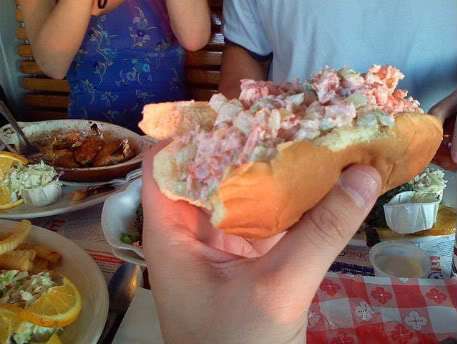

Doesn’t this look scrumptious? Great recipe here.

Nothing left to do now, but close your eyes and think of England. Pip pip!

(Sorry, my plover wouldn’t lay for me.)


ARCHIBALD
by John Betjeman

The bear that sits above my bed
A doleful bear he is to see;
From out his drooping pear-shaped head
His woollen eyes look into me.
He has no mouth, but seems to say:
‘They’ll burn you on the Judgement Day.’

Those woollen eyes, the things they’ve seen
Those flannel ears, the things they’ve heard —
Among horse-chestnut fans of green,
The fluting of an April bird,
And quarrelling downstairs until
Doors slammed at Thirty One West Hill.

(Rest is here, scroll down for poem.)


Let’s hear it for teddies!!        

Bearly believable Poetry Friday Roundup can be found at Big A little a.

**Bonus video: Sebastian and Charles here, with great shots of Aloysius. How wonderful to drift down the river with a picnic lunch and champagne!

Lobster Roll photo posted in accordance with Creative Commons Attribution 3.0 License.
an old bear to love


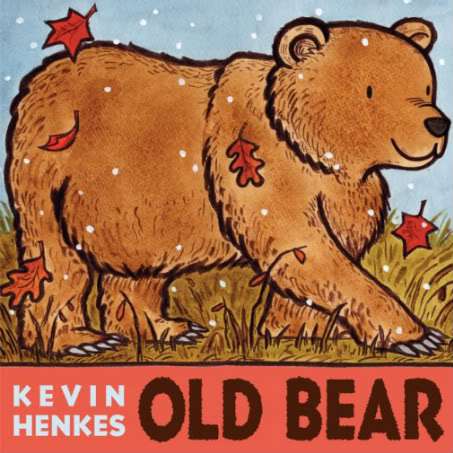
 OLD BEAR by Kevin Henkes (Greenwillow, 2008), ages 2-7, 32 pp.
Available: August 19, 2008

Look what’s coming out next week!

Another masterpiece by Kevin Henkes.

When I first saw the cover, I could feel the wonder. The bold outline, just the right shade of tawny cinnamon, the bear’s rounded face and snout, his warmth and gentle demeanor, and the title – drawn in letters with furry edges.

I knew I would love it before I even opened it.

Maybe it’s because, even after 30-something books, Kevin Henkes has never disappointed. He just keeps getting better. How is that possible?


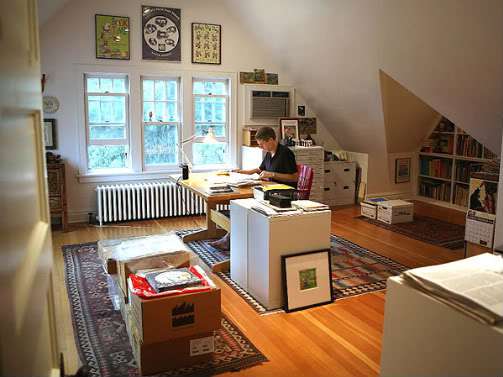
Kevin Henkes in his Madison, Wisconsin, studio, by Joe Koshollek (photo source)

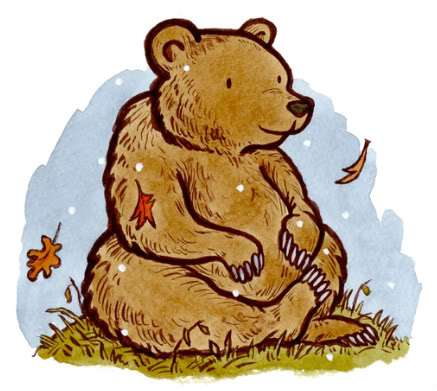
In this breathtakingly gorgeous book, it is snowing heavily, and Old Bear is fast asleep, dreaming of becoming a cub again outside in the world he loves. When we first see him, he’s all snug and cozy, inside an ink and watercolour illustration framed by thick, bold lines. His dream turns to spring, with a full-bleed double page spread in vivid pinks and lilacs. “The flowers were as big as trees. He took a nap in a giant pink crocus.” The little curled up ursine is so endearing!

Then he dreams of summer, wandering green hillsides: “the sun was a daisy and the leaves were butterflies.” In one of the most joyous, perfectly child-centric drawings I’ve ever seen, the cub is catching blueberries on his tongue, because they are raining from the clouds!

So magical!

Then it’s autumn, and “everything was yellow and orange and brown, even the birds and the fish and the water.” The cub is up a tree, while the world is teeming with the vibrancy of rust-colored fish and birds.

When it’s winter, the cub sits gazing at a world covered with snow and ice. It’s radiantly cool and brilliant, with a sky that is “blazing with stars of all colors.”

Finally, when Old Bear wakes up, he ventures out into a refreshing spring day, and it’s so beautiful that he has to make sure he’s not still dreaming.

Just as he did in A Good Day (Greenwillow, 2007), Henkes has created a deceptively simple storyline. The understated, lyrical language sets the stage for the dramatic double page spreads depicting each of the four seasons. Each page turn will surely prompt a Wow response, or at the very least, an excited, Oh!, followed by lots of sighing. It’s the perfect example of how the right combination of color and contrast can embody strong emotion.

What else did I like? The front cover of the book is autumn, the back is spring. The front endpapers are chestnut-colored autumn leaves, and the back endpapers are lavendar flowers. The title on the cover is embossed, and the typeface is remniscent of some of my favorite childhood books illustrated by Garth Williams. The words change color, too, with the seasons. Every detail is pitch perfect. But then, it’s Kevin Henkes.

Old Bear, which earned a starred review from Publishers Weekly, will be loved by children ages 2-7, and will lend itself nicely to classroom units about nature, colors, animals, and the four seasons. See the HarperCollins activity guide here.


 **Interior spread posted by permission, copyright © 2008 Kevin Henkes, published by Greenwillow/HarperCollins, All rights reserved.

many happy returns for the birthday boys!

Today we are celebrating a double birthday here at alphabet soup!

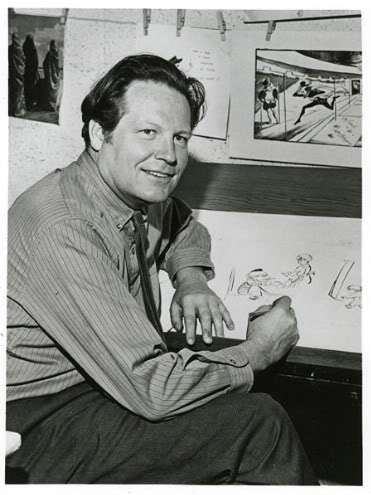
You may already know that Corduroy, the bear in search of a button and a friend, is 40 years old this year. But did you know that Corduroy’s creator, Don Freeman, was born exactly one hundred years ago today? That’s right: August 11, 1908.

Corduroy is certainly one of the most beloved bears in children’s literature, along with Paddington and Pooh. Even though there are only two picture books about him, he has managed to stand out among the plethora of other bear books published through the years.

His enduring charm for young readers exemplifies what Don Freeman defined as the essence of a good children’s story: simplicity without simple mindedness. This is a story about belonging, being loved for who you are, and friendship. What could be more important than that? And it’s told without a hint of didacticism, condescension, or sentimentality.

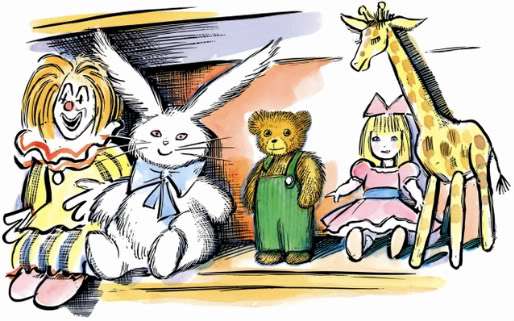
“Corduroy is a bear who once lived in the toy department of a big store. Day after day he waited with all the other animals and dolls for somebody to come along and take him home.”

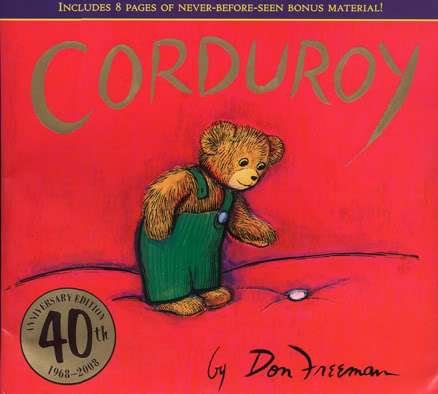
This past spring, Viking released a special 40th Anniversary Edition of this classic with extra-large trim size, embossed cover, and 8 pages of never-before-seen bonus material. It’s a beauty of a book, and a must-have for any diehard Corduroy fan.

Since Corduroywas first published when I was in high school (1968), I didn’t meet him until I began writing children’s stories and collecting bears in the 80’s. And I didn’t know much about Don Freeman until this year. What a fascinating life!

Originally from San Diego, Freeman moved to NYC in 1928 to study art at the Students Art League with John Sloan. He was fascinated by the theatre, and filled many sketchbooks with what he observed backstage on Broadway and all over the city. He supported himself by playing cornet in jazz and dance bands.

One night, while riding on the subway, he became so preoccupied with his sketching that he forgot his cornet on the train. After that, he decided to focus solely on his art. He was supposedly a gregarious sort, with lots of friends, including Louis Armstrong and William Saroyan.

He came to children’s books quite casually, co-authoring stories with his wife, Lydia. One of these early books was called Corduroy the Inferior Decorator (as yet, still unpublished), featuring a boy who drove his parents crazy by painting on the walls of their apartment. The name, “Corduroy,” was Don’s pet name for his son, Roy, who always wore corduroy overalls.

Years after Corduroy was published, Don wrote Linda Zuckerman, his editor when the book was released, explaining how he got the idea:

Of course I can’t remember exactly how it started, but I do recall wanting to do a story about a department store in which a character wanders around at night after the doors close. Then I also wanted to show the vast difference between the luxury of a department store and the simple life most people live. The idea of simple basic values was another theme that was running around in the back of my head . . .

Viking first rejected Corduroy, so Freeman submitted it to other publishers. They rejected it as well, but he believed in the story so strongly that he decided to resubmit it to Viking, who finally decided to take a chance on it.

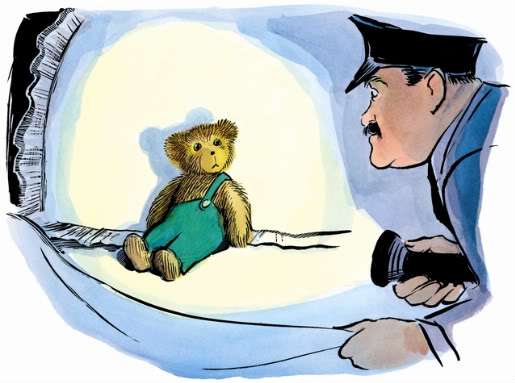
“Hello,” he said. “How did you get upstairs?”

The 40th Anniversary Edition contains correspondence between Freeman and his acquiring editor, Annis Duff, an early draft of the manuscript with Duff’s editorial notes, newspaper clippings on Freeman’s death, and several sketches alongside final illos. Great stuff for those who love process, history, and anecdotes.

I could not find any evidence of whether Freeman modeled Corduroy after a real teddy bear. But I do know that Freeman’s rendering manages to touch that hopeful, accepting, innocent child’s heart in all of us. Such a small bear in a huge department store! Nobody wanted him because he wasn’t perfect. How good we feel when Lisa finally takes him home.

Sadly, Freeman died of a heart attack just before the sequel, A Pocket for Corduroy, was published in 1978. I wonder if he had any idea how many millions of children would continue to take his loveable bear home after that.

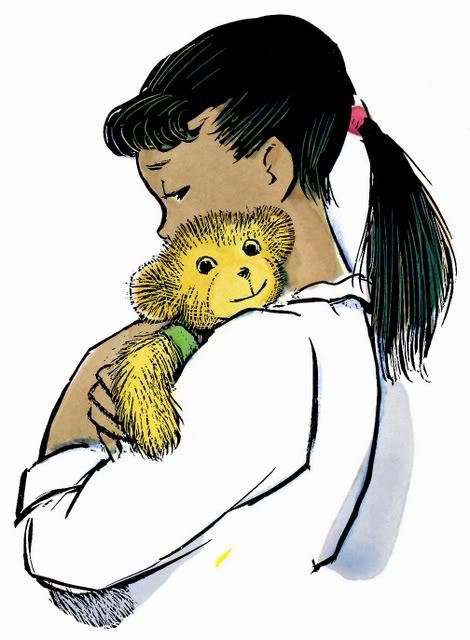
     “You must be a friend,” said Corduroy. “I’ve always wanted a friend.”
“Me too!” said Lisa, and gave him a big hug.”

Happy Birthday, Don and Corduroy!!

Don Freeman’s Official Website is here.

For a reading of the story, click here.

**All interior spreads posted by permission, copyright © 2008, The Viking Press, All rights reserved.

Photo of Don Freeman used in accordance with Creative Commons 3.0 Unported License.


vote for your favorite bear!

If you don’t have an LJ account, please vote in the comments. Would also love to hear why, too! Thanks :)!!


this porridge will never be just right!

 
                                               Charles Robinson, 1911

Just in time for the picnic, both Barbara O’Connor and Tadmack have posted this fictional editorial letter to the author of Goldilocks and the Three Bears. It’s here, under the cut, for your amusement (original source of letter is unknown). You must read it, especially if you need cheering up today.

Dear Writer:

1) Why is the Mama Bear’s porridge too cold when the Papa Bear’s porridge is too hot? Didn’t they come out of the same cooking pot? Perhaps incorporate a description of the bowls in question, showing that Papa Bear’s bowl exposes less surface area so that the porridge is unable to cool. Is there a science lesson to be taught here? (Mama Bear’s bowl must be wide and shallow; etc.) Or perhaps Mama Bear’s bowl is made of thin porcelain, and Papa Bear’s bowl is made of earthenware? Please insert some text explaining this to our readers.

2) What is Goldilocks’ motivation for tasting and eating the porridge? Has she perhaps traveled a long distance through the woods? Is she hungry at home? A paragraph or two about what attracts her to the porridge (which may be unknown or unappealing to today’s children) may help us “get into her skin”.

3) The porridge section of the story seems comparatively static and goes on too long. Try to shorten it, so that we can get on to the more exciting “chair and bedroom” scenes, which deliver more emotional punch to the reader.

4) Is the child’s hair color significant? You allude to it in the opening paragraph, and then we don’t hear about it any more. We need more mentions of the child’s hair and its importance in the story.

5) Is it likely that Papa Bear would notice that the cushions of his chair are wrinkled before all three bears notice that Baby Bear’s chair lies in splinters? Reorder for better flow/avoid confusion.

6) Goldilocks’ pronouncements of “just right” seem predictable by the time she gets to the bedroom. Perhaps we could have a surprise in this scene–perhaps Mama Bear’s bed is the most comfortable! Or, alternatively, Goldilocks could start with the Baby Bear’s bed and progress to Papa Bear’s bed, carrying out the theme of her insatiable desire to “crib” what belongs to another.

7) Goldilocks’ reaction to the bears at the end of the story seems overwrought. Why does she flee from the house? Traditionally bears are considered dangerous, but the bears in this story have many human characteristics. They are vegetarians (as testified to by the porridge) and their house is furnished with chairs, beds, et cetera. In view of this, Goldilocks’ flight makes her seem wimpy and old fashioned. Today’s children will be more attracted to a spunky, feisty Goldilocks. Please tweak the ending a little!

Yesterday, I read Robert Southey’s, The Story of the Three Bears (1837), the most influential version of the tale, though not the earliest recorded one. It’s written in prose and part of a collection of essays called, “The Doctor.”  

Surprising things I discovered:

the bears are all male, not a family unit,

    
                             Leslie Brook, 1905

the intruder, unnamed, is not a young girl, but an old woman,

        
                           Peter Newell, 1907

and the old woman is repeatedly chastised by the narrator, described as “naughty,” “impudent,” “bad,” with an “ugly, dirty head.”

Twelve years later, Joseph Cundall changed the old woman to a girl, because he felt there were already too many old ladies in stories. He named her “Silver Hair,” (Treasury of Pleasure Books for Young Children, 1849). Other versions soon followed, with the girl called “Silver Locks” and “Golden Hair,” until she was finally deemed “Goldilocks,” in Old Nursery Stories and Rhymes, illustrated by John Hassall in 1904.

      
                       Jessie Wilcox Smith, 1911

I’m wondering:

Why older women were so frequently portrayed in a negative light in fairy and folk tales. Consider the preponderance of witches, bitches, hags, shrews, evil queens, vixens, stepmothers, and the above-mentioned interloper. 

Why young girls were so often used to teach moral lessons.

Why Baby Bear is almost always male, garnering the most sympathy from the reader.

Still, I’m happy with how the bears were portrayed, right from the beginning. Whether all males or a family unit, clothed or unclothed, they were the model of good behavior — civilized, trusting, even sympathetic and forgiving. That’s good, because there are more humanized bears appearing in children’s stories than any other animal. 

Here are my 3 favorite versions of Goldilocks and the Three Bears, out of the zillions available:

Goldilocks and the Three Bears, retold by Jim Aylesworth, pictures by Barbara McClintock (Scholastic Press, 2003). Traditional retelling with charmingly detailed illustrations rendered in ink, watercolour and gouache.

Goldilocks and the Three Bears, retold and illustrated by James Marshall (Dial, 1988). A Newbery Honor book, tongue-in-cheek version, with Goldie depicted as a deliciously naughty minx.

Goldie and the Three Bears, by Diane Stanley (HarperCollins, 2003). An original modernized take on the classic, with a more sympathetic Goldie and a new ending, which finally absolves Goldie of her longstanding cowardice.

Oh, Christopher says it’s time for breakfast. 


Off to make some porridge.

   
                    Warning: Do not leave your bowl unattended.

Visit surlalunefairytales.com for more history, annotations, wonderful old illustrations, and modern interpretations of the tale. 

Here’s an animated Three Bears to delight the child within.

See all the Teddy Bear and Friends Picnic posts here.