remember: only you can prevent wildfires!

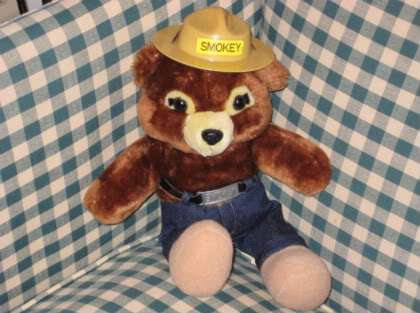
Everyone, welcome our special picnic guest for today, Smokey Bear!

This tireless ursine has been working steadily since 1944, raising public awareness to protect the nation’s forests. He especially wanted to be here today, after we received a letter from my penpal, Jean, who lives in Santa Cruz, California.

Apparently there are 1700 fires burning in California right now — two of them within a 20-mile radius of Jean’s home. They have been on mandatory water rationing for the last 3 years, while experiencing their 6th year of drought. The fire department simply does not have the men, equipment, or the water, to fight all these fires, and it’s still early in the season. Jean lives with constant smoke and has to wash the ash from her garden lettuce. Every day she thinks: “I sure hope we survive this.”

Though extremely arid conditions, lightning, and changing weather patterns may contribute to wildfires, nine out of ten are caused by humans. That’s why continuing efforts to educate Americans about safe practices indoors and outdoors is critical. Smokey Bear is the longest running public service ad campaign in American history, and it has reduced the number of acres lost to fires annually from 22 million to 4 million.
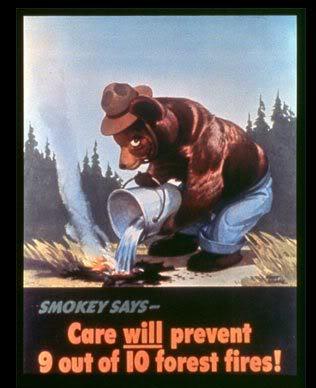
 

Smokey’s 1944 debut poster, illustrated by Albert Staehle


Am I saying his name wrong? Not now, but I had been my entire life! The official name for the mascot was and always has been “Smokey Bear.” But in 1952, the writing team of Steve Nelson and Jack Rollins wrote a song about Smokey, and added “the” to keep the song’s rhythm. Confusion has reigned ever since.

Did you know there was a living symbol of Smokey? Back in 1950, a black bear cub was rescued from a raging fire in the Capitan Mountains of New Mexico, which destroyed 17,000 acres. The cub was originally called Hotfoot Teddy (his paws and hind legs were burned), but he was later renamed after the mascot. He lived at the National Zoo in Washington, D.C., for 26 years, and is now buried at the Smokey Bear Historical Park.
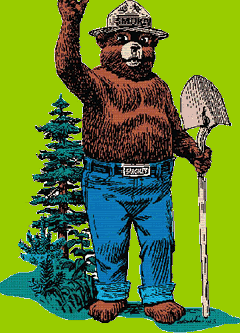
Ever since the public found out about the real-life Smokey, the character has been a big part of American pop culture. He has appeared in cartoons, comic strips, and books, and has been on the radio and TV for the Ad Council. In 1994, Smokey was honored with his own postage stamp, and today he even has his own zip code: 20252. The best part of Smokey merchandising is that because of the Smokey Bear Act of 1952, all royalties go to continuing education on forest fire prevention.

On August 9th, Smokey Bear will be 64 years old. His original slogan, “Only You Can Prevent Forest Fires,” was changed in 2001 to “Only You Can Prevent Wildfires.” Visit his website to learn more about fire safety, take the Smokey pledge, or use Google Earth to see the wildfires burning today. There is also a wonderful example of one of Smokey’s television ads, circa 1960’s, here. To share Smokey’s story with children, check out this book:
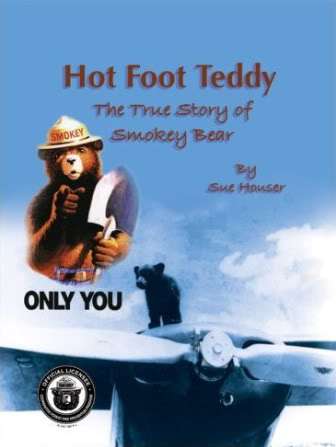
  HOT FOOT TEDDY: THE TRUE STORY OF SMOKEY BEAR
by Sue Houser (M.T. Publishing, 2007), all ages, 40 pp.

 (Portion of the proceeds benefits Smokey Bear Forest Fire Prevention Program)

Hopeful thoughts, prayers and hugs to you, Jean, and all those currently being threatened by wildfires. And thanks, Smokey, for continuing to be a strong and powerful presence in public service advertising!

SMOKEY’S CONSERVATION PLEDGE:

I give my pledge as an American to save and faithfully to defend from waste the natural resources of my country — its soil and minerals, in forests, waters and wildlife.

bears repeating


Here are some random tidbits for your picnic basket:

First, thank you thank you thank you to Tarie of Into the Wardrobe for awarding alphabet soup a 2008 Brilliante Weblog Premio! I am humbled and honored to be mentioned in the same list as Just One More Book, Brooklyn Arden, and Bloomabilities.

Have you read Marjorie Coughlan’s fabulous interview with Jen Robinson over at papertigers.org? Lots of insight and inspiration, with Jen explaining why books, reading, and literacy mean so much to her and what she hopes to accomplish with her fabulous blog, Jen Robinson’s Book Page. I am totally blown away by her commitment and dedication.
Make sure to read this post about writing YA by TadMack at Finding Wonderland. You probably know there is a lot of discussion going on in the kidlit blogosphere right now about the stigma YA literature seems to carry in the publishing world. Many bloggers are responding to a recent New York Times article by Margo Rabb, "I’m Y.A., and I’m O.K.," including LJ’s Little Willow and David Lubar.

Colleen Mondor is rounding up other reactions and opinions at Chasing Ray. She has also designated this week as a time for everyone to post about any issues or concerns they have about children’s and young adult publishing, so check back every day for updates.

Interesting discussion about verse novels in the comments of this recent Poetry Friday post by Sara Lewis Holmes (Read*Write*Believe). I especially liked David Elzey’s comment, written from the POV of a 13-year-old boy. 

Have a great week!


thursday smackerel: Pooh’s Honey Spice Cake

“‘What do you like doing best in the world, Pooh?’

‘Well,’ said Pooh, ‘what I like best . . . ‘ and then he had to stop and think. Because although Eating Honey was a very good thing to do, there was a moment just before you began to eat it which was better than when you were, but he didn’t know what it was called.” ~ from The House at Pooh Corner, by A.A. Milne


Even though the work week is almost over, right about now you may have a little sinking feeling.

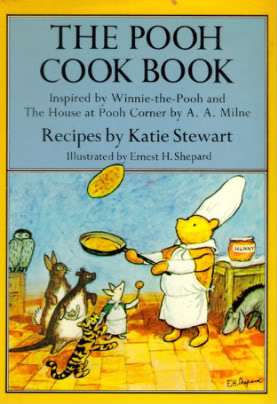
Not to worry, we’ve got just the thing, courtesy of our friend Pooh — Honey Spice Cake, from his very own cook book!

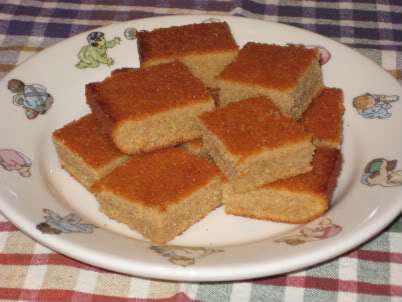
Quick and easy to prepare, perfect for elevenses, afternoon tea, dessert, and of course, picnics, this little treat is sure to please. Just don’t forget to share.

HONEY SPICE CAKE
(makes 24 squares)


7 oz. (or 7 rounded tablespoons) self rising flour
1 level tsp mixed spice (I used pumpkin pie spice)
1/2 level tsp ground ginger
1/2 level tsp ground cinnamon
5 oz. butter
4 oz. (or 4 rounded tablespoons) soft brown sugar
6 oz. (or 3 rounded tablespoons) honey
2 eggs
1 T water

Preheat oven to 350 degrees F.

Sift together the flour, mixed spice, ginger and cinnamon on to a square of greaseproof paper or foil and set aside.

Measure the butter or margarine, and the sugar, honey, and water into a saucepan. Place the pan over a low heat and stir with a wooden spoon until the fat has melted. Do not allow to boil. Draw the pan off the heat and allow to cool for about ten minutes.

Using a wooden spoon, beat the eggs into the honey mixture one at a time. Tip in the flour mixture all at once. Stir until it has blended and beat thoroughly.

Pour into the prepared cake tin (7″ x 11″ x1″, greased and lined with parchment paper), and spread evenly. Place in the centre of the preheated oven and bake for 30-35 minutes or until the cake is well risen.

Remove the cake from the oven using oven gloves. Loosen the sides of the cake with a knife and turn out. Allow to cool and then cut in squares.

~ Adapted from The Pooh Cook Book by Katie Stewart (Methuen, 1971).


our first honored guest!


Before Paddington, there was Pooh. And before Pooh, there was Rupert!

Hats off today to Rupert Bear, one of the oldest and most enduring humanized bear characters in children’s fiction. What, you say you don’t know him? I didn’t either, until I got into bear collecting, and learned that Rupert is actually 6 years older than Pooh, and 8 years older than Mickey Mouse. This also makes him the longest running children’s comic character in history.

    
                      "Nutwood in Spring," by John Harrold

Now, if I had grown up in the UK, Rupert would have been a household name. He was created by children’s book illustrator Mary Tourtel, and first appeared in a Daily Express comic strip in 1920. Mary’s husband, a night editor for the Express, wrote the captions for Mary’s pictures. The stories took place in the idyllic English village of Nutwood with Rupert and his friends Bill Badger, Pong Ping, Algy Pug, and Edward Trunk, among others, and included adventures with fairies, pirates, unicorns, wizards, knights, crooks, and magic carpets.


                            "Flight of the Firebird," by John Harrold

Though Mary created Rupert, we must credit Alfred Bestall (who stepped in after Mary retired), with improving the stories and plots and creating the classic Rupert story format familiar today. This enables readers of various ages to appreciate the stories on 4 levels — by following the summary headers of the strips, by reading the two line verse captions under each frame, by reading the prose narration of the story, or by simply enjoying the pictures in sequence.

      
                        "The Mysterious Garden," by John Harrold

Bestall also created additional art for the Rupert Annuals, first appearing in 1936 and continuing today. After Bestall retired at the age of 90 in 1973, several other artists have taken up the mantle, including John Harrold, whose illustrations are featured in this post. The Annuals have enabled children to fully embrace Rupert, whose stories, unlike those about Pooh, take place in a contemporary setting, complete with a cosy home and supportive parents. 

      
             Rupert Bear Annual No. 72, Egmont Books, Ltd., 2007

American children may know Rupert through his animated television series (sample Rupert cartoon here), which has aired on Nickelodeon and CBS. A new series, "Follow the Magic," features a decidedly younger Rupert, who, strangely enough, looks more like Pooh. As far as I know, this series only airs in Great Britain.

But guess who else loves Rupert? In 1984 Sir Paul McCartney and Geoff Dunbar created a short animated film called "Rupert and the Frog Song," which features Paul’s "We All Stand Together," (also included on his Pipes of Peace album). After noting that his own children loved Rupert as much as he did, Paul dug out his old Rupert Annuals and set to work. He initially wrote music for a full-length film, but plans were shelved. Still, the short film won a British Academy Award, and the video of "We All Stand Together" won a Grammy in 1986 for Best Music Video — Short Form. (Watch it here.)

Rupert will be 88 in November, and shows no signs of slowing down. With over 50 million books sold, an appearance every morning in the Daily Express, a much anticipated Annual published every year, as well as prints, videos, DVD’s, and assorted memorabilia for sale, Rupert’s longstanding, continuous appeal to young and old alike is definitely something to cheer about. Hip hip hooray!


All Rupert Bear images posted by permission, © Entertainment Rights Distribution, Ltd./Express Newspapers 2007. All rights reserved.

*The John Harrold images included in this post, as well as several others, are available as signed, limited edition glicee prints through Art of Illustration.


bearly beginning: who made the first teddy bear?


                              Roosevelt Bear bares all in his biography

Welcome to the Teddy Bear and Friends Summer Picnic!

We’re so glad you’re here. The resident bears have been practically jumping out of their fur with excitement. We’ve got lots of fun coming your way in the next several weeks — books, food, music, games, and a couple of special guests.

But first things first. We must pay homage to the man who started it all — President Teddy Roosevelt (1858-1919). You may know that in 1902 he travelled south to settle a boundary dispute between Mississippi and Louisiana. When his work was done, he decided to go bear hunting, but wasn’t successful in finding any game.

Members of his party didn’t want to disappoint him, so they chased down a stray cub, roped it and tethered it to a tree. They called the President over, but upon seeing the frightened animal, he absolutely refused to shoot it. A few days later, newspaperman Clifford Berryman drew a cartoon for The Washington Post, depicting the President’s encounter with the wild bear cub. 

This political cartoon soon appeared in newspapers all over the country, as the nation praised Roosevelt’s kindness and compassion. Morris and Rose Michtom, who owned a candy and toy shop in Brooklyn, were inspired by the cartoon to create two soft, stuffed bears, which they displayed in their shop window. They sold right away, and Morris decided to name the new toy "teddy’s bear," after obtaining the President’s permission to use his name. Michtom then founded the Ideal Toy and Novelty Co., which still exists today.

     
      The Morris Michtom Bear, a reproduction of the first bear produced by the Ideal Toy and Novelty Co., in commemoration of the teddy bear’s 100th birthday

At about the same time in Germany, Richard Steiff designed a stuffed bear based on bears he had seen at the zoo. It was displayed at the 1903 Leipzig Toy Fair, where an American buyer loved them and ordered 3,000 to be shipped back to the states. Steiff is still one of the premier bear manufacturers in the world, and all of its stuffed animals are known for their high quality, impeccable craftsmanship, and ability to retain their value on the secondary market.

             
                     Richard Steiff 1902 authentic replica

It is uncanny how teddy was born on both sides of the Atlantic at the same time, and how relatively similar the first prototypes look. Though the debate over who actually made the first teddy bear continues today, there has never been any disagreement over teddy’s popularity or the positive effect he has had on his human companions.

The Legend of the Teddy Bear by Frank Murphy, pictures by Gijsbert van Frankenhuyzen (Sleeping Bear Press, 2000), is a good introduction to teddy bear history for young readers ages 5 and up. The realistic oil paintings, rendered in earth-tones and bronzes, reflect Roosevelt’s deep love for nature while capturing the spirit of the past. Frankenhuyzen does a beautiful job of depicting Roosevelt and the Michtoms, and his stuffed bears appear warm and huggable without being overly cute. There is no mention of Richard Steiff in this book, as it is a work of historical fiction that solely traces the teddy bear’s American origin. 

      
        The Legend of the Teddy Bear by Frank Murphy,
        pictures by Gijsbert van Frankenhuyzen (Sleeping Bear Press, 2000), 
        ages 5+, 32 pp.

But where are my manners? I’ve been talking all this time and haven’t even offered you something to eat. What’s a picnic without food? Please have a bite, and see you next time!