This October marks 50 years since A Bear Called Paddington, by Michael Bond, was first published by William Collins & Sons in 1958. Paddington has certainly done well for himself since then, with a total of 70 titles translated into 40 languages, and over 35 million books sold. Not bad for a little stowaway from Darkest Peru.
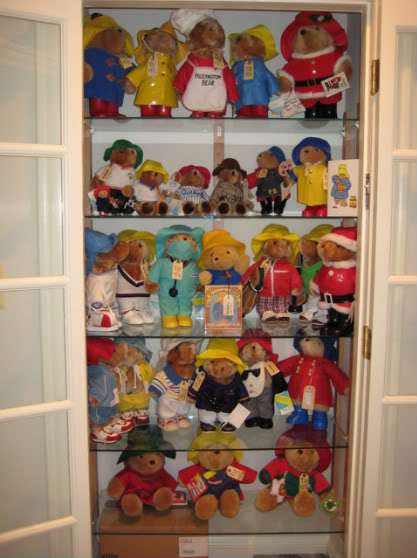
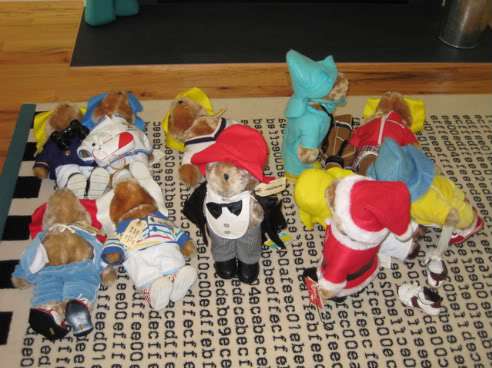
The 28 resident Paddingtons have been gearing up for this birthday celebration for quite some time, but I must report yet another fiasco that could have very well pooped this party for good.
Everything was going swimmingly the past two months until I posted the “Vote for Your Favorite Bear Poll.” We assumed it would be a face-off between Paddington and Pooh, but as it turns out, Pooh won by a mile, and only ONE PERSON voted for Paddington.
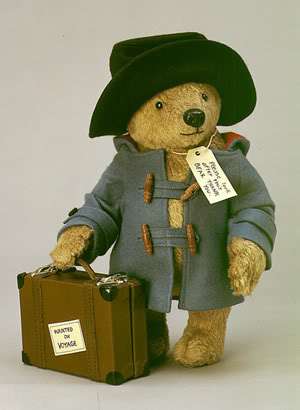
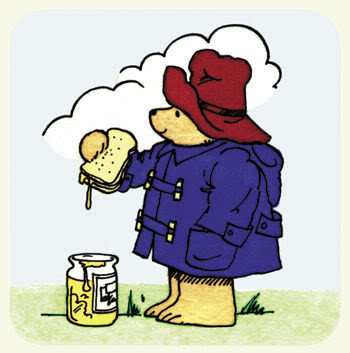
“Paddington Bear” by R. John Wright (2000)
Now, if it had been a close race, the Paddingtons would have accepted defeat gracefully, knowing full well the power of the Disney Machine. They would have had an extra marmalade sandwich and cup of cocoa, and that would have been that.
But only one vote?
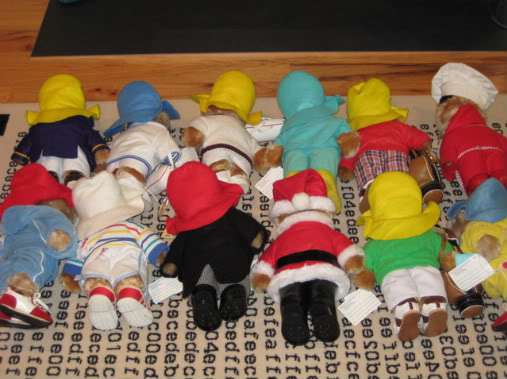
The resident Paddingtons were crushed to smithereens. They prostrated themselves with grief:
*Hard stare now emanating from your computer screen*
Friends, they will not be consoled. The only remedy I can think of is to tell you about two books published especially for their 50th Anniversary, and to sing Paddington’s praises in my loudest voice. Very easy to do, since he’s my personal favorite!
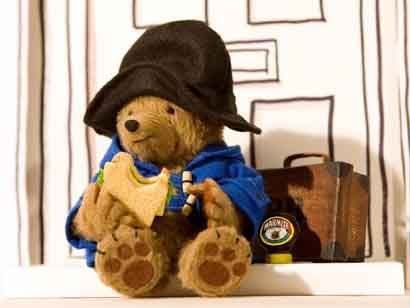
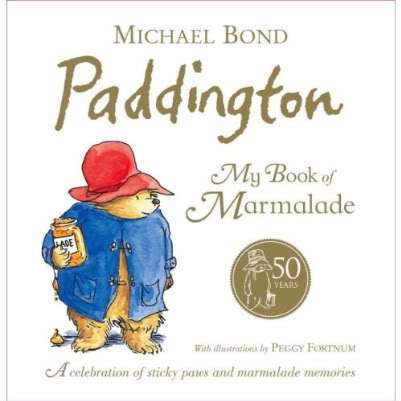
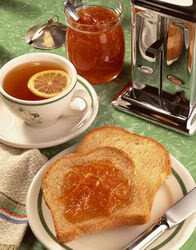
First, there’s an adorable mini book about Paddington’s favorite food, called My Book of Marmalade (HarperCollins, 2008). Marmalade is what sustained our bear on his long voyage from Darkest Peru to Paddington Station in London. He made the jar Aunt Lucy gave him last the entire trip, thanks to a skill he learned as a cub: eking. This is the fine art of making a chunk last for several days (easiest for those without functioning teeth). As you may know, Paddington is never without a marmalade sandwich tucked under his hat for emergencies. Some of these have been known to remain there for weeks.
Stickiness is part of his charm, and Mrs. Bird, the housekeeper, loves him all the more for it. In this book, Mrs. Bird shares her special recipe for marmalade, with a few suggestions for other uses. There’s also “Marmalade: A Potted History,” “Marmalade Dos and Don’ts,” “Marmalade Facts,” “How to Remove Marmalade Stains,” and the thoroughly engaging “Marmalade Memories.” Peggy Fortnum’s pen-and-ink drawings decorate the book throughout, on orange and white pages complete with orange paw prints. This is a great gift book for all ages, and a must-have for diehard fans.
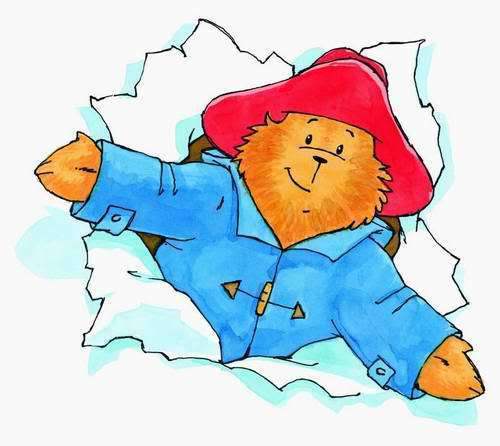
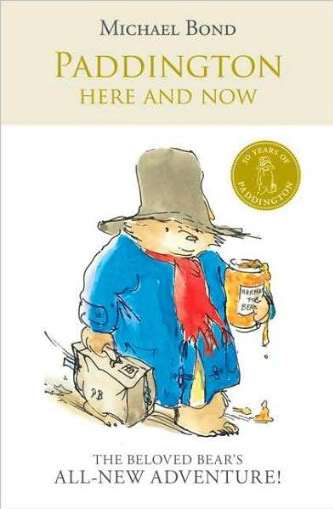
Paddington Here and Now (HarperCollins, 2008), is the 12th in Michael Bond’s chapter book series, the first installment in 30 years. Has Michael Bond lost his touch? Not a chunk! All the familiar and cherished elements remain: elevenses with Mr. Gruber at his antiques shop in Portobello Road; Mr. Curry, the grumpy next door neighbor; the Browns — patient, protective, and ever amazed by their resident bear; and Mrs. Bird, the stern housekeeper with a heart of gold.
Paddington, of course, has seven new adventures, the kind only he can have (he’s famous for saying,”Things just happen to me. I’m that sort of bear”) — such as painting Mr. Curry’s front gate with non-drying, anti-burglar paint, having his shopping cart towed away, being interrogated about his immigration status, and trying to pay for a first class vacation for seven using one air mile. You have to love his resourcefulness, ingenuity and unending desire to do his very best no matter the task at hand.
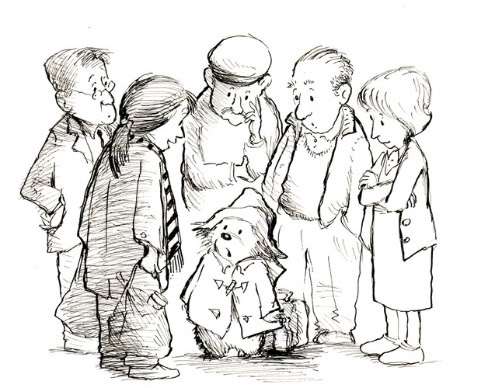
One of R.W. Alley’s illustrations from PADDINGTON HERE AND NOW
Moreover, Mr. Bond (who received an OBE for his contribution to children’s literature), has skillfully managed to give this book a contemporary feel. There is mention of stir fry, air miles, the London Eye, and Paddington’s encounter with an undercover reporter while working in the garden. Ever so polite, Paddington answers all questions posed by this annoying, intrusive man, who like some journalists, hears what he wants to hear in order to write a sensationalized story (echoes of the National Enquirer here). It is clear that Paddington, despite his naivete, has the upper hand with his arsenal of hard stares, British wit, and perfect comic timing.
These “assaults” of the modern world blend perfectly with the timeless elements prevalent in the series, such as the issue of immigration. Paddington’s tenuous stowaway status brings out the protective nature in all of us (who could resist a tag that says, “Please look after this bear. Thank you”), and it certainly resonates with anyone trying to find a home in a strange, foreign country.
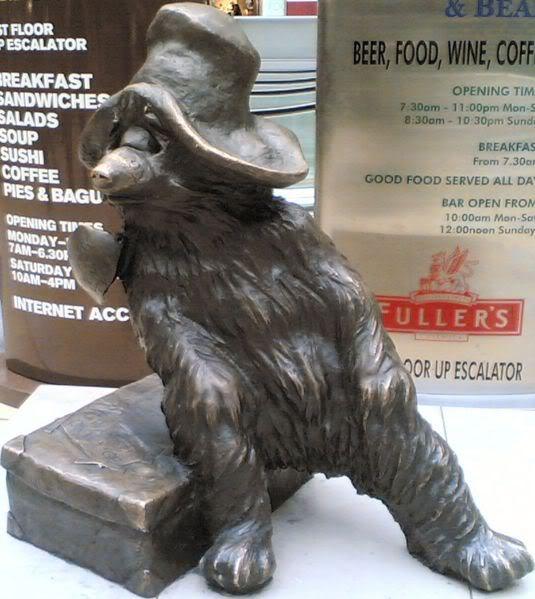
Bronze statue at Paddington Station, London, England
One of the main reasons Paddington appeals to me so much is that at no time in any of the books, does anyone ever question either the appropriateness or outrageousness of adopting a live bear. It is universally acknowledged, in a matter-of-fact manner, that Paddington is real and he’s accepted by the Browns without prejudgment. He’s often referred to as a “gentleman bear,” and his behavior and intentions are exemplary, even as his actions wreak havoc. Here and Now contains deliciously detailed pen-and-ink drawings by R.W. Alley (interview here).
Let’s see if they’re feeling better now:
Some seem to be rallying. Their full recovery from this devastating blow is now entirely up to you. If your only exposure to Paddington has been limited to a few of his picture books, or seeing his likeness on a sippy cup, and you haven’t actually read the original chapter book series or shared it with your children, make it a priority! There’s definitely more to Paddington than meets the eye. And don’t forget the marmalade!
Fabulous article/interview with Michael Bond at the TimesOnline. Did you know he wrote the first Paddington novel in just ten days? And that the character of Paddington was based on his father? Or that he was thinking of the child refugees in wartime Britain and Europe when creating Paddington?
Read about the Marmalade Festival held in the Lake District every year (lovely photos).
COOL FACTOID: A Paddington soft toy was the first object passed through by English tunnellers to their French counterparts when both sides of the Channel Tunnel (Chunnel) were joined together. My husband Len, the civil engineer, served as consultant on this project!
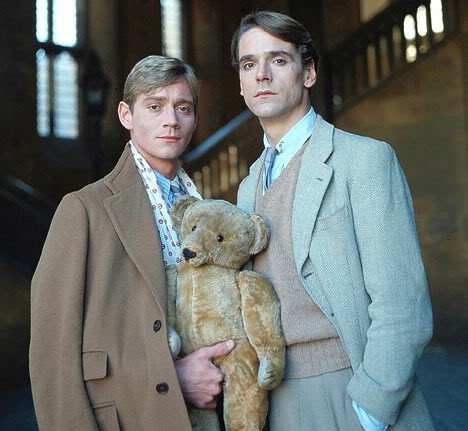
Anthony Andrews as Lord Sebastian Flyte, Jeremy Irons as Charles Ryder, and Aloysius
I’m simply over the moon that you could join me today, the last Poetry Friday of the July-August Teddy Bear and Friends Picnic. It’s the perfect time to salute Aloysius, the bear who appeared in the 1981 BBC television series, Brideshead Revisited, based on the novel by Evelyn Waugh.
As I mentioned in this post, seeing Aloysius prompted me to start collecting bears. I think it was the first time I realized that many adults still have their childhood teddies, and it’s absolutely nothing to be ashamed of!
Waugh based Aloysius on Archibald Ormsby-Gore (Archie), the real-life bear of poet, writer, and broadcaster, Sir John Betjeman, a friend at Oxford. Betjeman (tutored by C.S. Lewis), took Archie along to Oxford in the 1920’s, and died with him in his arms in 1984.
Archie has been described as being decidedly Protestant or Baptist, with strict moral codes, opposed to drinking and smoking. It’s a good thing somebear was of a responsible ilk, since Betjeman, apparently, was somewhat of a bounder.
The bear used in the series belonged to famous British teddy bear enthusiast and actor, Peter Bull, who initially named him Delicatessen. Seems Delicatessen spent his first 50 years on a grocery store shelf in Maine before its owner sent him to Bull for safekeeping. So the famous bear who starred in this very British series was an American, a 1907 Ideal Novelty & Toy Co. bear, to be precise, who changed his name to Aloysius, garnered international fame, and now resides in a museum near Oxford.
All this talk of England makes me want to watch the series, one of my all-time favorites, once again. I remember visiting Oxford in the late 70’s; the dreamy spires were magnificent, and just breathing the air made me feel smarter. In the world of Brideshead Revisited, the idle rich seem unhappily thwarted by Catholic guilt, and there is Aloysius, a symbol of Lord Sebastian Flyte’s refusal to grow up.
In the opening scene, Sebastian invites Charles Ryder to lunch in his rooms at Christ Church College (YouTube version here). There is lots of champagne, plover eggs in a mossy nest, and lobster thermidor. At one point, one of Sebastian’s guests, Anthony Blanche, recites from T.S.Eliot’s The Waste Land (thought to be shocking at the time) through a megaphone. This is based on a true incident enacted by future art critic Harold Acton, who wished to “excite rage in the hearts of Philistines.”
Exploring hands encounter no defence;
His vanity requires no response,
And makes a welcome of indifference.
(And I Tiresias have foresuffered all
Enacted on this same divan or bed;
I who have sat by Thebes below the wall
And walked among the lowest of the dead.)
*Fans self*
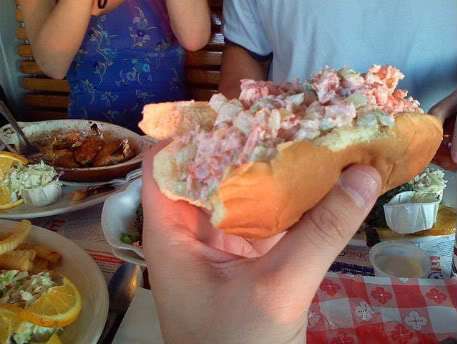
Today, let’s celebrate innocence in the midst of decadence. Just for you, I’m pulling out all the stops — lobster rolls, champagne, and John Betjeman’s poem about his beloved Archie.
Here’s to poetry, friends, good health and good writing!
Nothing left to do now, but close your eyes and think of England. Pip pip!
(Sorry, my plover wouldn’t lay for me.)
ARCHIBALD
by John Betjeman
The bear that sits above my bed
A doleful bear he is to see;
From out his drooping pear-shaped head
His woollen eyes look into me.
He has no mouth, but seems to say:
‘They’ll burn you on the Judgement Day.’
Those woollen eyes, the things they’ve seen
Those flannel ears, the things they’ve heard —
Among horse-chestnut fans of green,
The fluting of an April bird,
And quarrelling downstairs until
Doors slammed at Thirty One West Hill.
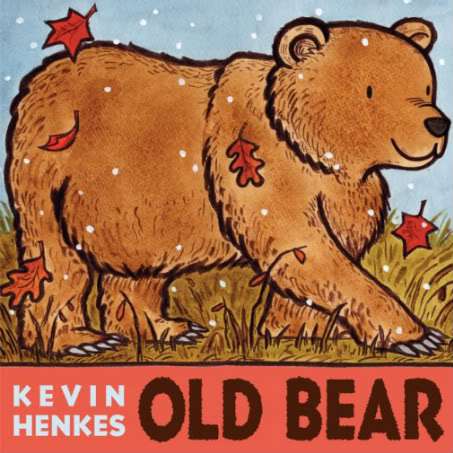
OLD BEAR by Kevin Henkes (Greenwillow, 2008), ages 2-7, 32 pp.
Available: August 19, 2008
Look what’s coming out next week!
Another masterpiece by Kevin Henkes.
When I first saw the cover, I could feel the wonder. The bold outline, just the right shade of tawny cinnamon, the bear’s rounded face and snout, his warmth and gentle demeanor, and the title – drawn in letters with furry edges.
I knew I would love it before I even opened it.
Maybe it’s because, even after 30-something books, Kevin Henkes has never disappointed. He just keeps getting better. How is that possible?
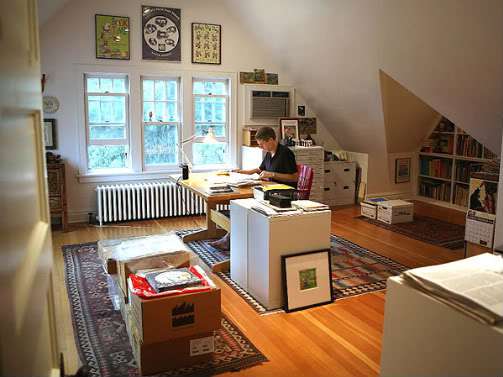
Kevin Henkes in his Madison, Wisconsin, studio, by Joe Koshollek (photo source)
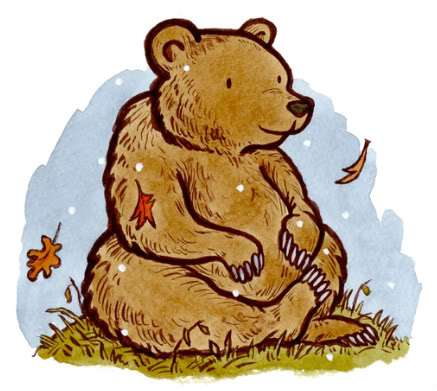
In this breathtakingly gorgeous book, it is snowing heavily, and Old Bear is fast asleep, dreaming of becoming a cub again outside in the world he loves. When we first see him, he’s all snug and cozy, inside an ink and watercolour illustration framed by thick, bold lines. His dream turns to spring, with a full-bleed double page spread in vivid pinks and lilacs. “The flowers were as big as trees. He took a nap in a giant pink crocus.” The little curled up ursine is so endearing!
Then he dreams of summer, wandering green hillsides: “the sun was a daisy and the leaves were butterflies.” In one of the most joyous, perfectly child-centric drawings I’ve ever seen, the cub is catching blueberries on his tongue, because they are raining from the clouds!
So magical!
Then it’s autumn, and “everything was yellow and orange and brown, even the birds and the fish and the water.” The cub is up a tree, while the world is teeming with the vibrancy of rust-colored fish and birds.
When it’s winter, the cub sits gazing at a world covered with snow and ice. It’s radiantly cool and brilliant, with a sky that is “blazing with stars of all colors.”
Finally, when Old Bear wakes up, he ventures out into a refreshing spring day, and it’s so beautiful that he has to make sure he’s not still dreaming.
Just as he did in A Good Day (Greenwillow, 2007), Henkes has created a deceptively simple storyline. The understated, lyrical language sets the stage for the dramatic double page spreads depicting each of the four seasons. Each page turn will surely prompt a Wow response, or at the very least, an excited, Oh!, followed by lots of sighing. It’s the perfect example of how the right combination of color and contrast can embody strong emotion.
What else did I like? The front cover of the book is autumn, the back is spring. The front endpapers are chestnut-colored autumn leaves, and the back endpapers are lavendar flowers. The title on the cover is embossed, and the typeface is remniscent of some of my favorite childhood books illustrated by Garth Williams. The words change color, too, with the seasons. Every detail is pitch perfect. But then, it’s Kevin Henkes.
Old Bear, which earned a starred review from Publishers Weekly, will be loved by children ages 2-7, and will lend itself nicely to classroom units about nature, colors, animals, and the four seasons. See the HarperCollins activity guide here.
Today we are celebrating a double birthday here at alphabet soup!
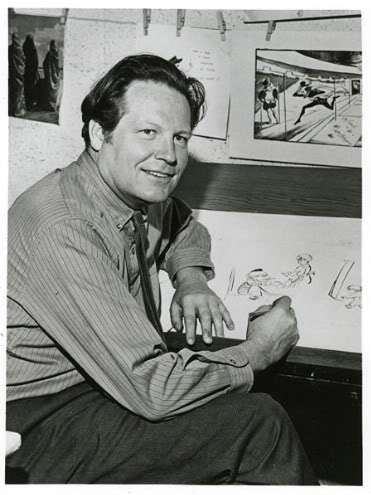
You may already know that Corduroy, the bear in search of a button and a friend, is 40 years old this year. But did you know that Corduroy’s creator, Don Freeman, was born exactly one hundred years ago today? That’s right: August 11, 1908.
Corduroy is certainly one of the most beloved bears in children’s literature, along with Paddington and Pooh. Even though there are only two picture books about him, he has managed to stand out among the plethora of other bear books published through the years.
His enduring charm for young readers exemplifies what Don Freeman defined as the essence of a good children’s story: simplicity without simple mindedness. This is a story about belonging, being loved for who you are, and friendship. What could be more important than that? And it’s told without a hint of didacticism, condescension, or sentimentality.
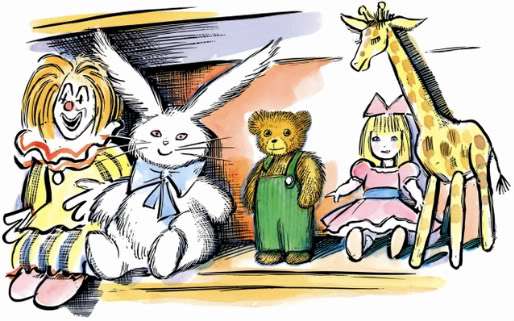
“Corduroy is a bear who once lived in the toy department of a big store. Day after day he waited with all the other animals and dolls for somebody to come along and take him home.”
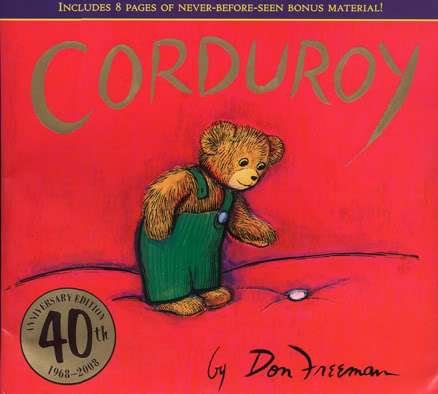
This past spring, Viking released a special 40th Anniversary Edition of this classic with extra-large trim size, embossed cover, and 8 pages of never-before-seen bonus material. It’s a beauty of a book, and a must-have for any diehard Corduroy fan.
Since Corduroywas first published when I was in high school (1968), I didn’t meet him until I began writing children’s stories and collecting bears in the 80’s. And I didn’t know much about Don Freeman until this year. What a fascinating life!
Originally from San Diego, Freeman moved to NYC in 1928 to study art at the Students Art League with John Sloan. He was fascinated by the theatre, and filled many sketchbooks with what he observed backstage on Broadway and all over the city. He supported himself by playing cornet in jazz and dance bands.
One night, while riding on the subway, he became so preoccupied with his sketching that he forgot his cornet on the train. After that, he decided to focus solely on his art. He was supposedly a gregarious sort, with lots of friends, including Louis Armstrong and William Saroyan.
He came to children’s books quite casually, co-authoring stories with his wife, Lydia. One of these early books was called Corduroy the Inferior Decorator (as yet, still unpublished), featuring a boy who drove his parents crazy by painting on the walls of their apartment. The name, “Corduroy,” was Don’s pet name for his son, Roy, who always wore corduroy overalls.
Years after Corduroy was published, Don wrote Linda Zuckerman, his editor when the book was released, explaining how he got the idea:
Of course I can’t remember exactly how it started, but I do recall wanting to do a story about a department store in which a character wanders around at night after the doors close. Then I also wanted to show the vast difference between the luxury of a department store and the simple life most people live. The idea of simple basic values was another theme that was running around in the back of my head . . .
Viking first rejected Corduroy, so Freeman submitted it to other publishers. They rejected it as well, but he believed in the story so strongly that he decided to resubmit it to Viking, who finally decided to take a chance on it.
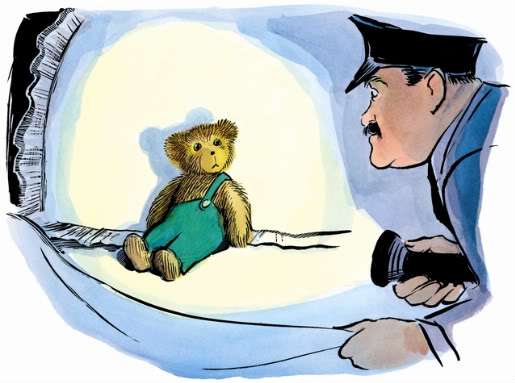
“Hello,” he said. “How did you get upstairs?”
The 40th Anniversary Edition contains correspondence between Freeman and his acquiring editor, Annis Duff, an early draft of the manuscript with Duff’s editorial notes, newspaper clippings on Freeman’s death, and several sketches alongside final illos. Great stuff for those who love process, history, and anecdotes.
I could not find any evidence of whether Freeman modeled Corduroy after a real teddy bear. But I do know that Freeman’s rendering manages to touch that hopeful, accepting, innocent child’s heart in all of us. Such a small bear in a huge department store! Nobody wanted him because he wasn’t perfect. How good we feel when Lisa finally takes him home.
Sadly, Freeman died of a heart attack just before the sequel, A Pocket forCorduroy, was published in 1978. I wonder if he had any idea how many millions of children would continue to take his loveable bear home after that.
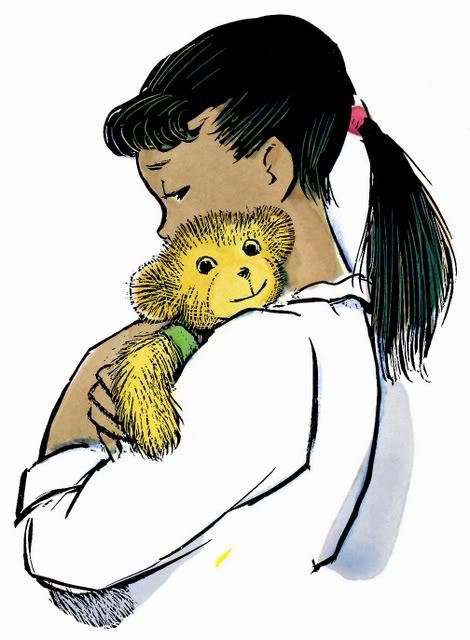
“You must be a friend,” said Corduroy. “I’ve always wanted a friend.”
“Me too!” said Lisa, and gave him a big hug.”




 Jama's Alphabet Soup
