SOUP’S ON: Debbi Michiko Florence in the Kitchen Interview!

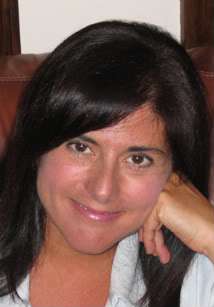
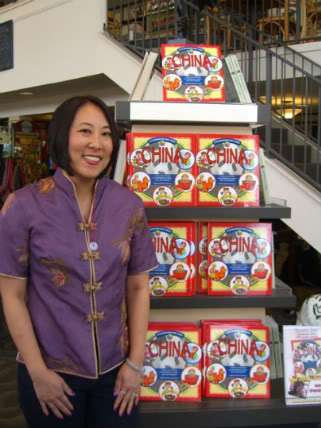
Debbi at her book launch party held at Books, Inc., Mountain View, CA


I’m very pleased today to welcome friend and children’s author, Debbi Michiko Florence, to the alphabet soup kitchen!

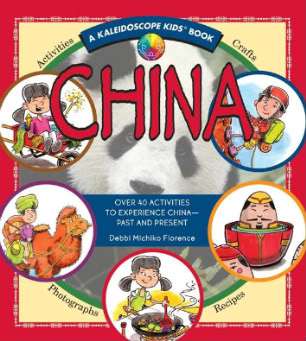
Debbi’s first book, China: A Kaleidoscope Kids Book, was just released in March, and it’s a beauty. A scrumptious volume containing over 40 activities and fascinating chunks of info about everything from China’s history, geography, culture, language, arts, to the all-important topic of food, it is the perfect hands-on learning resource for school or home.

Did you know the wheelbarrow was invented in China? What is the typical school day like for kids there? Maybe you’d like a calligraphy or chopsticks lesson, or are in the mood to embroider, make a clay soldier, juggle, or feast on mooncakes or dumplings. With an appealing format full of photos, cartoon drawings, maps, and diagrams, CHINA will surely get kids 8-13 excited and keep them engaged.

Debbi is visiting today from her home state of California, where she lives with her husband, teenage daughter, and rat terrier, Trixie. A full-time writer, Debbi has also been a fifth grade teacher, pet store manager, raptor rescue volunteer, and an Associate Curator for Education at the Detroit Zoo. She loves to travel, and has lived in such interesting places as Mexico City and Shanghai. Her next book, JAPAN, is due out next year.    

 Congratulations on getting your first book published, Debbi! Since CHINA is part of an existing series, how did this project come about? How much leeway were you given in selecting specific topics to include?

Thank you! I was very lucky to be asked to write this book. My friend, Nancy Castaldo, who has written many fabulous activity books on nature and the environment, was speaking to an editor when the editor mentioned she was looking for someone to write a book for kids about China. Nancy, who has read my work, recommended me and mentioned that I was living in Shanghai. The editor spoke with my agent, I wrote an outline, and I was given the contract! I have a background in education, so I think that helped. Because my book would be the first in the Kaleidoscope Kids Series under the new publishers, I had a lot of leeway. I was able to pick and choose the topics, with some guidance from the editor.


The research must have been a lot of fun. How did you gather all your information? Can you describe any especially interesting, surprising, or even frustrating experiences you had during this process?

It was a bit overwhelming at first. There was so much to learn and know and research and double-check! I probably over-researched. I was grateful to my editor for fact-checking and to my Mandarin teacher for her help. Because I lived in China, I was able to experience some of the things I wrote about first hand. That was pretty exciting!
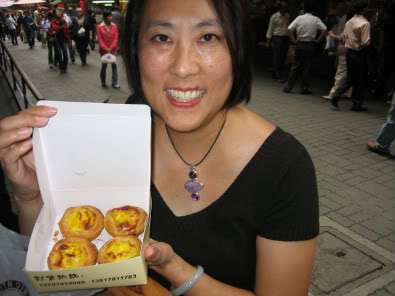
Debbi with her favorite dim sum treat, dan taht (egg custard), at Yuyuan Garden, Shanghai, China


I think the most frustrating experience for me was not knowing when to stop researching and start writing. I whined to friend and author Jerry Spinelli and he gave me this advice: “You can sit on the bench and study the game forever, but you’ll never score until you take off your sweats and start shooting.” Wise words! I think I knew I had enough research material, but was scared to start writing. Once he said that, I started writing, and the words just flowed, because by that time I did indeed know the material.

Briefly take us through the stages of bringing this project to completion, once you signed the contract.

I spent weeks and weeks researching and taking copious notes by longhand on yellow legal pads. I was lucky to have a large desk in China! I had piles of paper all over the desk and on the floor. Also on the floor, I had a huge map of China. It was like walking through a maze in my office.
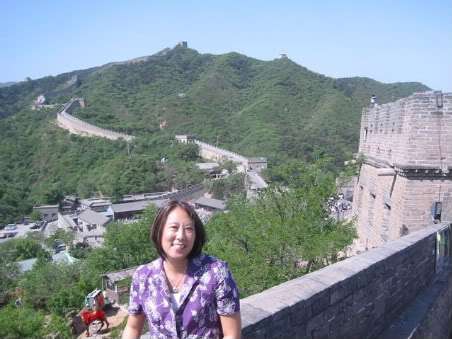
Debbi at the Great Wall


 I typed up my manuscript on my computer, using my notes as I wrote. I kept separate files for each section. Once I finished writing the entire draft, I created and wrote up the activities to go with the text. That was the most fun for me, since I had had experience with that when I was an outdoor school teacher, classroom teacher, and Associate Curator of Education of a zoo.
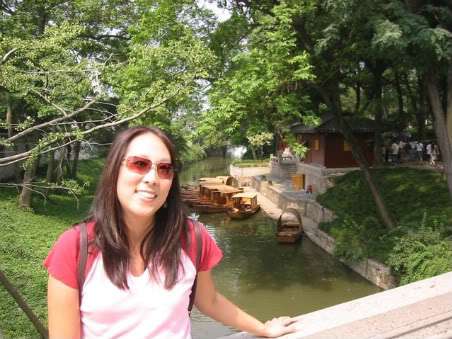
In front of a canal in Suzhou, China


 I revised and proofed my manuscript and had my daughter test the activities to make sure the instructions were clear and that the activities worked out. I had to make some adjustments. I turned in my draft to my editor. We went back and forth on rewrites and edits. I proofed a final galley and then it went to print! The entire process took place within a year!
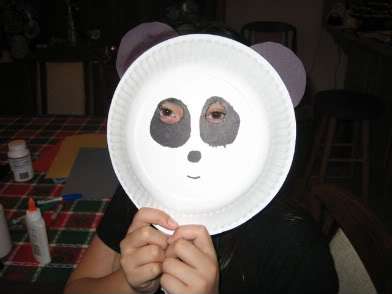
Debbi’s daughter tests the panda mask activity from CHINA


I especially love the chapters, “The Inventive Chinese,” “More Than Chow Mein,” and “China’s Amazing Art.” Do you have a favorite chapter?

I enjoyed writing all the chapters, but my favorite is a toss up between “More Than Chow Mein” (I love food) and the wildlife section. My college degree is in zoology and I’ve always had a strong interest in animals!

What’s next for you?

My agent is submitting my YA novel, so in the meantime, I’m trying to figure out what my next project will be. I have several WIPs in various stages. One is an incomplete first draft, another is on a third revision, and just recently, a new voice started speaking to me. This is unusual for me. In the past, I’ve always known what project was next. I’m also doing edits on my JAPAN book, a follow up to my CHINA book with Williamson Books (due out in summer of 2009).

Tell us about your general process when writing a novel. What is hardest for you? What do you feel are your strongest areas?

For my young adult novels, my process has changed over the years. I used to write a (crappy) first draft from beginning to end. Then I would spend time getting to know the characters and figuring out the story. Many revisions later, I’d have a draft I felt I could share for critique. More recently, however, a voice comes to me and I just freewrite — either scenes or dialogue, until I figure out what this character’s story is about. Then I write a (crappy) first draft. Some of those scenes/dialogue make it into the draft, but some do not. By nature, I am a plunger, making discoveries about my character and her story along the way. I don’t really outline, except that I think that my first drafts are in a way, a very long general outline.
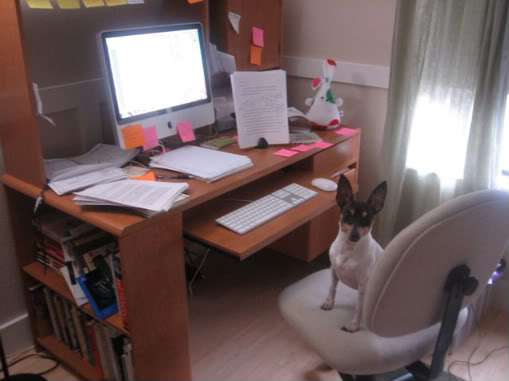
Trixie takes over Debbi’s writing space

Right now, for me, first drafts are the hardest part of writing a novel. I’m anxious to get to know the story and character, and I get frustrated that it takes so dang long. I’m much better, now, with revising drafts, especially with the smart help from my writing group!

What drew you to writing for children and young adults?

I started out writing travel articles (for a webzine) and adult short fiction. I had a couple of my short stories published in very small journals/magazines (The Berkshire Review, AIM Magazine). When I started writing my first novel, however, I was pleased to discover it was about a teenage girl. I had the wonderful fortune of crossing virtual paths with Cynthia Leitich Smith and she generously offered advice to me. One important bit of advice that seems obvious but wasn’t to me then, was to read the genre. Cyn became my mentor and because of her I have grown as a writer! I’m forever grateful! But I digress! 😉 What drew me to writing for young adults? I think my emotional age is stuck at 15. The period between ages 14-18 is the most vivid for me.

What kind of child and teenager were you? Do you remember the first story you ever wrote?

Well, if you ask my mom, she’ll tell you I was an angel. I think she has selective memory. 😉 It should not surprise anyone who knows me that I have always loved to read and write.

The first story I “wrote” was in picture form. I was probably in kindergarten or first grade. I can’t remember a time in my life when I wasn’t writing stories. The first real story I wrote that was “published” was in 4th grade for our class magazine. It was a story about Fluffy the dog and her puppies. I wonder if I have that stashed somewhere? Hmmmmm.
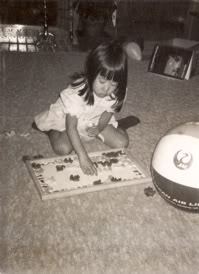
The author at work.


I’m a firm believer that people are what they eat. Please describe your favorite childhood food-related memory.

Then I am an umeboshi — a Japanese pickled plum. I just recently learned that it really isn’t a plum, but a type of apricot. Umeboshi is very sour and usually eaten with rice, but I love to eat it as a snack, plain. As I type this, I’m salivating!

When I was a toddler and visiting my great-aunt in Japan, she had a bunch of umeboshi drying in the sun outside. As I hear the story, I ran outside, grabbed handfuls of umeboshi, and shoved them in my mouth.

Today, if I receive homemade umeboshi, Bob (my husband) knows he can’t have any. I’ll share the store-bought kind, but homemade is all mine!

Do you like to cook? If so, what is your specialty? What food inspires your best work?

Despite my Soup Sister posts on my blog, I do not really love to cook. My husband is the chef in the family, but with him traveling so much for business, he hasn’t been around to feed me. That’s why I got the soup cookbook (New England Soup Factory Cookbook) and started making soups. I’m actually enjoying it. Perhaps I’ll branch out into other types of food! I don’t have a specialty yet. Ask me in a year or so! 🙂
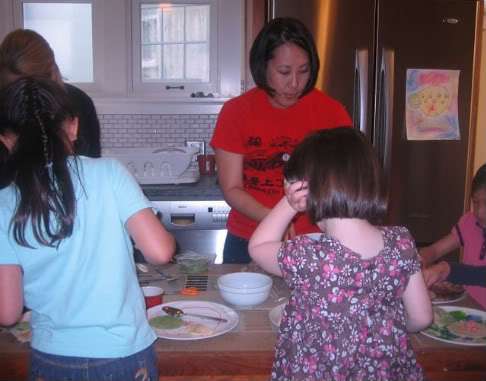
Making dumplings from the recipe included in CHINA

What three authors, living or deceased, would you love to have dinner with?

Madeleine L’Engle, Barbara Kingsolver, Judy Blume.

QUICK BITES

Describe yourself in 5 words.

I am incapable of that. 😉

Passions besides reading and writing

Family and friends, fine dining, my dog, blogging, shopping, vacations!

Books/authors that have had the most influence on your writing.

Too many to list!

Describe your fantasy meal.

Foie gras, Sydney rock oysters, Maine lobster, steamed artichoke, sushi, mom’s potato salad, Bob’s BBQ ribs, Japanese rice, and of course umeboshi! Dessert: lemon meringue pie and cupcakes.

Okay, that’s not really my fantasy meal, since those things combined wouldn’t taste great together. But those are some of my favorite foods!

3 fondest wishes.

I would spend all month trying to come up with an answer for this! 😉

Please share a favorite recipe with us.

You know, I was going to share a soup recipe, but I think I’ll share the ONE thing I can make without looking at a recipe and kept me from starving when I was in college. (Thanks, Mom!) I’m no gourmet cook! I recently started making this again and both Bob and my daughter love it!

HAMBURGER STROGANOFF

1 lb ground beef
1 onion, diced
2 cloves of garlic, diced
oil
1 small carton fresh mushrooms, sliced
3 T flour
1 can condensed cream of mushroom soup
water
8 oz. sour cream
cooked Japanese rice (or noodles if you must)

Saute onions and garlic in oil. Brown ground beef. Drain oil. Add mushrooms and flour, stirring over medium high heat until mushrooms are cooked through. Add cream of mushroom soup and 3/4 can of water. Stir well. Cover and simmer on low for about 10 minutes, stirring occasionally. Remove from heat and add sour cream. Mix well. Serve immediately over rice. (It’s the only way I’ll eat it, no pasta for me on this dish!)


 More Debbi, please:

A visit to her fabulous website is a must. Debbi’s archive of interviews with award-winning children’s authors dates back to 2001. Especially fun and fascinating is Trixie’s interview with Debbi!

Debbi’s Live Journal blog, One Writer’s Journey, is a warm and welcoming spot to chat and keep up with all of her adventures.

Click on over to papertigers.org to read Debbi’s wonderful essay, “Great Expectations: Breaking Down the Wall of Assumptions,” and a great review of CHINA!

Finally, there is an excellent interview with Debbi at the Women on Writing ezine, where she offers advice for beginning writers and more insight into her writing process.

Xie xie (thank you), and Zai jian (goodbye)!
 

SOUP’S ON: Grace Lin in the Kitchen Interview!

“Your work is to discover the world and then with all your heart give yourself to it.” ~ Buddha

Last year, children’s author/illustrator Grace Lin was asked in an Edge of the Forest interview what she would say if she had the complete attention of everyone in the United States for thirty seconds. Grace quoted Buddha, and if the body of work she’s produced during the last 10 years is any indication, she has definitely lived by those words.

Talented, prolific, critically acclaimed and beloved by her readers, Grace has illustrated ten picture books and written and illustrated a dozen more. Her use of bold colors, intricate patterns, swirls, and charming details mark a distinctive style that engages, delights, and invites the reader to look closer.

In 2006, Grace’s first middle grade novel, The Year of the Dogreceived tons of accolades, including Kirkus Best Early Chapter Book, ALA Notable Book for Children, and a National Parenting Publication Gold Award. The Year of the Dog is autobiographical, picking up where her picture books, The Ugly VegetablesDim Sum for Everyone, Fortune Cookie Fortunes, and Kite Flying leave off. Readers everywhere have fallen in love with Pacy Lin, her best friend, Melody, and her sisters, Lissy and Ki-Ki.

This year, a much-anticipated sequel, The Year of the Rat, was released along with yet another gorgeous picture book, Bringing in the New Year. In The Year of the Rat, we are treated to more of Pacy’s joyous, funny, and poignant experiences. Much like the classic Little House or Ramona books, these stories leave us craving more about this family and Pacy’s world, so full are they of heart and universal truth. Bringing in the New Year focuses on the preparations for Lunar New Year, complete with homemade dumplings and a dragon dance, with pictures that pull us right into the action.

I couldn’t think of a better way to top off Tea Party Month, than with Grace as my special guest of honor. I’m sure you’ve noticed how often she writes about food, using it as both subject and metaphor. She’s definitely my kind of girl — and she’s even brought cupcakes!

Continue reading

SOUP’S ON: Laura Vaccaro Seeger in the Kitchen!


photo by Laura’s son Dylan

Today, my friends, is a very special day: dogs are barking, bears are growling, and eggs are rolling, because today, Caldecott and Geisel Silver Award winning, New York Times bestselling children’s author/illustrator, Laura Vaccaro Seeger, is right here in the kitchen!

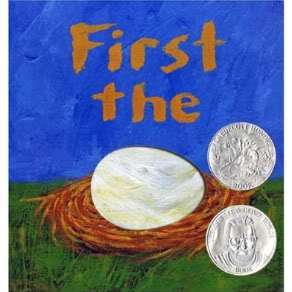
Laura is certainly no stranger to major awards, having received an Emmy for her work in television animation, and numerous accolades for every one of her ingeniously crafted concept books (The Hidden Alphabet, Lemons are Not Red, Walter Was Worried, Black? White! Day? Night!). Her first emergent reader, Dog and Bear: Two Friends, Three Stories, was named Boston Globe-Horn Book Best Picture Book for 2007. And then there’s First the Egg, Laura’s crowning glory.

This past January, First the Egg, a die-cut concept book about transformations, earned Caldecott and Geisel Honor Awards. It’s also a 2008 ALA Notable Book and 2007 New York Times Best Illustrated Book. Turn the page, and an egg becomes a chick. Turn another, and a seed becomes a flower; the next, and a tadpole becomes a frog. This organic process is ultimately transferred to the concept of creativity — “first the word, then the story; first the paint, then the picture,” which features a chicken, who then becomes an egg, bringing the cycle full circle. There is movement in the textured brushstrokes, and before you know it, the words and pictures have grown into an entire book. Beautiful, engaging, clever!

Recently, Laura, who lives on Long Island with her husband and two sons, very generously took time from her busy schedule to talk about her amazing books, her childhood, and what it feels like to get “the call” every children’s book creator dreams of. Oh, and she’s sharing a favorite recipe, of course!

Welcome to alphabet soup, Laura, and two big congratulatory hugs for winning Caldecott and Geisel Honor Awards for First the Egg! January 14th must have been a HUGE day for you. How did you find out that you had won both awards? Did you do anything special to celebrate?

Well, it is really very difficult to describe how it felt to receive those two phone calls. It’s something I’ve dreamed about every year since The Hidden Alphabet was published, never imagining that the dream could actually become a reality. In fact, a few years ago on the morning of the big announcements, I had a dream that I “got the call.” The dream was so real that even 20 minutes after I woke up, I wasn’t sure if it had actually happened or not. And, of course, when I finally realized that the call was truly just a dream, I spent the rest of that day moping around in despair. Now this year, more than a month after the actual calls, I am still pinching myself, worried that I am about to wake up any minute.

Continue reading

SOUP’S ON: Jackie Urbanovic in the Kitchen (Part 2)!

 Well, here we go with a back-to-back quack! (Click here if you missed Part 1.)

I hope you brought your appetite. For our second course with the multi-talented Jackie Urbanovic, we’ll be getting down to the nitty gritty detail of just how she makes her pictures. We’ll also hear about her consuming passion for comics, and for the first time ever on any blog, we’ll find out what she eats!

Quello again, Jackie. Could you describe how you did the illustrations for your two books featuring Max the duck?                                    

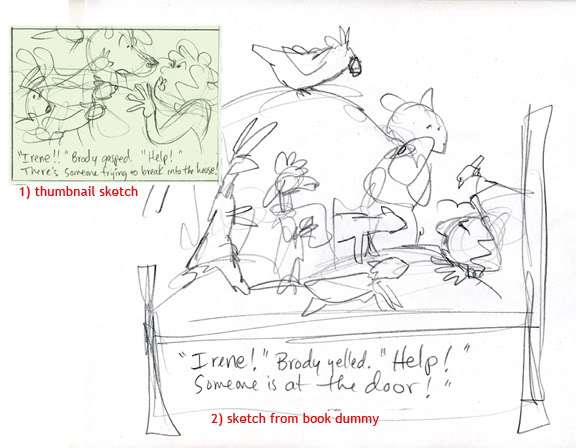
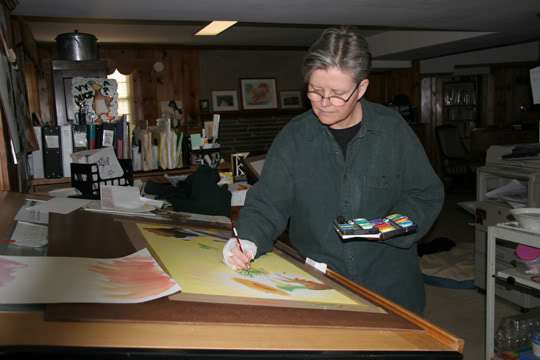
First, I look at the big picture. I begin with thumbnail sketches — tiny sketches for every page being roughly 2″ x 3″ in size. I doodle the entire story in sequence. I begin this small so that I can quickly see the pacing and movement of the entire book at once. This allows me to plan where the climatic points will fall and to begin deciding what will be illustrated and what will be left to the words. It also lets me make sure that the story is fitting well into the 32 pages I have. I may do a set of thumbnails 2 or 3 times as a way to experiment and quickly try out different possibilities.

Second, I begin what’s called a book dummy. This is a larger set of sketches, folded like a book, at the same size as the book will be. The drawings are still doodles, but now there is room to see a bit more detail and to hand write the text in place. At this stage I make more changes because I can now see with more clarity if my original ideas work once they are full-sized.


Third, I work on creating my characters –deciding how they will look. This can be a few hours or a few days of work. I begin with looking at reference photos of the type of animals or people I’m working on and sketching them just to learn what they look like. Then I begin a process of caricaturing and simplifying them — exaggerating their features and making them into a personality a reader can recognize. I do a lot of experimenting. Then I mail these sketches as well as the book dummy to my editor, who looks them over. We discuss what works and what could be better.

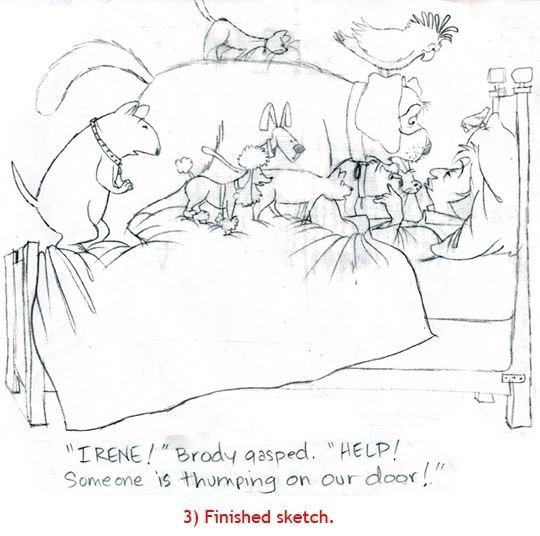
Fourth, I do another set of revisions based on my editor’s responses. This is sometimes another book dummy, but most often it is a set of finished sketches with the revisions incorporated.


Fifth, after we’ve gone through all the revisions, I enlarge each sketch 40% and trace the image onto watercolor paper using a light table. The light table allows me to see through the paper. I enlarge the sketch so that I have room to put in more detail and to be more free with my brush strokes.

Sixth, I wet each piece of paper and secure it to a masonite board using a wide paper tape. Once the paper dries, it stretches out taut. Now, when I paint, the paper won’t buckle.

Seventh, I paint on 3 to 6 pages at a time, moving from one to the other. While one painting is drying, I can work on the next. This also gives me the chance to put a half finished painting aside for awhile when I’m not sure about how it’s working. If I leave it for an hour or two and come back to it, I can often see what needs to change.


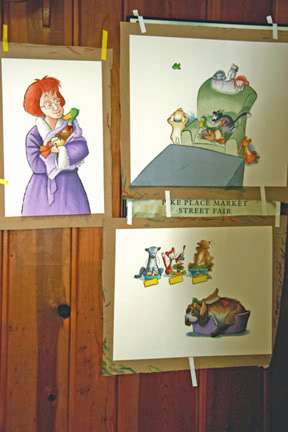
Lastly, I re-draw over the light pencil outlines with a brown watercolor pencil, dipped in water, for my final outline. As I finish each painting, I cut it off the board and tape it to the wall. This way I can compare the colors and textures from the earlier paintings to the later ones, making sure they stay consistent.

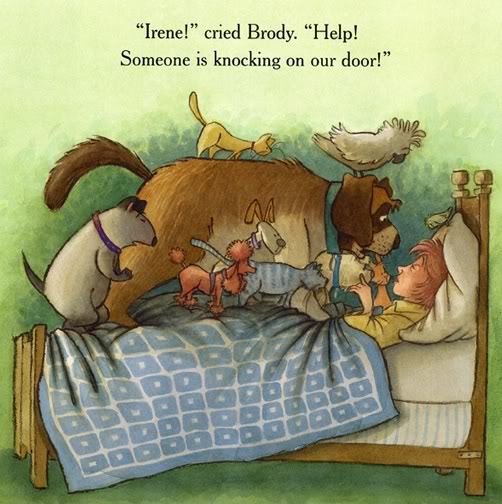
Finished art from Duck at the Door

Thanks so much! The average person merely sees the final product, not realizing how much detailed work and patience is involved in creating it. Let’s shift gears a little. The comic strip, Maggie, Inc., is a brilliant example of your passion for the genre. Did you draw comics/cartoons as a child? What were some of your favorite comic books? Would you like to do a graphic novel someday?

I love doing the Maggie, Inc., comic strip. There’s so much fodder for ideas and humor in my everyday life and that of my self-employed friends. My friend, Michelle Massman, came up with the idea and everyone I knew shared their stories with me. Yes, I drew cartoons as a child. I even created my own comic strips. I loved reading Uncle Scrooge comics the best. I also enjoyed reading Val, Archie, Batman, Superman, The Phantom — and I adored Mad Magazine. I also admired the drawing on the comic strips Pogo and Lil’ Abner, but I couldn’t understand the stories. A dear friend, Steve Thompson, brought those strips and others to my attention again as an adult. (He is the official Pogo historian and publishes the Fort Mudge Most, the Pogo/Walt Kelly fan magazine.)

I still read comics, comic strips and graphic novels. Here’s a partial list of my current faves:

Scary Grandmother by Jill Thompson
Elfquest by Wendy and Richard Pini
Howard the Duck by Steve Gerber
Groo the Warrior by Sergio Aragones
Usagi Yojimbo books by Stan Sakai
The Asterix books by Goscinny and Udzero
Nausicaa (and any books or films) by Miyazaki
Calvin and Hobbes by Bill Watterson
Mutts by Patrick McDonnell
Zits by Scott and Borgman
The cartoons and books of Jules Feiffer, Shel Silverstein, William Steig, Sempe, Posy Simmonds, Carol Lay, Peter Kruger, and Ronald Searle . . . and old comic strips: Gasoline Alley, Pogo, Little Nemo, Krazy Kat, Polly and her Pals.

My childhood dream was to become a comic book artist. I didn’t stray too far from that original dream, as picture books are a similar way to tell stories. And I would love to do a graphic novel someday.

This is so fascinating to me. Of course I read some comics as a child, but I am learning now about an entire industry that is exploding with exciting innovation and unleashed creativity. Speaking of innovation, Max the duck’s cooking has been described as creative and experimental. Yesterday you mentioned your love of cooking. Please describe your fondest food-related memory from childhood.

I love to cook and eat! I love discovering new foods and new recipes. I enjoy listening to the Splendid Table on NPR. I’d like to travel more just to sample the cuisine of many different cultures. And I’m fascinated with the politics of food and food production.

All of the women in my family are and have been tremendous cooks. My mother and grandmother grew their own vegetables and made many things from scratch:  pickles, horseradish, raisin bread, kugelis, sausage, jams, coconut cream pie. I remember my mom and grandma both used to cook chicken with potatoes and carrots in a shallow pot with a little water. It would cook slowly on the stove all day until everything was very soft. And the smell in the house was absolute heaven.

Okay, my mouth is officially watering, and I’m growing weak at the mention of coconut cream pie. Describe your favorite meal. Is there one particular food that inspires your best work?

My favorite meal . . . hmmm, that’s like asking me my favorite book. Don’t get me started! Let’s see — I love a good spinach pie with a side of tabouli along with some feta cheese and olives. Or something Thai or Vietnamese, or a good deli sandwich with pickles and fries, or, I could go on and on. Eating anything I really enjoy inspires me, especially when I can eat it with my family or friends. And while I’m not sure Gobstoppers inspire my best art, I do munch on them constantly while I work.

What can you tell us about the recipe you’re sharing today?

I recently experienced this recipe from my cousins Tomas and Jen. It’s a Lithuanian dish. It appeals to me because it harks back to my heritage. Had I seen it in a cookbook I would NEVER tried making it because it was such an odd combination of foods. But, fortunately, they brought the dish to my house first and I absolutely loved it. I guarantee it tastes much better than it sounds!

TOMAS AND JEN’S (AND NOW, JACKIE’S) FAMOUS COLD BEET SALAD

4 cans beets
1/2 jar dill pickles
1 can white beans or chickpeas
small red onion
mayonnaise to taste

Chop the beets, pickles and onion into small pieces. Mix with beans and mayonnaise. Serve cold.


Thank you so much, Jackie, for sharing this interesting, insightful, and wholly satisfying two course meal with us. Where else could we have gotten beets and gobstoppers on the same plate? It’s been great learning about you and your creative process!

For info on school visits and some of the books Jackie has illustrated for other authors, visit her website.

If you’d like to learn more about Jackie’s comic strip, Maggie, Inc., click here.

For a cool interview with Jackie’s mentor, Jane Resh Thomas, click here.


**All spreads posted by permission, © 2008 Jackie Urbanovic, All Rights Reserved.

SOUP’S ON: Jackie Urbanovic in the Kitchen (Part 1)!

                  
                     DUCK SOUP by Jackie Urbanovic 
                (HarperCollins, 2008), ages 4-8, 32 pp.

 Quello, everyone! 

 Please help me welcome Maxwell the duck and his creator, Jackie Urbanovic, to alphabet soup!

Jackie is the New York Times bestselling author/illustrator of Duck at the Door (HarperCollins, 2007), and its brand new sequel,Duck Soup, which was just released January 8th. She and Max are quacking to us live today from their home in Silver Spring, Maryland, where Jackie creates children’s books and runs her own business, Jackie Urbanovic Illustration. Yes, she’s a very busy woman, but she’s living out her childhood dreams. What could be better than that?      
       
Today we’re serving up Part 1 of our interview with Jackie. She’s got so many juicy tidbits to share, we thought, well shoot! Why not make it a two course meal and celebrate in style? I know you’re hungry, so let’s dig in.

Welcome to alphabet soup, Jackie! Congratulations on the release of Duck Soup, which is absolutely hilarious. I just have to ask, how did you get to be so funny?

I blame it all on my family! They love to laugh! They have always been practical jokers and storytellers. My grandfather would sit on the porch and tell stories. His stories were so compelling that no one minded that he was telling them in Lithuanian! I was a very shy and quiet child, myself. But I LOVED my family’s stories and I loved laughing and I wanted to be the one to make people laugh .  . . but I wasn’t brave enough to try — at least not out loud. So I listened and enjoyed and eventually began telling my stories on paper with my drawings. My mother also loved old movies and introduced me to the Marx Brothers, the Bowery Boys, Sid Caesar, Imogene Coca, Bob Hope, Bing Crosby, and other comedians of the time. We all also loved Betty Boop, Popeye, Bugs Bunny, and other cartoons.

Duck Soup is the second picture book you’ve both written and illustrated. I’m so impressed with how you created the perfect comic sequence with your words and pictures. Does writing come as naturally to you as illustrating?

Thank you for the compliment on my timing. I’m sure that comes from all the animations and sitcoms I’ve watched as well as the comics I’ve read. I’ve also studied animators’ drawings and movement sequences. It’s always been important to me to get just the right expression on each character and to have a sense of motion even in a still image.


from DON’T SQUEAL UNLESS IT’S A BIG DEAL by Jeanie Franz Ransom, pictures by
Jackie Urbanovic (Magination Press, 2005).


As far as my writing goes, it wasn’t until the last few years that I would have called myself an author as well as an illustrator, but I’ve always used words with my pictures even when I was a child. About 12 years ago, I consciously decided to study writing for children with Jane Resh Thomas, and I spent 3 years in her writing group — an invaluable experience. It was after studying with her that I began to think of myself as an author as well.

While drawing comes more easily to me than the writing, it wasn’t always that way. It took me years of learning and practicing for it to become easy . . . and while I’ve used words all my life, they were always secondary to pictures until recently, so I haven’t had quite as much time to practice with them yet. There are moments when it all falls together with amazing ease and moments when I feel like I’m wrestling with an octopus — like I’m untangling and rearranging a complex puzzle. But it is always entertaining. Figuring out how the words, pictures and ideas fit together is the most exciting part of the process for me. I tinker — destroy, rearrange, revise, and recreate. I go back and forth between words and pictures until I’ve managed to weave them together so well that neither of them makes sense by themselves.

How long was the journey to publication for the first book about Max, Duck at the Door?

Duck at the Door was my first book as an author/illustrator. I started it in Jane Resh Thomas’ writing group. It went through dozens of revisions. It took me 10 years to finish that one, although I wasn’t working on it daily. Sometimes I’d put it aside for as much as a year. I also worked on other stories at the same time that eventually fell by the wayside. That entire period of time was one of intense learning. Once I felt I had taken it as far as I could, I sent it to a literary agent who I’d been in contact with for years. We began working together beginning with that book.

               
              DUCK AT THE DOOR by Jackie Urbanovic
                  (HarperCollins, 2007), ages 4-8, 32 pp.

You’ve said that all the animal characters are based on real rescued animals either you or your friends have lived with. Who is the model for Max? Why did you give him an interest in cooking?

The original inspiration for the story was someone I met who lived with a houseful of dogs, cats, and rabbits she had rescued. So, not only are some of the fictional animals based on her pets, but the "mom" of the house, Irene, is inspired by her. The only character that I didn’t know in real life was Max. I’d never known anyone who had lived with a duck. So, his appearance came from my imagination, his name came from my friend, Max Haynes (also a writer and illustrator), and his personality came from my dear friend, Susan Dreiband. She is one of the most playful and mischievous people I know. I borrowed her playfulness, creativity, curiosity, big heart, and her ability to befriend anyone for Max. To all that I added my love of cooking and experimenting with food. I love food — buying it, creating it, sharing it, the politics and culture of it. And I’ve always been tickled by pretentious chefs and cooking shows.

How did you come up with the storyline for Duck Soup?

The storyline came to me in bed, of all places. I was unable to fall asleep one night and I was bored. So, I started telling myself a story about Max and his cooking. This was one of those times that it all came together easily. I wrote down the first draft of the story the next day.

Tell us more about your childhood. Any other artists in your family? Who or what influenced you the most?

I grew up in the country on the shores of Lake Erie. I spent a lot of time alone reading or watching movies. I had a stack of comics and I loved visiting the bookmobile. I also drew pictures for fun from the time I was 3 or 4 years old. And, of course, I loved to swim — especially with my siblings and cousins. My family was not only humorous, they were also creative. My dad could build just about anything, and my mom was a creative and wonderful cook and gardener. My sister played guitar and enjoyed art and several of my cousins are talented artists, even though it’s not the way they chose to make a living.

Who influences me the most? Your entire life exerts an influence on what you create — the people you know best, the hardships and joys, the movies and books you prefer, etc. So, it’s hard to narrow it all down; there are so many influences to credit. Teachers, artists, friends and family have all influenced my work. My love of animals is one of the most distinct influences and that comes directly from my family.

What is the most unusual job you’ve done so far, other than children’s book illustration?

Probably the most unusual was becoming an entrepreneur! It’s been the most exciting and most daunting thing I’ve ever done. It’s been the roller coaster ride of a lifetime. Next to THAT, the most unusual job I ever took was to illustrate a bus. A real life-sized city bus. I didn’t actually get to paint the bus myself, but I had a template and I had to design the space so that the art would fit over and around the windows and doors. I enjoyed the idea of my illustrations tootling back and forth on the streets of Chicago.

What inspires you? 

I’m inspired by dozens of things big and small: my friends, the idea of time travel, a funny sentence, a memory, my dogs and cat, bravery, creativity, the ability to transform difficulties into something good, novels, comic books, picture books, movies, strangers I see on the street, daydreams. Inspiration comes from everywhere.

What are you working on now?

Right now I’m working on the third Max the duck book, Duck and Cover (January 2009). This time a new animal shows up at the door seeking refuge: an alligator named Harold. He causes quite a stir, because, while they all want to help him, they’re not sure what to do with him because they don’t feel totally safe themselves!  I also just finished illustrating a hysterical picture book for Elizabeth Cody Kimmel, titled, Glamsters. It’ll be out this fall.


from DUCK AND COVER                       Coming this Fall!
             

QUICK BITES:

Describe yourself in 5 words:

Storyteller, time traveler, playful, caring, creative.

5 highlights of your career so far:

Doing what I love to do for a living.
Becoming a published author as well as illustrator.
Finding my agent.
Making the New York Times Bestseller list.
Making my editor, librarians, and lots of kids laugh (my childhood dream).

Passions besides art and writing:

Collecting antique toys (especially Cracker Jack toys), collecting books and graphic novels, swimming, bicycling, cooking, eating locally, animal rights, art museums, talking to other artists, being with friends.

Favorite books/authors:

The Tale of Despereaux by Kate DiCamillo
The Stupids by James Marshall
The Children of Green Knowe (entire series) by Lucy Boston
In the Night Kitchen by Maurice Sendak
Mary Poppins by P.L. Travers
James and the Giant Peach by Roald Dahl
Wind in the Willows by Kenneth Grahame
Harry Potter series by J.K. Rowling
Emily and the Incredible Shrinking Rat by Lynne Jonell
Blind Mountain by Jane Resh Thomas
Cheaper by the Dozen by Gilbreth and Carey
Time and Again by Jack Finney
The Beekeeper’s Apprentice (entire series) by Laurie King
Animal, Vegetable, Miracle by Barbara Kingsolver
The Stargazer by Jack London
Beach Music by Pat Conroy

Favorite Artists:

Ben Shahn, Alexander Calder, Julie Taymor, Quimetta Perle, Peter DeSeve, Garrison Keillor, Jessie Wilcox Smith, Linda Barry, Ohara Koson, Kawanabe Kyosai, Quentin Blake, Dave McKean, Walt Kelly, Grant Wood, Nick Park, Pixar Studios, Sylvain Chomet and many more  . . .

Tomorrow: The Quack Comes Back!  

In Part 2 of our interview, Jackie will show us how she makes her pictures, and we’ll learn more about her comic strip, Maggie, Inc. You won’t want to miss the all important food questions, either, and Jackie’s special recipe! See you then!

Jackie’s website!

  
**All spreads posted by permission, © 2008 Jackie Urbanovic, All Rights Reserved.