friday feast: hard to swallow


“The future will be gorgeous and reckless, and words, those luminous charms, will set us free again.”  ~ Carole Maso
 

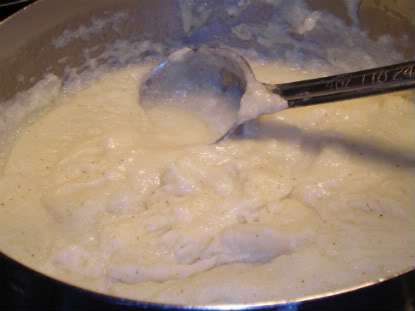
This week I tasted some unforgettable gruel, courtesy of Chinese American poet, Marilyn Chin.

It wasn’t what I was used to, since it didn’t nourish or comfort.

This was a powerful bowl of painful awareness and realization that caught me off guard. The speaker in Chin’s poem, “Gruel,” addresses the reader directly:

Your name is Diana Toy.
And all you may have for breakfast is rice gruel.
You can’t spit it back into the cauldron for it would be unfilial.
You can’t ask for yam gruel for there is none.
You can’t hide it in the corner for it would surely be found,
and then you would be served cold, stale rice gruel.
(from The Phoenix Gone, The Terrace Empty, 1994)
(Read the rest here.)

Diana Toy represents the subjugation and powerlessness of the Asian female, who must thrive on sustenance commonly associated with the poor. Moreover, she is the stereotypical exotic Oriental, passive and submissive, a sex toy coveted by white Western males.

“Gruel” is a good example of some of the prevailing themes in Chin’s work — intercultural identity, assimilation, social oppression, and above all, feminism. Her poems shock the reader out of complacency. She believes that poetry must do something:

I don’t quite believe in art for art’s sake. I believe there must be a higher order. What we write can change the world. That may sound a little idealistic but I feel it’s very important that poetry make something happen.

Born in Hong Kong and raised in Portland, Oregon, Chin confronts the reality of a minority culture bumping up against the dominant one. Are Asians the “model minority” or are they “inscrutable” and “duplicitous?”

What I like about “Gruel,” in particular, is how it resonates on a universal level. One need not be Asian to know inferiority, invisibility, or the feeling of having to settle. Later in the poem, when “nothingness will shine into the oil of your mother’s scrap-iron wok, into the glare of your father’s cleaver, and dance in your porcelain bowl,” I see the dominant Asian belief that what an individual does reflects on the entire group.

Chin also sees a degree of complacency, a “suburbanism,” in the choice of topics and forms used by some of her fellow American poets:

I have a problem with American poetry being self-satisfied, not pushing the limits. I write some ‘suburban’ poetry also. That happens to all academic poets in academic settings. I just think that poets need to relate to their work. I think there needs to be a dedication both content-wise and form-wise. I just think that poetry is a vibrant art, vibrant and complicated. But I don’t think American poets have taken advantage of the many possibilities that poetry can offer.

Just one bowl of “Gruel” has given me a lot of food for thought. After all, one need not be socially oppressed or politically motivated in order to write with an “activist” agenda. Words are the most powerful weapons we have. To what end are your efforts directed?
Today’s Poetry Friday Roundup is at writer2b.

“Men, their rights and nothing more; women, their rights, and nothing less.”
~ Susan B. Anthony
                                                              

somethin’ sizzling from lisa yee!

Ni hao (hello)!

If you’re craving a little Chinese, you’ve come to the right place.

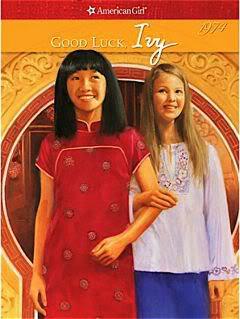
Our first dish in this month’s Asian Pacific Heritage Month potluck comes courtesy of the one-and-only Lisa Yee,  winner of the 2004 Sid Fleischman Humor Award and author of the wildly popular kids’ favorites, Millicent Min, Girl Genius, Stanford Wong Flunks Big-TimeSo Totally Emily Ebers (all published by Scholastic, 2003, 2005, 2007), and her newest book, Good Luck, Ivy (American Girl, 2007).


Good Luck, Ivy, a companion book to the American Girl Julie Series (by Megan McDonald), is set in 1970’s San Francisco. Ten-year-old Ivy Ling, Julie’s best friend, must decide between participating in a very important gymnastics tournament or attending a family reunion.

A perfect older brother, a mother in law school, a father working two jobs, and Julie moving away, often make Ivy feel invisible. A traumatic fall in a previous tournament has shaken her confidence, and she feels terrible after unintentionally hurting her grandparents’ feelings. And what about her report for Chinese school? How Ivy finds balance — both on the balance beam and in her life, makes for an engaging story sure to please young readers ages 8-12.

I especially like the warm family scenes featuring food! Ivy and her brother, Andrew, visit their grandparents, Gung Gung and Po Po, every Saturday morning for a steaming bowl of breakfast jook at their Chinese restaurant, the Happy Panda. But there are also scenes involving spaghetti, hamburgers, and Julie and Ivy’s invention: Chinese Almond Twisters — symbolizing the perfect blend of things American and Chinese, old traditions and new.

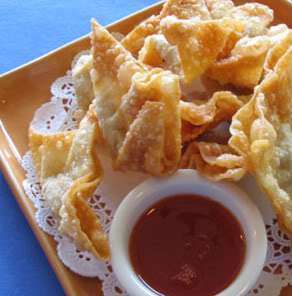
Today, Lisa is sharing a recipe for deep fried wonton, probably served at the Happy Panda, but more prominently featured in Stanford Wong Flunks Big-Time. Stanford’s grandmother, Yin-Yin, is famous for her dim sum (‘to touch the heart’), theorizing that if people’s mouths are full, they can’t fight. In a very touching scene, Stanford visits Yin-Yin in her nursing home, where she whips up a batch of wonton. He says, “I’ve missed Yin-Yin’s fried wontons almost as much as I’ve missed having her live with us.”

So, get into the spirit of Asian Pacific Heritage Month and fry up a batch of these. Of course, their flavor will be enhanced ten-fold if enjoyed alongside any one of Lisa’s fabulous books!

YIN-YIN’S WONTONS


1-1/2 T minced garlic
4 stalks green onions, finely chopped
1-1/2 lbs. ground pork (you can substitute ground beef or diced chicken)
3-1/2 T soy sauce
1-1/2 T sugar or honey
1 12-oz pkg. pre-made wonton skins
1 egg, beaten
3 cups cooking oil

1. Heat a tablespoon of the cooking oil in a large skillet. Add garlic and cook until browned.
2. Add green onions and saute.
3. Add ground meat and cook until the meat is browned. Drain the oil.
4. In a separate container, mix the soy sauce and the sugar or honey. Pour over the meat and cook. When the meat is done, turn off the burner and set the skillet aside.
5. Lay out the wonton skins in rows.
6. Place one tablespoon of meat in the center of each wonton skin.
7. Dip a pastry brush or the back of a spoon into the beaten egg, then “paint” two adjoining edges of the wonton skins.
8. Fold the skin in half diagonally so it forms a triangle, and press the edges together to be sure they are sealed.
9. Heat the remaining cooking oil in a large pot.
10. Drop wontons into the heated oil and cook until golden brown. Be sure to turn them while they’re cooking so they don’t get overdone.
11. Drain and let cool.
12. Eat!

Thanks, Lisa!