presidential potluck with mitali perkins

Friends, can you smell that positively divine aroma of fresh ginger, turmeric, cumin, chilies, and mustard emanating from your computer screen? 
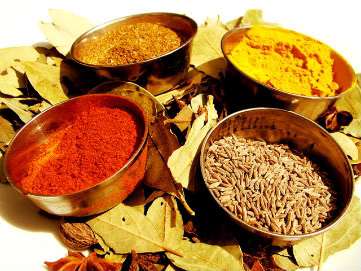
 

Thanks to First Daughter Sameera “Sparrow” Righton and her creator, Mitali Perkins, we can enjoy some authentic Indian food at our Asian Pacific American Heritage Month potluck today!

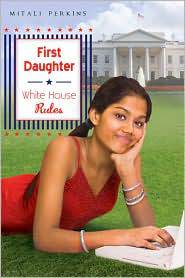
I don’t know about you, but I’m ready to don my salwar kameez and bhangra around the kitchen. I just read the first two books in Mitali’s First Daughter series, First Daughter: Extreme American Makeover, and First Daughter: White House Rules (Dutton, 2007, 2008). Loved them.
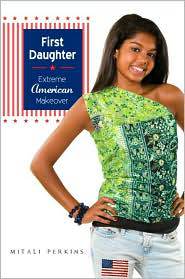
I admit I didn’t know quite what to expect. I had enjoyed The Not-So-Star-Spangled Life of Sunita Sen and Monsoon Summer. Positively adored Rickshaw Girl, which, as you probably know, has received loads of well deserved accolades, the latest of which is the 2008 Jane Addams Honor Award.

In 16-year-old Sparrow, I found a highly intelligent, compassionate, resourceful humanitarian, who just happens to be the President’s adopted daughter. In Extreme American Makeover, we see how Sparrow’s strong sense of self prevails, despite a physical makeover and attempts to “Americanize” the Pakistani heritage out of her while her dad is running for office.

Once her dad wins the election, they move into the White House, where things get even more interesting. In the second book, we see just how many of the White House “rules” Sparrow adheres to, as she interacts with her cousin Miranda, plays Cupid for her mom’s personal assistant, hangs with her SARSA friends at the Revolutionary Cafe, longs for her soulmate, Bobby, deepens her friendship with not-so-privileged Mariam, and of course, continues to blog. Despite the restrictions of a high profile lifestyle, somehow Sparrow manages to stay true to herself and positively affect those around her.

And how about those oatmeal scotchies! We first tasted them in Extreme American Makeover, but in White House Rules, these frosted wonders take on a life of their own. After the Swedish Ambassador raves about them, they become a staple at White House teas, enabling Miranda to earn some needed funds. Never underestimate the value of farm fresh milk! All I know is, I MUST make those cookies. Good thing Mitali has linked to some scotchies recipes here.

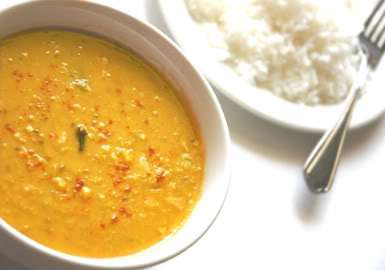
Speaking of recipes, Mitali has brought a childhood favorite today. She says, “We used to eat this almost every day when I was growing up. I LOVED it as a kid, mixed with steaming basmati rice and a side of hot mango pickle, and still do!”

So go ahead, whip this up. You know you want to. And while it’s simmering, peek into the White House to see what Sparrow is up to. I want her there come November.

BENGAL RED LENTILS (MASOOR DAL)
 

1-1/2 cups red lentils
3-1/2 cups water
6 sliced serrano chilies
1/4 tsp turmeric
1-1/2 tsp salt
4 T vegetable oil
1 cup minced onions
1 cup chopped tomatoes
1 T grated fresh ginger
1 T panch phanon mix (equal proportions of whole cumin, fenugreek, anise, mustard, and Indian black onion seeds mixed and sold as one spice; you’ll need to get this at an Indian store and it’s called “five spice mix”)
4 dried small red chilies (depending on how spicy you want it)
3 cloves crushed garlic

1. Rinse lentils well, add water, serrano chilies, turmeric and salt. Bring carefully to boil and cook over low to medium heat, partially covered, for 25 minutes. Cover and cook another 10 minutes. Adjust salt.

2. While lentils are cooking, cook onions in a frying pan in two tablespoons of oil until they are golden brown (approximately 10 minutes), stirring constantly. Add tomatoes and ginger and continue cooking until the tomatoes turn into a delicious and fragrant mush (approximately 8 minutes). Stir constantly so that tomato mixture doesn’t stick. Turn heat to low if necessary.

3. Scrape out the tomato mixture into the lentils and stir it in. Let lentils sit while you make the spiced oil.

4. Do a quick rinse of the frying pan, without soap, and dry thoroughly. Add the remaining two tablespoons of oil and heat over medium high heat. When oil is hot add panch phanon mix and heat until the seeds begin to pop, about 15 seconds. Add red chilies and fry for another 15 seconds, until they turn a little darker. Turn off heat and add the crushed garlic and let sizzle for about 30 seconds. Stir this mixture into the lentil/tomato mixture and serve with rice. Adjust salt.

*


wake up little sushi!


Ohayo gozaimasu (Good morning)!

O genki desu ka (How are you)?

Say this very fast: Sushi Chef Sushi Chef Sushi Chef!

Quite a mouthful! And so is sushi, one of my favorite Japanese foods. It’s a snack, a side dish, a main dish, a work of art, and an international sensation. From its humble beginnings as a way to preserve fish over a thousand years ago, to its modern day form originating in the 18th century (Edo period), sushi is king (or should I say, emperor), a veritable calling card for Japanese cuisine.

We gotta get something straight, though. There are people (not you) who think sushi means raw fish. The term, sushi (“it’s sour”), refers to the vinegared rice. Raw fish by itself is called sashimi. Moving on . . .

Confession time: rumor has it that I’m Korean. But I prefer Japanese food. Probably because of its emphasis on fish. Koreans are into hot and spicy and red meat, quite the carnivores. Anyway, I remember many a potluck and holiday dinner in Hawai’i with its requisite platter of sushi — alongside Chinese noodles and roast pork, three kinds of kimchee, ham, turkey, Korean kalbi, namul and taegu.

           
                 Futomaki with vegetable filling is my favorite!

Another confession: I only like cooked toppings or fillings with my sushi. Nothing raw for me. I’m a makizushi girl all the way. I’ll take futomaki (large rolls with 3 toppings) or hosomaki (smaller rolls), with cucumber, avocado, or carrots. I guess I find the nori and rolls comforting somehow. And I like to know my fish isn’t going to swim away before I bite into it.


Hungry yet?

I know (gasp), that some of you out there don’t like/won’t eat/haven’t tried/won’t try sushi. I sense my brother-in-law in New Hampshire might fit this description. 

               
                              No way!
 

Don’t worry. I’m not here to convince you otherwise. Instead, I’ve prepared a special sushi platter today to cater to all tastes. The goal is to learn a little, have fun, and celebrate the wonder of sushi in a virtual way. So nibble on a few pieces, or devour the entire platter.

Douzo meshiagare (Enjoy your meal)!


 First, test your general sushi knowledge with this IQ quiz.

To find out what type of sushi you are, click here!

If you’re a sucker for games, try Sushi Go Round. (It drove me crazy.)

An excellent primer featuring a little history and how to make sushi from Good Eats’ Alton Brown: Part I and Part II. Very interesting!!

Just for fun: 
                                                    Sushi candles

   
       Decorative Sushi                    Something for big appetites

And finally, For the Kids, the best sushi picture book ever (review coming next week):
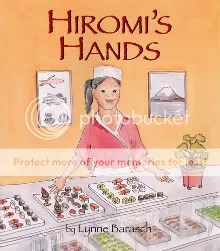
                
                HIROMI’S HANDS by Lynne Barasch
                (Lee and Low, 2007), ages 4-8

And a great wooden sushi toy, that just happens to be on sale:
       
                        Purchase here.

So, now — SHOW ME YOUR SUSHI!

What is your favorite?

Domo arigato gozaimasu (Thank you very much)!

                                 *Bowing*
   

Surfer of the Century: riding the waves with duke kahanamoku


Happy Nonfiction Monday!

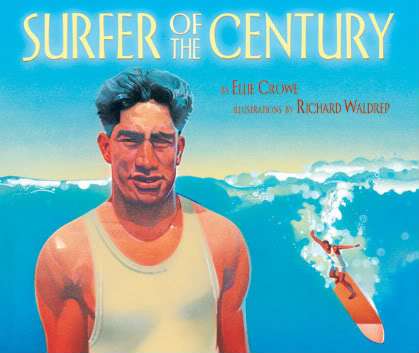
Since it’s Asian Pacific American Heritage Month, and the Summer Olympics are just around the corner, I thought it was the perfect time to take a closer look at a very cool picture book biography: Surfer of the Century: The Life of Duke Kahanamoku, by Ellie Crowe.

I heard his name a lot growing up in Hawai’i. He was an icon, a legendary hero, and lived according to his self-defined Creed of Aloha

In Hawai’i we greet friends, loved ones or strangers with Aloha, which means with love. Aloha is the key word to the universal spirit of real hospitality, which makes Hawai’i renowned as the world’s center of understanding and fellowship. Try meeting or leaving people with Aloha. You’ll be surprised by their reaction. I believe it and this is my creed.

I knew that Duke had won Olympic medals for swimming and that he was the father of surfing. But I didn’t know about the hardships he faced in order to reach his goals, particularly with regard to discrimination.

Call me naive. I grew up on a small island populated by people of every color. I never saw or heard of anyone being refused service in a restaurant because of the color of his/her skin. So I was surprised to learn that although he was sought after and admired because of his athletic brilliance, Duke was often treated like a non-person — being stared at or ignored, deemed a “strange looking, dark-skinned native from a distant land.”

I like how Crowe highlights many of the crucial events in Duke’s life with dramatic scenes that really stick in the reader’s mind: when he broke three Amateur Athletic Union world records to qualify for the U.S.Olympic team, and his times were so fast the officials in New York refused to believe them; when he missed his 100-meter freestyle race at his first Olympic games in Stockholm because he had overslept; when he rescued eight fishermen from a capsized boat in California with his surfboard; or when he was the only surfer able to ride a gargantuan wave, as described at the beginning of the book:

Surf’s up!

Eager surfers gripped their wooden surfboards and stared out at the monster waves. Spawned far out at sea, the thirty-foot “Bluebirds” streaked across miles of ocean in a solid line, crashing in white foam on Waikiki Beach. Such huge waves occurred only on extraordinary occasions, the result of underwater earthquakes or volcanic eruptions. Who dared surf the Bluebirds?

Only one surfer mastered the gigantic waves that day in 1917 — Duke Kahanamoku. He rode a thundering Bluebird for almost two miles, from the deep blue ocean to the white sand beach.

This story, of how a poor beachboy from Waikiki won 6 Olympic medals, introduced surfing to America, Australia and New Zealand, held the world’s fastest swimming record for twelve years, became Sheriff of Honolulu, and then official ambassador for the Islands, is sure to fascinate and inspire adults and kids alike. Beyond his official honors and medals, one remembers his modesty, courage, determination and good sportsmanship, no matter what the obstacle.

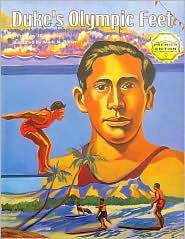
On an interesting side note, Ellie Crowe says in a Honolulu Star Bulletin interview that she first wrote about Duke’s early years in Duke’s Olympic Feet, which she submitted to Lee and Low Books.


 DUKE’S OLYMPIC FEET by Ellie Crowe
(Island Heritage, 2002), ages 1-6

When she didn’t receive an answer, she went ahead and published the book with Island Heritage, a regional publisher. Two years later, Lee and Low editor, Louise May, offered to publish Crowe’s manuscript, apologizing for the delay, but explaining that it had been buried on her desk. Crowe showed Louise the published book, and together they worked on a full biography geared for a national audience, which became Surfer of the Century.

This book received a starred review from School Library Journal, was named a Bloomsbury Review Editor’s Favorite 2007, and was one of only two books listed as a Notable Children’s Book for the Kiriyama Prize, which recognizes outstanding books about the Pacific Rim and South Asia. The striking art deco style illustrations done in gouache air brush by Richard Waldrep perfectly complement the era with gorgeous blues of ocean, pool, and sky.

For a complete roundup of today’s nonfiction features, see Anastasia Suen’s Picture Book of the Day blog.

friday feast: voices on the wind


“Because I know my mother’s language, I’ve enjoyed exchanging thoughts with other Polynesians to discover our alikenesses and our differences. And because I know my father’s, I can explain to others what we have had here and lost and what we still retain.”
~ Mary Kawena Pukui (1895-1986)


Imagine having a name that is like a poem:

Mary Abigail Kawena ‘ula-o-ka-lani-a-Hi’iaka-i-ka-poli-o-Pele-ka-wahine-‘ai-honua Na-lei-lehua-a-Pele Wiggin Pukui.

The Hawaiian part means: “The rosy glow in the sky made by Hi’iaka in the bosom of Pele, the earth-consuming woman. The crimson lehua wreaths of Pele.”

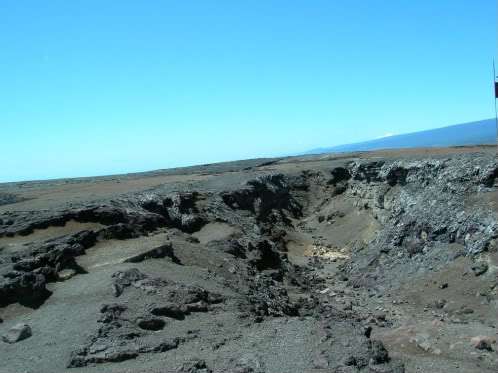
                   Volcanoes National Park, Island of Hawai’i

Now imagine spending the first six years of your life in a remote part of the world, a place of barren lava wastelands and green mountain forests. There are no outsiders, no influences from the Western world. There is only you and your grandmother, Po’ai, a former dancer in Queen Emma’s court, who teaches you everything she knows about ancient Hawai’i, through chants and hula. You learn geneaology, history, folklore, social behavior, herbal healing, music, family history and crafts.

The spoken word is powerful, sacred, and conveys everything you need to know about an entire civilization, so you listen carefully, watch, imitate and remember.

Mary Pukui, or Kawena (kah-VEH-nah), as she was fondly known, is a Hawaiian treasure. The daughter of a Hawaiian mother and a Caucasian father from Salem, Massachusetts, Kawena was a bridge between the old world and the new. Without her life’s work as an author, linguist, composer, dancer, teacher, ethnographer, historian, editor and translator, much of what we now know about the real Hawai’i would have been lost forever.

Her unusual upbringing, of being raised by her maternal grandmother, was authentic to the old Hawaiian custom of hanai. After Po’ai passed away, Kawena returned to her parents’ home, where her father spoke only English, and her mother, only Hawaiian.   

By this time, the Americans had taken over Hawai’i. Though the New England missionaries had brought written language, they had also banned Hawaiian in the schools. When she was fifteen, Kawena tried to help a new student, and was severely punished for speaking Hawaiian. Her parents withdrew her from school, but the hurt and humiliation she suffered lasted a lifetime.

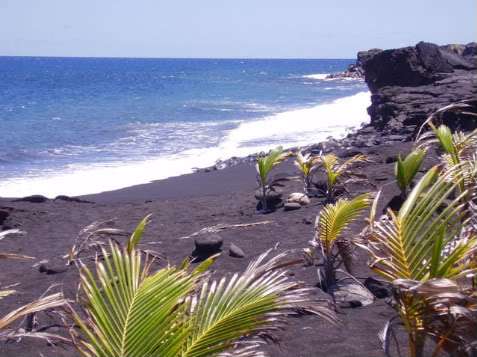
                     Black sand beach, Island of Hawai’i
Kawena grew up respecting both of her cultures, and could think in Hawaiian and English. But she saw how the world was changing, and was afraid that all things Hawaiian would be lost forever. As a teenager, she began to record words, sayings, bits of poems and proverbs that she remembered on scraps of paper. With the help of a neighbor, she also began translating folklore and poetry, and wrote down family stories.

She eventually worked for the Bishop Museum, where she translated Hawaiian newspapers and manuscripts, and gathered oral histories. She recorded more Hawaiian words and expressions on index cards. After 50 years of diligent annotating, her collection of 10,000 word entries became the most detailed, accurate and complete Hawaiian-English dictionary ever published.

And all those scraps of paper? Her lifelong collection of poetical sayings became ‘Olelo No’eau (Bishop Museum Press, 1983), her masterwork, considered to be the “finest compendium of traditional Hawaiian insight and lore, handed down through generations of oral tradition.”

It is easy to see how poetic the Hawaiian language is purely by sound — each vowel is enunciated, and only eight consonants are used — a musical syllabics resembling rolling waves in the sea. But more remarkable is that the Hawaiians thought poetically, describing the world and their emotions using the metaphors of nature. Animism, where every rock, tree, animal or plant has a soul or spirit, was central to their beliefs.

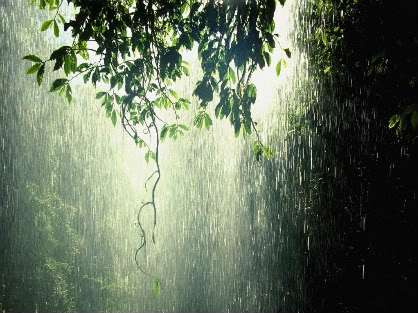
Like the Eskimos with their many ways of describing snow, the Hawaiians described rain in ways very specific to character and location:

Ka ua hehi ‘ulu o Pi’ihonua.
The rain that treads on the breadfruit leaves of Pi’ihonua.

Ka ua ho’opala ‘ohi’a.
The rain that ripens mountain apples.

Ka ua kani ko’o o He’eia.
The rain of He’eia that sounds like the tapping of walking canes.

Ka ua kapua’i kanaka o Palawai.
The rain of Palawai which sounds like human footsteps.

Ka ua kau la’au o Pahala.
The tree-resting rain of Pahala.

Ka ua Kupunikapa o Lanakila.
The hold-fast-to-the-clothing rain of Lanakila.

Ka ua Lanipa ‘ina o ‘Ulupalakua.
The sky-crackling rain of ‘Ulupalakua.

Ka ua ‘o’ili’ili maka akua.
The rain that appears here and there to denote the presence of a god.

Ka ua po’o nui o ke kuahiwi.
The big-headed rain of the mountain.

(all poetical sayings from ‘Olelo No’eau)

It is easy to see that in such a world, every natural detail is keenly observed, deeply revered, and honored with its own unique lyrical expression. And it is awe inspiring that poetry — whether in the form of chant or song, was the medium of preservation, education, inspiration and entertainment — practiced by commoners as well as kings. A spoken word was exhaled with the breath of the speaker, and once uttered, it was carried by the winds for generations.

I leave you with an original mele hula (a song for the dance), composed by Kawena in the early 1930’s with her mother, Pa’ahana Wiggin. The chant is organized around four indispensable words which denote four directions: luna (above), lalo (below), mauka (inland), and makai (toward the sea), and is often taught to kindergarten children in the original Hawaiian. Picture the children performing a sitting hula while chanting — gesturing above, below, inland, and toward the sea.

E’IKE MAI
(translation below)

I luna la, i luna
Na manu o ka lewa

I lalo la, i lalo
Na pua o ka honua

I uka la, i uka
Na ulu la’au

I kai la, i kai
Na i’a o ka moana

Ha ‘ina mai ka puana
A he nani ke ao nei.


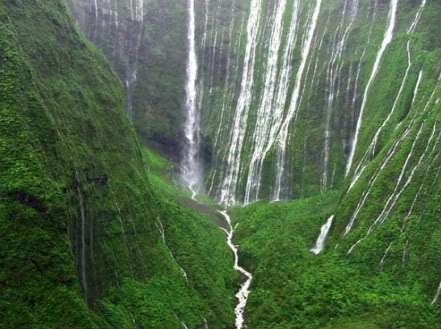
Mt. Wai’ale’ale on Kaua’i, the wettest spot on earth and place of origin, Hawaiian Island chain


BEHOLD

Above, above
all birds in air

below, below
all earth’s flowers

inland, inland
all forest trees

seaward, seaward
all ocean fish

sing out and say
again the refrain

Behold this lovely world.

Mary Kawena Pukui earned two honorary doctorates, and is the only native Hawaiian ever to be nominated for a Nobel Prize in Literature.

For some audio and video samples from the Bishop Museum archives featuring Kawena, click here.

This week’s Poetry Friday Roundup is at Two Writing Teachers.

Quick Pronunciation Guide:

a — ah

e — ay

i —
ee

o —
oh

u —
oo


the perfect blend from lensey namioka

It’s time for the second course in our Asian Pacific American Heritage Month potluck!

Last week, Lisa Yee tempted us with her won ton appetizers, but she wouldn’t share Colin Firth. This has left me hungrier than ever. How about you?

I’ve been a Lensey Namioka fan since the early 90’s, when I read the first book in her Yang family series for middle grade readers, Yang the Youngest and His Terrible Ear (Yearling,1994). I found the story of 9-year-old Yingtao, the only one of four siblings who is not musically inclined, warm and captivating, and it provided something relatively rare in books featuring Asian characters back then — humor. 

I was ecstatic when Lensey followed up with three more books spotlighting Yingtao’s sisters, Yingmei and Yinglang, and his older brother, Yingwu. Each sibling, with his/her respective personal, social, and cultural challenges, is lovingly depicted in Lensey’s engaging and refreshingly simple prose.

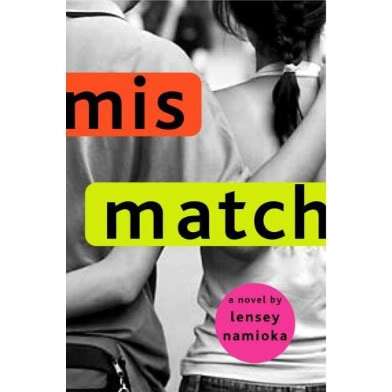
Lensey’s most recent book is a young adult novel called Mismatch (Delacorte, 2006), which I devoured over the weekend. Fifteen-year-old Sue Hua, a Chinese American girl whose family moves from culturally diverse Seattle to a mostly white suburb, falls for Andy Suzuki, who plays violin in the school orchestra. They are seen as an ideal couple since they are both Asian, but this is just one of many misconceptions that are examined and dispelled in the course of the novel.


Sue’s grandmother has painful memories of the Japanese occupation of China during WWII. Andy’s father harbors resentment over ill treatment he received on a visit to Beijing. What I found especially enlightening about this story is that it moves beyond familial disapproval of Sue and Andy’s relationship, to questions of personal identity and reverse prejudice. When Sue and Andy go to Japan on a school orchestra trip, questions of ethnicity are deepened as they interact with their host families.  

Lensey herself was born in Beijing, and could not speak English when her family moved to the U.S. at age nine, so she knows well the problems of cultural assimilation. She attended Radcliffe and UC Berkeley, and majored in mathematics, but decided she liked writing better. After marrying Isaac Namioka, a fellow mathematician, she visited Japan and became interested in the culture (she has written a series of samurai adventure mysteries set in 16th century Japan).

Mismatch beautifully weaves together Lensey’s wisdom and understanding of both Japanese and Chinese mores. The intercultural and intergenerational dynamics make for a fascinating and often surprising read.

I was nervous emailing Lensey, since I’ve admired her for so long, but discovered she is the generous, unassuming person I hoped she would be. She was busy packing for a trip to Europe, but took the time to send a favorite childhood recipe. She says, “The amounts of the ingredients are all approximate, since my mother didn’t have a recipe, and I just learned from watching her make the dish.”

I made this Sunday night, and found it to be easy, light, healthy and delish. Since tastes differ, I advise adding the soy sauce gradually until desired saltiness is achieved.

CHINESE CHICKEN SALAD


2 cups cooked chicken meat (can be boiled or microwaved), torn into shreds, about 1/4-inch thick
1/4 cup (or less) soy sauce
3 T sesame oil
2 stalks scallions, cut into slivers about 1 inch long
slivers of celery and cucumber, 1 inch long (optional)

Mix together all ingredients and serve cold.


For more about Lensey and her books, visit her website. There is also a nice feature about her at papertigers.org.