wok this way: china and korea stir fry


It’s been quite a month — flowers, salad, strawberries, and Asian Pacific American Heritage. As far as I’m concerned, every month is a time for ethnic pride, learning more about other cultures, and getting excited over books that feature new voices and perspectives. Do you need an excuse to eat more dim sum? Not me!

One of the ways I’ve been celebrating APAHM is to pick up some of the picture books I’d heard about, but never got around to reading. It was good to see titles featuring more Korean, Japanese, and South Asian characters, alongside the plentiful store of Chinese books. We still need more stories about Hawai’i and the Philippines, though, so I’d better get busy.

Anyway, today I’m serving up this tasty stir fry combining the flavors of Korea and China. Each title brims with its own brand of color, texture, and emotional resonance:

Continue reading

thursday smackerel: Pooh’s Honey Spice Cake

“‘What do you like doing best in the world, Pooh?’

‘Well,’ said Pooh, ‘what I like best . . . ‘ and then he had to stop and think. Because although Eating Honey was a very good thing to do, there was a moment just before you began to eat it which was better than when you were, but he didn’t know what it was called.” ~ from The House at Pooh Corner, by A.A. Milne


Even though the work week is almost over, right about now you may have a little sinking feeling.

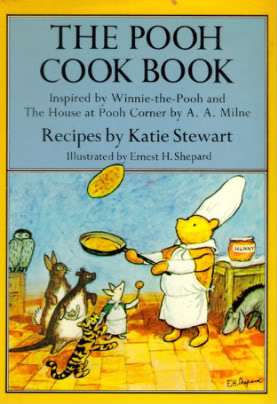
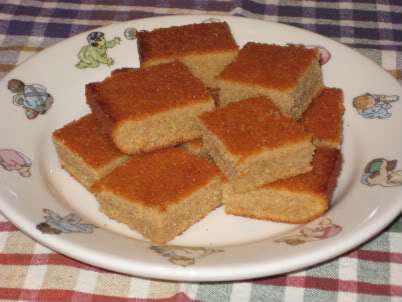
Not to worry, we’ve got just the thing, courtesy of our friend Pooh — Honey Spice Cake, from his very own cook book!

Quick and easy to prepare, perfect for elevenses, afternoon tea, dessert, and of course, picnics, this little treat is sure to please. Just don’t forget to share.

HONEY SPICE CAKE
(makes 24 squares)


7 oz. (or 7 rounded tablespoons) self rising flour
1 level tsp mixed spice (I used pumpkin pie spice)
1/2 level tsp ground ginger
1/2 level tsp ground cinnamon
5 oz. butter
4 oz. (or 4 rounded tablespoons) soft brown sugar
6 oz. (or 3 rounded tablespoons) honey
2 eggs
1 T water

Preheat oven to 350 degrees F.

Sift together the flour, mixed spice, ginger and cinnamon on to a square of greaseproof paper or foil and set aside.

Measure the butter or margarine, and the sugar, honey, and water into a saucepan. Place the pan over a low heat and stir with a wooden spoon until the fat has melted. Do not allow to boil. Draw the pan off the heat and allow to cool for about ten minutes.

Using a wooden spoon, beat the eggs into the honey mixture one at a time. Tip in the flour mixture all at once. Stir until it has blended and beat thoroughly.

Pour into the prepared cake tin (7″ x 11″ x1″, greased and lined with parchment paper), and spread evenly. Place in the centre of the preheated oven and bake for 30-35 minutes or until the cake is well risen.

Remove the cake from the oven using oven gloves. Loosen the sides of the cake with a knife and turn out. Allow to cool and then cut in squares.

~ Adapted from The Pooh Cook Book by Katie Stewart (Methuen, 1971).


friday feast: any way you slice it


“Poetry emphasizes the moment and minutes and unrepeatable processes of the soul making itself. You feel the enormous pressures put upon language, because each word has to be chipped out of silence and chosen out of desire. When you read a great poem you get a sense of continuous danger that the poem won’t go on. That blank space at the end of each line isn’t just spatial, it’s intellectual and emotional. It confronts what’s ungraspable in our lives and can’t be put into words.”
~
Suji Kwock Kim

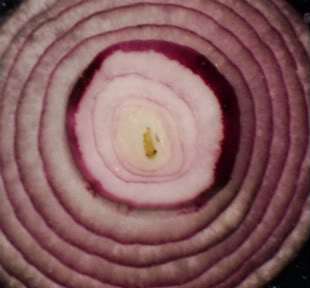
On this last Poetry Friday of Asian Pacific Heritage Month, I’m excited to share a truly exquisite poem: “Monologue for an Onion,” by Suji Kwock Kim.

The onion as a metaphor doesn’t seem so remarkable in itself; upon reading the title you’ve probably already assumed the poet will talk about “layers” and peeling them away to get at the truth. Yes, there is that, but there’s a bigger irony at play here, because the onion will implore you (and the person addressed in the poem), to stop peeling, stop cutting, stop chopping and relentlessly searching, and you will be compelled to do just the opposite.

Each time I read the poem, I feel the need to reread it. I want to get at its truth, its core. Regardless of what the onion says. Perhaps it is human nature to search for deeper truth, to not accept something at face value, even if it means destroying yourself in the process:  “Is this the way you go through life, your mind a stopless knife, driven by your fantasy of truth, Of lasting union — slashing away skin after skin From things, ruin and tears your only signs of progress?”

Here’s what else I like:

~ the poem is constructed like an onion, continuously winding in on itself. Kim doesn’t use conventional end rhyme, but embeds it in the middle of lines (stanzas 3-4 with rhymes “skin” and “in” and “life” and “knife”).

~ the onion declares from the beginning that it holds no further truth or meaning than what its outer layer shows, yet as we continue through the poem, more and more is revealed with each stanza.

~ the violent images of a knife slashing and destroying have political connotations; this and other poems in Kim’s collection examine the pain and turmoil of a divided Korea, and the tyranny of the Japanese occupation.

~ the infusion of many ironies: the one cutting the onion looks for a center when he himself lacks one, the one who has cut the onion is in pieces, etc.

Ultimately, human beings seek love, understanding, and truth — the heart of things. But the onion tells us we have “a core that is not one.” We will always remain divided, for as soon as we uncover one thing, fresh desire will slash through us once again.


MONOLOGUE FOR AN ONION
by Suji Kwock Kim


I don’t mean to make you cry.
I mean nothing, but this has not kept you
From peeling away my body, layer by layer,

The tears clouding your eyes as the table fills
With husks, cut flesh, all the debris of pursuit.
Poor deluded human: you seek my heart.

Hunt all you want. Beneath each skin of mine
Lies another skin: I am pure onion — pure union
Of outside and in, surface and secret core.

~ from Notes from the Divided Country (Louisiana State University Press, 2003).

(Read the rest here.)

Today’s Poetry Friday Roundup is at Wild Rose Reader.


more hot stuff: bonus recipe!

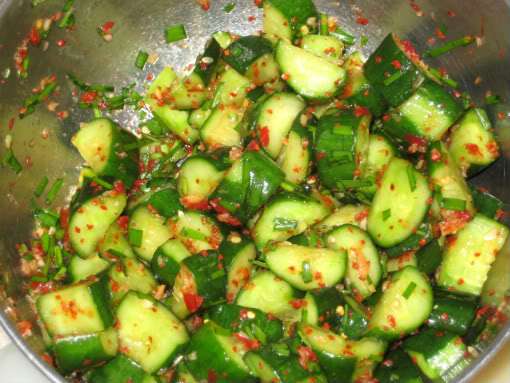
For those of you who’d like some homemade kimchee to go with Linda Sue Park’s recipe for bee-bim bop, here’s my mom’s recipe for cucumber kimchee. I always look forward to having some when I visit my family in Hawai’i. Thanks, Margaret — you’re the best Korean cook!

KOREAN CUCUMBER KIMCHEE


4-5 cucumbers (preferably Japanese cucumbers, which are smaller and crunchier)
about 1/4 cup kosher salt or Hawaiian sea salt/coarse
2 tsp minced garlic
2 tsp minced ginger
15 stalks chives, cut into 1/8″ lengths (do not chop)
1 T chili garlic sauce (can be found in Asian markets)
1 T ground Korean red pepper (dried)
sugar

1. Wash unpeeled cucumbers. Cut off ends and cut into 3/4″ bite-size quarter chunks.

2. Place in bowl and spread sea salt lightly. Toss and stir to distribute salt. Allow to sit about 1/2 hour. Rinse cucumbers in cold water and taste. If too salty, rinse cucumbers again in cold water. Drain in colander.

3. In mixing bowl, combine red pepper, dash of sugar, chili garlic sauce, garlic, ginger and chives. Add cucumbers and mix. Refrigerate. Ready to eat same day or several days later.


*


hot stuff: linda sue park!

Call out the fire department!

We’re serving up some hot stuff for the last course in our Asian Pacific Heritage Month potluck, courtesy of 2002 Newbery Award winner, Linda Sue Park!

Her newest book, Keeping Score (Clarion, 2008), is a warm, captivating, insightful, and sometimes heart-wrenching historical novel set in the 50’s, featuring 9-year-old Maggie Fortini, baseball lover to the core.

No, you don’t have to like or even know much about baseball to love this book. A few paragraphs in, and you’ll find yourself rooting for Maggie-o, as her dad calls her (after his favorite Yankees’ player, Joe DiMaggio). Like everyone else in the neighborhood (except her father and newfound friend, Jim, a firefighter like her dad), Maggie is a huge Brooklyn Dodgers fan. Her loyalty and perseverance are unwavering, as is her fierce determination to make things right. She is heartbroken when her team loses again and again, despite everything she’s done to “help” them, like praying really hard and keeping score for every game.

Jim’s the one who taught Maggie to keep score, and their special bond adds another dramatic layer to the story, since Jim is drafted, sent to Korea, and then stops writing to Maggie after awhile. This prompts her to learn more about the war, but it doesn’t allay her disappointment or uncertainty — a lot to cope with, especially for a girl who takes everything to heart, and ultimately feels responsible for things beyond her control. What happened to Jim in Korea? Can she help make him better? Will the Dodgers ever win the World Series? Much as she wants that, she’d be willing to let the Giants win if it would help Jim.

Keeping Score is superbly crafted, another example of Linda Sue’s masterful storytelling. I don’t think I’ve ever read a finer portrayal of what it really means to be a true-blue, dyed-in-the-wool fan. Maggie-o is as pure as they come. And I learned some new things about baseball, the Korean War, and hope. 

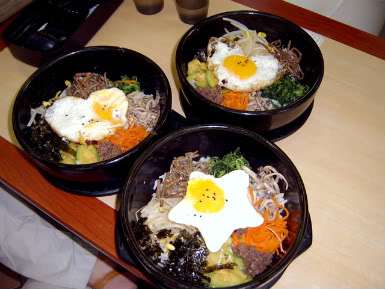
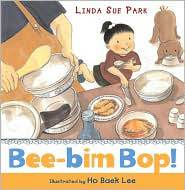
Today, Linda Sue is sharing her recipe for Korean bee-bim bop (rice topped with vegetables and meat). It is included in her picture book, Bee-Bim Bop (Clarion, 2005), which is a delightful read aloud written in verse, about a child helping her mother make the dish.

Linda Sue: “There are as many versions of bee-bim bop as there are families who cook it. This recipe is one that we make at home . . . Mung bean sprouts, sesame seeds, kochee-chang, and kimchee are available at many large supermarkets as well as Asian grocery stores.”

BEE-BIM BOP
(serves 4)


2 cups white rice

Marinade

2 cloves garlic, peeled
2 green onions (scallions)
5 T soy sauce
2 T sugar
2 T vegetable oil
1 tsp sesame seeds, roasted (optional)
1 T sesame oil (optional)
1/8 tsp black pepper

Meat

1 lb. tender, lean beef (such as sirloin tip)

Vegetables

2 carrots
2 pkgs. frozen spinach, defrosted, or 1 lb. fresh spinach, washed
1 lb mung bean sprouts

Other ingredients

4 eggs
salt and pepper
vegetable oil for frying

1. Cook rice with 4 cups water, either in a rice cooker or pot. If using a pot, let the water boil, then lower the heat, cover and let simmer for 20-30 minutes until the rice is tender and all of the water has been absorbed.

2. Mince the garlic and chop the green onions. Mix all the marinade ingredients in a big bowl.

3. Slice the beef across the grain into very, very thin slices. Put the beef into the bowl with the marinade. Stir well with a big spoon. Wash your hands. Then stick your hands into the bowl, grab handfuls of beef, and squish all of it around for 2-3 minutes (to make it tender). Set beef aside.

4. Beat the eggs with a fork until the whites and yolks are completely mixed together.

5. Coat a nonstick frying pan with 1 tsp. of vegetable oil and heat on medium for about a minute. Pour about 1/4 of the egg, and rotate the pan quickly so the egg spreads out in a thin layer on the bottom. After a minute, flip the egg using a wide spatula, and cook another minute. Cook the rest of the egg this way until you have about 4 thin pancakes.

6. When the pancakes are cool enough to handle, stack them on top of each other and roll the stack tightly. Cut the roll into 1/4-inch slices. Toss the slices in a medium size bowl, then set aside.

7. Julienne the carrots and fry them in about 1 T of vegetable oil in a large frying pan or wok over a high flame until tender. Set aside.

8. If you are using frozen spinach, thaw, then squeeze some of the water out of it. If you are using fresh spinach, cook in a pot of boiling water for about 2 minutes, drain, let cool for a few minutes, then squeeze some water out. Stir fry thawed or precooked spinach in 1 T of vegetable oil for 2-3 minutes until tender. Empty the spinach into a bowl, season with salt and pepper, then set aside.

9. Pour 1 cup water into a large saucepan, add 1/4 tsp salt, bring to a boil. Add bean sprouts, cover and cook for 2-3 minutes. Drain the sprouts and empty them into a bowl.

10. Cook the beef with marinade in a large frying pan over high heat, about 2-3 minutes.

To serve:

Put the rice, bowl of egg strips and vegetables, and the pan of meat where everyone can reach them. Each person puts a pile of rice in the middle of a soup bowl or plate and some meat and vegetables on top. Top with egg ribbons. If you like spicy food, add some ko-chee-chang (hot pepper paste). Now mix everything together. Serve with kimchee* on the side if you wish.

(Adapted from the printed recipe found in the book, which contains directions for a child to help an adult.)
For more about Linda Sue and her books, visit her website and blog.

On Keeping Score:

New interview and review at papertigers.org.

Original essay by Linda Sue at Powells Books.

Book excerpt at Amazon.com.

**for some yummy kimchee, click here!